 ChatGPT,
  Claude,
  Gemini,
  Grok — all four for
Guide to Purchasing Self-Managed VPS Hosting with Bluehost
Bluehost offers Self-Managed VPS hosting, giving users complete control with full root access, dedicated resources, and extensive customization options—all at an affordable cost. This service allows you to install applications and software of your choice and adjust performance settings to meet your specific needs. Enjoy a clean-slate hosting environment without the added costs of unnecessary server management!
Our Self-Managed VPS hosting plans are perfect for tech-savvy users who enjoy taking control of their own hosting servers. While these VPS plans come with a more hands-on approach and less direct support, you'll have the flexibility to customize your experience to fit your unique hosting needs. If you're comfortable managing your own server, this option is a great way to get powerful hosting at a more affordable price!
We offer the following Self-Managed VPS hosting plans:
- NVMe 2
- NVMe 4
- NVMe 8
- NVMe 16
For the features and prices of each VPS plan, check out the Bluehost Self-Managed VPS Hosting Plans Comparison article.
We have created a video guide to walk you through the steps.
How to Purchase a Self-Managed VPS Hosting Plan
Here are the steps to purchasing Self-Managed VPS hosting.
Purchase Self-Managed VPS Hosting
- In your browser, go to https://www.bluehost.com/vps-hosting.
- Click the Choose Plan button for the Self-Managed VPS hosting plan you prefer.
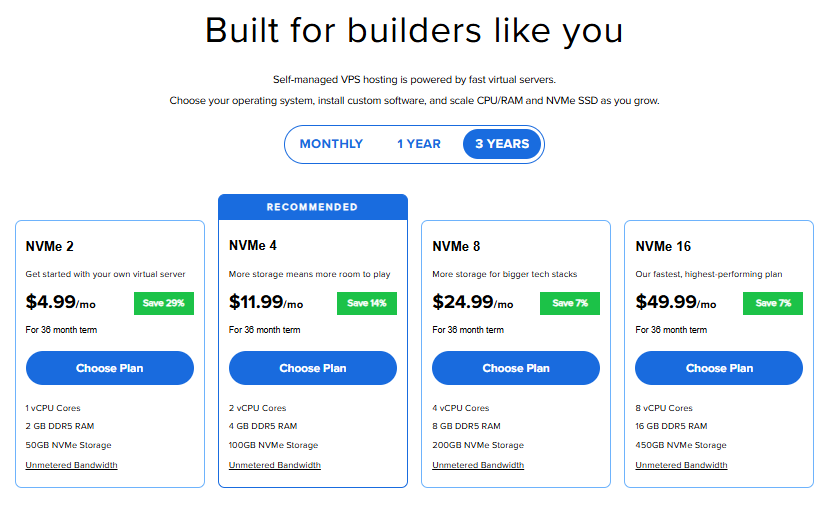
- On the next page, you can configure your VPS server to fit your needs. They are divided into the following sections:
- Location: You can select your data center in the Location section.
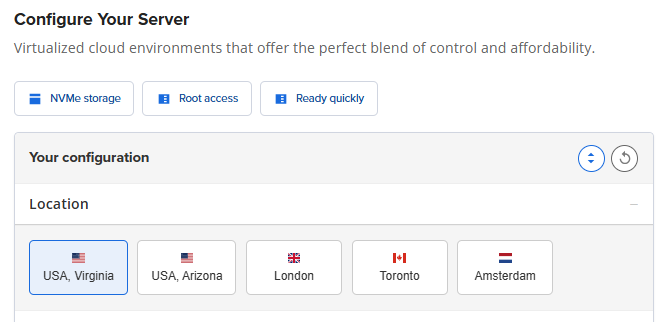
- Hardware: The Hardware section shows your pre-selected Self-Managed VPS plan. If you want to switch to another Self-Managed VPS plan, you can do so in this section under the Pre-selected tab.
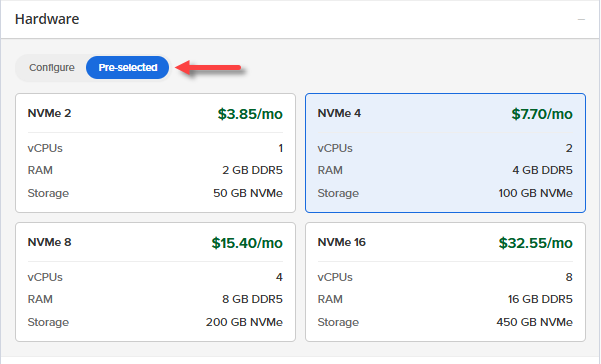
The Configure tab enables you to customize your VPS by selecting the RAM, vCPUs, and Storage that best align with your hosting needs.
- Software (Optional): In the Software section, you have the choice to further customize your VPS server from the three tabs: Plain OS, OS With Panel, and Application.
- Plain OS:
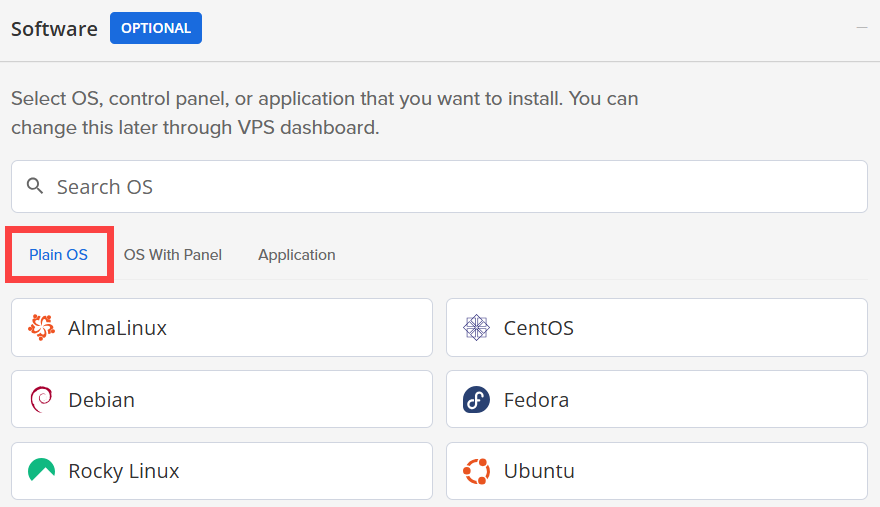
- AlmaLinux: A free, open-source Linux distribution designed to be a stable and community-driven alternative to CentOS, ideal for enterprise use.
Available Versions: 8,9, and 10 - Debian: One of the oldest and most stable Linux distributions, known for its reliability and vast software repository, great for servers and desktops.
Available Versions: 12 and 13 - Rocky Linux: Created as a community-driven successor to CentOS, focusing on stability and compatibility for enterprise environments.
Available Versions: 8, 9, and 10 - CentOS: A free, enterprise-class Linux distribution initially derived from Red Hat Enterprise Linux (RHEL), widely used in servers; now shifted focus to CentOS Stream.
Available Versions: 9 and 10 - Fedora: A cutting-edge Linux distribution sponsored by Red Hat, known for incorporating the latest features and technologies, popular among developers and tech enthusiasts.
Available Versions: 41, 42, and 43 - Ubuntu: A user-friendly and popular Linux distribution based on Debian, great for beginners and widely used on desktops, servers, and cloud environments.
Available Versions: 22.04, 24.04, 25.04, and 25.10
- AlmaLinux: A free, open-source Linux distribution designed to be a stable and community-driven alternative to CentOS, ideal for enterprise use.
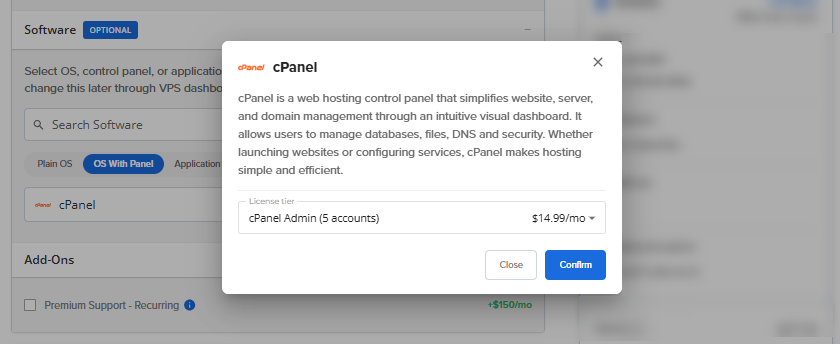
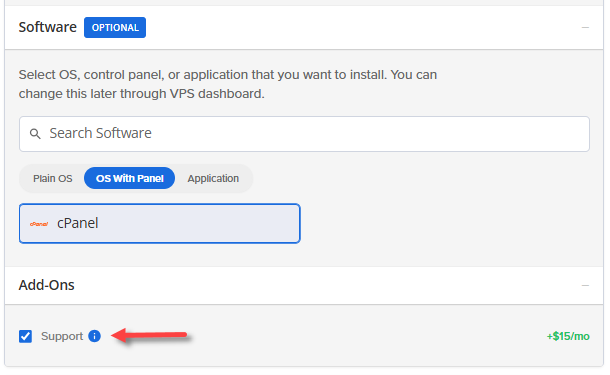
- OS With Panel: Under the OS With Panel tab, click cPanel to add up to 100 cPanel accounts to your server at an additional fee.
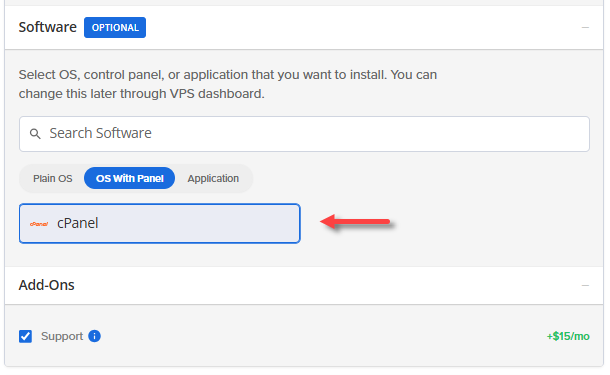
In the pop-up, select your preferred cPanel license tier, then click Confirm.
- Application:
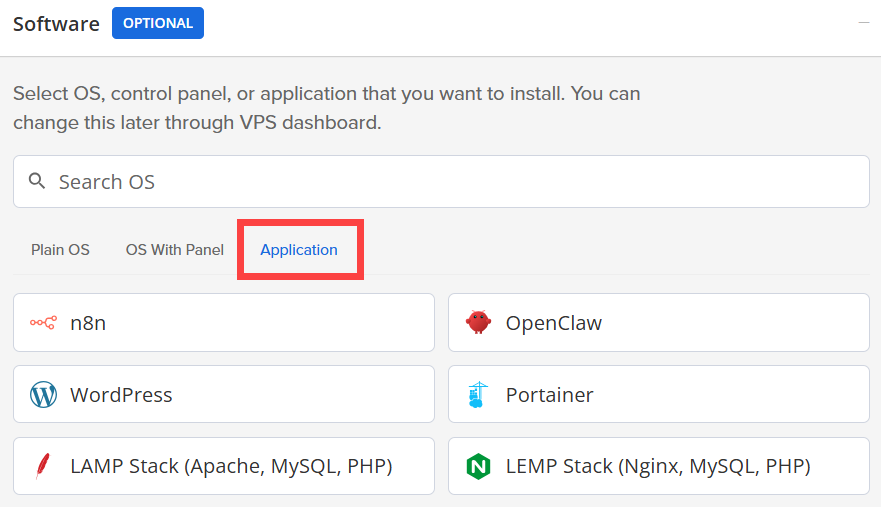
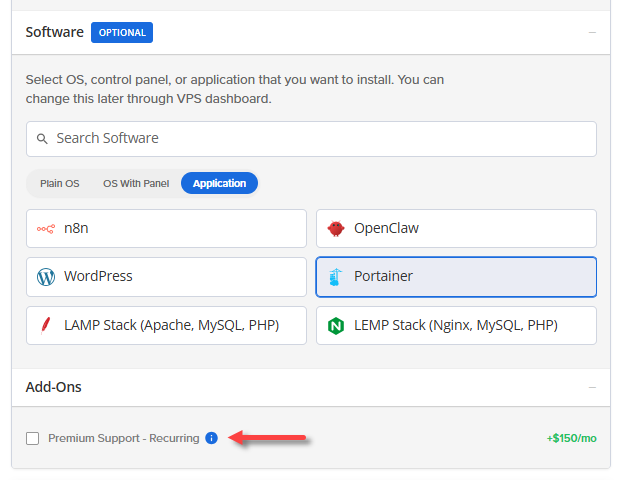
- n8n: An easy-to-use, open-source workflow automation tool that lets you connect apps and services to automate tasks without coding.
- WordPress: A popular content management system (CMS) used for building websites and blogs, known for its flexibility and large plugin ecosystem.
- LAMP Stack: A classic web development stack comprising Linux, Apache, MySQL, and PHP — perfect for hosting dynamic websites and web apps.
- OpenClaw: A self-hosted, open-source AI agent that executes tasks through large language models, using messaging platforms as its user interface.
- Portainer: A simple and intuitive management UI for Docker and Kubernetes environments, making container deployment and monitoring easier.
- LEMP Stack: Similar to LAMP, but replaces Apache with Nginx — stands for Linux, Nginx, MySQL, and PHP — widely used for high-performance web hosting.
- Plain OS:
- Add-Ons:
- Support: Selecting cPanel brings you cost-effective support for all cPanel services, ensuring you have all the help you require at a great value.
- Premium Support: Opting for any software other than cPanel grants you access to Premium Support. This service provides you with priority access to our expert team, ensuring faster responses and personalized assistance whenever you need it.
- Support: Selecting cPanel brings you cost-effective support for all cPanel services, ensuring you have all the help you require at a great value.
- Advanced Options:
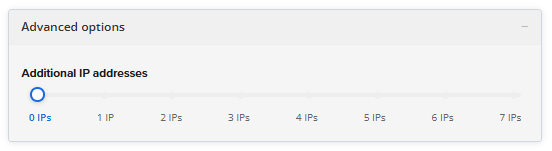
- Additional IP Addresses: You can add IP addresses for an additional fee.
- Additional IP Addresses: You can add IP addresses for an additional fee.
- Location: You can select your data center in the Location section.
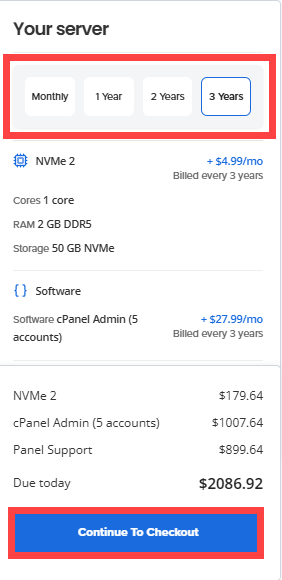
- Select your preferred billing term and view your Order Summary. Click the Continue to Checkout button to proceed.
- Do the following on the Checkout page:
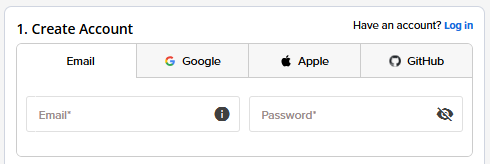
- Create an Account: Create your Bluehost account. You can do this easily by using your email address or by connecting with your Google, Apple, or GitHub account — whichever you prefer!
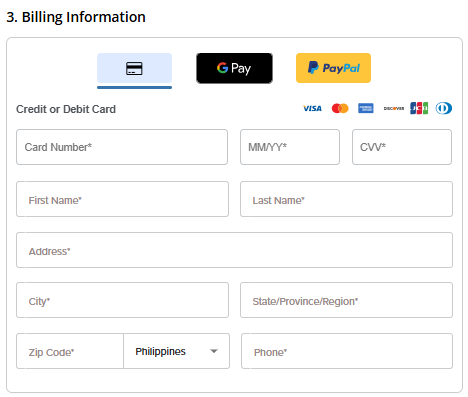
- Billing Information: Select your preferred payment method: credit card, Google Pay, or PayPal. Enter your billing information.
- Create an Account: Create your Bluehost account. You can do this easily by using your email address or by connecting with your Google, Apple, or GitHub account — whichever you prefer!
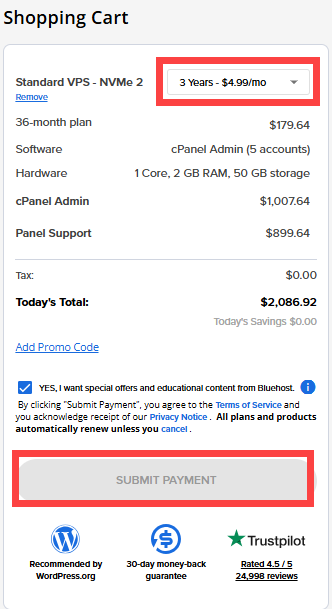
- In the Shopping Cart section, adjust the terms as needed. Click Submit Payment to complete the purchase.
Post-Purchase
After you complete your purchase, your Self-Managed VPS hosting will begin provisioning. You can locate your new VPS hosting in the Hosting tab of your Bluehost Portal.
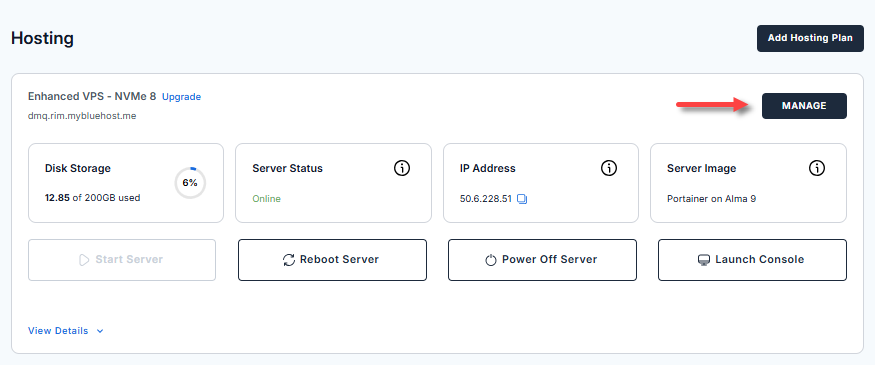
Under the Hosting tab, you will see the disk storage and server status of your Self-Managed VPS hosting right away. You will also have the following functionalities:
- Disk Storage: Displays the available and used space on your Self-Managed VPS, helping you keep track of your data and files.
- Server Status: Displays the current condition of your server, indicating whether it’s running smoothly or needs attention.
- IP Address: Lists the unique Internet address assigned to your server, which you use to access your server remotely.
- Server Image: Shows the operating system and key applications currently installed on your Self-Managed VPS.
- Start Server: Powers up your server if it’s turned off, making it ready to use.
- Reboot Server: Restarts your server to refresh the system without turning it off completely.
- Power Off Server: Safely shuts down your server, stopping all running processes.
- Launch Console: A feature offered in Self-Managed VPS that provides a direct interface to your server. This interface is provided through your Bluehost Portal. The difference between this and other remote access methods, like SSH, is that SSH requires configuration and relies on networking to connect to your server’s command-line interface directly. This direct connection is important because it ensures you can always manage, troubleshoot, and fix problems on your server—even when other remote access methods fail.
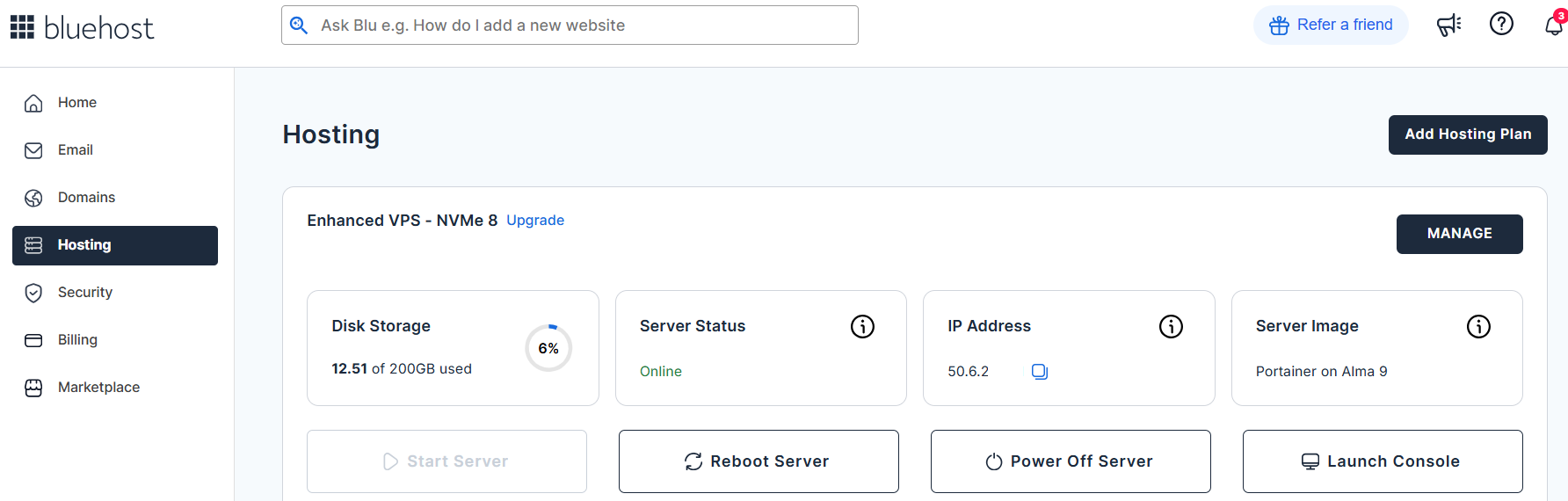
Click the Manage button to open the VPS panel.
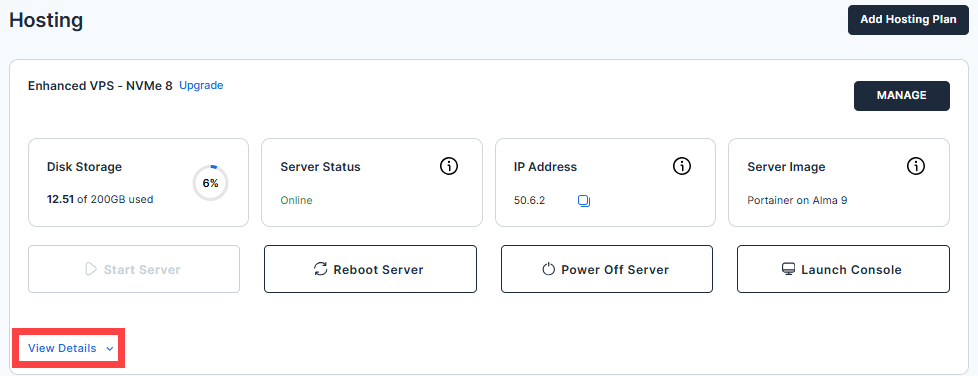
Click the View Details link for more details about your Self-Managed VPS hosting.
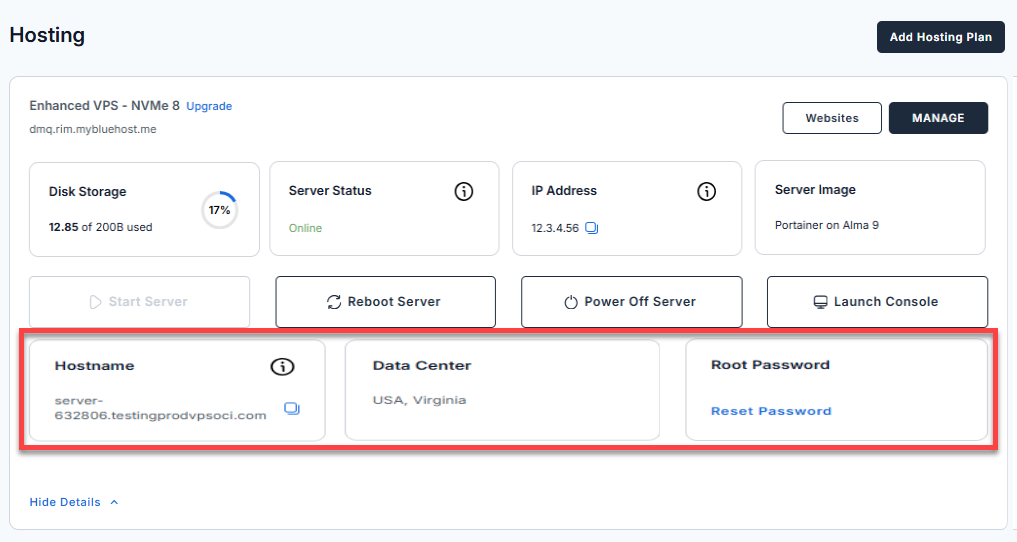
- Hostname
- Data center
- Feature to reset the root password
Summary
Bluehost’s Self-Managed VPS hosting provides a powerful and flexible hosting solution for users who want full control over their servers. With options to choose your preferred Linux distribution, add popular applications like WordPress or Portainer, and customize your server resources, you get exactly what you need without paying for unnecessary management. Key features such as disk storage monitoring, server status, easy start/reboot/power off controls, and direct console access make managing your VPS straightforward. For those who want extra help, Premium Support offers priority assistance from Bluehost’s expert team. Whether you’re a developer, business owner, or tech enthusiast, Self-Managed VPS combines affordability, customization, and control to suit your unique hosting needs.