


Key highlights
- Know why popular domain extensions are crucial for building trust, branding and SEO success.
- Explore the best domain extensions for agencies and brands, including .com, .org and .net and find the ideal TLD for your business needs.
- Explore other domain extension options including niche, geographic and industry-specific TLDs that can highlight your brand’s identity.
- Understand how modern trends like .ai, .io and corporate top-level domains are shaping the future of online branding.
- Discover how Bluehost helps you secure the right domain extension with free domains, privacy protection and premium support trusted by millions.
Choosing the right domain extension is one of the first big steps in building your online identity. Think of it as the outfit your website wears, it makes an impression before anyone even clicks. At Bluehost, we’ve guided millions of businesses and personal brands in finding their perfect domain name and we know how much the most popular domain extensions matter for trust, branding and SEO.
Today, there are countless TLD options and extensions, but users still lean toward common domain extensions like .com, .org or .net. And the trend keeps growing, the second quarter of 2025 closed with 371.7 million domain name registrations across all TLDs, up by 3.3 million from Q1. Clearly, the right domain extension is more important than ever.
What is a domain extension?
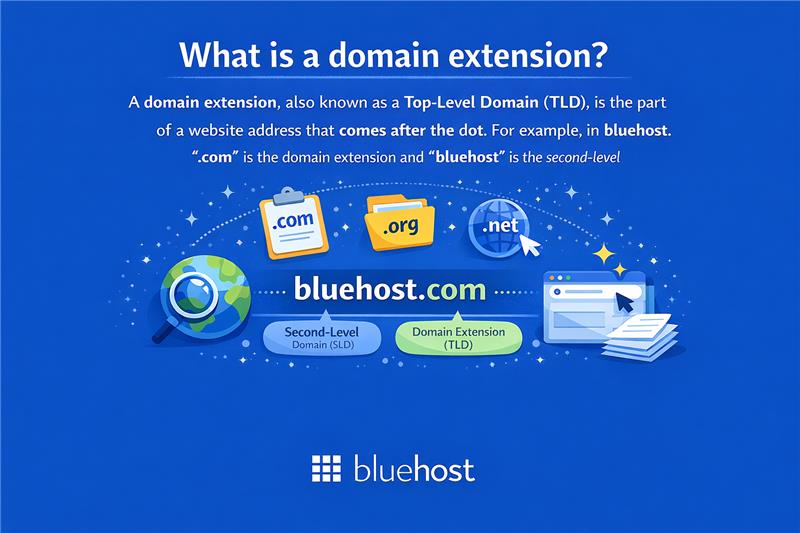
A domain extension, also known as a Top-Level Domain (TLD), is the part of a website address that comes after the dot. For example, in bluehost.com, “.com” is the domain extension and “bluehost” is the second-level domain (SLD). Together, they create the full domain name that users type into their browser.
Think of it like a house address: the SLD is the name of your house and the domain extension is the street it’s on. Some common domain extensions you see every day are .com, .org, .net, .co and .ai. These are considered popular domain extensions because they’re widely recognized and trusted.
Selecting the right domain extension goes beyond simple availability—it shapes how visitors, search engines and AI-powered platforms perceive your website’s purpose, credibility and relevance in 2026. Domain extensions signal your site’s intent and help establish trust with your target audience.
For example:
- .com: widely recognized for businesses and general use.
- .org: often linked with nonprofits and online communities.
- .net: originally intended for network services but now a strong alternative to .com.
So when you’re picking your perfect domain name, don’t just think about the brand, consider how the domain extension options you choose can shape your site’s identity, SEO and even credibility in the eyes of your target audience.
Also read: Domain Name and Extension Guide
A brief history of domain extensions
The history of began on March 15, 1985, with the registration of Symbolics.com, the world’s first .com domain. For decades, the internet relied on just a handful of standard options like .com, .net and .org to define online real estate.
To manage this rapidly growing infrastructure, the Internet Corporation for Assigned Names and Numbers (ICANN) was established in 1998, tasked with overseeing the stability and coordination of the global internet’s unique identifiers.
A pivotal shift occurred in 2012 when ICANN authorized a massive expansion of the domain name system, introducing hundreds of generic Top-Level Domain extensions. This evolution transformed the internet from a restrictive environment into a diverse landscape of descriptive choices. Instead of being limited to generic addresses, businesses can now select the for their specific niche, utilizing options like .tech, .store or .guru.
This variety empowers brands to create memorable, relevant online identities that communicate their purpose instantly.
What are the types of domain name extensions?
When choosing the right domain extension for your domain name, it helps to understand the different categories available. Each type of top-level domain (TLD) comes with its own purpose, rules and benefits. At Bluehost, we’ve guided millions of customers in finding the perfect domain, so here’s a breakdown you can trust.

1. Generic domain extensions (gTLDs)
Generic top-level domains are what most people think of when they hear popular domain extensions. These include classics like .com, .net and .org, as well as newer TLD options like .xyz, .online, .mobi and .shop. Anyone can register a gTLD, there are no geographic or industry restrictions.
- Example: bluehost.com “bluehost” is the second-level domain (SLD) and “.com” is the generic domain extension.
- Why choose gTLDs? They’re widely recognized, trusted and often the best fit for businesses, personal brands and startups.
2. Sponsored domain extensions (sTLDs)
Sponsored TLDs are special domain extension options overseen by organizations, governments or industries. They come with strict eligibility rules, which makes them highly credible and special use domains.
For example:
- .gov: restricted to U.S. government agencies.
- .mil: reserved for the U.S. military.
- .edu: only for accredited educational institutions.
Because they’re exclusive, these sponsored domain extensions are not open to the general public, but they carry unmatched authority and trust online.
3. Country code domain extensions (ccTLDs)
Country code top-level domains represent individual countries or regions. They are always two letters long for example, .uk for the United Kingdom, .in for India and .de for Germany.
- Some ccTLDs are strictly limited to citizens or local businesses (like .us), while others (like .co for Colombia) have become popular extensions worldwide, often used as a shorter alternative to .com.
- Why choose ccTLDs? They’re perfect for businesses choosing the best TLD for SEO, improving for regional search results and building a trustworthy online identity within that country.
New to domains? Here are 3 tips to get started. Watch our video to learn more.
Restricted vs. unrestricted domain extensions
Domain extensions fall into two main categories based on registration requirements. Understanding the difference between restricted and unrestricted options is crucial when selecting the best domain extension for your agency or brand.
Unrestricted domain extensions
Most generic top-level domains (gTLDs) are unrestricted and available to anyone:
- .com, .net, .org: Open to immediate registration without specific qualifications
- No verification required: Anyone can register these extensions instantly
- Widely recognized: Universal appeal across all industries and audiences
- No eligibility criteria: Perfect for brands seeking flexibility and broad recognition
Restricted domain extensions
Certain gTLDs require proof of eligibility to ensure registrants match the domain’s intended purpose:
- .pro: Requires verification of professional credentials or license
- .name: Designed for personal names with specific registration rules
- .nyc: Requires proof of physical address or connection to New York City
- Validation required: Must demonstrate you meet established criteria before registration approval
- Purpose-specific: Available to the public but limited to qualified registrants
Note that restricted gTLDs are distinct from “Sponsored” TLDs, which are strictly controlled by specific agencies or organizations.
Understanding this distinction helps agencies and brands avoid registration errors and select domain extensions that enhance credibility while serving as authentic markers of professional standing.
What are the most popular domain extensions?

With over 1,200 possible TLDs available today, choosing the right one can feel overwhelming.
The good news? You don’t always need to chase premium-priced domains or wait for the “perfect” name to free up. By exploring popular domain extensions across categories, you can still secure a domain name that fits your brand, your target audience and your online goals.
Here are some of the most popular domain extensions this year, organized by trending categories:
| Extension | Total registrations | Market share (%) | Best use |
|---|---|---|---|
| .com | 157.9 million | ~42% | Commercial, global, universal trust |
| .net | 12.6 million | ~3.5% | Tech, networks and backup for .com are unavailable |
| .org | 10.6 million | ~4% | Non-profits, education, communities |
| .co | 4 million | ~1% | Startups, brands, short memorable names |
1 .com
The .com domain extension is the world’s most widely recognized TLD, powering almost half of all registered websites. It’s often the default choice because people naturally type “.com” when searching for a site. For businesses, startups and even personal brands, securing the perfect domain name with .com builds instant credibility. It’s the go-to TLD for many businesses, making it the safest option if it’s available.
Also read: Choosing Between .com and .net Extensions
2 .net
The .net extension was originally intended for network services and web-based companies. Over time, it has become a popular alternative to .com. If your desired domain name is taken on .com, .net is often a shorter alternative that still feels professional and trustworthy. Many tech companies and service-based websites choose .net to build a solid online identity without paying a premium price for .com.
3 .org
The .org extension is strongly linked to non-profits, political parties and online communities. Because of this association, users often view .org as more trustworthy and reliable than other TLDs. If your site focuses on informational websites, education or causes, .org can be the right domain extension to connect with a target audience that values credibility and transparency.
4 .co
Originally the country code TLD (ccTLD) for Colombia, .co has grown into a popular choice for global brands and tech startups. It’s short, easy to remember and often used as a shorter alternative to .com. Many businesses prefer .co when they want a modern and creative online identity without waiting for their perfect domain name to become available in .com.
Whether you go with .com, .net, .org or .co, you’re choosing from the top domain extension list that has shaped the web for decades. And with Bluehost, a premium, reliable partner in domains and hosting, you’re not just picking a name; you’re securing your brand’s future with a company trusted by millions.
Note: When you host your website with Bluehost, you’ll get a free domain name for the first year, whether you choose a popular domain extension like .com or explore other TLD options such as .store, .online or .biz. It’s the easiest way to start your online journey with a perfect domain name and reliable hosting in one place.
Also read: Free Domain Name with Hosting in 2026
What are some other domain extension options?
While popular domain extensions like .com, .net, .org and .co remain the go-to choices, there are plenty of other domain extension options that might be a better fit depending on your brand, audience or industry. Exploring these alternatives can help you find a good TLD that’s available, affordable and aligned with your online identity.
1. Popular domain extensions: Country code domains
When it comes to building trust with a target audience, few things work better than a Country Code Top-Level Domain (ccTLD). A ccTLD is a domain extension made of two letters that represent a specific country or region.
They act as geographic TLDs, instantly signaling that your website is local, relevant and trustworthy to users in that region.
| Extension | Country | Total registrations | Market share (%) | Best for |
|---|---|---|---|---|
| .cn | China | 21 million | 4.5% | China-focused brands/businesses |
| .de | Germany | 17.7 million | 3.5% | German businesses, trusted in Europe |
| .uk | United Kingdom | 10.8 million | 3.1% | British/local businesses, regional SEO |
| .ru | Russia | 5.8 million | 1.5% | Russian market, local/government |
| .nl | Netherlands | 6.14 million | 0.49% | Dutch entities, eCommerce, local SEO |
| .br | Brazil | 5.39 million | 1.5% | Portuguese language, Brazil-based |
| .au | Australia | 3.6 million | 1.0% | Australian companies, .com.au trusted |
| .fr | France | 4.0 million | ~1% | French services, geo-targeting |
| .in | India | 3 million | Not stated | India brands, national focus |
| .eu | European Union | 3.6 million | 1% | Pan-European presence, EU-wide sites |
As of June 30, 2025, there were 316 global ccTLD extensions in the root zone, including internationalized domain names (IDNs). Out of these, the top 10 ccTLDs accounted for a massive 58.1% of all ccTLD domain registrations. The leaders were:
- .cn: China
- .de: Germany
- .uk: United Kingdom
- .ru: Russia
- .nl: Netherlands
- .br: Brazil
- .au: Australia
- .fr: France
- .in: India
- .eu: European Union
These local TLDs are not just widely recognized, they’re also growing. The second quarter of 2025 closed with371.7 million domain name registrations across all TLDs, up by 3.3 million from Q1 (as stated before). ccTLDs contributed significantly to this growth, proving that businesses and personal brands increasingly see the value in choosing the right domain extension for local trust and SEO.
Renewal rates also show their stability: recent quarterly renewal estimates ranged from 84.0% for .eu to 73.1% for .ru, which reflects strong long-term adoption.
For businesses, nonprofits, government agencies and even tech startups, a ccTLD can be the perfect domain to connect directly with a market. For example, a company in India choosing .in or a brand in Germany selecting .de signals credibility in that region, while also giving a boost in local SEO rankings.
At Bluehost, we recommend ccTLDs for brands that want to go beyond a generic domain extension and create an online identity that feels authentic, trustworthy and tailored to their community.
2. Popular domain extensions: Industry-specific TLDs
Not every website needs to fit into the same mold as .com or .org. In recent years, industry-specific TLDs have become a popular choice for businesses and personal brands that want their domain name to instantly communicate what they do. These domain extension options are tailored for specific industries, making it easier for your target audience to understand your site at a glance.
| Extension | Total registrations | Market share (%) | Best for |
|---|---|---|---|
| .tech | ~ 679,423 | ~0.14% (estimated) | Technology companies, startups, software, AI, robotics, data science |
| .shop | 3.2 million | ~1.06% (estimated) | eCommerce stores, online shopping websites, retail brand presence |
| .law | Restricted, ~30,000+ | <0.01% (restricted use) | Licensed legal professionals, law firms, legal services, courts |
| .store | 1.8 million | ~0.27% (estimated) | Online stores, eCommerce, product sellers, inventory and storage solutions |
Here are some of the most popular industry-specific domain extensions today:
- .tech: Perfect for tech startups, technology companies and innovators in the digital space. If your business name or online identity is built around technology, this TLD option makes sense.
- .shop: Designed for eCommerce websites, this extension clearly signals that your site is about shopping. It’s a shorter alternative to traditional domains and a great fit for retailers.
- .law: Built for law firms, legal consultants and government agencies that want to project authority and trust. With .law, your domain extension itself acts as proof of credibility.
- .store: Another eCommerce-focused extension, .store is a perfect domain for businesses that want to stand out in online retail. It’s one of the fastest-growing industry-specific TLDs in recent years.
Why choose these special use domains? Because they combine branding and clarity. A user landing on brandname.shop instantly knows it’s a shopping site. A startup with innovate.tech doesn’t just tell people they’re in tech, the domain extension reinforces it.
From an SEO perspective, Google treats all TLDs equally. What matters is building trust, relevance and authority. But an industry-specific TLD can give you a marketing edge by making your domain name more memorable, relevant and aligned with your brand story.
At Bluehost, we’ve seen how these TLD options help businesses create the perfect domain name that connects directly with their target audience while boosting their online identity. If your brand lives in a specific industry, choosing an industry-specific TLD could be the smartest step you take this year.
3. Popular domain extensions: trending / modern
The world of domain extensions is evolving fast. While common domain extensions like .com, .net and .org remain strong, many businesses and personal brands are turning to trending and modern TLD options that feel fresh, creative and industry-driven.
These popular domain extensions are especially appealing to tech startups, digital-first companies and creators who want a unique online identity that stands out.
| Extension | Total Registrations | Market Share (%) | Best For |
|---|---|---|---|
| .ai | Over 600,000 | ~0.16% (estimated) | AI companies, startups, tech innovation |
| .xyz | Around 4.8 million | ~1.3% (estimated) | Creative brands, next-gen websites, startups |
| .io | About 1.6 million | ~0.44% (estimated) | Tech startups, developer tools, SaaS platforms |
| .top | Approximately 3.2 million | ~0.87% (estimated) | Trendy brands, marketing campaigns, general use |
Here are some of the most popular modern extensions making waves today:
- .ai: Once a country code TLD (ccTLD) for Anguilla, .ai has exploded in popularity among tech startups and AI companies. If your business name relates to artificial intelligence, this domain extension instantly signals relevance and innovation.
- .xyz: Known as the extension “for the next generation,” .xyz is a shorter alternative that has become a popular choice for creative projects, startups and even blockchain/crypto communities. It’s modern, flexible and designed for personal brands as well as businesses.
- .io: Originally a ccTLD for the British Indian Ocean Territory, .io has become widely recognized in the tech world. Many web-based services, apps and SaaS companies use .io because it’s short, memorable and tech-focused.
- .top: Designed as a general use TLD, .top positions itself as a “universal domain.” It’s affordable, catchy and often chosen by businesses that want their brand to feel bold and accessible.
Why are these modern TLDs trending? Because they reflect shifts in consumer behavior and technology. In recent years, brands want more than just availability, they want a perfect domain that matches their target audience and industry identity. And while Google treats all TLDs equally in terms of SEO, a creative extension can give you a marketing edge, helping your site stand out in search results and in memory.
At Bluehost, we’ve seen these modern TLDs rise because they match how businesses and creators actually think today: fast-moving, innovative and global. A .ai instantly connects you with the AI industry, while a .io signals that you’re part of the startup and SaaS ecosystem. Extensions like .xyz and .top give brands freedom to be bold, creative and memorable.
4. Popular domain extensions: restricted and sponsored
Not all popular domain extensions are available for anyone to register. Some are what we call restricted or sponsored TLDs, special domain extension options that are reserved for very specific groups and purposes. These special use domains carry an extra layer of trust and credibility, which is why they’re so widely recognized across the internet.
| Extension | Total registrations | Market share (%) | Best for |
|---|---|---|---|
| .edu | Approx. 1.8 million | Very small, highly restricted | Educational institutions, universities |
| .gov | Very limited 16,050, official government use only | Negligible, exclusive | Government agencies and departments |
| .mil | Very limited 699, exclusive military use | Negligible | US military and defense-related organizations |
Here are the three most important restricted extensions:
- .edu : The .edu domain extension is reserved strictly for accredited, post-secondary educational institutions. Universities, colleges and some training organizations use .edu to signal authority and expertise. Because it’s so tightly controlled, a .edu domain name is a powerful way to build an online identity rooted in learning and knowledge. When users see .edu, they immediately associate it with verified, reliable and informational websites.
- .gov: The .gov extension is exclusive to U.S. government agencies. It requires rigorous verification before approval, which is why it’s one of the most trusted domain extension options online. From city websites to federal programs, .gov domains make it clear that the site represents an official source. If you want credibility in the government sector, there is no shorter alternative .gov is the right domain extension.
- .mil: The .mil domain extension is reserved for the United States Department of Defense and military organizations. It’s not available for public use, but it remains one of the most important special use domains on the web. For users, a .mil domain provides assurance that the site is official and secure, backed by a government defense body.
Unlike common domain extensions such as .com or .org, these restricted TLD options aren’t about branding or personal choice. They exist to provide trust, authority and verification in fields where credibility matters most education, government and military services.
How to choose the best domain extension?
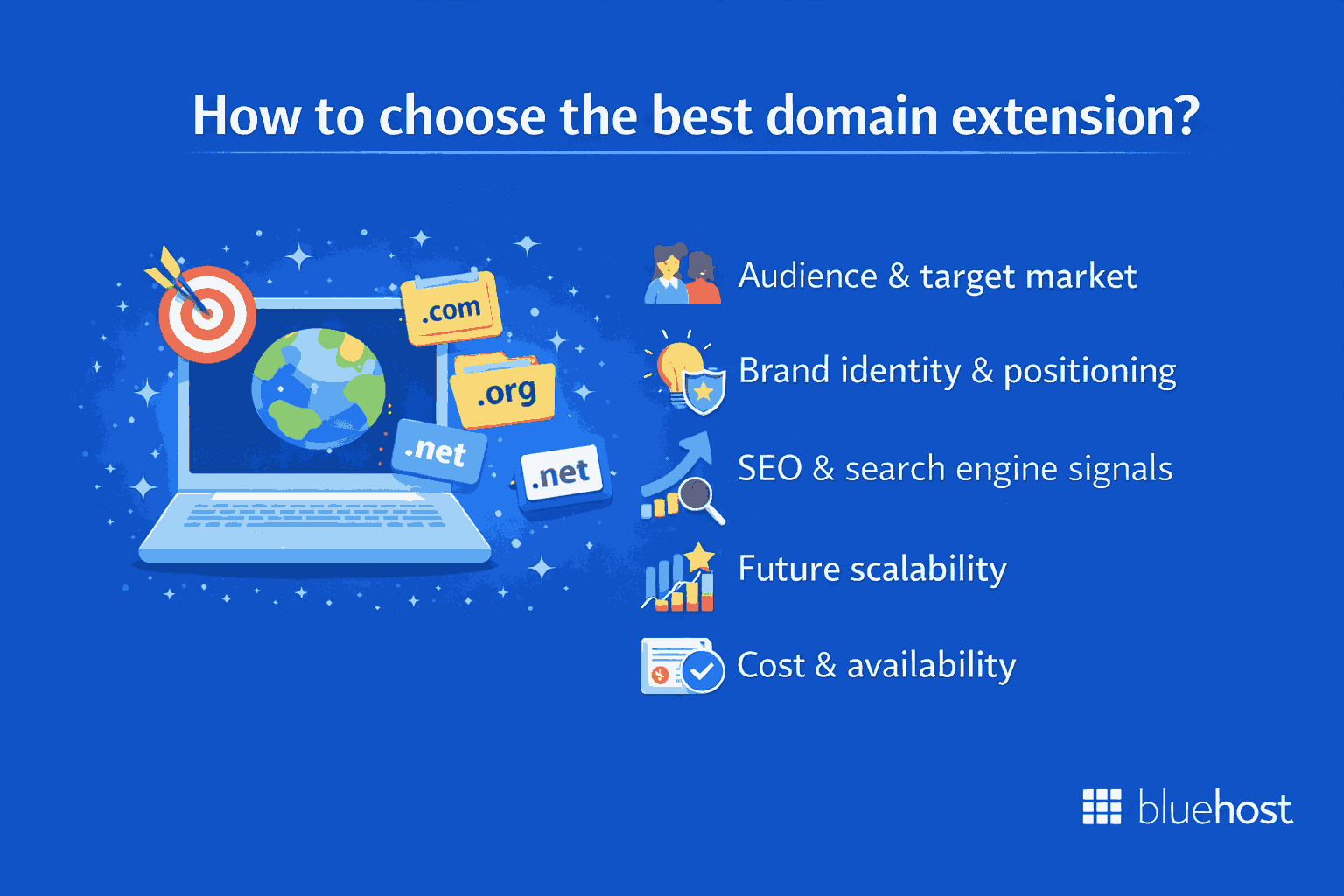
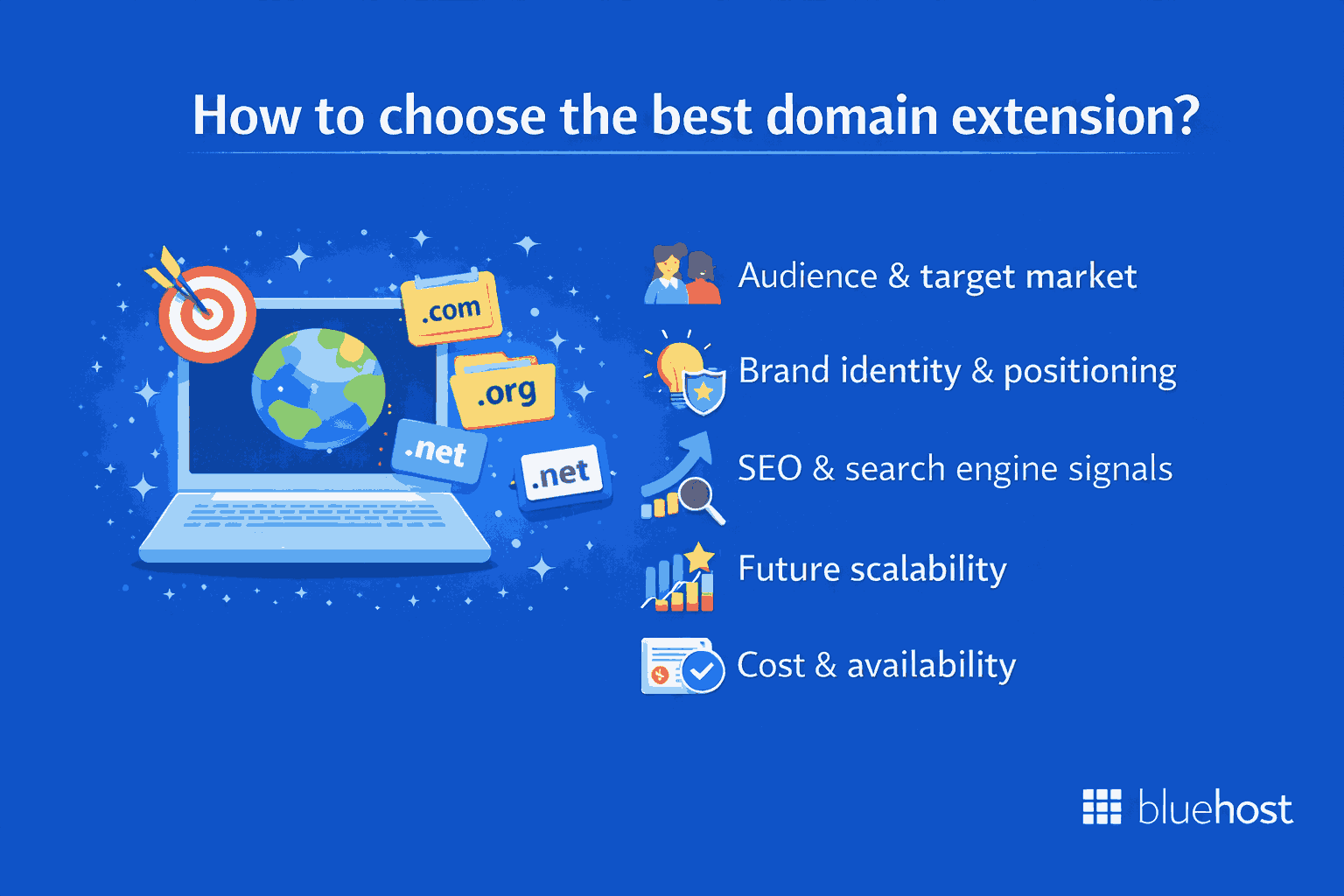
The best TLD depends on your audience, brand identity, SEO goals, scalability and cost. At Bluehost, we’ve seen that the most popular domain extensions like .com, .org and .net remain strong, but other domain extension options are gaining ground.
Here’s what to consider when choosing the right domain extension:
- Audience & target market
- Brand identity & positioning
- SEO & search engine signals
- Future scalability
- Cost & availability
Let’s explore each factor in detail to help you find the perfect domain name and a good TLD that builds long-term trust.
1. Audience & target market
If your site targets a global audience, .com is often seen as the most popular domain extension and still the safest choice. But if you’re aiming at a regional market, country code TLDs like .in or .de can be a good TLD to connect with your target audience locally.
2. Brand identity & positioning
Your domain extension is part of your brand’s online personality. Common domain extensions like .org work well for nonprofits, while corporate top-level domains allow large organizations to create their own branded extensions (e.g., .google). If you’re building one brand that you want to scale globally, choosing the right domain extension becomes even more critical.
3. SEO & search engine signals
Search engines like Google treat every different TLD equally in rankings, but user behavior tells a different story. People are more likely to click popular domains like .com or .org because they’re widely recognized. Still, newer popular domain extensions like .ai, .biz and .store are gaining traction in the modern internet economy.
4. Future scalability
If you’re just starting, you may pick from common domain extensions, but think about growth. A good TLD today should support tomorrow’s expansion. For example, an eCommerce brand may choose .shop now but later secure other domain extension options like .store or .biz to protect their online identity.
5. Cost & availability
Some of the most popular domain extensions like .com are in high demand, while newer TLD options may be easier to find and more affordable. At Bluehost, we offer premium domain names for businesses that want SEO-rich, high-value web addresses, giving you an edge without compromising your perfect domain name.
Whether you choose a common domain extension, explore corporate top-level domains or experiment with different TLD options, Bluehost helps you secure the best TLD for your brand, article or business site, trusted by millions, premium in service and built for the future of the internet.
Also read: Official Bluehost Coupon Codes for 2026: Save Big on Hosting & More
Domain name availability and legal considerations
Before finalizing your domain registration, conducting legal due diligence is a critical step to protect your brand’s future. To avoid costly legal disputes and rebranding expenses, follow these essential steps:
- Check for trademark conflicts using the United States Patent and Trademark Office (USPTO) database or your country’s local equivalent
- Verify your chosen name doesn’t infringe on existing trademarks
- Ensure you own your online identity without the threat of cease-and-desist orders
- Confirm legal availability before committing to your domain name
Beyond legal checks, it’s essential to secure your brand presence across all digital platforms and protect your personal information:
- Investigate name availability across social media platforms to ensure brand consistency
- Secure matching handles to help users find you easily and strengthen your digital presence
- Protect your personal information from the public WHOIS database, which lists contact details for every registered domain and makes you a target for spammers and identity theft
- Consider Bluehost’s Domain Privacy Protection to mask sensitive data with generic contact information while maintaining full ownership of your domain
Leveraging domain extensions for branding and marketing
Your choice of domain extension acts as a powerful branding asset, transforming a standard web address into a memorable marketing tool. By strategically selecting and using the right extension, you can create a unique online identity that sets your business apart.
Creative branding with domain hacks
Creative businesses often leverage “domain hacks” to create distinctive brand identities:
- Domain hacks integrate the extension into your brand name (e.g., ma.tt or flic.kr)
- Creates catchy, shorter URLs that stick in users’ minds
- Provides a unique online identity that stands out
- Effectively differentiates your business from competitors using traditional domain options
Strategic marketing applications
Domain extensions enhance your marketing campaigns and social media presence in several ways:
- Utilize campaign-specific TLDs like .sale, .promo or .blackfriday for temporary landing pages
- Create clear, urgent calls to action directly in the address bar
- Secure custom short links to maintain brand consistency on platforms with character limits
- Drive higher engagement and trust across every customer touchpoint
Also read: Top-Level Domain Extensions Explained
Future trends in domain extensions
The future of domain extensions is moving beyond just .com and common domain extensions, opening up other TLD options that shape how businesses, startups and personal brands build their online identity.
Key domain extension trends shaping your TLD choice in 2026:
- AI-driven recommendations
- The rise of .ai & .io
- Geo-targeted ccTLDs for local SEO
- Niche domains for specialized brands
- .com always dominates
Let’s look at each of these top TLD trends in detail and see how to choose the best TLD or good TLD for your brand.
1. AI-driven recommendations
Tools like ChatGPT and Perplexity are already helping users brainstorm the perfect domain name with smart, AI-driven recommendations. Instead of manually testing dozens of ideas, AI can suggest the best TLD and popular domains based on your business name, target audience and industry. At Bluehost, we offer an AI Domain Name Generator to make this process even easier.
2. The rise of .ai & .io
As tech startups and AI companies continue to grow, .ai and .io are quickly becoming popular domain extensions. What started as niche or even country-code TLDs are now widely recognized in the tech community as signs of innovation. If you’re in AI, SaaS or digital products, these may be the good TLDs to consider over more traditional choices.
3. Geo-targeted ccTLDs for local SEO
Country code TLDs (ccTLDs) like .in, .uk or .de are seeing renewed importance as businesses compete for local SEO. Search engines often boost geographic TLDs in regional searches, making them a trusted way websites end for companies focused on local markets. If your strategy is regional, a ccTLD could be the right domain extension for building local trust and visibility.
4. Niche domains for specialized brands
We’re also seeing growth in niche domain extensions like .eco, .health, .crypto, .biz and .agency. These industry-specific TLDs let you immediately communicate your focus, helping your target audience know what your site is about before even clicking. For example, a brand using .eco signals sustainability, while a .biz shows it’s business-oriented. These popular domains give you more creative room when building your online identity.
5. .com always dominates
The big question: will .com continue to rule the top TLDs? The answer is yes, for now. It remains the most widely recognized and trusted domain extension, making it the go-to TLD for many businesses. But the growth of other domain extension options shows that the future will be more diverse. The perfect domain for your brand might not always be .com, it could be one of the many popular domain extensions rising today.
The future of domain extensions is about choice, flexibility and branding power. Whether you stick with the most popular domain extensions like .com, explore good TLDs like .ai or .io or venture into niche domains, Bluehost is here to help you secure the best TLD for your brand’s future on the internet.
Also read: New Domain Extensions for Business Websites
Best domain extensions for agencies and brands: Best practices for 2026
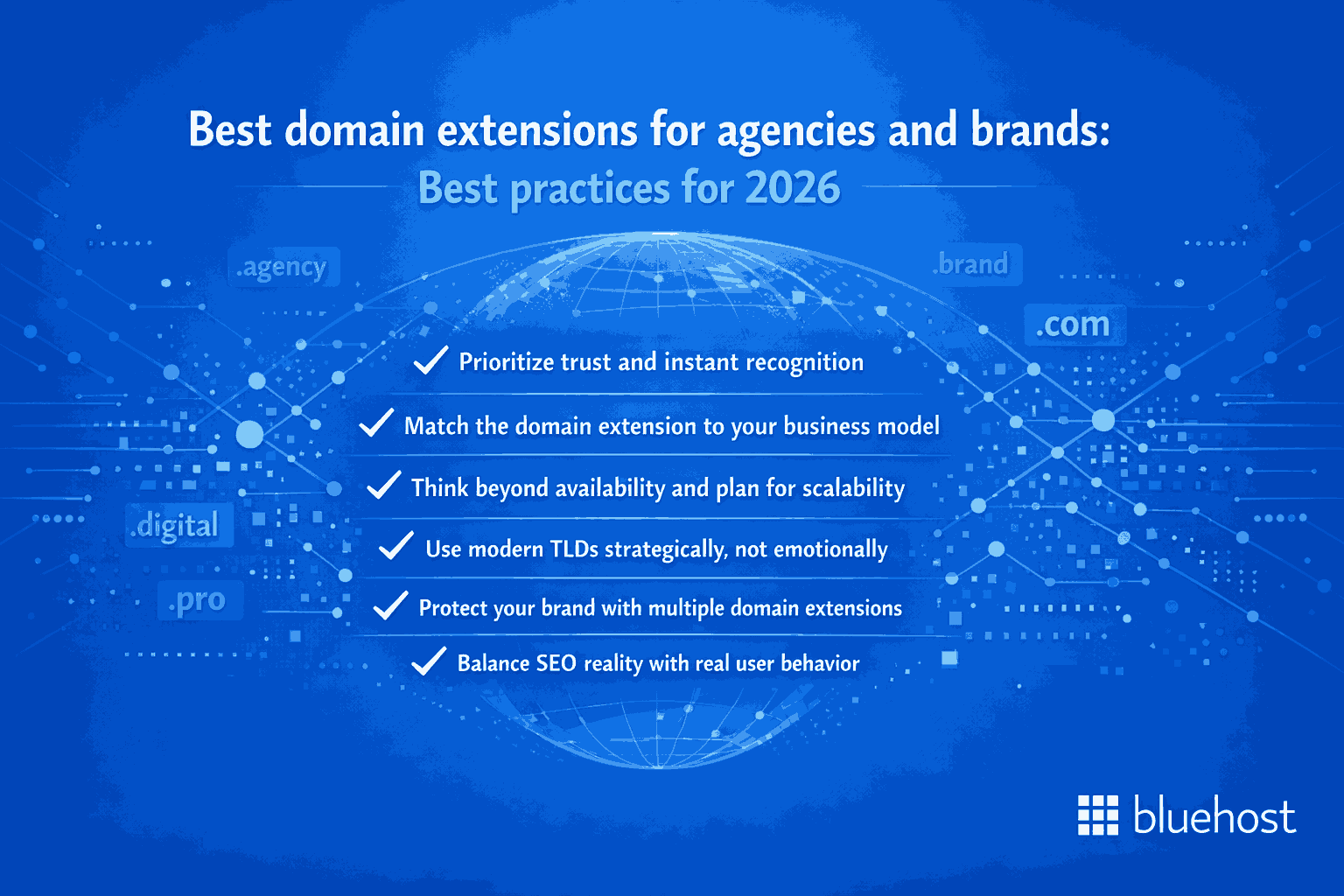
As digital competition increases and AI-driven discovery reshapes how users find brands, choosing the best TLD is no longer just a technical decision, it’s a strategic branding move. In 2026, agencies and brands need domain strategies that balance trust, memorability and long-term growth.
Best practices at a glance
- Prioritize trust and instant recognition
- Match the domain extension to your business model
- Think beyond availability and plan for scalability
- Use modern TLDs strategically, not emotionally
- Protect your brand with multiple domain extensions
- Balance SEO reality with real user behavior
Below, we break down each best practice in detail to help you choose the best domain extensions for your agency or brand.
1) Prioritize trust and instant recognition
For agencies and brands, credibility matters more than ever. Users still associate trust with familiar endings.
- .com remains the best TLD for global agencies, established brands and service-based businesses
- It’s still the most popular domain, especially for first-time visitors
- If available, .com should always be your first choice for primary websites
While newer options are growing, .com continues to outperform other domain extensions in click-through behavior and brand recall.
2) Match the domain extension to your business model
Not every brand needs the same approach. The best domain extensions in 2026 depend on what you do and who you serve.
- Agencies & consultants:
.com,.co,.agency,.pro - Tech & SaaS brands:
.com,.ai,.io,.tech - eCommerce brands:
.com,.store,.shop - Community or nonprofit brands:
.org,.foundation
The goal is alignment. Your domain should instantly communicate what your brand does without explanation.
3) Think beyond availability, think scalability
Many brands choose a domain simply because it’s available. In 2026, that’s not enough.
- Choose a best TLD that can grow with your brand
- Avoid overly narrow extensions if you plan to expand services
- A scalable domain strategy often starts with a strong popular domain and expands into supporting TLDs
For example, an agency may launch with a .com and later secure niche domain extensions for campaigns or products.
4) Use modern TLDs strategically, not emotionally
Newer domain extensions like .ai, .io and .xyz are powerful when used with intent.
- Use modern TLDs to reinforce industry relevance
- Avoid using them just to “sound trendy”
- Make sure the extension strengthens clarity, not confusion
A modern TLD works best when it supports your positioning, not replaces trust built by a popular domain.
5) Protect your brand with multiple domain extensions
Strong brands don’t rely on a single domain.
- Register your primary domain plus key variations
- Secure common alternatives (.net, .co) to avoid brand confusion
- This protects traffic, reputation and long-term SEO value
Owning multiple best domain extensions ensures users always find the right brand, even if they mistype or guess.
6) Balance SEO reality with user behavior
From a search engine perspective, most domain extensions rank equally. From a user perspective, they don’t.
- Users still trust familiar endings more
- Click behavior favors well-known and popular domain structures
- Geographic TLDs boost local SEO when used correctly
The best TLD is one that aligns with both algorithms and real human expectations.
Secure the best domain extensions with Bluehost Domains
Choosing the right domain extension is only half the job, securing it with a trusted registrar matters just as much. With Bluehost Domains, agencies and brands can search, register and manage the best TLDs from one reliable platform.
- Access a wide range of domain extensions, from popular domains like
.comand.netto modern and niche options - Get a free domain for the first year with eligible hosting plans
- Protect your brand with domain privacy and easy renewal management
- Trusted by millions of businesses worldwide
Whether you’re launching a new agency, scaling a brand or protecting multiple best domain extensions, Bluehost makes it easy to secure a popular domain that supports long-term growth.
Case study: How a .com domain helped Midfield Lavender Farm bloom online?
When Jeannie and Brian Miller of Midfield Lavender Farm decided to take their Tennessee getaway from a family retreat to a full-grown business, they knew they needed more than word-of-mouth. They needed a trusted online presence. That’s when they chose MidfieldLavenderFarm.com a .com domain that immediately gave their website recognition and credibility.
Why .com made the difference:
- Widely recognized & trusted: As the most popular domain extension, .com helped the farm’s website feel instantly professional to new visitors.
- Easy to remember: Guests traveling from six different states during their first U-Pick season could easily recall and share the farm’s domain name.
- SEO & search signals: With a common domain extension like .com, Midfield Farm showed up in local searches faster, driving event bookings and product sales.
- Brand alignment: Choosing a good TLD like .com gave them a perfect domain that matched their family-friendly, professional image, not just a farm, but a trusted brand.
The results speak for themselves:
Since launching their .com website with Bluehost, the farm’s sales have grown by 300% in just 5 years. Their digital presence now supports online product sales, ticket bookings for events and seasonal updates that keep their community engaged year-round.
For Midfield Lavender Farm, securing a .com domain wasn’t just about having a website address, it was the foundation for building a brand that’s now recognized both locally and online.
To know more about stories like Midfield Lavender Farm, explore our customer case studies and see how others built success with Bluehost.
Final thoughts
Choosing the right domain extension plays a key role in how your brand is trusted, discovered and remembered online. From common domain extensions like .com, .net and .org to modern popular domains such as .ai or .store, each option shapes your branding and SEO differently.
While .com remains the most popular domain and often the best TLD for global reach, today’s range of best domain extensions gives brands more flexibility to stand out by industry or audience.
Get started with Bluehost Domain Search Tool to explore available options, compare extensions and secure the best TLD for your brand in just a few clicks.
FAQs
The .com extension is the most popular domain in the world because it’s trusted, credible and easy to remember. This popular domain extension remains the best choice for businesses and personal brands. Among all domain extensions available today, .com continues to be one of the most recognized ways websites establish their online presence.
You can easily search and register your perfect domain through most domain registrars. Many providers offer competitive pricing on domain extensions, allowing you to secure a popular domain and reliable hosting together, saving both time and money.
If your preferred popular domain is taken, try adding a keyword, choosing from other domain extensions or exploring alternatives like .net, .co or .ai. Many domain extension options are available to help you find smart, brand-safe alternatives that still match your vision.
Consider your target audience, brand identity and reach when selecting domain extensions. For global appeal, common domain extensions like .com or .net work best. For local SEO, ccTLDs help. For niche markets, popular domain options like .tech or .store can be excellent choices. Understanding different domain extensions helps you make the right decision.
Google treats most domain extensions equally, but geographic extensions boost regional SEO and industry-specific ones improve niche relevance. Choosing from popular domain extensions that build trust can improve visibility and support long-term SEO success. The right domain extensions help establish credibility with both search engines and users.
Yes, many brands register multiple domain extensions (.com, .net, .co) to protect their online identity. Securing variations of your popular domain across different domain extensions ensures you cover all bases and keep your brand consistent across the internet.
Yes, corporate top-level domain extensions like .google or .apple strengthen branding and trust. These popular domain choices work well for big companies, but for most small businesses, traditional domain extensions like .com remain the most reliable option.
The best option among domain extensions is one that supports scalability and trust. For most agencies, .com works best as a popular domain choice, while niche or industry-focused domain extensions can support specific services or campaigns.
Newer domain extensions are reliable and SEO-neutral, but a popular domain like .com still earns higher trust and click confidence from users. When comparing domain extensions, .com continues to be the most recognized popular domain choice globally.
Yes. Many brands use additional domain extensions for marketing campaigns, landing pages or product launches while keeping their primary site on a trusted popular domain with established domain extensions.
Yes, industry-specific domain extensions can significantly enhance brand clarity by instantly communicating what a business does. When strategically combined with a popular primary domain extension for your main web presence, niche-specific domain extensions serve as powerful branding tools that help visitors immediately understand your business focus and industry expertise.
Yes. Registering multiple domain extensions early is crucial to protect your brand identity, prevent misuse by competitors and ensure consistent brand recognition across different online channels. Securing popular domain variations safeguards your brand’s future.

Write A Comment