


Key highlights
- WooCommerce vs Shopify compares flexibility and ownership against speed and convenience for building and scaling an online store.
- Shopify enables faster setup with managed hosting, while WooCommerce offers deeper control through WordPress.
- WooCommerce provides stronger long-term cost control by avoiding platform transaction fees and fixed pricing tiers.
- WooCommerce supports advanced SEO through WordPress plugins and full control over content and site structure.
- Shopify scales through plan upgrades, while WooCommerce scales through hosting and infrastructure choices.
Launching an online store is exciting – until the first big decision slows everything down. Choose the wrong platform and growth becomes harder, costs creep up and simple changes turn into long-term limitations. That’s why the WooCommerce vs Shopify debate matters so much for businesses selling online today.
Both platforms power successful stores, but they are built for very different paths. Shopify focuses on speed and convenience, while WooCommerce prioritizes flexibility, ownership and long-term control through WordPress.
In this guide, you’ll see how WooCommerce and Shopify compare across setup, customization, pricing, performance and scalability, so you can choose the platform that fits your business today and supports growth tomorrow.
TL;DR: WooCommerce vs Shopify
The choice between WooCommerce and Shopify ultimately comes down to a trade-off between immediate convenience and long-term control.
- Choose Shopify if you want the fastest setup with a fully hosted, low-maintenance platform.
- Choose WooCommerce if you want full ownership, deeper SEO control and long-term cost flexibility.
Shopify is a closed, hosted platform with predictable monthly pricing and minimal technical setup, but limited customization.
WooCommerce, built on WordPress, is open-source and highly flexible, allowing unlimited customization, stronger SEO and better control over costs.
| Comparison | WooCommerce | Shopify |
| Best for | Customization, SEO & scaling | Rapid setup & simple management |
| Ownership | User-controlled (Owned) | Platform-controlled (Rented) |
| Flexibility | Unlimited (Open Source) | Limited to apps & themes |
| Verdict | Best for brands wanting control | Best for beginners wanting speed |
Choosing between WooCommerce vs Shopify for your business needs
WooCommerce vs. Shopify is a common comparison when evaluating modern eCommerce platforms. Both options support online selling, but they differ significantly in architecture, control and scalability.
Shopify vs WooCommerce reflects a hosted platform versus a self-managed ecosystem.
- Shopify delivers a fully hosted solution. Hosting, updates and security remain bundled within a controlled platform environment.
- WooCommerce operates as a WordPress plugin. Store design, checkout behavior and integrations remain fully customizable through themes, plugins and code.
These differences directly affect infrastructure responsibility.
- Shopify abstracts hosting decisions away from store owners.
- WooCommerce requires reliable hosting to maintain speed, security and stability at scale.
To understand how these differences play out in practice, it helps to compare both platforms across core features.
How do WooCommerce and Shopify compare on core features?
Choosing between WooCommerce and Shopify depends on how much control, flexibility and cost predictability a business needs over time. Both platforms support modern eCommerce requirements, but they differ in structure, ownership and how they scale as a store grows.
To make those differences easier to evaluate, the table below compares WooCommerce and Shopify across the core features that affect day-to-day store management.
Feature overview: WooCommerce vs Shopify
| Feature | WooCommerce | Shopify |
| Ease of use | Requires more setup but offers greater control, especially for WordPress users. | Fully hosted platform with a simplified setup process. |
| Customization | Fully customizable using themes, plugins and code. | Customization mainly through themes and apps. |
| Cost | Free core plugin. Costs depend on hosting, domains and extensions. | Monthly subscription plus transaction fees for third-party gateways. |
| Hosting | Requires separate hosting. | Included with all plans. |
| Payment options | Broad gateway support with no platform transaction fees. | Wide gateway support, but extra fees for third-party providers. |
| Scalability | Scales through hosting resources and plugins. | Scales through higher-tier plans. |
| SEO capabilities | Advanced SEO through WordPress and plugins like Yoast. | Solid basics with limited deep control. |
| Support | Support depends on hosting and plugin providers. | 24/7 platform support included. |
The table highlights high-level differences, but each feature affects real stores in different ways. The sections below break down these comparisons in detail to help you understand how each platform performs in practice.
WooCommerce vs Shopify: Setup and installation
WooCommerce operates as a WordPress plugin and requires a more hands-on setup. Users must choose hosting, install WordPress and configure WooCommerce. While this introduces additional steps, it removes platform limitations and provides full ownership of the store environment.
For WooCommerce stores, the hosting environment directly affects performance and reliability. Managed WooCommerce hosting simplifies setup through one-click installation and guided configuration, while still preserving long-term flexibility.
Shopify follows a fully hosted model. Hosting, security updates, PCI compliance and platform maintenance are handled automatically, allowing new stores to launch quickly with minimal technical involvement. This approach suits businesses that prefer focusing on operations rather than infrastructure.
WooCommerce vs Shopify: App ecosystem
WooCommerce leverages the massive WordPress ecosystem with 60,000+ plugins and thousands of eCommerce-specific extensions, many free or available as a one-time purchase ($50–$300)*.
Users gain complete control over:
- Checkout flows
- Product logic
- Shipping calculations
- Membership and subscription models
This control comes without platform tier restrictions.
This open extensibility suits stores with unique requirements, international selling complexity or businesses planning extensive custom development, while Shopify excels for rapid deployment of standard features via its polished app marketplace.
Shopify provides a curated app marketplace with over 8,000 professionally developed apps covering email marketing, reviews, social integrations, inventory management and more.
Most core features are accessible via one-click installs, but popular apps often cost $10–$100/month* each, with advanced functionality typically requiring Shopify Plus ($2,000+/month)* or custom development.
As store complexity grows, Shopify’s app ecosystem reveals limitations around:
- Checkout customization, which remains restricted on Basic and Shopify plans
- Advanced multi-vendor marketplaces
- Bespoke pricing rules that demand higher tiers or enterprise development
WooCommerce vs Shopify: Cost and pricing
WooCommerce pricing model
WooCommerce follows a modular cost model. The core plugin is free.
Typical starter costs are driven by:
- Hosting, often about 5–15 USD/month* on entry-level plans
- A domain, around 10–20 USD/year*
- Optional premium themes or extensions, commonly 50–200 USD/year each
No platform-level transaction fees apply for third-party gateways. You only pay standard payment processor rates, such as 2.9% + 0.30 USD per transaction.
This structure allows businesses to control spending as they grow – starting lean and adding paid functionality only when needed – instead of being locked into predefined SaaS tiers.
Shopify pricing model
Shopify uses a fixed monthly pricing structure that includes hosting, security and core features.
Core plans typically range from about 39 USD/month* for Basic to 399 USD/month* for Advanced when billed monthly, before apps and payment processing.
However, total costs often rise due to:
- Paid apps
- Higher-tier plans
- Extra transaction fees of around 0.5%–2% per order when using third-party payment gateways instead of Shopify Payments
These fees apply on top of standard card processing costs, such as 2.9% + 0.30 USD on the Basic plan.
*Disclaimer– Prices are subject to change.
WooCommerce vs Shopify: Performance and speed
WooCommerce performance depends on hosting and optimization choices.
- SSD storage improves database performance
- Caching reduces server load during peak traffic
- CDN integration improves global page delivery
With optimized hosting, WooCommerce stores can maintain fast load times even as traffic increases.
Shopify manages its own infrastructure and delivers consistent baseline performance. However, resources are shared and high-traffic stores may need to upgrade plans to maintain speed.
WooCommerce vs Shopify: Scalability and growth
WooCommerce scales horizontally.
- Hosting resources expand as needed
- Features are added through plugins
- Growth does not force pricing tier changes
This flexibility supports long-term and unpredictable growth patterns.
Shopify scales vertically through plan upgrades. As traffic and feature needs grow, higher-tier plans become necessary, which can significantly increase monthly costs.
WooCommerce vs Shopify: Support and resources
WooCommerce relies on the WordPress ecosystem.
- Extensive documentation and community support
- Plugin developers handle feature-specific issues
- Hosting providers support infrastructure and performance
Support quality varies based on the hosting environment and store complexity.
Shopify includes 24/7 platform support with all plans. This works well for standard setups, but complex customizations often require third-party app developers.
WooCommerce vs Shopify: Design and themes
WooCommerce integrates with the broader WordPress theme ecosystem. Thousands of free and premium themes allow deeper visual control, making it easier to match a unique brand identity.
Shopify offers mobile-responsive themes with editor-based customization. Advanced design changes, including checkout modifications, may require knowledge of Shopify’s Liquid language or paid development support.
WooCommerce vs Shopify: Inventory management
WooCommerce offers greater flexibility.
- Unlimited products and categories
- Extensions for bulk editing and imports
- Advanced inventory workflows via plugins
This approach scales well for large or complex catalogs.
Shopify includes built-in inventory tools for tracking stock, variants and collections. Advanced inventory needs often require additional apps.
WooCommerce vs Shopify: Marketing and SEO
WooCommerce benefits from WordPress’s content-driven architecture.
- Full control over URLs and metadata
- Advanced SEO plugins like Yoast
- Strong alignment with content marketing strategies
This makes WooCommerce a better fit for organic search–driven growth.
Shopify includes built-in marketing tools and basic SEO controls. While suitable for product-focused stores, advanced SEO customization remains limited.
WooCommerce vs Shopify: Security and data control
WooCommerce provides greater data ownership. Security and backups depend on hosting and site management choices, but store owners retain full control over files and databases.
Shopify manages security, SSL certificates, PCI compliance and backups. However, data remains within Shopify’s hosted environment.
WooCommerce vs Shopify: International selling and multilingual support
WooCommerce supports international selling through WordPress plugins such as WPML and Polylang. This allows region-specific content and language control without platform restrictions.
Shopify supports multi-currency selling and multilingual features through apps. These tools add functionality but can increase costs.
Overall value
WooCommerce suits businesses that prioritize control, customization and long-term scalability. Its flexibility, cost structure and SEO depth make it a strong choice for growing brands with evolving needs.
Shopify suits businesses that prioritize simplicity, speed and managed infrastructure. It works best for standardized stores with predictable growth.
With the core differences covered, the next step is understanding which platform aligns better with specific business goals.
Which platform is right for your business?
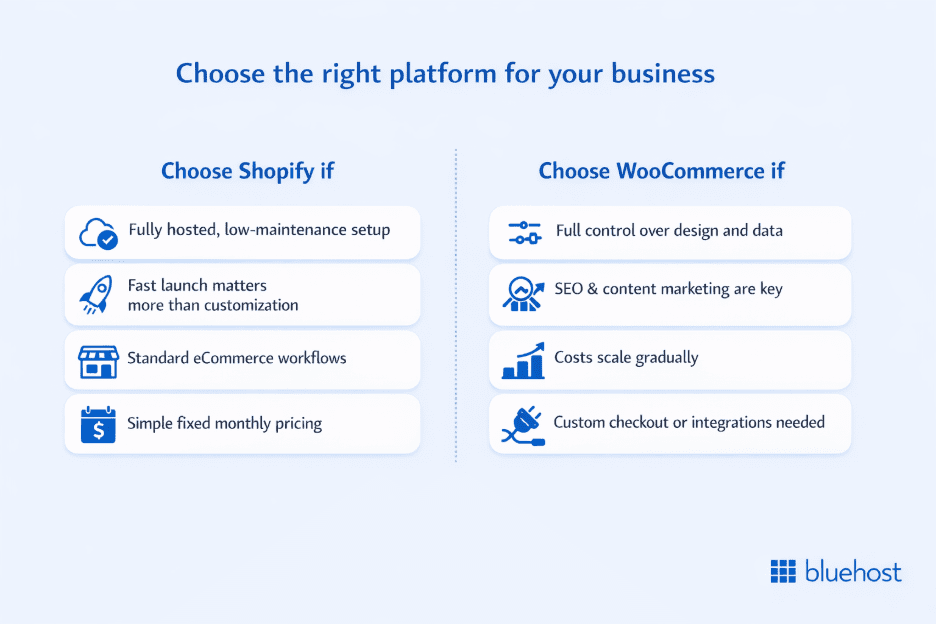
After reviewing features, pricing, performance and scalability, the decision becomes clearer when viewed through business priorities rather than platform capabilities alone. Both Shopify and WooCommerce support modern online stores, but they solve different operational problems.
Choose Shopify if:
- A fully hosted, low-maintenance setup is the primary goal.
- Speed to launch matters more than deep customization.
- The store follows standard eCommerce workflows without complex logic.
- Fixed monthly pricing feels easier to manage than modular costs.
Shopify works well for businesses that want infrastructure, updates and security handled in one place. This approach can limit flexibility as the store grows.
Choose WooCommerce if:
- Full control over design, data and functionality is important.
- SEO and content marketing play a central role in acquisition.
- Costs need to scale gradually rather than through fixed pricing tiers.
- Custom checkout flows, pricing rules or integrations are required.
WooCommerce suits businesses that expect their store to evolve over time and want flexibility without platform-imposed constraints.
At this stage, the platform decision is largely complete. The next practical consideration is how WooCommerce stores are hosted and managed.
How to get started with WooCommerce hosting?
Unlike fully hosted platforms, WooCommerce depends on the hosting environment for speed, security and reliability. This makes hosting a foundational choice rather than a secondary detail.
A WooCommerce-ready hosting setup should support:
- Optimized WordPress performance under load
- Secure checkout and payment processing
- Automated backups and update handling
- Scalability as traffic and product catalogs grow
Choosing hosting built specifically for WooCommerce reduces setup friction and avoids performance issues later. Bluehost WooCommerce hosting provides an environment designed for WordPress stores, with configurations tailored for online selling rather than generic websites.
This allows store owners to focus on products, customers and growth instead of infrastructure management.
With the platform and hosting direction clear, the next step is preparing for launch.
What to consider before launching your online store?
Before launching, taking a moment to align platform and hosting choices with business goals helps prevent rework later.
- Growth expectations: Anticipated traffic and catalog size influence infrastructure needs.
- Customization requirements: Unique workflows favor flexible platforms.
- Marketing strategy: Content-led growth benefits from stronger SEO control.
- Budget structure: Subscription-based versus modular costs affect long-term spending.
Clarifying these factors early reduces the likelihood of costly migrations or platform limitations as the store scales.
Final thoughts
Choosing between WooCommerce and Shopify should be the result of intent, not convenience. Shopify works well when the goal is a fast launch with minimal technical decisions. WooCommerce makes more sense when flexibility, SEO control and long-term scalability matter.
Before moving forward, take one practical step: define how the store needs to grow over the next 12 to 24 months. That clarity helps avoid platform limits, unexpected costs and future migrations.
If WooCommerce is the right fit, the next action is setting up a hosting foundation that can handle traffic, transactions and growth from day one. With Bluehost WooCommerce hosting, you can start with an environment built specifically for WordPress stores and focus on launching, optimizing and scaling with confidence.
FAQs
It depends on business goals. WordPress, via WooCommerce, suits businesses that prioritize SEO, content control and full site ownership. Shopify works better for users who want a fully managed platform with minimal technical involvement.
Shopify is usually easier for beginners because it is fully hosted and handles setup, updates and security automatically. WooCommerce takes more initial setup but offers greater flexibility and ownership as the store grows.
When WooCommerce is paired with us, the onboarding becomes much simpler through guided setup, built-in tools and visual site creation features that reduce technical effort.
Shopify is easier to use at the start because it is fully hosted and handles setup, updates and security automatically. WooCommerce requires more initial setup, but it provides greater flexibility and control once the store is established.
WooCommerce often costs less over time because it does not charge platform transaction fees and allows flexible spending on hosting and plugins. Shopify’s monthly plans, app subscriptions and third-party payment fees can increase total costs as the store grows.
Yes. WooCommerce can support large product catalogs and high traffic when paired with the right hosting and performance optimization. Scaling depends on infrastructure choices rather than platform limits, which gives more flexibility as demand increases.
Yes. WooCommerce requires WordPress hosting to run an online store. Choosing hosting optimized for WooCommerce helps ensure faster load times, secure transactions and smoother scaling as traffic grows. With Bluehost WooCommerce hosting, you can set up a store environment designed specifically for WordPress eCommerce.



Write A Comment