 ChatGPT,
 Claude,
 Gemini,
 Grok — all four for
Key highlights
- Understand how search engines rank AI-generated platforms so you can select a tool that drives organic traffic.
- Learn the core technical SEO capabilities of modern AI builders to ensure your site loads fast and functions correctly.
- Uncover simple optimization strategies that help you maximize your visibility on Google without needing complex coding skills.
- Explore the balance between automated content creation and human editing to keep your search rankings safe from search engine penalties.
- Know which essential features to look for in a platform so you can decide if AI website builders are good for SEO for your business.
Many business owners assume that “automated” means “bad for search,” so they skip a faster build out of fear that automation could hurt their rankings. That assumption costs them time and budget.
So, are AI website builders good for SEO? Yes, in most cases they are, because they handle the technical groundwork that supports rankings, though your content and strategy still decide how high you climb. The trouble is that owners rarely know where the tool’s job ends and theirs begins.
Below you will find the short verdict, the specific factors these builders manage well, the gaps you need to cover yourself and a buying checklist you can apply to any platform.
Let’s dive in!
Are AI website builders good for SEO? The short answer
AI website builders are good for SEO when they produce clean, fast, mobile-friendly pages and let you control titles, headings and content. The automation handles structure and code. You handle relevance, originality and keyword targeting. Rankings come from combining both, not from the builder alone.
1. What “good for SEO” actually means
Search engines reward sites they can crawl, load and understand quickly. That breaks down into a few measurable things: how fast pages render, whether the code is clean enough for bots to read, how well the site works on phones and whether the page structure signals what each page is about. A builder that gets these fundamentals right gives your site a strong technical SEO foundation.
2. What AI builders handle automatically
Modern automated builders take care of much of the technical SEO checklist without you touching code. Most generate responsive layouts, produce a sitemap, apply heading tags in order and create editable meta titles and descriptions. Several also add image alt text fields and basic schema markup, which helps search engines display rich results.
3. Where owners still carry responsibility
Automation cannot judge whether your content answers a searcher’s question better than a competitor. You still own keyword research, the quality and depth of each page, the internal links between pages and the work of earning links from other sites. A builder can frame a fast, well-coded house. You still have to furnish it with content people want.
Ultimately, AI website builders are good for SEO if you treat their automated outputs as a baseline and actively customize your site for real users.
As you plan your SEO strategy, understanding how search engines treat these automated systems is crucial to avoiding ranking setbacks.
Will Google penalize AI-built websites?
No. Google does not penalize a page simply because AI helped create it. Google’s own guidance on AI-generated content states that the focus is on content quality and helpfulness, not the method of production. What gets penalized is thin, generic or unhelpful content that exists only to game rankings.
The distinction matters because Google evaluates the quality and usefulness of content, not how it was created. The real test is whether your pages provide value to users, not whether a human or an AI agent wrote the first draft.
This is why the quality of the AI experience matters so much. A builder that asks about your services, location and customers can produce content that reflects your actual business. A builder that fills pages with filler text invites exactly the kind of generic output that struggles to rank.
The real SEO impact comes from the website builder’s capabilities, not the use of AI. Let’s look at how an SEO website builder can help or hinder your rankings.
How does an SEO website builder affect rankings?
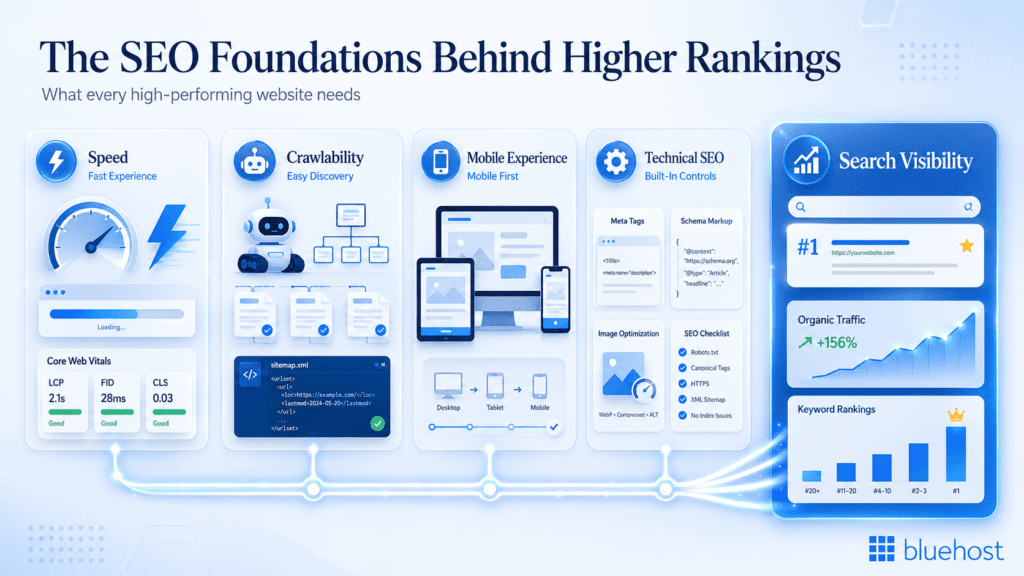
Choosing an SEO website builder shapes several signals Google measures directly. Understanding the “why” behind each one helps you see what you are really buying when a platform promises search-friendly pages.
1. Site speed and Core Web Vitals
Google’s Core Web Vitals measure loading, interactivity and visual stability, with a Largest Contentful Paint under 2.5 seconds counted as good. Faster pages keep visitors from bouncing and give crawlers an easier time. When First Contentful Paint sits low, around 0.65 seconds on strong hosting, users see content almost instantly, which supports both rankings and conversions.
2. Clean code and crawlability
Search bots read your page source before they rank it. Bloated or messy code slows that process and can hide important content. Good builders output lean HTML and a logical page hierarchy so crawlers reach every page without getting stuck, which is what crawlability really means in practice.
3. Mobile responsiveness and indexing
Google indexes the mobile version of your site first, so a layout that breaks on phones can sink rankings even if the desktop view looks fine. AI builders typically generate responsive designs that adjust to any screen, which removes one of the most common technical mistakes small sites make.
4. Built-in technical SEO settings
The settings that used to require a developer now sit in a dashboard. Look for control over these elements when you compare platforms:
- Editable meta titles and descriptions for every page
- Image alt text fields that describe each visual for search and accessibility
- Automatic sitemap generation and submission
- Schema markup for businesses, reviews or products
When a builder bundles these, you spend your time on strategy instead of plumbing, which is where most owners get the best return.
In short, an SEO-friendly website builder can strengthen the technical foundation of your site, making it easier for search engines to crawl, understand and rank your content.
However, strong technical SEO is only part of the equation, the real value often comes from what happens after your first website draft is generated.
Why the AI experience matters after the first draft?
Search visibility is never a one-time task. Google rewards sites that stay current, add useful pages and refine their content as a business grows. Yet many AI builders treat website creation as a single event. They generate a draft, hand it over and disappear, leaving you to wrestle with a complex editor on your own.
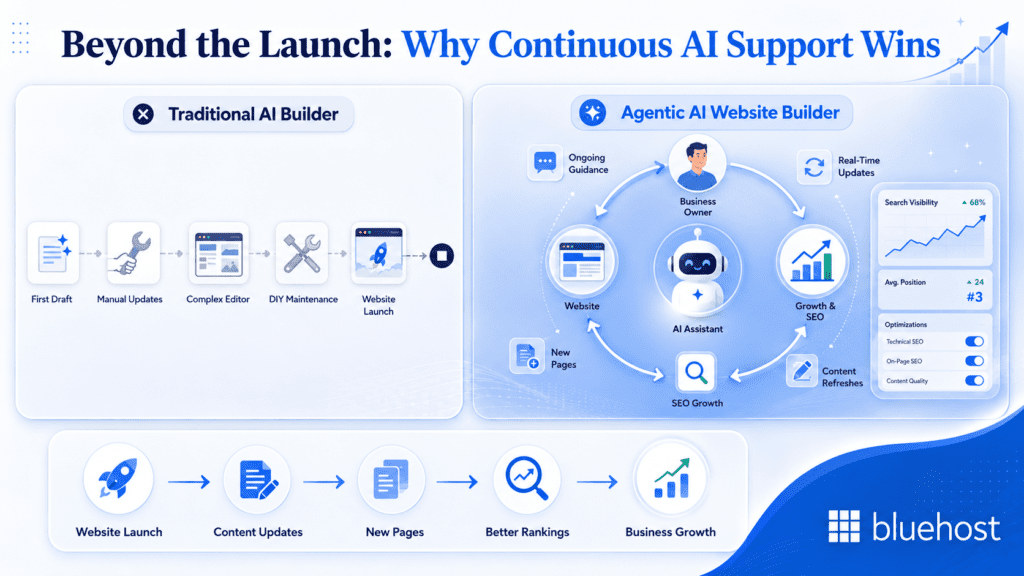
A stronger, agentic approach changes that. Instead of a one-and-done generator, a conversational AI agent stays in the loop. You can ask it to rewrite a service description, add a new location page, adjust a section or refresh a blog post and it makes the change with you in real time. That ongoing support is what keeps a site healthy in search over months and years.
Think about how rankings build. A new service page, a seasonal promotion, an updated FAQ or a fresh article all send positive signals to Google. If updating your site feels difficult, those improvements simply never happen. The builders that help with SEO long after launch are the ones that move beyond the first draft and keep collaborating with you.
The best AI website builders do more than generate a first draft, they make it easier to continuously improve your website as your business and SEO needs evolve.
Of course, ongoing support is only one piece of the puzzle, so let’s address some of the most common concerns businesses have about AI website builders and SEO.
Are AI website builders good for SEO? Common concerns and solutions
While an AI site generator serves as an enabler for rapid deployment, it often leaves technical gaps that affect search engine visibility. Understanding where these tools fall short helps you optimize your site effectively.
| Common AI website builder SEO challenge | Why it matters | How to avoid It |
| Generic or duplicate AI-generated content | Similar content across multiple websites can make it difficult to rank and demonstrate expertise. | Treat AI-generated content as a first draft. Add original insights, examples, customer stories and brand-specific details. |
| Thin pages with limited information | Short, generic pages often fail to satisfy search intent or convert visitors into customers. | Expand service pages with FAQs, pricing details, use cases, testimonials and unique business information. |
| Weak local SEO differentiation | Businesses may struggle to stand out from nearby competitors in local search results. | Include location-specific content, local customer reviews, service areas and business-specific expertise. |
| Limited control over URLs and redirects | Poor URL management can create broken links, indexing issues and a confusing site structure. | Choose a platform that allows custom URLs, slug editing and 301 redirects. |
| Slow page speed and template bloat | Excessive code, scripts and design elements can hurt user experience and search rankings. | Test pages with speed tools and choose a builder that generates lightweight, optimized websites. |
| Poor site structure and navigation | Search engines may struggle to understand and crawl disorganized websites. | Use a clear hierarchy with logical navigation, internal links and well-structured pages. |
| Limited editing and customization options | Difficulty making updates can slow SEO improvements and business growth. | Select a platform that allows ongoing content, design and SEO edits without technical barriers. |
| Lack of post-launch guidance | Many builders help create a website but offer little support for future optimization and growth. | Choose a solution that provides ongoing support, SEO tools and website management resources. |
| Builder lock-in and migration challenges | Moving to another platform later can be costly and time-consuming. | Look for platforms that provide ownership, portability and flexibility as your business evolves. |
How to avoid post-launch search issues
Most automated site problems trace back to a single cause: the tool stops optimization work the moment the site goes live. To prevent performance drops, establish a post-build routine. Edit every AI-generated page to inject your distinct industry voice, review all meta settings manually and run speed tests before publishing. These steps turn basic automation into a sustainable search advantage.
AI website builders can support strong SEO performance, but long-term rankings still depend on content quality, technical flexibility and ongoing optimization after launch.
The good news is that some AI website builders are designed to reduce these challenges by combining automation with the tools and flexibility needed for long-term search engine optimization growth.
How Bluehost AI Website Builder simplifies SEO from the start?
When evaluating whether AI website builders are good for SEO, the underlying technical structure of the platform is critical. Our Bluehost AI Website Builder uses an interactive, conversational process to generate and maintain search-friendly websites, removing the manual configuration typically required for search optimization.
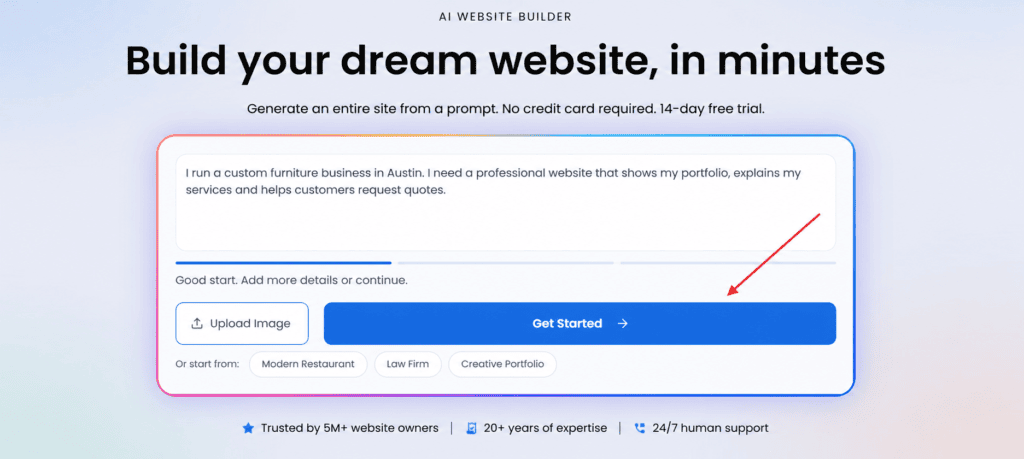
- Gathering 5 industry-specific questions before generating your site ensures the initial content aligns with your actual business offerings.
- Creating logical site structures with clear heading hierarchies helps search engine crawlers index your web pages, demonstrating how AI website builders are good for SEO.
- Generating metadata and image alt text automatically provides search engine optimization from the moment your website launches.
- Using conversational text prompts to request content updates or add new pages simplifies site maintenance without complex editing tools.
- Bundling essential features like hosting, a free domain for the first year, free SSL security and 24/7 human support keep your website secure and accessible online.
- Optimizing technical performance automatically eliminates the need to configure complex database settings or manage third-party SEO plugins.
Automated technical setup directly improves search engine visibility. Because search engines prioritize user experience, our tool runs on hosting infrastructure that delivers a 0.65-second First Contentful Paint and a 99.99% uptime SLA to meet core speed and reliability requirements.
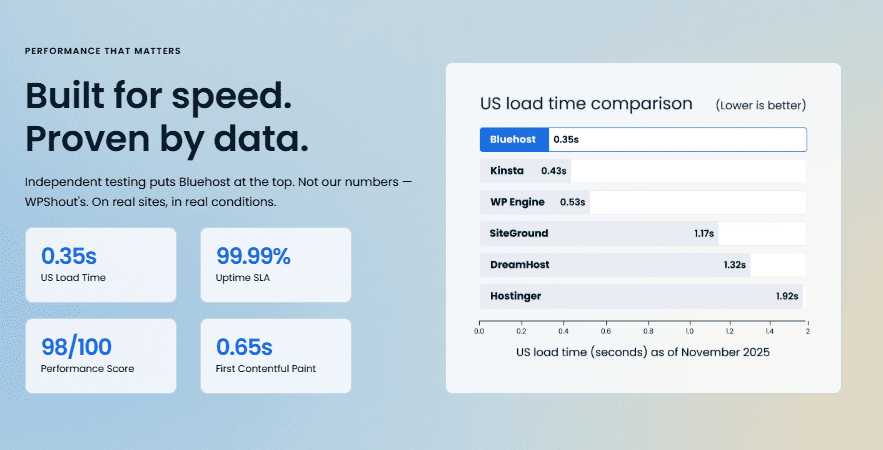
You can start building with the Bluehost AI Website Builder to establish a search-friendly online presence and adjust your layouts through direct text commands.
To maximize these benefits, it’s important to understand how to get the most SEO value from your AI website builder.
Next, let’s look at the steps you can take to strengthen SEO performance after your website goes live.
Getting the most SEO value from an AI website builder
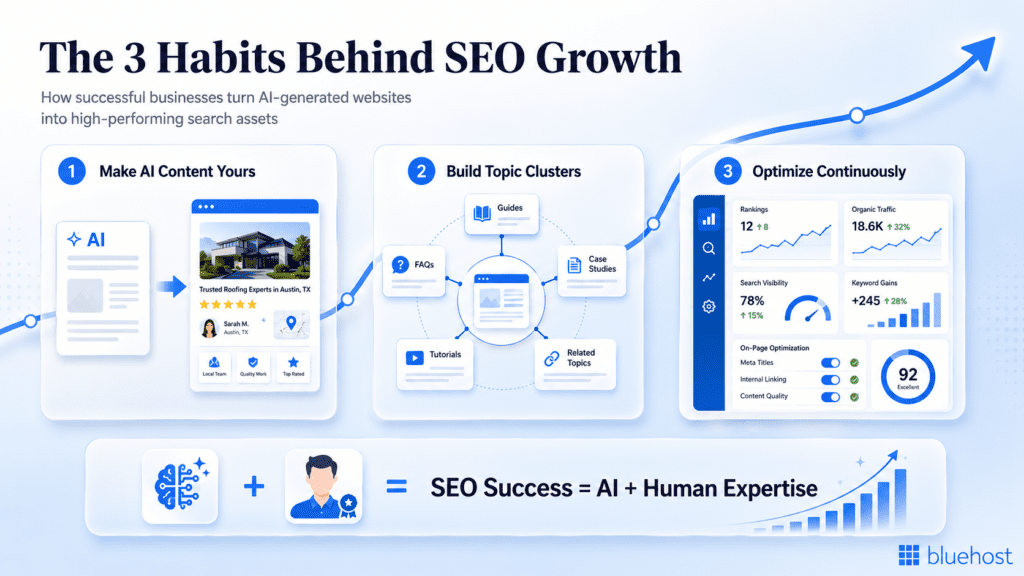
Strong AI website builder SEO results come from treating the tool as a head start, then layering human judgment on top. The three habits below separate sites that stall from ones that grow.
1. Edit and humanize AI content
A local plumbing company might use AI to draft a dozen service area pages in minutes. The pages rank only after the owner edits them with real job photos, neighborhood names, pricing notes and answers to questions customers actually ask. Originality and first-hand detail are what convince Google your page deserves the top spot, a point reinforced by Google’s emphasis on helpful, people-first content (Google).
2. Build topical authority with supporting pages
One page rarely covers a topic fully. Group related pages so they reinforce each other, for example a main service page supported by detailed guides, FAQs and case studies. Link them together with descriptive anchor text. Search engines read these clusters as a sign that your site has real depth on a subject.
3. Monitor performance and iterate
SEO is not a one-time setup. Connect free tools like Google Search Console and Google Analytics to track which pages bring traffic and which queries you rank for. Review the data monthly, update pages that slip and expand the ones that perform. Small, regular improvements compound over time and tend to outpace a single big launch.
AI website builders can accelerate SEO success, but long-term rankings still depend on content quality, topical authority and ongoing optimization.
With that in mind, the next step is knowing which features separate an SEO-friendly website builder from one that simply gets you online.
Also read: Google Search Console Insights: How to Use It Effectively
What should businesses look for in an SEO-friendly website builder?
If long-term search performance matters to your business, look beyond speed and design alone. Use the checklist below to evaluate whether a website builder supports sustainable SEO growth.
| SEO-friendly website builder feature | Why it matters for SEO and growth |
| Understands your business before building | Creates a website tailored to your industry, services, audience and goals instead of generating generic content. |
| Generates business-specific content | Helps produce relevant pages that align with search intent rather than relying on recycled filler text. |
| Creates a logical site structure | Makes it easier for search engines to crawl, understand and index your website. |
| Supports post-launch editing | Allows you to update content, optimize pages and improve SEO without needing coding skills. |
| Scales as your business grows | Makes it easy to add new pages, services, products, locations and content over time. |
| Includes hosting, domain and security | Simplifies website management and ensures essential technical requirements are handled in one place. |
| Provides ongoing support | Gives you access to expert help when troubleshooting issues or making website updates. |
| Offers an easy-to-use editor | Reduces friction and helps you maintain and improve your website without a steep learning curve. |
| Supports ongoing content updates | Enables you to refresh content, publish new pages and keep information current for users and search engines. |
| Balances AI assistance with user control | Lets you benefit from AI-generated content while retaining full control over customization and optimization. |
Pro tip: Before choosing a website builder, ask how it handles updates after launch. The best solutions continue supporting website growth, content changes and optimization rather than leaving you to manage everything alone.
Choosing an SEO-friendly website builder can have a lasting impact on your website’s visibility, scalability and long-term growth. The right platform not only helps you launch faster but also gives you the tools to optimize, improve and expand your online presence over time.
Final thoughts
So, are AI website builders good for SEO? For most businesses, the answer is yes, as long as you remember that the tool handles the technical foundation while you supply the relevance and originality.
The automation gives you clean code, fast load times, mobile-ready layouts and editable meta settings. Your content, keyword choices and ongoing edits decide how far you climb.
Lasting AI website builder SEO success is a partnership between smart automation and human editing, never one without the other.
Ready to put that into practice? Start today with Bluehost AI Website Builder’s 14-day free trial and create your website in minutes. Later, refine the AI-generated drafts into pages that showcase your unique expertise and business value.
FAQs
AI can handle a large share of SEO groundwork, including page structure, headings, metadata, alt text and content drafts. It cannot replace your judgment on accuracy and customer relevance, so ongoing refinement still adds value beyond what automation provides.
Yes. Google ranks AI-built websites the same way it ranks any other website. Search rankings depend on the quality of the content, user experience and technical SEO not whether AI helped create the site. Modern AI website builders can generate fast, mobile-friendly and well-structured websites. But long-term SEO success still depends on publishing original, helpful content and optimizing key elements such as URLs, headings and metadata
The best choice gives you fast hosting, clean code, mobile-responsive templates, editable meta data and easy content control. Prioritize speed, security inclusions like SSL and a CDN and the freedom to edit URLs and headings over flashy design options you may never use.
It can, but quality and originality decide the outcome, not the fact that AI wrote the first draft. Google rewards content that shows genuine experience and answers the searcher’s question. Add your own data, examples and voice to AI drafts so they stand apart from similar pages.
It depends on what you value. AI builders offer convenience and speed with the technical work done for you, which suits non-technical owners. WordPress offers deeper control and plugin flexibility for those willing to manage it. Both can rank well, so the right pick comes down to how much hands-on control you want.
With the right tool, yes. A conversational AI builder lets you add pages, rewrite copy and refresh content through simple requests, which keeps your site current and supports stronger long-term search performance.

Write A Comment