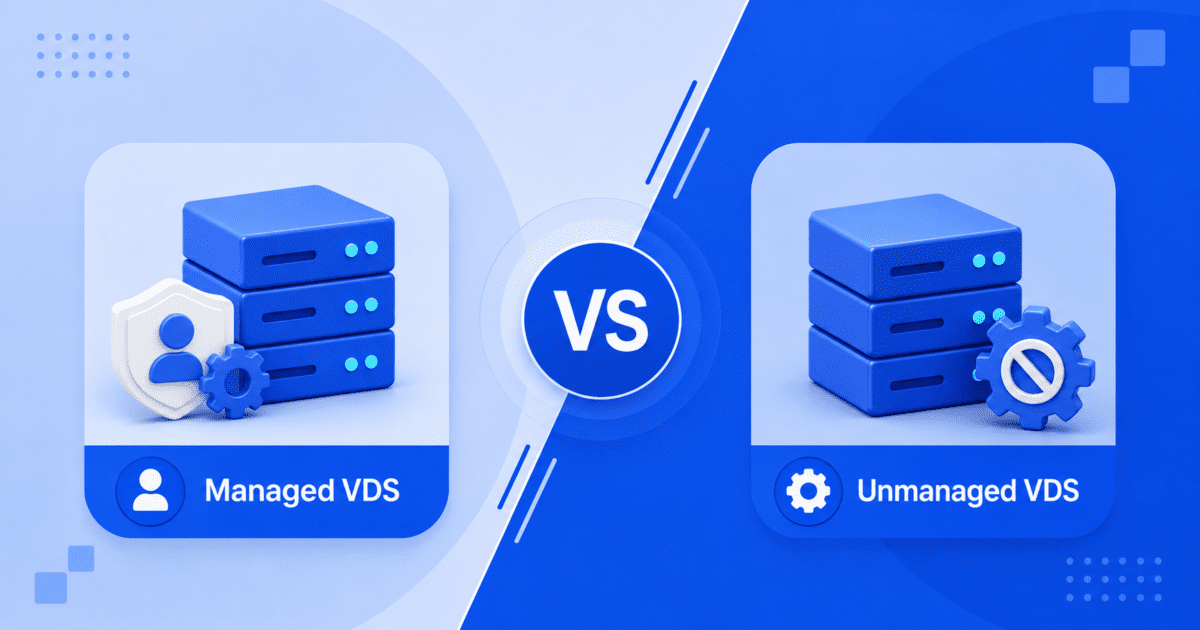
When comparing managed vs unmanaged VDS hosting, the main difference comes down to who handles server administration. With managed VDS hosting, the hosting provider takes care of server maintenance, security patches, software updates, monitoring performance and many server management tasks. Unmanaged VDS hosting gives you full root access, but you handle all server management.
Businesses without a dedicated IT team often choose managed hosting for convenience and technical support. Developers, agencies and teams with strong technical expertise often prefer unmanaged hosting because it provides greater flexibility, deeper customization and full control over server settings.
Understanding the difference between managed and unmanaged hosting can help you choose the right hosting solution for your workload, budget and technical requirements.
Key highlights
- Delegate server administration, security updates and ongoing maintenance to the hosting provider with managed VDS hosting.
- Gain full root access, complete control and dedicated resources for custom server configurations with unmanaged VDS hosting.
- Choose managed hosting if your business does not have in-house system administrators.
- Use unmanaged hosting when advanced customization and greater control are required by developers, agencies or technical teams.
- Choosing between managed vs unmanaged VDS hosting depends on your technical knowledge, budget and operational needs.
What is managed VDS hosting?
Managed VDS hosting is a hosting service where the hosting provider handles most server management tasks for you. This typically includes server setup, operating system updates, security patches, monitoring performance, automated backups and technical support.
A managed hosting plan is designed for businesses that want dedicated resources without handling server administration themselves.
Who is managed VDS hosting best for?
Managed VDS hosting is often a good fit for:
- Businesses without a dedicated IT team
- Website owners with limited technical skills
- Teams that want hands-off server maintenance
- Organizations that prioritize convenience and support
What does managed VDS hosting typically include?
Most managed VPS hosting or managed VDS hosting plans include:
- Initial setup and server configuration
- Operating system and software updates
- Security measures such as malware scanning and intrusion detection
- Automated backups
- Performance optimization and monitoring
- Technical support for server-related issues
Keep in mind that managed hosting services vary by provider. Some managed VPS plans include extensive server management, while others only cover basic maintenance and support. If you prefer greater flexibility and control, unmanaged VDS hosting may be a better fit.
What is unmanaged VDS hosting?
Unmanaged VDS hosting is a hosting solution where you receive dedicated resources, full root access and complete control over the server environment. The hosting provider supplies the infrastructure, while you manage the operating system, software installation, security and server maintenance.
Unlike managed hosting, an unmanaged plan gives you full freedom over server settings, custom software and server configurations.
Who is unmanaged VDS hosting best for?
Unmanaged VDS hosting is commonly used by:
- Developers and DevOps teams
- Agencies managing multiple websites
- SaaS businesses and technical founders
- Organizations with a dedicated IT team
- Users who require complete control over their hosting environment
What are you responsible for with unmanaged VDS hosting?
With unmanaged servers, you handle:
- Operating system installation and updates
- Security hardening and security patches
- Firewall configuration and DDoS protection tools
- Software installation and application management
- Automated backups and recovery planning
- Monitoring performance and troubleshooting
- Server management and ongoing maintenance
Because unmanaged hosting requires technical expertise, it is best suited for users with the technical know-how to manage all the technical details of a VPS server. In return, you gain full control, root access and the ability to customize your server environment exactly as needed.
To help you determine which option aligns with your skills, budget and management preferences, let’s compare managed and unmanaged VDS hosting side by side.
Managed vs. unmanaged VDS: Key differences at a glance
Both hosting models offer dedicated resources and improved performance, but they differ significantly in terms of control, maintenance responsibilities and support levels.
| Feature | Managed VDS Hosting | Unmanaged VDS Hosting |
| Server administration | Hosting provider takes care of server management | You manage the server yourself |
| Technical expertise required | Low to moderate | High |
| Root access | May be limited depending on the provider | Full root access |
| Server control | Limited to provider-supported configurations | Complete control over server settings |
| Operating system updates | Handled by the hosting provider | Your responsibility |
| Security patches | Applied by the provider | Managed by your team |
| Technical support | Covers many server-related issues | Usually limited to infrastructure support |
| Custom software | May have restrictions | Install and configure any supported software |
| Time commitment | Minimal ongoing maintenance | Requires ongoing maintenance and monitoring |
| Cost | Higher due to included management services | Lower because you pay primarily for infrastructure |
| Best for | Businesses seeking a hands-off hosting service | Developers, agencies and technical teams |
| Flexibility | Moderate | High |
The choice between managedvs unmanaged VDS hosting comes down to convenience versus control. A managed hosting plan reduces operational overhead by handling server management tasks for you. An unmanaged plan provides full control over the server environment and lets you customize every aspect of your infrastructure.
If your team has the technical knowledge to manage updates, security hardening and performance optimization, unmanaged hosting often provides greater flexibility and value. If you prefer the hosting provider to handle those responsibilities, managed hosting may be the better fit.
Also read: VDS vs Bare Metal Server: Which Hosting Fits Best?
The right choice ultimately depends on your technical expertise, operational priorities and the type of applications you plan to run.
How do you decide which one fits your workload?
The best choice depends on your technical expertise, operational priorities and the level of control you need over your server environment.
Choose unmanaged VDS hosting if:
An unmanaged plan is often the better option when you:
- Have a dedicated IT team or in-house system administrators
- Need full root access and complete control over server configurations
- Run custom software, containers or specialized application stacks
- Manage CI/CD pipelines, automation platforms or AI workloads
- Host multiple websites or client environments
- Want to pay for dedicated resources rather than management services
Many agencies and developers choose unmanaged VDS hosting because it gives them the freedom to customize the operating system, software stack and security settings without provider restrictions.
Choose managed VDS hosting if:
A managed hosting plan may be the better fit when you:
- Lack server administration experience
- Prefer the hosting provider takes care of updates and maintenance
- Need help with server setup and security measures
- Want support with monitoring performance and routine server management
- Value convenience over deep customization
Managed hosting can reduce the workload on internal teams by handling many technical aspects such as software updates, security patches and ongoing maintenance.
Where does Bluehost VDS fit?
At Bluehost, our Virtual Dedicated Server (VDS) hosting is built for developers, agencies, eCommerce businesses and technical teams that need dedicated resources, full root access and complete administrative control. It is an unmanaged hosting solution designed for workloads that demand predictable performance and customization.
This makes Bluehost VDS a strong fit for:
- Containerized applications
- CI/CD and development environments
- AI inference and automation platforms
- High-traffic eCommerce stores
- Agency hosting environments
- Custom database and SaaS workloads
If you want hardware-level resource isolation, cloud-like scalability and the freedom to manage your own server environment, unmanaged VDS hosting is often the right choice.
Why do agencies and developers often choose unmanaged VDS?
For many technical teams, unmanaged VDS hosting provides the flexibility, performance and control needed to run demanding workloads without paying for management services they do not require.
1. Lower costs for technical teams
Managed hosting includes server administration, monitoring and maintenance, which increases overall costs.
Teams with the technical skills to manage their own infrastructure often choose unmanaged VPS hosting or unmanaged VDS hosting. This approach allows them to invest more in dedicated resources instead of paying for ongoing server management.
2. Full root access and complete control
Unmanaged hosting gives you full root access to the operating system and server environment.
This allows developers and system administrators to:
- Install custom software
- Configure server settings
- Build custom development environments
- Deploy containers and automation tools
- Fine-tune performance and security settings
For agencies managing diverse client requirements, this level of server control can be essential.
3. Predictable dedicated performance
Unlike shared hosting, unmanaged VDS provides dedicated resources that are reserved exclusively for your instance.
With Bluehost VDS, dedicated vCPU cores and RAM are mapped directly to your environment, helping deliver consistent performance for resource-intensive workloads.
This is particularly valuable for:
- Agency multi-tenant environments
- High-traffic eCommerce stores
- CI/CD pipelines
- Database-intensive applications
- AI inference and automation platforms
4. Built for modern workloads
Bluehost VDS combines dedicated compute resources with full root-level freedom and cloud-like scalability. Teams can deploy custom environments, run specialized workloads and scale resources as requirements grow.
Key capabilities include:
- DDR5 RAM and NVMe storage
- Full root access
- Dedicated resources
- One-click application templates
- Click-to-Buy scaling options
- Support for tools such as n8n, OpenClaw and Portainer
For agencies, developers and technical founders, unmanaged VDS often delivers the right balance of performance, flexibility and cost efficiency.
Also read: VDS vs Cloud Server: Key Differences and Which One Fits Your Workload
Even after narrowing down the best fit for your workload, avoiding common selection mistakes can save time, money and future migration efforts.
What are the most common mistakes when choosing between managed and unmanaged VDS?
Choosing the wrong hosting model can lead to unnecessary costs, performance issues or management challenges. Here are some of the most common mistakes to avoid.
1. Underestimating the time required for unmanaged hosting
Unmanaged hosting gives you complete control, but it also comes with ongoing responsibilities.
Many users focus on the lower cost of an unmanaged plan and overlook the time needed for:
- Server maintenance
- Security hardening
- Software updates
- Backup management
- Troubleshooting server-related issues
If your team lacks the technical knowledge to handle these tasks, managed hosting may be a better fit.
2. Assuming VDS and VPS are exactly the same
VDS and VPS are often used interchangeably, but they are not always identical.
A virtual private server typically runs within a shared virtualization environment. A Virtual Dedicated Server (VDS) allocates dedicated resources to each instance, providing stronger performance isolation and more predictable resource availability. The exact architecture varies by web hosting provider.
3. Paying for managed services you do not need
Some businesses automatically choose fully managed VPS hosting because it seems like the safer option.
If you already have a dedicated IT team, DevOps engineers or experienced system administrators, paying extra for managed VPS plans may provide limited value. In many cases, an unmanaged hosting solution offers greater flexibility at a lower cost.
4. Not checking what support actually covers
Technical support varies significantly between providers.
Before purchasing a managed or unmanaged plan, verify:
- What support channels are available
- Whether support covers server administration or only infrastructure
- Backup and recovery assistance
- Security monitoring services
- Operating system support
Understanding the support scope upfront can help you avoid surprises later.
5. Choosing based on price alone
Cost matters, but it should not be the only factor. The right decision depends on your technical expertise, workload requirements, security needs and available resources. A cheaper unmanaged plan can become expensive if your team is not prepared to manage the server environment properly.
Final thoughts
The right choice between managed and unmanaged VDS hosting depends on your team’s skills, workload requirements and desired level of control. Managed hosting reduces server administration by handling updates, maintenance and security tasks. Unmanaged hosting gives you complete control over the server environment, making it ideal for developers, agencies and businesses with technical expertise.
Before choosing a hosting solution, assess your team’s time, customization needs and maintenance capacity. For teams that value dedicated resources, full root access and scalable performance, unmanaged VDS can be a strong foundation for growth.
Explore Bluehost VDS Hosting to build with dedicated resources, full control and room to scale.
Frequently asked questions
VDS hosting can be either managed or unmanaged, depending on the hosting provider. Managed VDS includes server management services, while unmanaged VDS gives you full control over the server environment and operating system.
That depends on the hosting provider. Some providers offer both managed and unmanaged hosting plans, allowing customers to switch as their needs change. Always review upgrade options before choosing a plan.
Yes, most unmanaged hosting providers offer technical support for network, hardware and infrastructure-related issues. Server administration, software installation, security updates and server maintenance are usually your responsibility.
Unmanaged VDS hosting requires technical expertise and a solid understanding of server management. Beginners who are unfamiliar with operating systems, security patches and server configurations may find managed hosting easier to maintain.
Not necessarily. Managed hosting often includes security measures such as malware scanning, automated backups and software updates. An unmanaged server can be equally secure when managed by experienced system administrators who follow security best practices.
Neither option is universally better. Managed hosting is ideal for users who want convenience and support. Unmanaged hosting is better for developers, agencies and technical teams that need full root access, complete control and deeper customization.

Write A Comment