 ChatGPT,
 Claude,
 Gemini,
 Grok — all four for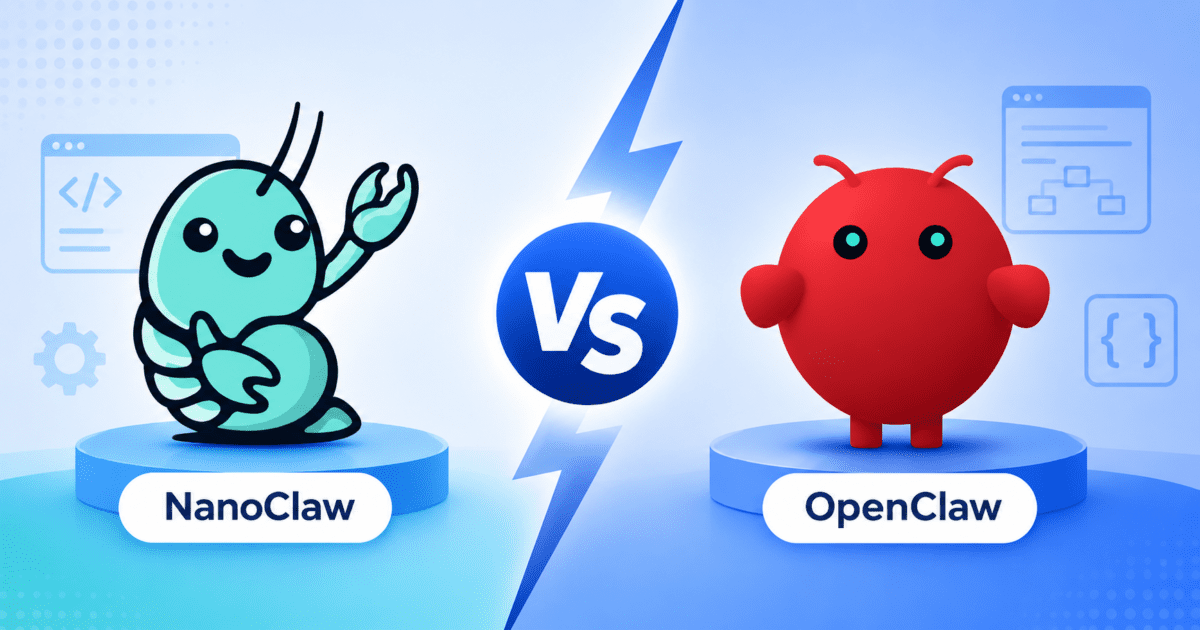
Key highlights
- Discover the core differences between NanoClaw’s lightweight design and OpenClaw’s robust architecture.
- Learn which framework is better suited for rapid prototyping versus production-grade applications.
- Compare NanoClaw and OpenClaw on performance, scalability, ease of use and AI integration.
- Understand the ideal use cases for each platform to make a more informed decision for your next project.
- Explore why Bluehost VPS hosting is the optimal environment for deploying powerful OpenClaw applications.
The framework you choose today will either accelerate your growth or quietly become your biggest technical liability. Getting that decision right from the start saves you time, money and a painful rebuild down the road.
NanoClaw and OpenClaw are two frameworks built for very different goals. NanoClaw prioritizes simplicity and speed, making it ideal for rapid prototyping and lightweight projects. OpenClaw, on the other hand, is engineered for production-grade performance, distributed workloads and seamless AI integration.
This guide breaks down exactly where each framework excels, where it falls short and which one deserves a place in your next project
What is NanoClaw?
NanoClaw is a lightweight development framework designed for rapid prototyping and small-scale applications. It focuses on simplicity and minimal overhead, making it an excellent choice for developers who need to get a project up and running quickly. Its core philosophy is to provide essential tools without imposing a rigid structure, giving developers maximum flexibility.
The framework is often favored by hobbyists and freelancers. Its small footprint and straightforward documentation lower the barrier to entry. If your project has a limited scope or you are experimenting with a new idea, NanoClaw provides the agility you need. It allows you to build functional applications without a steep learning curve or complex configurations.
Also read: What is NanoClaw? AI Agent Automation on VPS
Understanding NanoClaw’s design helps in seeing how it differs from more comprehensive solutions.
What is OpenClaw?
OpenClaw is a robust and scalable framework built for production-grade applications and AI-driven projects. It offers an extensive set of tools designed for performance, security and long-term maintainability. OpenClaw is engineered to handle complex workflows and large datasets, making it a preferred choice for businesses and technical founders with ambitious goals.
This platform is ideal for tech-savvy users and engineers building sophisticated applications. It provides the power and control needed for custom AI integrations and demanding workloads. With its focus on stability and scalability, OpenClaw supports your project as it grows from a concept to a full-featured service.
Also read: What is OpenClaw AI?
Here’s a side-by-side look at how NanoClaw and OpenClaw compare across the features that matter most.
What are the key differences between NanoClaw and OpenClaw?
When comparing NanoClaw and OpenClaw, it is helpful to see their features side-by-side. Each framework was built with a different primary user in mind. This table highlights the most important distinctions to guide your decision.
| Feature | NanoClaw | OpenClaw |
| Primary use case | Rapid prototyping and small projects | Production-grade and AI applications |
| Performance | Optimized for low-resource environments | Built for high-traffic and heavy workloads |
| Scalability | Limited; best for single-server setups | High; designed for distributed systems |
| Ease of use | Very easy to learn and deploy | Steeper learning curve, more powerful |
| Ecosystem | Minimalist, relies on third-party libraries | Rich ecosystem with integrated tools |
The choice between them depends entirely on your project’s scope and future goals. Deciding which one fits best requires looking at your specific needs.
When should you choose NanoClaw?
NanoClaw is the perfect choice for specific types of projects. If you are a student, a hobbyist or a freelancer working on a personal blog or a small portfolio site, its simplicity is a major advantage. The framework allows you to launch quickly without getting bogged down in complex configurations. Its minimal resource requirements also make it suitable for low-cost hosting environments.
It also excels in situations where you need to validate an idea rapidly. For proof-of-concept applications or internal tools with a limited user base, NanoClaw provides just enough functionality to get the job done. While OpenClaw is more powerful, its extensive features can be overkill for these smaller-scale scenarios. NanoClaw’s primary limitation is its scalability, which makes it less ideal for projects you expect to grow significantly.
If your project demands more power and room to grow, you may need a different solution.
When should you choose OpenClaw?
OpenClaw is the clear winner for teams that want to move beyond AI experimentation and build AI they actually own. If you are a technical founder or an engineer building internal AI tools, automated workflows or AI-powered services, OpenClaw provides the stable, self-hosted foundation you need. Its architecture is designed for high availability and performance under pressure, ensuring your application remains responsive as your workload grows.
The framework’s AI orchestration and workflow capabilities are key differentiators. OpenClaw lets you build and run private AI agents, create reusable prompt pipelines and connect AI directly to your internal tools and APIs, without sending sensitive data to external SaaS platforms. This makes it the superior choice for any team that needs AI embedded into their operations, not just bolted on top.
Once you have chosen OpenClaw for its scalability and infrastructure control, the next step is selecting a hosting environment that can fully support those advantages.
Why choose Bluehost for OpenClaw hosting?
Our VPS plans give you dedicated resources, NVMe storage and full root access to run your AI workflows reliably in production. Whether you are running a lightweight personal agent or building a full-scale AI automation system, we have a hosting plan built for it.
From solo builders deploying NanoClaw to technical teams operationalizing OpenClaw, here is how our self-managed VPS supports both.
NanoClaw on Bluehost VPS
NanoClaw is designed to run continuously, but a local machine was never built for always-on AI agents. Our VPS gives NanoClaw a stable, persistent runtime that stays online 24/7, keeping your messaging workflows, scheduled tasks and agent processes running without interruption. With full root access, you can customize containers, channels and model providers exactly the way your stack requires.
NanoClaw runs each agent group in isolated Docker containers and our infrastructure maintains that isolation with a dedicated, container-friendly environment. As your workload grows, you can scale vertically across our VPS tiers without replatforming.
Also read: How to Set Up NanoClaw on a VPS with Docker – Complete Guide
OpenClaw on Bluehost VPS
OpenClaw is built for technical operators who want to move from AI experimentation to systems they fully own and control. Our VPS gives it the dedicated infrastructure to run as a reliable AI automation layer inside your organization, with NVMe storage and unmetered bandwidth keeping your performance consistent under real workloads.
For teams running n8n alongside OpenClaw, our VPS lets you deploy both on the same infrastructure, giving you a fully owned automation and AI stack.
If you need a lightweight, always-on personal agent with a runtime you can audit and customize, NanoClaw on Bluehost VPS is the right fit. If you are operationalizing AI at a team level with agents, prompt pipelines and deep workflow integrations, OpenClaw is built for your workload. Pick the one that matches your use case and deploy on our self-managed VPS with dedicated resources from day one.
Final thoughts
Both NanoClaw and OpenClaw are valuable tools, but they serve different purposes. NanoClaw is an excellent choice for small, quick projects where speed of development is the top priority. Its simplicity makes it accessible and efficient for prototypes and personal sites. It fills an important niche for developers who value minimalism and flexibility.
However, for any serious business application, AI-driven service or high-traffic website, OpenClaw is the more strategic choice. Its robust architecture, scalability and seamless AI integrations provide the foundation needed for long-term growth and stability. When paired with a powerful hosting solution like Bluehost VPS, OpenClaw unlocks its full potential.
Ready to build a powerful, scalable application? Explore Bluehost high-performance VPS hosting plans to get dedicated resources, root access and the expert support you need to succeed.
FAQs
NanoClaw is a lightweight framework built for rapid prototyping and small projects, while OpenClaw is a robust, scalable solution designed for production-grade and AI-driven applications. Your choice depends on your project’s scope, complexity and long-term growth expectations.
Yes, both frameworks can be hosted on Bluehost. If you are running NanoClaw, our shared or starter plans work well. For OpenClaw, our VPS and Dedicated Hosting plans give your project the dedicated resources, NVMe storage and 24/7 expert support it needs to thrive.
If your project relies heavily on AI models, automation or production workloads, OpenClaw is the better choice because it offers a more robust architecture and easier AI integration. NanoClaw is better suited for experimenting with ideas or building smaller applications where simplicity is the priority.
NanoClaw is generally easier for beginners due to its lightweight design, straightforward setup and lower learning curve. OpenClaw offers more advanced capabilities but requires additional configuration and is better suited for experienced developers building larger applications.
For long-term projects, OpenClaw is the better option. Its architecture is designed to support higher traffic, distributed workloads and complex AI integrations, making it a stronger choice for business applications and growing platforms. NanoClaw is better suited for prototypes, personal projects and applications with limited scalability requirements.

Write A Comment