 ChatGPT,
 Claude,
 Gemini,
 Grok — all four for

Key highlights
- Discover the origins and core philosophies of AlmaLinux and Rocky Linux.
- Compare the key differences in sponsorship, governance and community support.
- Understand which Linux distribution best suits your VPS hosting priorities.
- Explore our Self-Managed VPS options for AlmaLinux and Rocky Linux.
Choosing the right operating system is one of the most important decisions when setting up a Virtual Private Server (VPS). For years CentOS was the go-to choice for developers and businesses. Now two new leaders have emerged to fill its shoes: AlmaLinux and Rocky Linux. Both are stable, secure and based on Red Hat Enterprise Linux (RHEL).
This guide compares AlmaLinux and Rocky Linux head-to-head. We will explore their origins, support models and key differences. By the end you will have a clear understanding of which OS is the best fit for your VPS hosting needs.
Both AlmaLinux and Rocky Linux are free, enterprise-grade Linux distributions that maintain compatibility with Red Hat Enterprise Linux (RHEL). From a performance and stability perspective, they’re nearly identical. The biggest differences lie in their governance, project backing, community philosophy and release approach.
What is AlmaLinux?
AlmaLinux is a free, enterprise Linux distribution designed to maintain compatibility with Red Hat Enterprise Linux (RHEL). It provides a stable platform for production workloads while following the AlmaLinux project’s current compatibility model. The project is backed by a non-profit foundation ensuring it remains free and community-governed forever. It focuses on providing a stable and secure platform for production workloads.
Because of its strong corporate backing and commitment to long-term support, AlmaLinux quickly became a trusted choice for businesses. It offers a reliable alternative for former CentOS users. For a deeper dive into its architecture and features, consider reading our guide on AlmaLinux VPS explained. This makes it a solid foundation for any VPS environment.
Now let’s look at its main alternative and how it came to be.
What is Rocky Linux?
Rocky Linux, another free enterprise-grade operating system was founded by Gregory Kurtzer, the original creator of CentOS. His goal was to create a true community-driven successor after Red Hat shifted the focus of the CentOS project. Like AlmaLinux, it is also a bug-for-bug compatible fork of RHEL.
The project is managed by the Rocky Enterprise Software Foundation (RESF). It emphasizes transparency and community involvement in its development process. This focus has attracted a large and active user base. Many see it as the spiritual successor to the original CentOS.
With both distributions having similar technical foundations, let’s explore their key differences.
AlmaLinux vs Rocky Linux: What’s the difference?
While AlmaLinux and Rocky Linux are very similar, they have some key differences in their backing, governance and support models. Both are excellent choices for a VPS, but understanding these distinctions can help you pick the right one for your specific needs.
For a more comprehensive look, review our VPS operating system comparison.
Here is a direct comparison of their most important features.
| Feature | AlmaLinux | Rocky Linux |
| RHEL compatibility | 1:1 binary compatible | Bug-for-bug compatible |
| Governance | AlmaLinux OS Foundation | Rocky Enterprise Software Foundation |
| Enterprise backing | CloudLinux-backed foundation | Community-led with CIQ sponsorship |
| Support lifecycle | 10 years | 10 years |
| Security updates | Rapid RHEL-aligned updates | Rapid RHEL-aligned updates |
Both operating systems are nearly identical from a technical standpoint. The choice often comes down to which project’s philosophy you prefer. A corporate-backed foundation or a community-led project.
1. RHEL compatibility
Both AlmaLinux and Rocky Linux are designed to maintain compatibility with Red Hat Enterprise Linux (RHEL). AlmaLinux follows a 1:1 binary compatible approach, while Rocky Linux describes itself as bug-for-bug compatible. In practice, both aim to provide the same application compatibility and enterprise-grade stability as RHEL.
Verdict: Both distributions are equally reliable for running RHEL-compatible workloads on a VPS.
2. Governance
AlmaLinux is governed by the AlmaLinux OS Foundation, an independent nonprofit organization that oversees the project’s direction. Rocky Linux is managed by the Rocky Enterprise Software Foundation (RESF), with a strong emphasis on community participation and transparent decision-making.
Verdict: Choose AlmaLinux if you prefer a foundation-backed governance model. Choose Rocky Linux if you value a community-first development approach.
3. Enterprise backing
AlmaLinux originated with CloudLinux and continues to benefit from enterprise sponsorship while remaining community governed. Rocky Linux receives support from CIQ and other contributors but positions itself as a community-led project inspired by the original CentOS philosophy.
Verdict: AlmaLinux may appeal more to businesses seeking established enterprise backing, while Rocky Linux is a strong choice for developers who prioritize community leadership.
4. Support lifecycle
Both AlmaLinux and Rocky Linux provide a 10-year support lifecycle for each major release, closely matching RHEL. This gives businesses and developers confidence that they’ll receive updates and maintenance without frequent operating system upgrades.
Verdict: There’s no meaningful difference here. Both are excellent choices for long-term production environments.
5. Security updates
Both projects closely follow RHEL security releases and publish patches quickly to help keep systems secure. Their commitment to timely security updates makes them suitable for hosting production websites, applications, and business workloads.
Verdict: Both distributions offer strong security update practices, making this category effectively a tie.
This comparison should help you decide which OS is a better fit for you.
Should you choose AlmaLinux or Rocky Linux for VPS hosting?
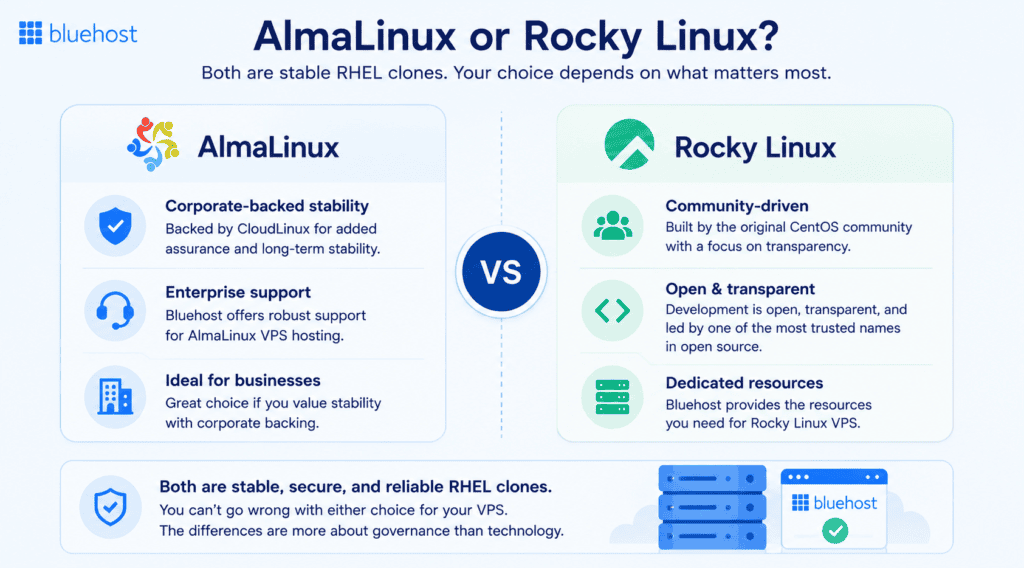
Choosing between AlmaLinux and Rocky Linux depends on your priorities. If you value the stability that comes with corporate backing, then AlmaLinux is an excellent choice. Its connection to CloudLinux provides a level of assurance that many businesses find appealing. If you’re planning on setting up AlmaLinux, Bluehost offers robust support.
On the other hand, if you prefer a project driven by the original CentOS community spirit, Rocky Linux is a great option. Its development process is transparent and led by one of the most trusted names in the open-source world. For those considering deploying Rocky Linux, Bluehost also provides dedicated resources.
Ultimately, both are stable, secure and reliable RHEL clones. You cannot go wrong with either choice for your VPS. The differences are more about governance than technology.
Now let’s explore how Bluehost supports your choice of Linux VPS.
Why choose Bluehost VPS for AlmaLinux or Rocky Linux?
Bluehost empowers you to build your ideal server environment with Self-Managed VPS hosting. We offer multiple versions of both AlmaLinux and Rocky Linux, so you can choose the operating system that best fits your needs. Our plans give you full control over your server with root access and powerful hardware.
All our VPS plans include fast NVMe storage and the industry-leading cPanel control panel. However, our Self-Managed VPS plans do require technical expertise to manage. For users who want expert help, we offer Managed VPS plans that include 24/7 human support. This ensures you have the power you need with the support you can trust.
With these options, you can confidently manage your hosting environment.
What are our final thoughts?
Both AlmaLinux and Rocky Linux are outstanding choices for VPS hosting. They provide the stability and security that CentOS users came to expect. Your decision will likely come down to whether you prefer the corporate-backed model of AlmaLinux or the community-driven approach of Rocky Linux.
Since their technical foundations are nearly identical, the risk of choosing one over the other is very low. You can confidently build a powerful and reliable website on either platform.
Ready to build your ideal server? Choose your OS and get started with a Bluehost Self-Managed VPS plan today.
FAQs
AlmaLinux is a free, open-source enterprise Linux distribution created by CloudLinux. It is a 1:1 binary compatible fork of Red Hat Enterprise Linux (RHEL), offering a stable and secure platform for production workloads on a VPS. It’s backed by a non-profit foundation, ensuring its continued development and support.
Rocky Linux is a free, enterprise-grade operating system founded by Gregory Kurtzer, the original creator of CentOS. It serves as a community-driven successor to CentOS, also being a bug-for-bug compatible fork of RHEL. The Rocky Enterprise Software Foundation (RESF) manages the project, emphasizing transparency and community involvement.
Both AlmaLinux and Rocky Linux are highly similar technically, being RHEL clones. Key differences lie in their backing and governance: AlmaLinux has strong corporate backing from CloudLinux, while Rocky Linux is community-driven and led by the original CentOS founder. Both offer long-term support and timely security updates.
Your choice depends on your preference for project philosophy. If you value corporate stability and backing, AlmaLinux is a strong choice. If you prefer a community-led, grassroots approach, Rocky Linux is ideal. Both provide stable, secure and reliable environments for VPS hosting.

Write A Comment