 ChatGPT,
 Claude,
 Gemini,
 Grok — all four for
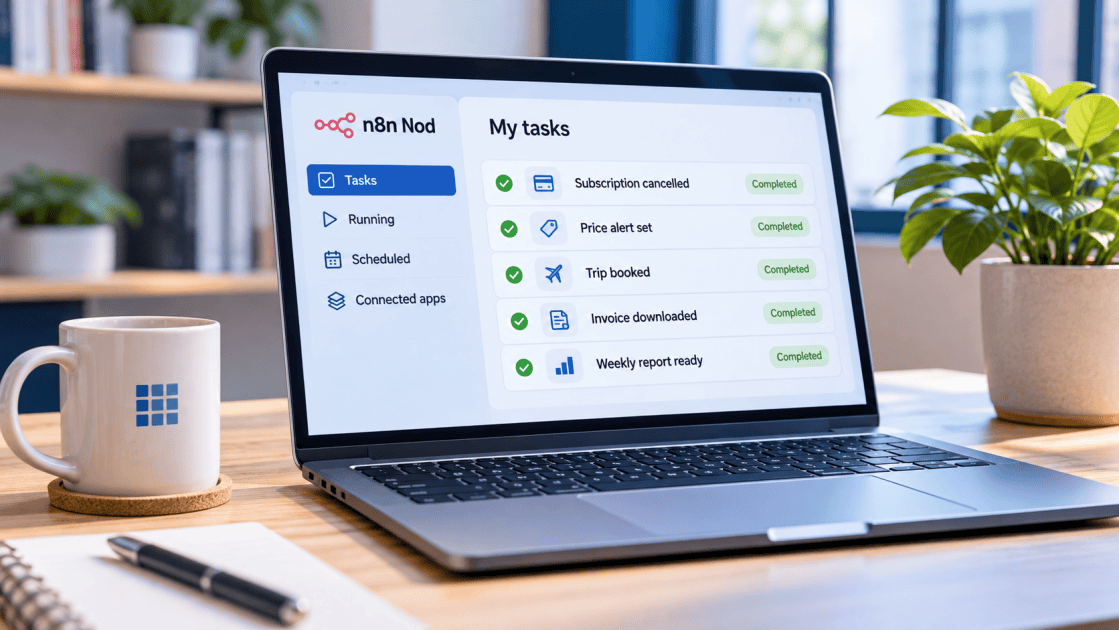
n8n Labs is a new team inside n8n. On November 10, n8n announced Nod, a standalone personal AI agent with its own computer and browser. It is separate from the n8n ai agent that workflow builders already know.
Quick summary
- n8n, the workflow automation company, just released Nod, a personal AI agent built apart from its main product
- Nod is meant for one person’s own errands, not a team’s shared work, a split n8n itself draws clearly
- It runs on its own computer, and n8n lays out exactly how it earns a person’s trust before acting
- n8n also admits where Nod still falls short, rather than selling it as a finished product
- The launch points to a wider shift: AI agents built for a single person are becoming their own category, separate from workplace automation
What Nod actually is
n8n has always been about helping people automate work, and it says that goal has not changed. Nod is a standalone app. It is separate from n8n, and separate from the n8n ai agent that workflow builders can already build inside the platform. There is no server to set up first. You install Nod on a Mac or a Windows machine, connect a handful of accounts and start asking it for things.
For now, a person connects their own AI provider, with an API key or a ChatGPT plan, so Nod suits someone who is already comfortable with that kind of setup.
No n8n account is needed and there is no server or cloud service to set up first. Because it has its own computer, a sandbox that runs locally, and its own browser, it can finish jobs that a chat tool would normally hand back to you as a to do list. n8n Labs is a new team inside the company. It is built to try out ideas outside the core workflow product. Its release notes stress that Nod does not change the direction of that main product.
That framing, one product built around one user, is the clearest way to understand why n8n describes Nod the way it does.
Also read: What Is n8n? The Complete Guide to Self-Hosted Workflow Automation
Single player versus multiplayer
n8n described the split in its own words. A lot of what people build in n8n is multiplayer: processes that a team or a business shares and runs on one n8n instance together. Nod is built for a single player. It is for one person, it connects to that person’s accounts, and it gets their jobs done, whether the job is for their business or their household.
Nod also lives outside n8n. It is a separate app from n8n and from the agents someone can build inside n8n, and no n8n account is needed to use it. When its first testers sat down with the product, many of them landed on the same split without being asked. Their chat assistant is where they think and write, n8n runs their shared processes, and Nod takes the ongoing jobs that are theirs alone.
n8n says Nod is for anyone who wants to hand off the mundane parts of a week: the forms, the follow-ups, the logins, the reminders. Solo operators and freelancers use it for their business, and plenty of people use it for errands at home.
Those personal, ongoing jobs are exactly what n8n built Nod to handle. Its own list of examples makes that concrete.
What Nod is built to do
n8n listed some of the jobs people actually hand to Nod, in its own announcement, and the list reads less like a tech demo and more like a chore list.
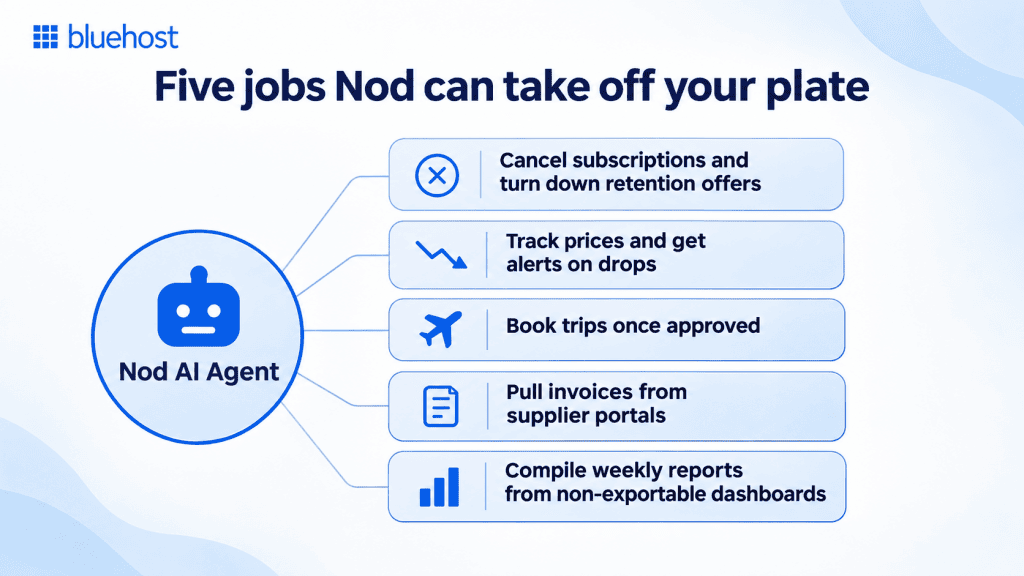
They include:
- Cancel a subscription, turn down the retention offers, and ask for a refund
- Watch a price and get told when it drops
- Find a hotel that fits a trip and book it once you say go
- Sign in to supplier portals each month, download the invoices, and file them for an accountant
- Pull last week’s numbers from a dashboard that has no way to export the data, and put them in a weekly report
None of those need an API. Nod carries its own browser into sites that were never built to talk to an agent. It treats a missing integration as something to work around rather than a wall to stop at.
Nod also works ahead of a person. It reads the apps someone has connected and offers up jobs it could take off their plate. A person talks to it in one conversation, either in the app or on Telegram or WhatsApp, while it runs several jobs in parallel in the background. Jobs that repeat, like a morning brief or a price check, can run on a schedule.
An agent working in the background, on a schedule, with access to an inbox and a calendar, needs real guardrails. n8n lays out exactly how Nod earns that trust.
An agent with your inbox has to earn trust first
An agent that can send email and pay with a saved card has to earn that trust, n8n said in its announcement, and it laid out how Nod is built to be checked:
- The code is open source, under an Apache 2.0 licence, and every rule Nod follows is in that code
- It runs inside a private virtual machine on a person’s own computer, with its own browser, so data, memory and saved logins stay on the machine running it
- A separate check confirms a person actually asked for something. This happens before Nod sends, pays, posts or deletes anything. A web page or an email cannot give Nod orders on its own.
- Saved logins and cards are encrypted on the machine, and Nod enters them through private forms the model cannot read
- Every sign in, card use and action is logged, along with what each task cost
That permission check is itself a model, n8n acknowledged, and it can make mistakes, which is why Nod asks when a person’s words do not cover an action.
Nod is open source and free to run, though a person still pays their model provider for the AI it uses, or they can connect an open source model running on their own computer. Some early testers found tasks cost more than they expected. Cost had been a focus of the recent releases, n8n noted, and the latest one brought it down substantially. On spending, Nod:
- Shows what each task cost, and ends a finished task with a receipt
- Lets a person set a monthly spending limit
- Checks in once a single task passes five dollars, an amount that can be changed
Those guardrails cover what Nod does carefully. They say nothing about what it still cannot do at all.
Where Nod still falls short
n8n was plain about what Nod does not do yet. When Nod is running on a laptop, it stops when the laptop sleeps. Each installation has one owner. It cannot make phone calls.
Some testers already keep Nod on an always on Mac mini, or run it on their own server instead of a laptop. A hosted version of Nod is on the roadmap, though it does not exist yet.
Gaps like that are exactly what n8n says it expects at this stage, and why it is calling Nod an experiment rather than a finished product.
The bottom line on Nod: An experiment, not a product
n8n frames Nod as a research preview, not a finished product. Building and using it taught the team a lot about how AI can take on more of the work people do, and that is why it is releasing Nod now, so more people can try it and point out where it should go next.
Nod is an n8n Labs experiment, and it does not change the direction of n8n itself. Work on n8n and the n8n ai agent that workflow builders already use will continue as planned.
What n8n has put out is narrow and still clear. It has built an AI agent for a person’s own errands. That is separate from the AI agent a team uses for shared work. Now it wants the people trying Nod to help shape what comes next.
Methodology note: This article is based entirely on n8n’s own announcement, “Meet Nod: a standalone personal agent from n8n Labs that runs on your computer”, published November 10, 2026. All facts, figures and quotes are drawn from that source.

Write A Comment