


Key highlights
- Learn the essential types of digital marketing channels and discover which ones align best with your business goals and target audience needs
- Understand how to evaluate and select the right digital marketing services that will maximize your ROI and drive measurable business growth
- Explore proven digital marketing strategies used by successful businesses and gain actionable insights you can implement immediately
- Discover comprehensive digital marketing courses and training resources that will accelerate your expertise and professional development
- Know how to build an integrated digital marketing approach that combines multiple channels for maximum impact and sustainable results
Getting noticed in today’s crowded online marketplace is a challenge every business owner faces. Digital marketing has become the essential solution, offering cost-effective ways to reach global audiences that traditional advertising cannot match. Whether you’re a startup entrepreneur or established business, building your digital presence is no longer optional, it’s critical for success.
What makes digital marketing powerful is its versatility and precision. From social media to email campaigns, you have multiple channels to connect with ideal customers. Data-driven strategies deliver measurable results, allowing you to track ROI with accuracy. This levels the playing field, letting small businesses compete with larger brands through targeted approaches.
This guide explores the various types of digital marketing and reveals the most effective methods to achieve your business goals.
What is digital marketing?
Digital marketing encompasses all marketing efforts that use electronic devices and the internet to connect with customers. It fundamentally differs from traditional marketing by utilizing online channels, such as websites, social media and email, alongside digital technologies like mobile apps and search engines to engage audiences.
While traditional methods often rely on one-way communication, digital marketing fosters real-time, two-way interaction. This approach allows you to leverage data analytics, gaining immediate insights into customer behavior to refine your strategies continuously.
The evolution from static advertising to interactive engagement has transformed business growth. Traditional marketing typically involves broad exposure with higher entry costs and less precision. In contrast, digital marketing provides precise targeting and lower costs.
For example, instead of billboard ads, businesses now reach customers through social media posts and search engine results. This shift enables businesses of all sizes to build meaningful customer relationships online, ensuring that even small brands can compete effectively in the global marketplace.
Want to put these strategies into action? Watch our master class, Boost Your Brand with Digital Marketing Strategies for WordPress and learn how to turn traffic into real growth.
How does digital marketing work?
Regardless of the specific types of digital marketing you choose, the fundamental mechanism works by leveraging data to connect with your ideal audience. The process begins with identifying target customers through analytics, creating relevant content and distributing it across appropriate digital channels. You then engage users on these interactive platforms and measure results to optimize your digital marketing strategies.
For example, a small business owner creates a WordPress website and optimizes it for search engines. They share content on social media, collect email subscribers and track which efforts generate sales. This integrated approach uses customer data to personalize experiences, showing that effective marketing is accessible even without extensive technical knowledge.
Ready to move from learning to execution? Explore how Bluehost Professional Digital Marketing helps businesses turn digital insights into measurable results.
The benefits of digital marketing
- Cost-effectiveness: Digital campaigns typically cost significantly less than traditional advertising while reaching more people. This efficiency allows you to maximize your budget and achieve a higher ROI compared to print or broadcast media.
- Measurable results: Unlike traditional methods, you can track ROI, conversion rates and customer behavior in real-time. This transparency helps you identify exactly which digital marketing strategies are driving growth.
- Targeted precision: You can reach specific demographics, interests and behaviors with pinpoint accuracy. This ensures your message connects with the exact audience looking for your digital marketing services or products.
- Global reach: Digital channels eliminate physical barriers, allowing you to connect with international audiences instantly and expand your market presence beyond local limitations.
- Level playing field: Small businesses can compete effectively with larger competitors. By mastering different types of digital marketing, you can outmaneuver big brands through creativity and agility rather than just budget size.
- Customer engagement: Digital platforms foster two-way communication, enabling you to build lasting relationships and trust through direct interaction with your community.
- Flexibility and agility: You can quickly adjust campaigns based on performance data. If a tactic isn’t working, you can pivot immediately to optimize your results.
To fully capitalize on these benefits, a robust technical foundation is essential. Businesses using comprehensive hosting solutions can better leverage these advantages through reliable website performance and integrated tools, ensuring that the traffic you generate translates into seamless user experiences and conversions.
What are the 12 types of digital marketing?
Navigating the diverse landscape of types of digital marketing is essential for building a robust online presence. Successful digital marketing strategies typically combine multiple methods based on your unique business goals, target audience and resources. The following comparison highlights the core strengths of each approach to help you identify the right mix for your needs.
| Type name | Primary purpose | Best for | Key benefit |
|---|---|---|---|
| Content marketing | Educate and provide value | Building authority | Long-term trust |
| Social media marketing | Build community | Brand awareness | Direct engagement |
| Search engine optimization (SEO) | Increase visibility | Organic traffic | Sustainable growth |
| PPC advertising | Drive immediate traffic | Quick conversions | Precise targeting |
| Email marketing | Nurture relationships | Customer retention | High ROI |
| Video marketing | Engage visually | Storytelling | High information retention |
| Affiliate marketing | Sales via partners | eCommerce growth | Performance-based cost |
| Influencer marketing | Leverage credibility | Niche audiences | Authentic social proof |
| Mobile marketing | Reach mobile users | Local businesses | Location-based targeting |
| Marketing analytics | Measure performance | Decision making | Data-driven insights |
| Marketing automation | Streamline tasks | Scaling efforts | Efficiency and consistency |
| Native advertising | Non-intrusive ads | Brand lift | Seamless user experience |
Understanding these options allows businesses to curate the perfect toolkit for their objectives. Let’s dive deeper into each method to explore its specific benefits, best practices and ideal use cases.
1. Content marketing
Content marketing involves creating and distributing valuable content to attract and engage your target audience. Rather than directly promoting products, you provide helpful information that solves problems and builds trust. Key formats include blog posts, guides, ebooks, infographics and podcasts.
Among the different types of digital marketing, this approach effectively establishes expertise, improves SEO and generates organic traffic. To succeed, identify audience pain points, produce educational content consistently and optimize for search engines.
For example, a web hosting company publishing comprehensive guides on building websites attracts potential customers searching for hosting solutions. Remember that delivering quality content requires reliable web infrastructure for fast loading and a superior user experience. This makes content marketing one of the most effective digital marketing strategies for small businesses to nurture long-term customer relationships.
To go deeper, watch our video on 10 Website Content Creation Strategies to learn how to plan, create and scale content that actually drives results.
2. Search engine optimization (SEO)
Search Engine Optimization (SEO) is a vital type of digital marketing that helps your website rank higher in search results and increases organic visibility. Successful types of digital marketing strategies rely on three core pillars: on-page SEO (content and keywords), off-page SEO (backlinks and authority) and technical SEO (site speed and security).
Most online experiences start with a search, making strong rankings essential for driving traffic to your site. To get results, you need thorough keyword research, high-quality content that answers user questions and a mobile-friendly website design.
SEO delivers long-term credibility and cost-effectiveness compared to paid ads. Strong rankings need a solid technical foundation, which is why we offer full-service SEO solutions paired with reliable hosting.
Our platform ensures the fast load times and high uptime that search engines prioritize for better rankings. We also provide WordPress-optimized hosting that works seamlessly with specialized plugins, making it easier for you to implement critical SEO tactics without technical headaches.
3. Social media marketing
Social media marketing uses platforms like Facebook, Instagram, LinkedIn, Twitter and TikTok to build brand awareness and drive traffic. This essential component of types of digital marketing relies on a dual approach: organic content for community engagement and paid advertising for targeted reach.
You should leverage platform-specific strengths, such as LinkedIn for B2B connections, Instagram for visual brands and TikTok for younger audiences. Success requires you to post consistently, engage with comments and utilize features like Stories or Reels for authentic behind-the-scenes content.
To measure effectiveness, track key metrics including engagement rate, follower growth and click-through rate. As these digital marketing strategies drive traffic to your site, reliable hosting becomes crucial for handling sudden visitor spikes. A fast website ensures you convert social clicks into customers without technical issues.
To learn how to build a strong presence from the ground up, watch our video on How to Build Your Brand on Social Media, including tips on writing an effective social media bio and mastering social media marketing basics.
4. Pay-Per-Click (PPC) advertising
Pay-Per-Click (PPC) advertising is one of the most effective types of digital marketing. It’s a paid model where you pay a fee each time someone clicks your ad. This strategy offers immediate visibility on platforms like Google Ads and social media. You bid on specific keywords to position your ads in search results or feeds.
You only pay when someone actually visits your site. This provides precise targeting and measurable ROI. At Bluehost, our professional digital marketing service helps businesses maximize their PPC campaigns for better results.
Common PPC formats include search ads, display banners, shopping listings and video ads. To succeed with this type of digital marketing, focus on thorough keyword research and compelling ad copy. You must also ensure your landing pages load quickly to maximize conversions.
Regular A/B testing helps you refine your budget and improve results over time. When you combine PPC with organic types of digital marketing strategies, you create comprehensive visibility. Your business can capture both paid and organic traffic simultaneously for maximum reach.
5. Email marketing
Email marketing stands out as one of the most powerful types of digital marketing available today. For every dollar you spend on email marketing, you can generate $36 in return, making it an incredibly cost-effective strategy. This method involves sending targeted messages like newsletters, promotional offers and abandoned cart reminders to nurture customer relationships and drive sales.
Effective email strategies rely on building subscriber lists organically, segmenting audiences for personalization and optimizing subject lines for mobile devices. Key metrics like open rates and click-through rates help you track performance and refine your approach.
At Bluehost, we believe a professional email address is crucial for credibility and deliverability. That’s why our professional email solution ensures your messages reach inboxes instead of spam folders. By maintaining list health and delivering consistent value, small businesses can build lasting loyalty and drive repeat revenue.
To get started the right way, watch our masterclass on Email Marketing Best Practices and learn how to create campaigns that get opened, clicked and converted.
6. Video marketing
Video marketing stands out among types of digital marketing for its ability to build emotional connections and drive engagement. Since social algorithms prioritize video, using formats like product demos, tutorials and short-form Reels can significantly boost your reach. You do not need a professional studio to start; authentic storytelling filmed on a smartphone often resonates best with audiences and builds trust quickly.
To maximize results, optimize videos with captions for sound-off viewing and custom thumbnails. While third-party platforms host your content, embedding videos on your website requires robust hosting infrastructure to ensure smooth performance without slowing down your site. Integrating video into your digital marketing strategies improves information retention and offers versatile content you can repurpose across multiple channels to maximize your return on investment.
7. Affiliate marketing
Affiliate marketing stands out as a performance-based digital marketing approach where businesses pay commissions to partners who promote their products. US affiliate marketing spending crossed $12 billion in 2025, making it one of the most effective types of digital marketing strategies today.
This model creates a win-win ecosystem connecting merchants, affiliates and customers. Affiliates earn income by sharing unique tracking links through their blogs, social media or email lists whenever users purchase through their recommendations.
Bluehost affiliate marketing offers creators and businesses a powerful income opportunity. You can earn between $65 on per qualified hosting sale, with no earnings cap limiting your potential. The program benefits users by providing free access to join, straightforward tracking through Impact and reliable monthly payouts.
With a generous 30-day cookie window, you get credit for purchases made within a month of your referral. Many successful affiliates leverage WordPress sites as their primary content platform. Reliable hosting maintains the uptime and performance needed to maximize conversions and passive income potential from affiliate links.
New to affiliate marketing? Watch our video on Getting Started with Affiliates to learn how to set up, promote and track your affiliate links effectively.
Also read: Affiliate Marketing for Beginners: Start Earning Online in 2025
8. Influencer marketing
Influencer marketing is one of the most effective digital marketing strategies for building trust. It involves partnering with credible individuals to promote your products or services. The landscape ranges from mega-influencers (1M+ followers) down to nano-influencers (1K-10K).
While large numbers look impressive, smaller influencers often deliver superior engagement and authenticity for niche audiences. You can structure these partnerships through sponsored posts, product reviews or affiliate arrangements.
To succeed, identify influencers whose audience matches your target market. Prioritize engagement rates over follower counts and clearly define deliverables. You should track performance using unique discount codes or links to measure results.
Small businesses can start with micro-influencers by offering product exchanges before paid deals. Focus on building long-term relationships rather than one-off promotions to maximize impact and reach.
Want to learn more? Watch our video on What Is Influencer Marketing to see how it works and how to get started.
9. Mobile marketing
Mobile marketing connects you with audiences on smartphones and tablets through optimized websites, apps and SMS campaigns. Since the majority of internet traffic now originates from mobile devices, this approach is critical for modern digital marketing strategies.
Key components include responsive web design that automatically adjusts to screen sizes, location-based geo-targeting and in-app advertising. You can also leverage unique tools like QR codes and push notifications to drive immediate engagement.
To succeed, prioritize mobile-first best practices like fast loading speeds and thumb-friendly navigation. Simplify your forms, use large click-to-call buttons and ensure images are optimized for cellular networks.
Regularly test your website on various devices to guarantee a seamless experience. Remember that effective mobile optimization starts with reliable, fast hosting infrastructure to support growing mobile commerce demands.
10. Marketing analytics and data
Marketing analytics involves collecting and analyzing data to inform strategic decisions, ensuring your success relies on evidence rather than guesswork. You should track metrics across key categories: website analytics, monitoring traffic and conversion rates, social media data tracking engagement and reach and email metrics like open and click rates.
Advertising analytics focus on CPC and ROAS, while customer analytics reveal lifetime value and retention. These insights clarify which types of digital marketing effectively drive growth for your business.
To leverage these insights, utilize tools like Google Analytics and CRM systems to monitor performance. Beginners should start with basic metrics aligned to specific goals, such as setting up conversion tracking to measure sales or leads.
Use this data to identify high-converting channels and underperforming content, allowing you to refine your digital marketing strategies. By consistently testing and optimizing based on real performance data, you turn raw numbers into actionable steps that improve ROI.
11. Marketing automation
Marketing automation uses software to streamline repetitive tasks, enabling you to deliver personalized communication at scale. By establishing workflows triggered by specific user behaviors, such as visiting a pricing page or abandoning a cart, you free yourself to focus on high-level strategy. Essential applications include email drip campaigns, lead nurturing sequences and social media scheduling, which help you maintain consistency and ensure no potential customer slips through the cracks.
For small businesses, this technology is accessible through entry-level tools like Mailchimp and Constant Contact or mid-range solutions like HubSpot. Start by mapping your customer journey and implementing simple automations, such as welcome emails for new subscribers.
As you refine your digital marketing strategies, gradually increase sophistication. Always remember that automation should enhance your ability to connect authentically rather than replace the human element that your audience values.
12. Native advertising and sponsored content
Native advertising is a strategic paid media approach where ads match the look, feel and function of the platform where they appear. Unlike intrusive banner ads, native content, such as sponsored articles, promoted social media posts or recommended widgets, blends seamlessly with organic material to provide genuine value. This method effectively combats ad fatigue and builds brand authority by focusing on helpful storytelling rather than direct sales pitches.
To leverage this, among other types of digital marketing, always clearly disclose sponsored content to maintain reader trust. Focus on creating high-quality, educational material that aligns with the publisher’s audience and tone.
For example, a business might publish a sponsored guide on an industry blog or a promoted LinkedIn post sharing professional insights. When executed well, native advertising enhances the user experience while delivering significantly higher engagement rates than traditional display advertising.
What is a digital marketing strategy?
A digital marketing strategy serves as the comprehensive plan guiding all your online efforts toward specific business goals. While individual tactics like social media and email marketing are vital tools, a solid strategy provides the essential framework connecting them purposefully. Without this roadmap, marketing often becomes a series of scattered, ineffective tasks rather than a cohesive effort to grow your business.
A robust strategy encompasses critical elements including clear business objectives, detailed target audience definition, competitive analysis and deliberate channel selection. It also outlines your content plan, budget allocation, success metrics and timeline.
This documentation prevents wasted resources and ensures your marketing investments drive measurable results. Ideally, your strategy should be documented yet remain flexible enough to evolve based on real-time performance data and market changes.
Creating an effective plan requires understanding the mechanics behind the planning process. To help you succeed, we will examine what a complete strategy looks like, the step-by-step process to build one and the different digital marketing strategies available to match your unique business model.
What does a digital marketing strategy look like?
A robust digital marketing strategy document serves as a concrete roadmap, detailing exactly how you will achieve your business goals. For example, a small eCommerce business targeting a 50% increase in online sales over one year might allocate resources specifically: SEO (30%), social media (25%), email marketing (20%), paid ads (20%) and content creation (5%), with quarterly reviews to optimize performance. Your document should be detailed enough to guide decisions but flexible enough to adapt based on results.
- Strategic foundation: Executive summary of goals, target audience profiles and competitive landscape analysis.
- Tactical execution: Channel strategy, content plan themes and a timeline showing campaigns and milestones.
- Management & measurement: Budget breakdown, success metrics (KPIs) and team responsibilities.
How to build a digital marketing strategy
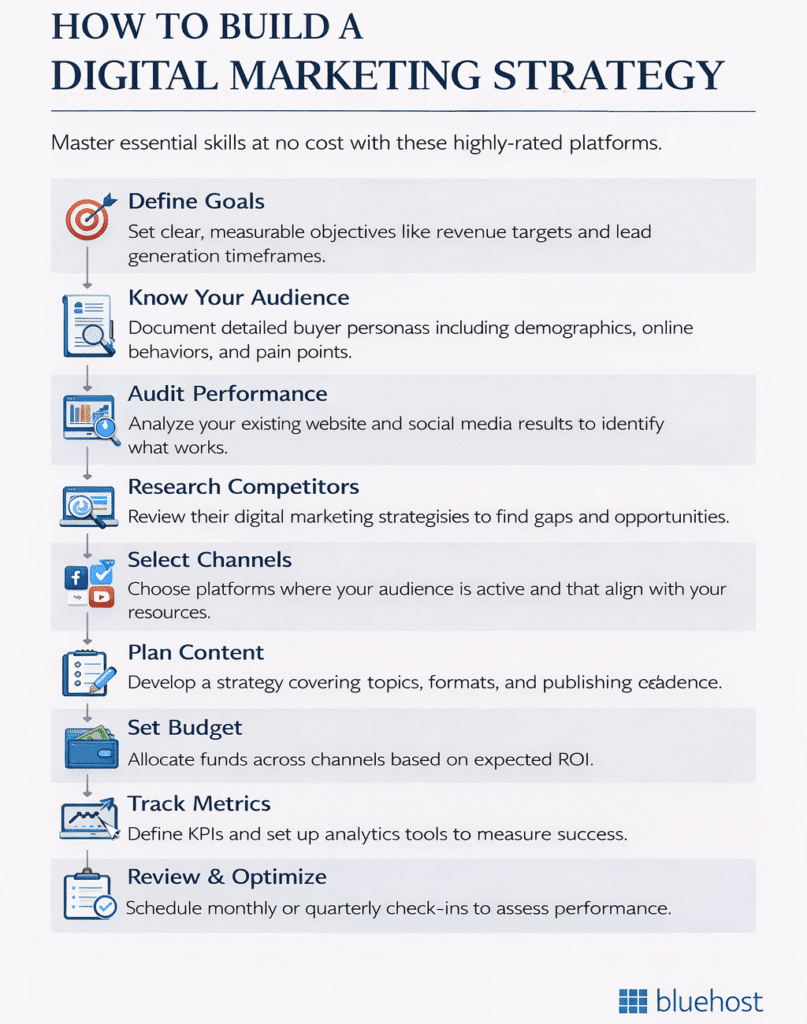
- Define goals: Set clear, measurable objectives like revenue targets and lead generation timeframes.
- Know your audience: Document detailed buyer personas including demographics, online behaviors and pain points.
- Audit performance: Analyze your existing website and social media results to identify what works.
- Research competitors: Review their digital marketing strategies to find gaps and opportunities.
- Select channels: Choose platforms where your audience is active and that align with your resources.
- Plan content: Develop a strategy covering topics, formats and publishing cadence.
- Set budget: Allocate funds across channels based on expected ROI.
- Track metrics: Define KPIs and set up analytics tools to measure success.
- Create timeline: Outline specific campaigns, responsibilities and deadlines in an action plan.
- Review and optimize: Schedule monthly or quarterly check-ins to assess performance.
Building a successful foundation doesn’t require a massive budget, making these steps accessible for small businesses starting from scratch. Focus on thoughtful planning and execution to grow your digital presence effectively.
Types of digital marketing strategies
Selecting effective digital marketing strategies requires aligning your approach with your resources and timelines. Understanding these Types of Digital Marketing helps you identify the best fit for your situation.
- Content-first strategy: Builds authority and suits long-term growth on a limited budget. Ideal for establishing credibility through valuable content creation.
- SEO-focused strategy: Perfect for businesses with longer sales cycles seeking organic traffic. Focuses on search engine optimization to drive sustainable, long-term results.
- Paid acquisition strategy: Delivers immediate visibility when you have advertising funds and need urgent results. Provides quick wins through paid advertising channels.
- Social-first strategy: Thrives with B2C brands targeting younger demographics. Leverages social media platforms to build engagement and community.
- Email-centric strategy: Best for companies with an existing customer base to nurture retention. Focuses on building relationships through targeted email campaigns.
- Multi-channel integration strategy: Maximizes coverage for organizations with ample resources. Combines multiple marketing channels for comprehensive reach.
- Partnership and collaboration strategy: Ideal for those with limited teams who can leverage influencers and partnerships to expand reach without extensive internal resources.
How to do digital marketing: A step-by-step implementation guide
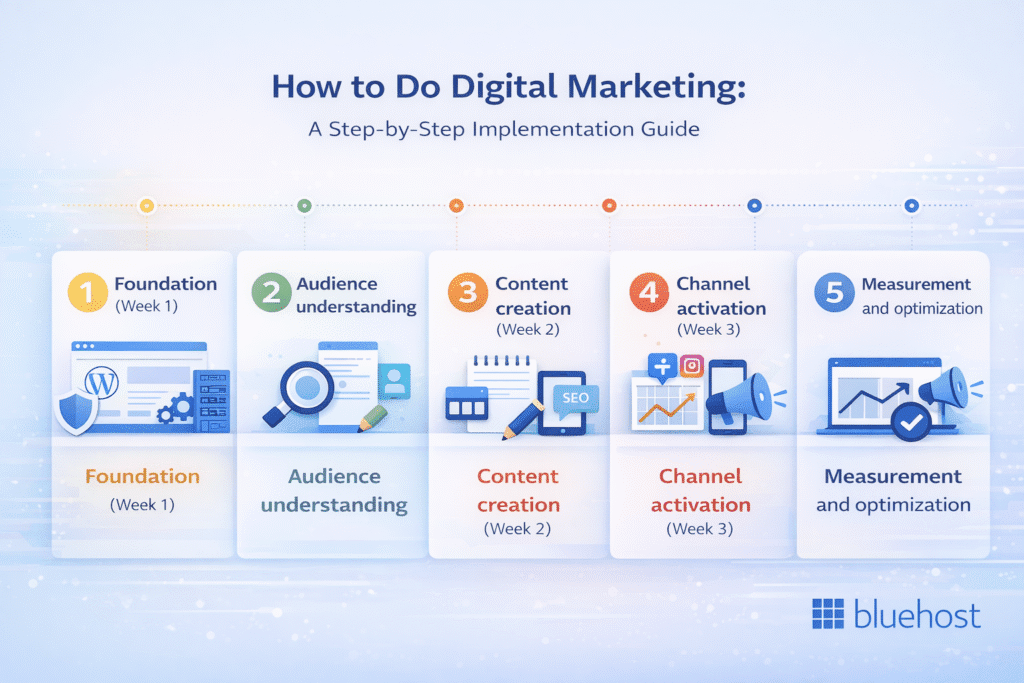
Implementing effective digital marketing strategies requires a structured plan rather than random acts of promotion. Start small to manage resources effectively and scale your efforts based on real performance data. Follow this practical roadmap to launch your campaigns:
- Phase 1: Foundation (Week 1): Establish your digital presence by setting up a professional WordPress website on reliable hosting and installing essential plugins. Secure technical foundations are crucial for future growth.
- Phase 2: Audience understanding: Identify your target customers and research where they spend time online. Create detailed buyer personas based on their specific needs and pain points.
- Phase 3: Content creation (Week 2): Create your first month’s content calendar. Develop valuable, SEO-optimized content that specifically addresses the questions your audience is asking.
- Phase 4: Channel activation (Week 3): Schedule and publish your first posts across 2-3 chosen channels. Focus on consistency and authentic engagement rather than trying to be everywhere.
- Phase 5: Measurement and optimization: Track key metrics to analyze what is working. Double down on successful tactics and adjust underperforming efforts to maximize results.
Remember that even the best digital marketing services rely on solid infrastructure. Ensure you have reliable web hosting, email deliverability and site security in place to support your marketing implementation.
Common challenges in digital marketing (and how to overcome them)
- Generating consistent traffic: Develop a content strategy focused on SEO and patience rather than expecting instant results.
- Limited budget: Prioritize organic channels and high-ROI activities instead of spreading funds too thin.
- Creating engaging content: Streamline the process by researching audience questions and repurposing your best work across various types of digital marketing channels.
- Measuring ROI: Set up proper tracking for business metrics like leads and sales to clarify what works.
- Standing out from competitors: Develop an authentic brand voice that solves specific problems rather than just selling.
- Coping with constant platform changes: Focus on fundamentals rather than chasing every trend.
- Managing time: Use scheduling tools and batch content creation to work more efficiently.
- Website technical issues: Ensure you have reliable hosting and regular backups to maintain the speed and security your audience expects.
The future of digital marketing: Emerging trends and technologies
Understanding what is digital marketing today requires looking ahead at the technologies reshaping the industry. Artificial Intelligence (AI) and machine learning are revolutionizing digital marketing strategies, making advanced tools like personalized chatbots and automated content creation accessible to small businesses.
As privacy regulations tighten, you must pivot toward privacy-first marketing by prioritizing first-party data over third-party cookies. Meanwhile, emerging types of digital marketing like voice search optimization and immersive AR experiences offer exciting new ways to capture attention in a crowded digital space.
Authenticity remains crucial as sustainable, purpose-driven marketing gains importance alongside fast-paced trends like social commerce and video-first content. Platforms now prioritize short-form video and in-app purchasing, creating opportunities for direct engagement.
To adapt without feeling overwhelmed, you might explore digital marketing courses to build skills or partner with digital marketing services for specialized tasks. Start small, perhaps by testing livestream shopping or refining your video SEO and remember that while technology changes, building trust through genuine value remains the ultimate goal.
What are the best digital marketing courses and certifications?
While hands-on experience teaches you a lot, structured digital marketing courses provide the strategic framework needed to scale effectively. You might know the basics, but formal education bridges the gap between guessing and executing proven digital marketing strategies.
Investing in certification builds credibility and gives you the comprehensive knowledge to manage complex campaigns. Whether you are building a career or growing your own business, the right education helps you avoid costly mistakes and accelerates your results.
- Free online courses: These options are perfect for beginners wanting to understand what is digital marketing without financial commitment.
- Comprehensive programs: Paid courses provide deep dives into specific types of digital marketing and often include career mentorship.
- Specialized certifications: Targeted training for skills like SEO or PPC validates your expertise to potential clients.
Most platforms offer self-paced learning, allowing you to upskill while managing your daily operations. By understanding how to oversee digital marketing services or run them yourself, you ensure your marketing budget delivers real value.
Why take a digital marketing course?
Formal education streamlines your path to success by offering a structured learning environment instead of piecing together random information. Digital marketing courses allow career changers, business owners and freelancers to master industry best practices quickly.
You gain comprehensive frameworks that clarify what is digital marketing while avoiding costly beginner mistakes. These programs also validate your skills with credentials that employers trust and provide networking opportunities with fellow learners.
However, courses only provide the roadmap. True success with digital marketing strategies requires consistent practice and real-world application. The most effective learning method combines formal study with hands-on implementation on your own website or project.
This approach helps you understand how various types of digital marketing fit into a broader strategy or prepare you to offer professional digital marketing services. By testing concepts immediately, you move beyond theory to build practical skills that drive real business growth.
Best free online digital marketing courses
- Google Digital Garage: Complete beginner-friendly digital marketing fundamentals with a free, industry-recognized certificate.
- HubSpot Academy: Learn inbound, content, email and SEO marketing with practical, strategy-focused certifications.
- Moz SEO Learning Center: Build a strong SEO foundation covering keywords, on-page optimization and link building.
- Google Analytics Academy: Master website analytics, reporting and user behavior tracking using Google Analytics tools.
- Meta Blueprint: Learn Facebook and Instagram marketing, ads, targeting and campaign optimization from Meta.
- YouTube Creator Academy: Grow YouTube channels with video strategy, optimization, audience growth and monetization lessons.
- Coursera (Audit Mode): Access university-level digital marketing courses for free from Google, Meta and top institutions.
Final thoughts
Understanding what is digital marketing effectively is less about having a massive budget and more about executing a smart strategy. While the diverse types of digital marketing available today can seem overwhelming, success comes from choosing the right mix of tactics. You do not need to master every channel immediately. Thousands of small businesses have built massive audiences by starting with limited resources and scaling gradually. Whether you are self-taught or exploring digital marketing courses, the key is to begin with a solid foundation.
Follow this roadmap to launch your efforts:
- Establish your foundation: Build a professional website on reliable hosting.
- Select your channels: Focus on 2-3 digital marketing services or platforms where your audience is active.
- Create consistently: Publish valuable content that solves user problems.
- Optimize: Use data to refine your digital marketing strategies over time.
Your marketing campaigns are only as effective as the website they drive traffic to. Ensure your site delivers the speed, security and uptime necessary to convert visitors into customers. Get started with reliable web hosting services today to build the scalable infrastructure your business deserves.
FAQs
Focus on 2-3 channels where your target audience is most active. Effective digital marketing strategies typically mix SEO, social media and email marketing to build a presence without overwhelming limited resources.
Costs range from $0 for DIY organic strategies to thousands monthly for paid campaigns. Small businesses can effectively start with a $500-1000 monthly budget to cover essential tools and advertising.
Paid advertising generates immediate traffic while organic strategies like SEO and content marketing typically show meaningful results in 3-6 months. Consistent effort is vital for long-term success.
Yes, a website serves as your digital home base where you control the experience and own customer data. It remains essential even when using social media platforms extensively.
Small businesses can effectively handle marketing in-house using free tools. Agencies offer specific digital marketing services and expertise for businesses ready to scale quickly.
What is digital marketing if not meeting customers where they spend time online? It encompasses all marketing efforts using electronic devices and the internet to connect with audiences.
Common types of digital marketing include search engine optimization (SEO), content marketing, social media and email marketing. Successful brands often combine these methods for broader reach.
Formal degrees are not required but digital marketing courses can accelerate your learning. Many professionals start with free online resources before pursuing specific certifications.

Write A Comment