 ChatGPT,
 Claude,
 Gemini,
 Grok — all four for
Key highlights
- Learn the essential types of digital marketing channels and discover which ones align best with your business goals and target audience needs.
- Understand how to evaluate and select the right digital marketing services that will maximize your ROI and drive measurable business growth.
- Explore proven digital marketing strategies used by successful businesses and gain actionable insights you can implement immediately.
- Discover Bluehost Professional Digital Marketing services to help improve online visibility, attract qualified traffic and support measurable business growth.
Standing out in today’s crowded online marketplace is a major challenge for every business owner. Fortunately, learning about the different types of digital marketing provides a practical solution, offering cost-effective ways to connect with global audiences in ways traditional advertising cannot match. Whether you are a new startup or an established company, building your online presence is critical for long-term success.
The power of online promotion lies in its versatility and precision. From social media to email campaigns, you have multiple channels to connect with your ideal customers. These data-driven strategies deliver measurable results, letting you track your return on investment with accuracy. Using targeted approaches allows small businesses to compete directly with larger brands.
Our guide explores these diverse online strategies and reveals the most effective methods to achieve your unique business goals.
What is digital marketing?
Digital marketing is the practice of promoting products, services or brands through electronic devices and the internet. Unlike traditional marketing methods, it relies on online channels to reach audiences where they already spend their time. Understanding the different types of digital marketing helps you connect with potential customers and grow your business online.
Regardless of the specific types of digital marketing you choose, the fundamental mechanism works by leveraging data to connect with your ideal audience. The process begins with identifying target customers through analytics, creating relevant content and distributing it across appropriate digital channels. You then engage users on these interactive platforms and measure results to optimize your digital marketing strategies.
Ready to move from learning to execution? Explore how Bluehost Professional Digital Marketing helps businesses turn digital insights into
What are the benefits of digital marketing?
Over 5 billion people use the internet every day, yet most businesses still struggle to reach the right audience at the right time. Marketing is not a single tactic but a broad set of methods, from SEO (Search Engine Optimization) and content marketing to paid advertising, email and social media, each working differently and delivering different results depending on how and where you apply it.
- Cost-effective brand reach: Unlike traditional print or television advertising, different types of digital marketing let you reach a massive audience on a modest budget.
- Measurable ROI: Real-time analytics tools show you exactly how much revenue each campaign generates.
- Precise audience targeting: You can filter your audience by demographics, interests and online behavior.
- Global brand visibility: An online presence removes geographical barriers, allowing a small local shop to sell to customers worldwide.
- Rapid campaign adjustments: Digital platforms provide immediate performance data, so you can change underperforming ads or shift budgets instantly.
- Stronger customer engagement: Interactive channels like social media, email and blog comments encourage two-way communication.
Also read: 8 Key Benefits of Digital Marketing for Small Businesses in 2026
Quick comparison of the different types of digital marketing
Not every type of digital marketing serves the same purpose. Some channels, like SEO and content marketing, focus on long-term growth, while others, such as PPC advertising, deliver immediate visibility and faster results. The table below provides a quick comparison of the 12 most common types of digital marketing, including their primary purpose, ideal use cases and the metrics used to measure success.
| Digital marketing type | Primary purpose | Best for | Time to results | Key success metric |
|---|---|---|---|---|
| Search Engine Optimization (SEO) | Improve organic search visibility | Long-term traffic and brand authority | Long-term | Organic traffic, keyword rankings |
| Content Marketing | Educate and engage your audience | Building trust and generating leads | Long-term | Traffic, engagement, leads |
| Social Media Marketing | Build brand awareness and community | Audience engagement and brand visibility | Short–Medium | Engagement rate, followers, website clicks |
| Pay-Per-Click (PPC) | Drive immediate targeted traffic | Fast leads and sales | Immediate | CTR, conversions, ROAS |
| Email Marketing | Nurture leads and retain customers | Customer retention and repeat purchases | Short | Open rate, CTR, conversions |
| Video Marketing | Explain, educate and entertain | Brand storytelling and product education | Short–Medium | Views, watch time, engagement |
| Affiliate Marketing | Generate sales through partners | eCommerce and SaaS businesses | Medium | Sales, affiliate revenue |
| Influencer Marketing | Build trust through creators | Brand awareness and niche audiences | Short–Medium | Reach, engagement, conversions |
| Mobile Marketing | Reach users on smartphones and tablets | Local businesses and mobile shoppers | Short | Mobile traffic, app installs, SMS engagement |
| Marketing Analytics | Measure campaign performance | Data-driven decision making | Ongoing | ROI, conversion rate, CAC |
| Marketing Automation | Automate repetitive marketing tasks | Scaling lead nurturing and customer journeys | Medium | Lead conversion, workflow performance |
| Native Advertising | Promote content within third-party platforms | Brand awareness and content discovery | Short | Engagement, CTR, brand lift |
While each digital marketing channel offers unique advantages, the most successful businesses combine multiple strategies rather than relying on a single approach. Next, let’s take a closer look at each type of digital marketing and how it can support your business growth.
Different types of digital marketing to grow your business
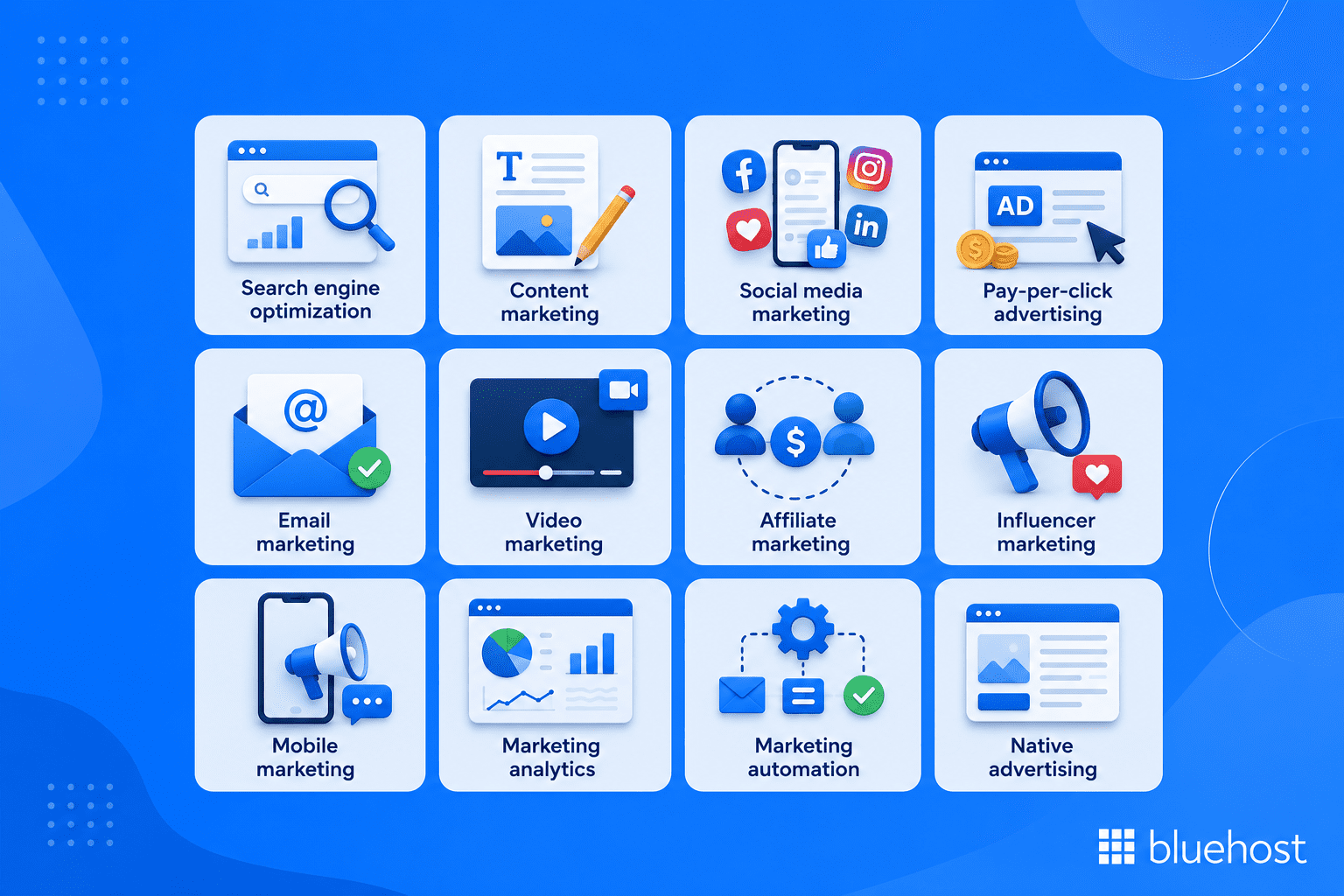
Digital marketing isn’t a one-size-fits-all strategy. Each marketing channel serves a unique purpose, from improving your search rankings and driving website traffic to building customer relationships and increasing sales. The right mix depends on your business goals, target audience and where your customers spend their time online.
1. Search engine optimization
Search Engine Optimization (SEO) is a vital type of digital marketing that helps your website rank higher in search results and increases organic visibility. Successful types of digital marketing strategies rely on three core pillars: on-page SEO (content and keywords), off-page SEO (backlinks and authority) and technical SEO (site speed and security).
Most online experiences start with a search, making strong rankings essential for driving traffic to your site. To get results, you need thorough keyword research, high-quality content that answers user questions and a mobile-friendly website design.
Best for
- Reducing reliance on paid advertising
- Building long-term organic traffic
- Increasing brand visibility and authority
- Generating high-intent leads
Our Professional Digital Marketing Service includes Pro SEO, a managed service that helps your business improve search engine rankings and attract more organic traffic. Our SEO specialists develop a customized strategy using keyword research, on-page optimization, content improvements, link building and performance tracking to support long-term online growth.
Also read: SEO vs Social Media Marketing: What’s the Difference?
2. Content marketing
Content marketing is the practice of creating and sharing valuable, relevant content, such as blog posts, guides, videos, infographics and case studies to attract, engage and retain your target audience. Instead of directly promoting your products or services, content marketing focuses on answering customer questions, solving problems and building trust, making it a powerful long-term strategy for driving organic traffic and generating leads.
Best for
- Building brand authority and trust
- Driving long-term organic traffic
- Educating potential customers
- Supporting SEO and lead generation
Also read: Content Marketing vs SEO: How They Work Together
3. Social media marketing
Social media marketing uses platforms like Facebook, Instagram, LinkedIn, TikTok and X (formerly Twitter) to promote your brand, engage your audience and drive traffic to your website. By sharing valuable content, interacting with followers and running targeted ad campaigns, businesses can increase brand awareness, generate leads and build lasting customer relationships.
Best for
- Increasing customer engagement and loyalty
- Building brand awareness
- Growing an engaged online community
- Driving website traffic
- Promoting products, services and events
Also read: 11 Advantages of Social Media Marketing for Businesses in 2026
4. Pay-per-click advertising
Pay-Per-Click (PPC) advertising is one of the most effective types of digital marketing. It’s a paid model where you pay a fee each time someone clicks your ad. This strategy offers immediate visibility on platforms like Google Ads and social media. You bid on specific keywords to position your ads in search results or feeds.
You only pay when someone actually visits your site. This provides precise targeting and measurable ROI. At Bluehost, our professional digital marketing service helps businesses maximize their PPC campaigns for better results.
Best for
- Driving immediate website traffic
- Generating qualified leads quickly
- Promoting new products, services or seasonal offers
- Targeting high-intent customers
- Increasing conversions with measurable results
Bluehost Professional Digital Marketing service includes Pro PPC, a fully managed pay-per-click advertising solution designed to help your business reach customers faster through targeted search ads. Our Google Ads-certified specialists create, monitor and optimize your campaigns using strategic keyword targeting, AI-powered bid optimization, custom ad creation and ongoing performance reviews to maximize your advertising budget and generate qualified leads.
Also read: SEO vs PPC: Which Drives Better ROI for Your Business
5. Email marketing
Email marketing stands out as one of the most powerful types of digital marketing available today. For every dollar you spend on email marketing, you can generate $36 in return, making it an incredibly cost-effective strategy. This method involves sending targeted messages like newsletters, promotional offers and abandoned cart reminders to nurture customer relationships and drive sales.
Effective email strategies rely on building subscriber lists organically, segmenting audiences for personalization and optimizing subject lines for mobile devices. Key metrics like open rates and click-through rates help you track performance and refine your approach.
Best for
- Nurturing leads throughout the buyer’s journey
- Building long-term customer relationships
- Promoting products, services and special offers
- Increasing customer retention and repeat sales
- Driving website traffic and conversions
Also read: How To Start Email Marketing the Easy Way
6. Video marketing
Video marketing stands out among types of digital marketing for its ability to build emotional connections and drive engagement. Since social algorithms prioritize video, using formats like product demos, tutorials and short-form Reels can significantly boost your reach. You do not need a professional studio to start; authentic storytelling filmed on a smartphone often resonates best with audiences and builds trust quickly.
Best for
- Driving website traffic and conversions
- Increasing brand awareness
- Demonstrating products or services
- Building customer trust and credibility
- Boosting audience engagement
Also read: 30 Best AI Marketing Tools to Grow Your Business in 2026
7. Affiliate marketing
Affiliate marketing continues to be one of the fastest-growing digital marketing channels. According to the Performance Marketing Association’s 2025 Industry Study, U.S. affiliate marketing spending reached $13.62 billion in 2024, generating $113 billion in eCommerce sales. This growth highlights the increasing importance of affiliate partnerships as a performance-driven marketing strategy.
This model creates a win-win ecosystem connecting merchants, affiliates and customers. Affiliates earn income by sharing unique tracking links through their blogs, social media or email lists whenever users purchase through their recommendations.
Best for
- Expanding brand reach through trusted partners
- Driving sales and qualified leads
- Increasing revenue with performance-based marketing
- Growing eCommerce businesses
- Building long-term partnerships with creators and publishers
Also read: Affiliate Marketing on Social Media: Choose the Best Platforms for Success
8. Influencer marketing
Influencer marketing is a digital marketing strategy where businesses collaborate with content creators and industry experts to promote their products or services. Influencers have established trust with their audiences, making their recommendations more authentic and persuasive than traditional advertising. Depending on your goals, you can partner with nano-, micro-, macro- or celebrity influencers to increase brand awareness, drive engagement and boost sales.
According to Influencer Marketing Hub’s 2025 Benchmark Report, the global influencer marketing industry is projected to reach $32.55 billion in 2025, reflecting its continued growth as brands invest more in creator-led campaigns.
Best for
- Driving website traffic and sales
- Increasing brand awareness
- Building trust and credibility
- Reaching niche audiences
- Promoting product launches
Also read: The Ultimate Guide to Influencer Marketing: Strategies for Success
9. Mobile marketing
Mobile marketing is a digital marketing strategy that targets users on smartphones and tablets through channels such as SMS, mobile apps, push notifications, responsive websites and location-based advertising. With most consumers using mobile devices to browse, shop and search for local businesses, optimizing your marketing for mobile is essential to delivering a seamless customer experience.
According to Statista, mobile devices accounted for around 63% of global website traffic in the first quarter of 2025, making mobile optimization a critical component of any digital marketing strategy.
Best for
- Improving the mobile shopping experience
- Reaching customers on the go
- Driving local traffic and in-store visits
- Increasing app downloads and engagement
- Delivering personalized, location-based promotions
Also read: Marketing Video Maker: How to Grow Your Brand in 2026
10. Marketing analytics
Marketing analytics is the process of collecting, measuring and analyzing data from your digital marketing campaigns to understand what’s working and where improvements are needed. By tracking key metrics such as website traffic, conversions, customer acquisition cost (CAC) and return on investment (ROI), businesses can make data-driven decisions that improve campaign performance and maximize marketing spend.
Best for
- Measuring campaign performance
- Understanding customer behavior
- Optimizing marketing ROI
- Improving conversion rates
- Making data-driven marketing decisions
11. Marketing automation
Marketing automation uses software to streamline and automate repetitive marketing tasks, such as sending emails, nurturing leads, posting on social media and tracking customer interactions. By automating workflows based on user behavior and preferences, businesses can deliver personalized experiences at scale while saving time and improving marketing efficiency.
According to Salesforce’s State of Marketing report, 78% of marketers say marketing automation is essential to delivering personalized customer experiences across multiple channels.
Best for
- Increasing customer retention and conversions
- Nurturing leads through the sales funnel
- Automating email campaigns and follow-ups
- Personalizing customer experiences
- Improving team efficiency and productivity
Also read: How to Use AI for Affiliate Marketing: 10 Best Tools in 2026
12. Native advertising
Native advertising is a form of paid media where promotional content matches the look, feel and function of the platform on which it appears. Unlike traditional display ads, native ads blend seamlessly into websites, social media feeds and content platforms, making them less disruptive and more engaging for users. Common examples include sponsored articles, recommended content widgets and in-feed social media ads.
Best for
- Improving engagement compared to traditional display ads
- Increasing brand awareness
- Promoting content and thought leadership
- Driving qualified website traffic
- Reaching audiences without disrupting their browsing experience
Choosing the best digital marketing strategies for your small business
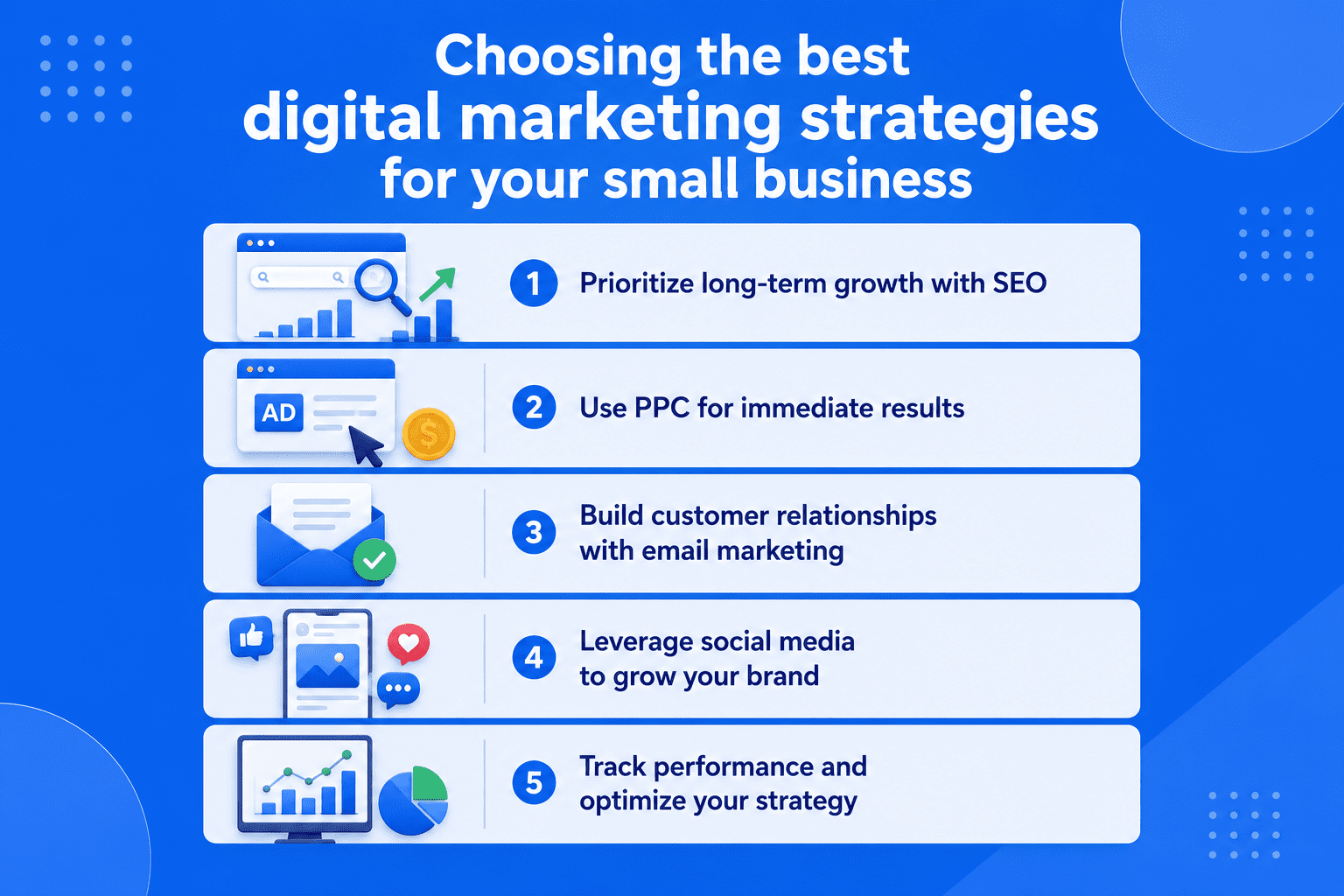
With so many types of digital marketing available, it’s easy to feel overwhelmed. Rather than trying every marketing channel at once, start with a strong foundation and expand your efforts as your business grows.
Use the table below to identify the digital marketing channels that best align with your goals.
| Business goal | Recommended digital marketing types |
|---|---|
| Increase brand awareness | Social media marketing, Video marketing, Influencer marketing |
| Drive long-term organic traffic | Search engine optimization (SEO), Content marketing |
| Generate leads quickly | Pay-per-click (PPC) advertising, Native advertising |
| Build customer loyalty | Email marketing, Marketing automation |
| Increase online sales | SEO, PPC, Email marketing, Affiliate marketing |
| Reach local customers | Local SEO, Mobile marketing, PPC |
| Promote a new product or service | Social media marketing, PPC, Influencer marketing, Video marketing |
| Improve marketing performance | Marketing analytics, Marketing automation |
1. Prioritize long-term growth with SEO
If your goal is to attract consistent, organic traffic, begin with search engine optimization (SEO) and content marketing. Publishing helpful, keyword-optimized content can improve your search rankings, establish your authority and generate qualified leads over time.
2. Use PPC for immediate results
While SEO takes time to build momentum, pay-per-click (PPC) advertising can drive targeted traffic and generate leads almost immediately. PPC is especially effective for promoting new products, seasonal campaigns or time-sensitive offers.
3. Build customer relationships with email marketing
Email marketing helps you stay connected with customers after their first interaction. Regular newsletters, personalized offers and automated follow-ups encourage repeat purchases, improve customer retention and increase lifetime value.
4. Leverage social media to grow your brand
Social media marketing helps you connect with your audience, increase brand awareness and drive traffic to your website. Sharing valuable content and engaging with followers consistently can strengthen customer relationships and build trust over time.
5. Track performance and optimize your strategy
Monitor key performance metrics such as website traffic, conversions, engagement and return on investment (ROI). Using marketing analytics helps you identify what’s working, refine your campaigns and allocate your budget more effectively.
As your business grows, managing multiple marketing channels can become time-consuming. Bluehost Professional Digital Marketing Service gives you access to expert-managed solutions tailored to your goals.
Use Pro SEO to improve organic search rankings and attract long-term traffic, Local SEO to help customers in your area find your business in local search results and Pro PPC to generate immediate visibility and qualified leads through targeted advertising campaigns.
How does Bluehost help simplify marketing for your business?
Beyond WordPress solutions, Bluehost offers professional digital marketing support for businesses that want to improve visibility, attract the right audience and grow online without managing every campaign themselves.
Our Professional Digital Marketing Service includes expert-managed SEO, Local SEO and PPC services built around your business goals. Whether you want to grow long-term organic traffic, appear in local search results or reach customers faster with paid ads, Bluehost specialists help create, launch and optimize strategies that support measurable growth.
Pro SEO
Improve your website’s visibility in organic search results with an expert-managed SEO strategy designed for long-term growth.
- Improve search rankings with keyword research and on-page optimization.
- Increase organic traffic through content improvements and link building.
- Monitor progress with ongoing performance tracking and expert recommendations.
Local SEO
Help local customers find your business by improving your visibility in location-based search results.
- Target customers with geographic keyword optimization.
- Build local authority through citations and high-quality backlinks.
- Increase visibility in your service areas with location-focused SEO.
Pro PPC
Reach potential customers faster with professionally managed pay-per-click advertising campaigns.
- Drive qualified traffic with strategic keyword targeting and custom ads.
- Maximize your advertising budget through AI-powered bid optimization.
- Improve campaign performance with ongoing monitoring and expert management.
By combining expert support with flexible SEO and PPC services, our Professional Digital Marketing service makes it easier to manage digital marketing without needing to become a marketing expert yourself. You get a strategy tailored to your business while staying focused on serving customers and growing your business.
Common digital marketing mistakes to avoid
Even the best digital marketing strategy can fall short if common mistakes go unchecked. Avoiding these pitfalls can help you improve campaign performance, maximize your marketing budget and achieve better long-term results.
1. Trying every channel at once
It’s tempting to be active on every platform, but spreading your resources too thin can reduce the effectiveness of your campaigns. Start with the marketing channels that align with your goals and audience, then expand as your business grows.
2. Not tracking conversions
Measuring clicks and website traffic is important, but tracking conversions, such as purchases, form submissions or newsletter sign-ups, provides a clearer picture of your marketing success. Use analytics tools to monitor performance and optimize campaigns based on real results.
3. Ignoring mobile optimization
With most users browsing and shopping on mobile devices, a slow or poorly designed mobile experience can drive potential customers away. Ensure your website is responsive, easy to navigate and loads quickly across all devices.
4. Sending traffic to slow pages
Whether visitors arrive through SEO, PPC or social media, slow-loading pages can increase bounce rates and reduce conversions. Improve page speed by optimizing images, enabling caching and using reliable website hosting.
5. Publishing content without keyword intent
Creating content without understanding what your audience is searching for can limit your visibility in search results. Conduct keyword research and align your content with search intent to attract relevant traffic and improve SEO performance.
6. Overpromoting instead of educating
Constantly promoting your products or services can reduce audience engagement. Focus on creating helpful, informative content that answers questions, solves problems and builds trust. Educational content is more likely to attract visitors, earn shares and convert readers into loyal customers.
Final thoughts
Understanding the different types of digital marketing is the first step toward building a strategy that delivers measurable results. While each channel offers unique benefits, the most effective marketing strategies combine multiple approaches. The key is to choose the channels that align with your business goals, audience and budget.
As your business expands, managing multiple marketing channels can become increasingly complex. Bluehost Professional Digital Marketing simplifies the process with expert-managed solutions tailored to your goals. Whether you want to improve your organic rankings with Pro SEO, attract nearby customers through Local SEO or generate immediate traffic with Pro PPC, our specialists can help you build a results-driven digital marketing strategy while you focus on running your business.
Ready to take your digital marketing to the next level? Explore Bluehost Professional Digital Marketing Services to access expert-managed Pro SEO, Local SEO and Pro PPC services designed to improve your online visibility and attract qualified traffic.
FAQs
The main types of digital marketing include SEO, content marketing, social media marketing, PPC advertising, email marketing, video marketing, affiliate marketing, influencer marketing, mobile marketing, marketing analytics, marketing automation and native advertising.
The best type depends on your business goals. SEO and content marketing are best for long-term growth, PPC is best for immediate traffic, social media is best for brand awareness and email marketing is best for customer retention.
SEO, content marketing and email marketing are typically the most cost-effective because they can generate long-term results without requiring continuous ad spend.
SEO is better for long-term organic growth, while PPC is better for fast visibility and immediate leads. Many businesses use both together for stronger results.
Email marketing often delivers one of the highest ROI rates because it targets people who have already shown interest in your business. SEO can also deliver strong long-term ROI once rankings improve.
Most small businesses should start with two to four channels, such as SEO, content marketing, email marketing and social media. As the business grows, they can expand into PPC, video or influencer marketing.
Beginners should start with a professional website, basic SEO, helpful content and email marketing. These create a strong foundation before investing in more advanced channels like PPC, automation or influencer marketing.

Write A Comment