 ChatGPT,
 Claude,
 Gemini,
 Grok — all four for
Key highlights
- Optimize for AI-driven search engines to maintain visibility in 2026.
- Leverage advanced topical authority to dominate niche affiliate markets.
- Implement user-centric data analytics to refine conversion rate optimization.
- Diversify traffic sources beyond traditional search to protect revenue.
- Prioritize high-quality, E-E-A-T-focused content to build audience trust.
‘A common SEO joke says the best place to hide something online is page two of Google results.’
It’s a classic SEO joke, but there’s a harsh truth behind it. If your blog isn’t ranking on the first page, you need to improve SEO for affiliate marketing.
As a Bluehost affiliate, your success depends on how well your content does in search results. More visibility means more traffic, more clicks and ultimately, more commissions.
But SEO isn’t just about stuffing keywords into your content and hoping for the best. It’s a mix of strategy, optimization and technical know-how.
In this guide, we’ll break down Bluehost affiliate SEO strategies for you. Learn how to rank affiliate blogs and drive organic traffic for affiliates to maximize your earnings.
What is affiliate marketing for SEO?
Affiliate marketing SEO drives organic traffic by optimizing content for search engine rankings, combining keyword targeting and technical quality to reach readers without paid ads.
- Builds trust: High search rankings establish your blog as a credible authority
- Targets intent: Connects with readers during high-intent searches to increase conversions
- Maximizes ROI: Provides a sustainable, long-term traffic channel for independent creators
By aligning your content with high-intent searches, you position your blog as a trusted resource at the exact moment of purchase, making seo affiliate marketing your most effective conversion tool.
Understanding the modern affiliate marketing SEO landscape
Modern SEO rewards genuine helpfulness and E-E-A-T guidelines over technical tricks. To succeed in seo affiliate marketing, you must act as a trusted advisor rather than just a source for clicks.
- Answer real audience questions with honest, experience-led insights
- Use technical SEO, like page speed and structured markup, to ensure a frictionless reader experience
- Build credibility to drive the behavioral signals that reinforce long-term rankings
By prioritizing trust and transparency, you create a self-reinforcing cycle where authority and expertise naturally amplify your search visibility.
Why SEO matters for affiliate marketers?
Unlike paid ads that stop when funding ends, SEO affiliate marketing creates a reliable engine for long-term growth. A single optimized post can drive passive traffic and recurring commissions for years, turning one-time efforts into a scalable income stream.
- High intent: Organic searchers convert better because they are actively seeking solutions and trust organic recommendations.
- Stronger ROI: Search-driven content delivers superior long-term returns compared to paid advertising channels.
- Cumulative growth: Every new post builds site authority, improving rankings across your entire content library over time.
SEO is the essential foundation for sustainable affiliate growth. By investing in quality content once, you benefit from compounding returns as your site’s authority and search visibility strengthen across every published post.
What are the benefits and drawbacks of SEO for affiliate marketing?
SEO and affiliate marketing make a powerful combination, but the results are not immediate. Understanding the realistic trade-offs helps you set expectations and plan your content strategy around what actually compounds over time.
Benefits
- Your content earns passive commissions long after you publish, turning a single optimized post into a recurring revenue asset.
- Organic visitors arrive with high intent, meaning they are actively researching a purchase decision rather than scrolling past an ad.
- Rankings compound as your site builds topical authority, making each new post easier to rank than the last.
- Managing outcomes, like tracking which posts convert, requires far less ongoing spend than managing paid ad budgets.
Drawbacks
- New affiliate blogs typically wait a few months before organic rankings generate meaningful traffic or commissions.
- Algorithm updates can shift rankings without warning, making consistent content quality and guideline compliance non-negotiable.
- Building enough topical authority to compete in established niches demands a sustained publishing cadence before results become visible.
The asymmetry is clear: the investment is front-loaded in time and effort, but the return from seo for affiliates grows without requiring additional cost per click once rankings take hold.
Is SEO for affiliate marketing still worth it?
SEO for affiliate marketing remains a premier channel for driving high-intent traffic. Success in 2026 requires shifting from keyword-stuffing to providing genuine expertise and solving specific user problems.
- Prioritize first-hand experience and honest product comparisons to build trust
- Implement affiliate SEO strategies in 2026 by targeting high-commission niches like web hosting
- Focus on building topical authority as a long-term investment rather than chasing shortcuts
While this approach requires patience, it transforms your blog into a self-sustaining traffic engine that generates consistent commissions around the clock.
Affiliate marketing SEO vs. client SEO
Affiliate SEO shifts the focus from client approvals to total ownership. Unlike service-based SEO, you control the strategy and timelines, directly linking every optimization decision to your own revenue.
- Experiment with conversion-focused layouts and buyer-intent keywords without third-party oversight
- Iterate rapidly on site structure and internal linking to capture market shifts
- Implement affiliate SEO strategies 2026 to build compounding assets that scale over time
By treating affiliate marketing as a publishing business rather than a service, creators build high-value assets. While results require patience, the strategic independence and scalability offer a superior path for long-term growth.
Is PPC or SEO better for affiliate marketing?
| Factor | PPC | SEO |
|---|---|---|
| Cost | Ongoing ad spend required | Free organic traffic once ranked |
| Time to results | Immediate (hours to days) | Gradual (3–6 months typically) |
| Traffic longevity | Stops when budget runs out | Compounds over time |
| Best for | Testing offers quickly | Building sustainable income |
PPC delivers traffic fast, but every click costs money. The moment your budget dries up, your traffic disappears with it. For most affiliate marketers promoting hosting plans or digital products, ad costs can easily outpace commissions before you find a winning formula.
SEO and affiliate marketing, by contrast, work together as a long-term growth engine. The content you optimize today can generate passive traffic and commissions for years. If you are a budget-conscious creator building a Bluehost affiliate blog, SEO for affiliates is the smarter starting point. Focus on ranking intent-driven content first. Once your organic revenue grows, you can layer in PPC to amplify what already converts.
How to combine SEO with SEM?
Think of SEM as a shortcut to smarter SEO. Before investing months in building topical authority, use a brief PPC campaign to validate your keywords. If the traffic converts into commissions, you have proof the keyword is worth the long-term investment; if not, you save months of effort chasing the wrong audience.
- Fast-Track Data: A small budget reveals conversion data months before organic rankings appear
- Proven Winners: Build your content strategy around keywords that are already driving real affiliate commissions
- Strategic Insight: Use PPC performance to refine meta descriptions and identify high-converting user intent for your affiliate SEO strategies in 2026
Integrating SEM and SEO ensures every piece of content you publish for seo for affiliates starts with a measurable advantage. When both channels share performance data, your content ranks for terms that actually convert, leading to faster growth and more focused affiliate earnings.
Keyword research for affiliates
Keyword research is the foundation of SEO. Finding the best keywords helps attract potential customers who are actively searching for hosting solutions.
Tools to use for keyword research
- Google Keyword Planner: This free Google tool helps you find keyword ideas, analyze search volume and estimate competition. Best for discovering new keywords based on search trends.
- Ubersuggest: A beginner-friendly tool that provides keyword suggestions, competition analysis, search trends and SEO difficulty scores. This helps you target the right keywords.
Tips to find long-tail keywords
- Look for question-based queries. For example, ‘Is Bluehost Good for Beginners?’
- Target buyer-intent keywords. For example, ‘Best Bluehost Plan for Small Businesses’
- Use competitor analysis to discover keywords that drive organic traffic for affiliate blogs
On-page SEO best practices
Optimizing key elements on your blog ensures search engines and users can easily understand your content.
- Blog titles: Include your target keywords naturally. For example, ‘SEO for Affiliate Marketing: How to Rank Higher on Google’
- Headers (H1, H2, H3): Structure your content for readability and SEO
- Meta descriptions: Write compelling descriptions (150-160 characters) with keywords to improve click-through rates
- Internal and external links: Link to relevant pages on your site and authoritative sources to boost credibility
Off-page SEO checklist
Backlinks show trust and authority to search engines, helping your site rank higher. Here is an off-page SEO checklist:
- Guest posting: Write guest posts on reputable blogs in your niche. Include backlinks naturally within your content, linking to relevant posts on your site. Prioritize guest posting on authority sites with strong domain ratings to maximize SEO benefits.
- Social sharing: Leverage social media channels on platforms such as Facebook, Twitter, LinkedIn and Pinterest. Use engaging visuals and compelling captions to boost engagement. Scheduling tools like Buffer or Hootsuite help maintain consistency.
- Engage in forums and communities: Actively participate in discussions on relevant forums like Quora and Reddit. Answer relevant questions by providing valuable insights and naturally mentioning your blog where appropriate. This helps build credibility.
Technical SEO for affiliate marketing
Technical SEO ensures your site loads fast, performs well and meets Google’s ranking criteria. Here is how to make an SEO-friendly website:
Site speed optimization
- Use a lightweight theme and optimize images
- Enable caching and use a reliable Content Delivery Network (CDN)
Mobile responsiveness
- Choose a responsive theme that easily adapts to all devices
- Use Mobile-friendly testing tools to check your website
Core Web Vitals
- Improve Largest Contentful Paint (LCP) by optimizing page load time
- Enhance Interaction to Next Paint (INP) by reducing JavaScript execution time
- Ensure Cumulative Layout Shift (CLS) remains minimal by using fixed dimensions for images and videos
Stay aligned with affiliate and SEO best practices
Long-term success in SEO affiliate marketing depends on more than rankings. You need to stay compliant with Google’s helpful content guidelines and the FTC’s disclosure requirements. Transparency is not just a legal obligation, it directly builds reader trust, which in turn improves engagement signals and affiliate conversions.
- Add a clear affiliate disclosure at the top of every post that contains affiliate links, not buried in the footer
- Write content that genuinely helps your audience first, with affiliate links placed where they add relevant value
- Use
rel="sponsored"orrel="nofollow"attributes on all affiliate links to stay aligned with Google’s link guidelines - Avoid exaggerated claims or fabricated reviews; Google’s Helpful Content systems are designed to reduce the visibility of low-value or unhelpful content.
- Regularly audit your content to ensure it still reflects accurate product information and current affiliate terms
Readers who trust your recommendations are far more likely to click and convert. Honest, well-disclosed content also tends to earn more backlinks and lower bounce rates, both of which strengthen your overall SEO and affiliate marketing performance over time.
How to rank affiliate blogs?
Creating high-value content that matches user intent is essential for better rankings.
- Focus on content that solves problems and provides value to your readers
- Ask readers to leave comments and share their thoughts
- Promote content on social media to increase reach and visibility
- Use keywords, internal links and on-page SEO best practices
- Gain links from reputable sites to increase authority
Examples of content that rank well for affiliate blogs:
- Comparison posts: ‘Bluehost vs. Hostinger: Which is Better for Beginners?’
- Tutorials: ‘How to Set Up a WordPress Blog with Bluehost’
- Listicles: ‘10 Best Hosting Plans for Beginners’
10 SEO tips for affiliate marketing websites
These ten tips cover the most impactful actions you can take to improve your SEO affiliate marketing results without overhauling your entire site at once.
- Write for user intent first: Match your content to what the reader actually wants to accomplish so Google rewards you with higher rankings.
- Optimize image alt text: Describe every image with relevant keywords so search engines can index your visuals and drive additional traffic.
- Craft compelling meta descriptions: A clear, keyword-rich description under 160 characters improves click-through rates directly from search results.
- Strengthen internal linking: Connect related posts using descriptive anchor text to distribute authority across your site and reduce bounce rates.
- Update old content regularly: Refreshing outdated posts with new data and keywords signals relevance to Google and recovers lost rankings.
- Target long-tail keywords: Specific phrases with lower competition convert better because they attract readers closer to a buying decision.
- Improve page load speed: Faster pages rank higher and keep visitors engaged longer before they click an affiliate link.
- Use structured headings (H2, H3): Organizing content with clear headers helps Google understand your topic and qualify you for featured snippets.
- Add schema markup: Review schema on comparison or product posts increases rich result eligibility and boosts click-through rates.
- Build topical authority: Publishing a cluster of related posts around one niche signals expertise to Google and lifts your entire site’s rankings.
What are some common SEO mistakes on affiliate marketing websites?
Even well-intentioned affiliates can quietly sabotage their own rankings. These are the most damaging SEO mistakes in affiliate marketing and why fixing them directly improves your traffic and commissions.
- Keyword stuffing: Forcing your target keyword into every paragraph signals manipulative intent to Google, which triggers ranking penalties and pushes your content down in search results.
- Ignoring mobile responsiveness: Google uses mobile-first indexing, so a site that looks broken on a smartphone will rank lower across all devices, costing you organic traffic before a visitor even reads your content.
- Neglecting page speed: Slow load times increase bounce rates, which tells Google your page isn’t delivering value, directly reducing your position in the search results over time.
- Writing thin content: Pages that exist only to push an affiliate link, with little context, no genuine insight and no original perspective, fail Google’s helpful content standards and rarely earn backlinks or repeat visits.
- Skipping internal linking: Failing to connect related posts leaves authority siloed on individual pages, which prevents your site from building the topical depth that supports stronger rankings across your entire blog.
Each of these errors compounds over time. Avoiding them is not just about following SEO and affiliate marketing best practices, it directly determines whether your blog earns passive income or stalls on page two.
What are some SEO tools for affiliate marketing?
Using the right SEO tools can streamline your efforts and improve results.
Yoast SEO
Yoast SEO is a great tool for improving your on-page content. It gives helpful tips to boost your SEO efforts, even if you are just starting. Using the Yoast SEO plugin in WordPress makes it simple to enhance meta titles, descriptions and focus keywords.

Ahrefs
Ahrefs is a strong tool for checking backlinks and improving your SEO efforts as an affiliate marketer. With Ahrefs, you can find useful details about your website’s backlinks. This will improve your rankings and bring more organic traffic to your affiliate blog.

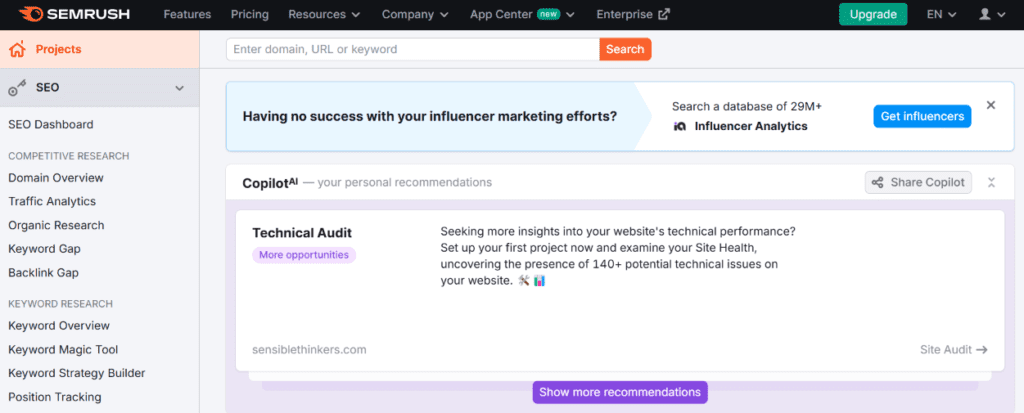
SEMrush
SEMrush is a handy tool if you want to research competitors for SEO and affiliate marketing. It helps you look at your competitors’ strategies, keywords and backlinks. When you know what works for them, you can improve your own strategies to stay ahead.
Google Search Console and Google Analytics
Google Analytics and Google Search Console give you helpful information about your website traffic, user behavior and keyword rankings. The Search Console looks at technical parts and indexing. And Google Analytics offers a detailed analysis of user engagement and conversion rates.

Read more: 9 Best SEO Tools for Beginners in 2025
Measuring and optimizing affiliate SEO performance
Success in affiliate SEO goes beyond raw traffic; focus on metrics that drive revenue, such as click-through rates (CTR) and keyword movements. To refine your affiliate SEO strategies for 2026, prioritize data that reveals how users interact with your links and content.
- Keyword optimization: Use Google Search Console to identify and refresh content ranking in positions 6–10 to reach page one
- Link performance: Track affiliate CTR to move high-converting links to prominent positions and remove ignored ones
- Intent alignment: Analyze bounce rates to ensure your content matches reader expectations and search intent
Scaling your affiliate efforts requires replacing intuition with data-driven optimizations that align your content with actual search performance and user behavior.
How to combine your SEO and affiliate marketing strategy?
Effective affiliate SEO strategies 2026 prioritize buyer-intent keywords from the start. Mapping terms like “best hosting” ensures Bluehost-related content addresses specific user needs before any links are placed.
- Build content calendars around search queries rather than specific products
- Align search intent with high-quality answers to satisfy helpful content guidelines
- Position affiliate links as logical solutions to the reader’s problems
Solving the reader’s problem first builds the trust necessary for conversions. Providing genuine expertise and value consistently outperforms thin sales pitches in both rankings and click-through rates.
Top SEO trends for affiliate marketers in 2026
AI-driven search is transforming affiliate discovery, rewarding sites that utilize structured data and clear topical organization to stay visible in Google’s AI Overviews.
- Use NVMe SSD hosting to achieve the sub-second load times required by 2026 Core Web Vitals.
- Optimize for voice search by creating conversational, question-based content.
- Incorporate original data and screenshots to distinguish your site from generic aggregators.
Maintaining a fast, mobile-optimized technical foundation is essential for a competitive affiliate SEO strategy as search technology evolves.
The future of SEO in affiliate marketing
Search is evolving rapidly with AI Overviews, making thin, keyword-stuffed content less effective. To succeed with affiliate SEO strategies in 2026, building a personal brand around authentic, first-hand expertise is essential for long-term rankings.
- Lead with honest, experience-based reviews and real outcomes
- Prioritize user satisfaction and helpfulness over keyword density
- Build audience trust to improve engagement signals and conversion rates
Technical infrastructure is equally critical. A fast, reliable site ensures your content performs optimally, preventing ranking drops from downtime or slow speeds during crucial traffic spikes.
How Bluehost Full Service + SEO can strengthen your search strategy?
For readers who want expert help beyond DIY optimization, Bluehost Full Service + SEO combines custom website design, SEO support and ongoing maintenance in one managed solution for small and medium-sized businesses.
It includes a five-page WordPress website with a built-in blog, SEO-friendly content for up to five pages, Website Analytics, Simple SEO, two hours per month of expert on-page SEO support, 10 local citation links and ongoing support to help enhance, update and maintain the site over time.
What Bluehost Full Service + SEO includes:
- Custom 5-page WordPress website with built-in blog
- Project consultation and brand-based design
- SEO-friendly content for up to 5 pages
- Website Analytics and Simple SEO tools
- 2 hours/month of expert on-page SEO support
- 10 local citation links
- Monthly strategy support with a dedicated online marketing account manager
- Ongoing website updates, maintenance and support
- Optional eCommerce add-on with WooCommerce setup and payment gateway configuration
For businesses that want to improve visibility while saving time behind the scenes, Bluehost Full Service + SEO offers a more hands-on way to build, support and grow their online presence.
Final thoughts
By prioritizing SEO for affiliate marketing and staying consistent with these proven strategies, you can significantly improve your blog’s search performance. While SEO requires patience, the long-term rewards, steady organic traffic and improved affiliate conversions are well worth the effort for any digital marketer.
Ready to scale your rankings faster? With Bluehost Full Service + SEO, our team of experts handles everything from keyword research to technical optimization, giving your affiliate blog the competitive edge it needs to dominate search results while you focus on growing your business.
FAQs
To optimize your blog for search engines: 1. Follow on-page SEO best practices. 2. Use keyword research tools. 3. Create high-value content that matches the user’s intent.
Best SEO strategies for affiliate marketing include: 1. Focus on keyword research. 2. Writing high-quality content. 3. Optimizing on-page elements and building backlinks.
Improve site speed, ensure mobile friendliness, build quality backlinks and use SEO tools like Google Search Console and SEMrush.
Affiliate links do not harm rankings when following compliant affiliate SEO strategies in 2026 and avoiding manipulative practices. Ensure all commercial links include rel=”sponsored” or rel=”nofollow” attributes to meet Google’s guidelines and avoid manual penalties. Prioritize natural, contextual link placement over excessive stuffing to maintain content quality, reader trust and organic visibility.

Write A Comment