 ChatGPT,
 Claude,
 Gemini,
 Grok — all four for
For more than two decades, the web ran on a simple exchange. Google sent traffic. Websites earned clicks.
That balance is breaking.
As generative AI moves directly into Google Search, the familiar model of discovery built around blue links is giving way to something very different.
Answers now appear instantly, often without the need to visit a website at all. For publishers, creators and businesses, this shift is not theoretical. It is already changing who gets seen, who gets traffic and who gets left out.
Search is no longer just about being found. It is about being chosen by an AI.
From directory to answer machine
Google Search did not start as an answer engine. It began as a directory of links. Users searched, scanned results and clicked through to websites for information.
That structure is beginning to shift.
With the rollout of AI Overviews, Google increasingly delivers direct responses at the top of the results page. These summaries pull information from multiple sources and present it as a complete answer.
According to study conducted in recent years, nearly 60% of Google searches end without a click. For a growing share of searches, clearly the results page itself has become the destination. The line between search and answers is now blurred.
This shift is already visible in user behavior.
The decline of the organic click
Organic clicks were the lifeblood of the open web for years. Ranking meant traffic. Traffic meant growth.
That assumption no longer holds.
As AI-generated responses expand across search results, organic clicks are no longer the default outcome. They are becoming the exception. Studies show an inverse relationship between AI Overviews and website performance.
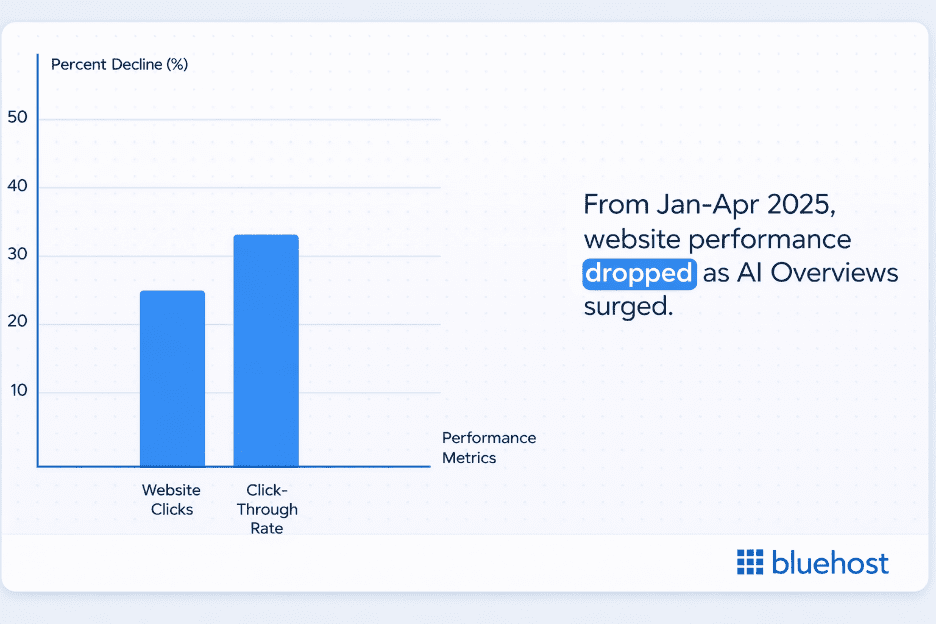
As AI summaries increased, overall website clicks dropped by roughly 23% and CTR plummeted 32%.
Being cited in an AI answer does not automatically translate into winning.
A traditional blue link acts as a doorway. It combines a crafted title and description designed to pull the user in.
An AI citation, by contrast, often functions like a footnote. It provides attribution but little incentive to click.
In practice, ranking first inside an AI Overview can drive traffic comparable to ranking sixth on a traditional results page. Visibility remains, but engagement changes dramatically.
AI as the new gatekeeper
This is where the real shift happens. AI is becoming the new gatekeeper for business decisions.
If your content is not included in the AI’s shortlist of sources, it is effectively invisible. You are not competing for clicks anymore. You are competing for inclusion.
That requires a new way of thinking.
Instead of optimizing solely for rankings, content now needs to be structured so clearly and credibly that an AI system chooses it as the foundation for its answer. This shift has given rise to a new strategy known as generative engine optimization or GEO.
The new playbook: Generative engine optimization
GEO represents a fundamental change in mindset.
Search engine optimization focused on earning clicks. Generative engine optimization focuses on providing answers. The goal is not to attract traffic at any cost, but to become a trusted source that AI systems rely on when summarizing complex topics.
At its core, GEO is built on a few principles.
Content must directly answer real questions. Structured data is important for websites and SEO because machines can easily parse and interpret them. And it must demonstrate clear experience, expertise, author transparency and trust. These signals strongly correlate with whether content is included in AI-generated responses.
This is not about gaming algorithms. It is about clarity, credibility and usefulness at scale.
Practical GEO tactics that influence how AI surfaces your content
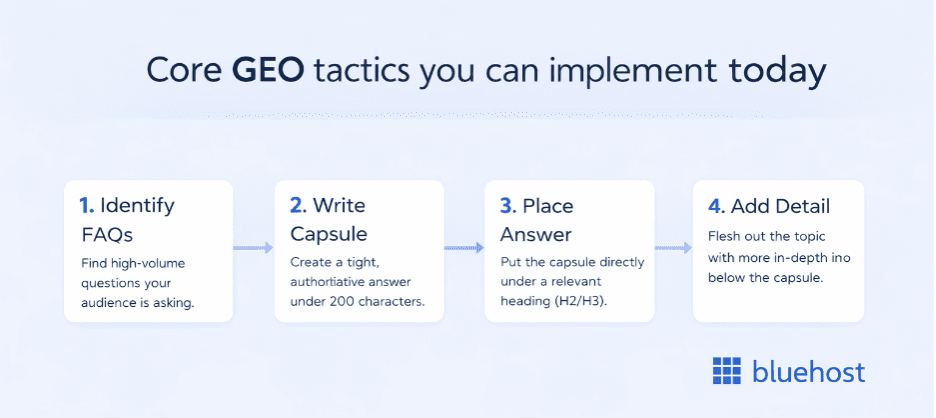
Some tactics are emerging as especially effective in this new environment. These tactics help your content stay visible when AI summarizes results, by delivering clear answers and stronger context for everyone.
Step 1. Identify FAQs
- Pull the highest-intent questions your audience actually asks (Search Console queries, “People also ask,” support tickets, on-page search).
- Prioritize questions with clear, factual answers and strong relevance to your page topic.
- Group related questions around the same entity or concept so your section stays focused.
Step 2. Write capsule
- Write a single, direct answer in under 200 characters.
- Keep it authoritative and specific. Remove filler, qualifiers and setup sentences.
- Use simple language that can stand alone if quoted.
Example capsule:
“IP whitelisting blocks all traffic by default and allows access only from approved IP addresses or ranges.”
Step 3. Place answer
- Put the capsule immediately under the most relevant H2 or H3, before any longer explanation.
- Make the heading match the question as closely as possible.
- If you use schema, align it with the same Q&A meaning so machines can map the heading to the capsule accurately.
Step 4. Add detail
- Expand below the capsule with depth that supports reuse and trust:
- Structured data: add Schema.org markup where it fits (FAQPage, HowTo, Article, Organization, Person).
- Entity focus: define the main entities, related concepts and relationships (what it is, how it works, when to use it, limits).
- Trust signals: include author bio, publish/update dates and credible citations that back the claims.
- Add practical elements like steps, examples, edge cases and common mistakes to reduce ambiguity and improve accuracy.
Rethinking what success looks like
Traditional metrics are starting to lose precision.
Traffic and click-through rates still matter, but they no longer tell the full story. In an AI-driven search environment, influence and presence are becoming more meaningful indicators.
New signals of success include how often a brand appears in AI-generated answers, its share of voice across summaries and the quality of engagement from fewer but higher-intent visitors.
In this model, quality of engagement outweighs raw volume.
Who is content really for now?
This leads to an uncomfortable but necessary question.
Are we creating content for humans or for AI?
The answer is both.
The challenge of this new era is serving a dual audience without compromising either. Content still needs to resonate with people, earn trust, and provide value. At the same time, it must be structured clearly enough for AI systems to interpret and reuse accurately.
Those who manage this balance will shape the next phase of discovery.
Final thoughts
The end of the click does not mean the end of opportunity.
Search is not disappearing. It is evolving. Visibility now depends less on ranking alone and more on becoming a reliable source in an AI-mediated environment.
The winners in this next phase will be the ones who adapt early. They will create content that answers questions with authority, earns trust consistently and works for humans and machines alike.
The rules of search are changing quietly. The impact will not be quiet at all.

Write A Comment