 ChatGPT,
 Claude,
 Gemini,
 Grok — all four for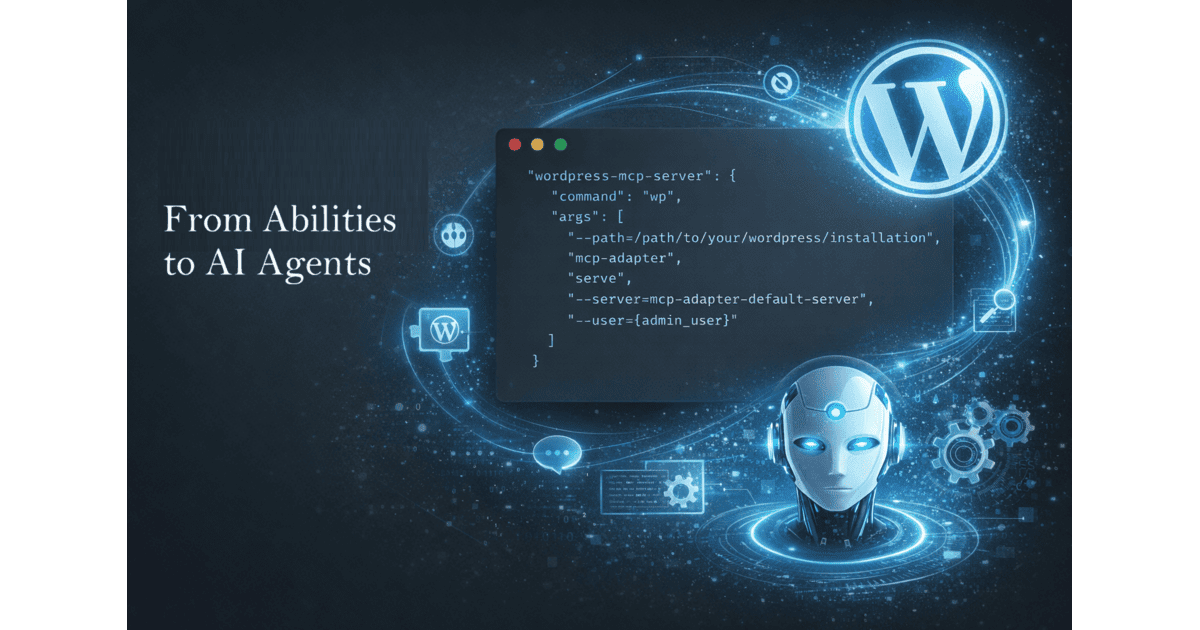
WordPress is preparing for a future where AI does more than generate content. It is laying the groundwork for AI to execute tasks directly inside websites.
With the introduction of the new Model Context Protocol (MCP) Adapter, the platform is laying the groundwork for AI agents to operate within WordPress itself.
This is not another writing assistant or chatbot plugin. It is a structural layer that allows AI systems to act, not just suggest.
The shift moves WordPress closer to an era where websites are not only built with AI, but partially run by it.
What WordPress announced
In its official announcement on 4th February 2026, titled From Abilities to AI Agents: Introducing the WordPress MCP Adapter, WordPress outlined a transition from Abilities to AI agents.
At the center of that shift is the MCP Adapter: a developer-focused infrastructure layer that connects AI systems to WordPress through a standardized protocol.
To understand what MCP is, check out this article What is the Model Context Protocol (MCP)? – Model Context Protocol
The Adapter builds on the Abilities API introduced in WordPress 6.9. Together, they create a framework in which AI agents can safely discover a site’s capabilities and execute them within defined boundaries.
There is no new AI button on the dashboard. No chatbot suddenly appearing in wp-admin.
Instead, WordPress shipped plumbing. And plumbing changes everything.
Also read: WordPress’s Abilities API: Why this Small Update Signals a Big Shift for the Open Web
What the MCP Adapter actually does
The MCP Adapter implements support for the Model Context Protocol, a standardized way for AI systems to understand and interact with external tools.
In practical terms, it allows AI clients, whether local AI tools or cloud-based agents, to communicate with WordPress in a structured and predictable format.
Instead of guessing API calls or scraping endpoints, AI systems can discover registered “abilities” and execute them intentionally.
WordPress becomes something AI can reason about.
From AI suggestions to AI execution
Until now, most AI integrations in WordPress have been content centric. They generate blog drafts, suggest SEO improvements or write product descriptions.
Useful, but limited.
The MCP Adapter signals a shift from assistance to automation.
Instead of merely drafting a post, an AI agent could:
- Create the post
- Assign categories
- Optimize metadata
- Schedule publication
- Trigger related workflows
- Update connected content
This is structured execution, not autocomplete. The difference is subtle but foundational.
What AI agents could now do inside WordPress
With properly registered abilities, AI agents can potentially:
- Manage content operations
- Moderate comments
- Sync external systems
- Update inventory data
- Generate and publish reports
- Run internal maintenance tasks
The key distinction is that actions are intentional and permissioned. They are not improvised scripts or brittle integrations.
This transforms WordPress from a content management system into an environment where AI systems can safely navigate and act within.
Why standardization changes the equation?
AI systems have been capable of automation for years. What they lacked was a shared interface.
Without standardization, every integration requires custom plugins, fragile REST endpoints or workaround-heavy development. Automation existed, but it did not scale cleanly across ecosystems.
By implementing the Model Context Protocol, WordPress turns automation into infrastructure.
That shift moves AI integration from experimentation to platform-level architecture.
Security and permission boundaries remain central
Letting AI agents execute actions inside websites naturally raises concerns around misuse and escalation.
WordPress’s approach does not bypass its safeguards. Instead, it anchors AI operations firmly within its existing permissions model.
AI agents operate as authenticated users. Their capabilities are limited by assigned roles. An agent running under an editor account cannot delete plugins. An agent without publishing rights cannot push content live.
Every registered ability requires a permission callback before execution. WordPress validates whether the acting user, human or AI, is authorized to perform the action.
Nothing runs without verification.
The architecture prioritizes control over convenience.
What this means for the WordPress ecosystem
This update is less about features and more about positioning.
As website builders like Wix and Shopify invest heavily in AI-driven automation, WordPress is taking a different route. Rather than embedding a closed AI layer, it is building an open, protocol-based foundation that allows external AI systems to integrate cleanly.
- For agencies, this could mean workflow automation across multiple client sites.
- For developers, it opens new possibilities for AI-powered tooling.
- For hosting providers, it signals deeper automation within infrastructure and management layers.
The shift also reinforces WordPress’s long-standing philosophy: openness over enclosure.
Instead of centralizing AI inside a proprietary assistant, it is exposing structured capabilities to an ecosystem.
A foundational move, not a flashy release
WordPress did not launch a headline-grabbing chatbot.
It introduced a structural layer that enables AI agents to operate natively within websites.
That distinction matters.
AI tools for content generation are becoming more common. Infrastructure that allows AI to safely execute actions inside an open platform is far rarer.
The MCP Adapter may not change how your site looks tomorrow. But it quietly lays the groundwork for how websites could function in an agent-driven future.
And that shift positions WordPress not just as a content platform adapting to AI, but as a system preparing for it at the architectural level.

Write A Comment