 ChatGPT,
 Claude,
 Gemini,
 Grok — all four for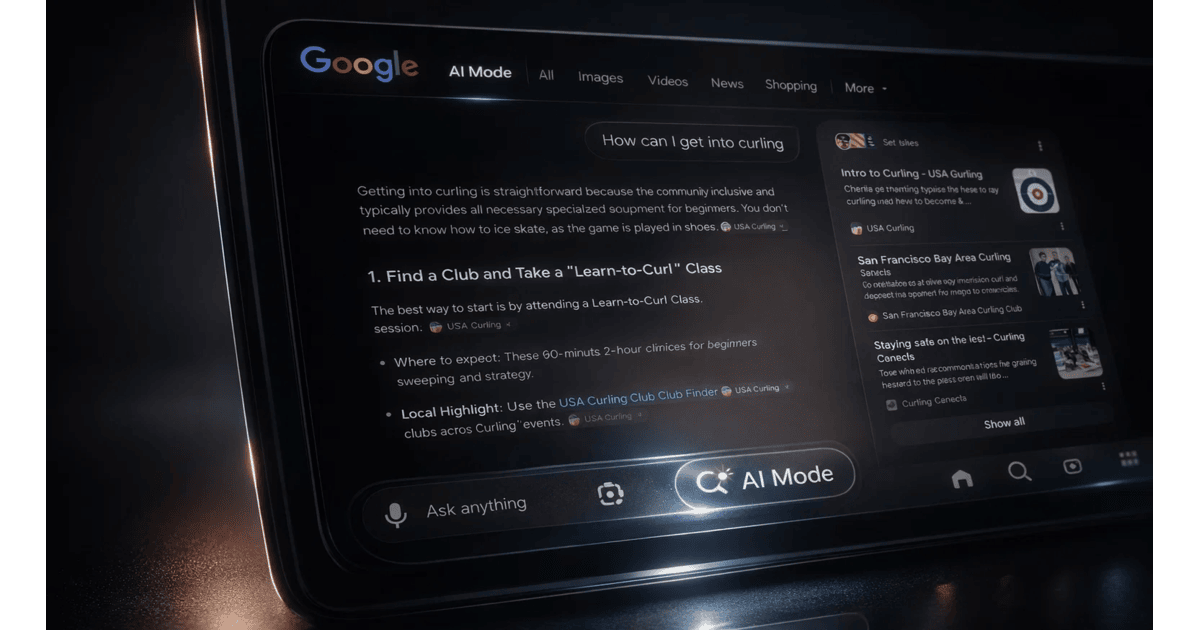
Google isn’t just answering queries with AI, it’s redesigning the moment of attribution. The newest AI citation previews make sources more visible, but they also raise the bar: only pages that feel “reference-worthy” will win the click.
For small business owners, bloggers and digital marketers, this is not just another SEO update. It is a shift in how people discover websites and whether they choose to click through at all.
Here is what is happening and what it means for your website performance.
Google AI mode is changing how people see your content
Robby Stein, Google Search’s Vice President of Product shared an update on X on 18th February. It stated that Google is rolling out a redesigned link experience within AI Overviews and AI Mode across desktop and mobile devices.
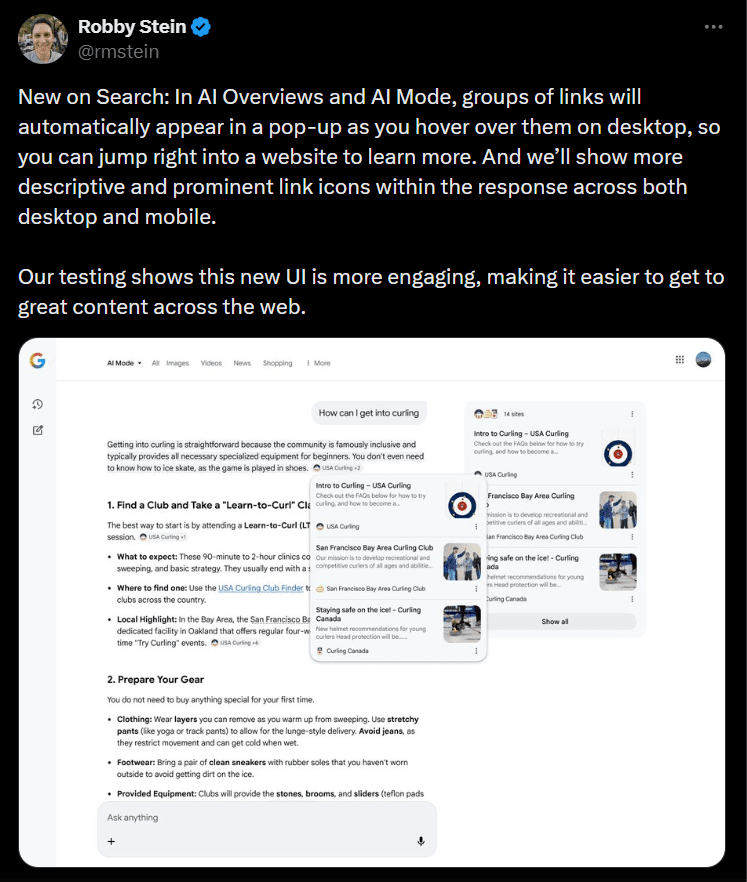
This means that citations are becoming more visible and interactive on desktop and mobile. When users hover or tap, they can see more detailed previews of the source.
Why is this important?
This signals two important things:
- Google knows publishers are concerned about lost visibility.
- Traffic from AI results is actively reshaped.
According to Google’s own Search blog, while overall organic click volume to websites has remained relatively stable year-over-year, average click quality has increased.
Google reports slightly more quality clicks, defined as users who do not immediately return to the results page, compared to a year ago. This comes even as users submit longer and more complex queries that often trigger AI summaries at the top of search results.
For website owners, the real question is not just whether users will click, but whether your link is compelling enough to earn that click after the AI summary has already answered part of the query.
As AI filters information upfront, the clicks that remain carry higher intent. That shift changes the equation. A decline in clicks does not automatically translate into a decline in opportunity.
Fewer clicks do not mean less opportunity
AI summaries can reduce traditional clicks. But they also create a new kind of visibility. As we explored in our breakdown of how generative AI is rewriting Google Search, the shift is not about eliminating websites. It is about changing how and where they are surfaced.
- The performance trade-off
This shift may reduce overall sessions but increase intent.
Broad informational queries resolved by AI summaries can lower top-of-funnel impressions. However, the clicks that remain are often more deliberate, improving engagement and conversion potential.
Shallow, impression-driven content may lose visibility. Deep, well-structured evergreen content is more likely to be cited and repeatedly surfaced.
In short, volume may decline, but authority and intent matter more.
- Real-world example: A local service business
Consider a local accounting firm that publishes blog posts answering basic tax questions.
Previously, a post titled “What is GST?” might generate steady top-of-funnel traffic from informational searches. With AI summaries now answering that question directly, impressions and clicks for that page may drop.
However, a more comprehensive guide such as “GST Filing Checklist for Small Businesses in 2026” that includes step-by-step processes, downloadable templates and region-specific advice is more likely to:
- Be cited inside AI-generated answers
- Attract higher-intent visitors
- Convert readers into consultation inquiries
In this scenario, total traffic may decrease, but qualified leads may increase.
The opportunity shifts from volume to value. That shift requires website owners to rethink how they plan, structure and measure their content strategy moving forward.
What should website owners do next?
Since Google expanded AI-generated citations and interactive previews, the journey to your website has quietly changed. Ranking is no longer the first gate. Evaluation now happens before the click.
That makes strong on-page fundamentals and structured optimization even more important, especially if you’re following proven WordPress SEO best practices.
The funnel looks different:
Exposure → Citation → Preview → Click
And each stage filters opportunity.
- Exposure: Structured pages survive first contact
Before your URL is ever shown, AI systems crawl, parse and compress your content into a structured understanding.
If your page is:
- Topically scattered
- Overloaded with filler
- Unclear in hierarchy
It may still rank, but it will struggle to move beyond exposure.
Clear section headings, tight topic focus and direct explanations increase the likelihood your content becomes usable inside AI-generated answers.
Messy pages lose visibility before users even know they exist.
- Citation: Authority is chosen, not assumed
AI summaries do not pull from the “most optimized” page. They pull from pages that feel definitive.
That usually means:
- Original framing or data
- Concrete examples
- Clear, complete explanations
- Demonstrated topical depth across multiple related articles
Thin content can rank on traditional SERPs. It rarely serves as a cited source in an AI overview.
The shift here is subtle but important: Ranking gets you indexed. Authority gets you referenced.
- Preview: The Moment most clicks die
The new citation previews: hover cards, expandable source panels, mobile tap previews create a friction point.
Users now evaluate your brand before they visit it.
In seconds, they assess:
- Is this current?
- Is this credible?
- Does this feel established?
- Is this worth leaving the AI answer for?
If your publishing date is outdated, your author bio is unclear or your page slow on mobile, the decision is made instantly.
The preview stage is where weak brands lose the click.
- Click: Value beyond the summary
AI answers increasingly resolve surface-level questions. That means the click must deliver something the summary cannot replicate.
Clicks now depend on:
- Deeper frameworks
- Real-world implications for a specific audience
- Tools, templates or structured models
- A strong, defensible point of view
If your page simply restates what is already summarized, the user has no incentive to continue.
The click belongs to the page that extends the conversation. And the pages that win are not just better written. They are better built to support this shift at every level. This brings us to infrastructure. Let us look at how it serves as a critical layer behind every stage.
Infrastructure is the hidden layer behind every stage
The new AI search funnel is not just about content. It is also about technical readiness.
Each stage: Exposure, Citation, Preview and Click depends on how reliably your site performs.
- Exposure depends on crawl stability
Before your content is ever cited, it must be consistently accessible.
If your site experiences:
- Server errors
- Slow response times
- Frequent downtime
AI systems may struggle to crawl and process your pages efficiently.
Reliable hosting ensures your content survives the first filter: access.
- Citation depends on structured delivery
AI systems do not just read content. They parse the structure.
Clean HTML hierarchy, fast load times and predictable server behavior support accurate content extraction.
If your infrastructure is unstable, even strong content can become harder to interpret at scale.
- Preview depends on speed and credibility
The redesigned citation previews create a critical moment.
If a user taps your source and your page:
- Loads slowly
- Shifts layout unexpectedly
- Feels unresponsive on mobile
The decision is made instantly.
Preview is no longer just about branding. It is about experience within seconds.
- Click depends on performance under intent
AI search may reduce casual clicks. The remaining traffic is often higher-intent.
Higher intent users expect:
- Immediate load speed
- Seamless navigation
- No friction
If your infrastructure cannot handle performance under load, the opportunity ends at the click.
The bottom line: Search strategy must evolve
Search is becoming more conversational. AI systems summarize, expand and reshape queries before users ever see a link.
That does not eliminate websites. It changes how they compete.
For website owners and digital marketers, the strategy shifts from chasing rankings alone to building authority, clarity and technical resilience.
The businesses that win in this next phase will not just publish content. They will own strong platforms, optimize for visibility inside AI systems and invest in infrastructure that supports long-term growth.
In an AI-driven search landscape, your website is still your foundation. The difference is how you prepare it for the future.

Write A Comment