 ChatGPT,
 Claude,
 Gemini,
 Grok — all four for
Key highlights
- Compare SEO vs SEM by weighing long-term organic search growth against immediate paid advertising visibility.
- Evaluate long-term ROI versus short-term traffic and conversion gains.
- Choose between SEO vs SEM based on your specific business goals and budget.
- Analyze audience search intent to optimize keyword targeting and budget.
- Leverage both channels to maximize total search engine market share.
More than 14 billion searches are conducted on Google every single day.
Yet for most businesses, only a fraction of that traffic ever lands on their website. The question is: how do you claim your share? The answer starts with understanding the core debate of SEO vs SEM: two of the most powerful strategies in digital marketing and knowing which one aligns with your goals, timeline and budget.
Understanding SEO vs SEM is essential for any business looking to gain visibility in search engine results, yet these two strategies work in fundamentally different ways. SEO builds lasting organic traffic over time, while SEM delivers fast wins through paid search. Choosing the wrong strategy for your goals and budget can mean wasted spend and missed growth opportunities.
In this SEO vs SEM breakdown, we cover how each strategy works, where they differ in cost and results and which approach best fits your business goals and budget.
What is search engine optimization?
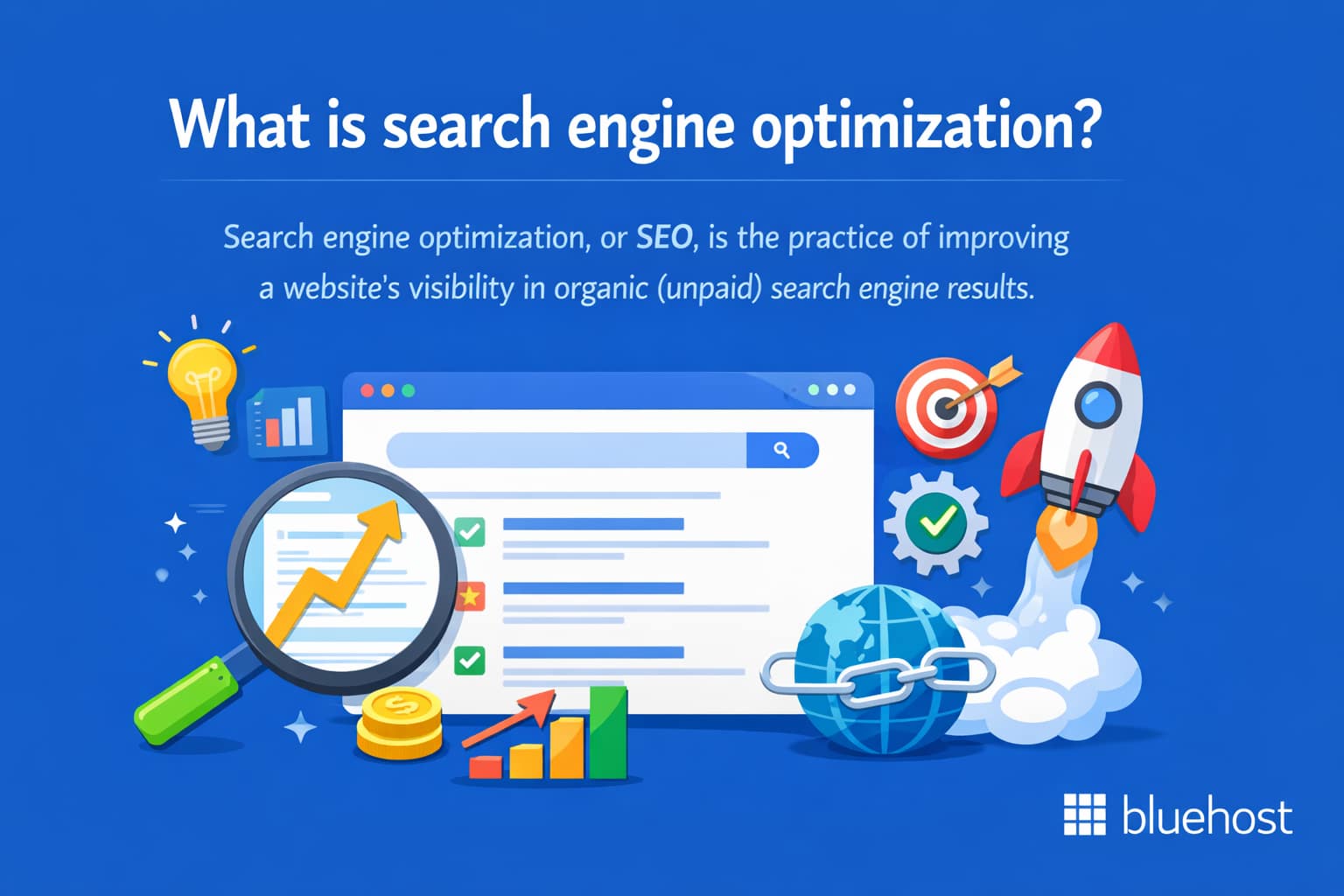
Search engine optimization, or SEO, is the practice of improving a website’s visibility in organic (unpaid) search engine results. When someone types a query into Google or Bing, SEO determines whether your website appears and how high it ranks on the results page.
SEO is not a single tactic. It is a multi-layered strategy that spans technical improvements, content creation and authority building. The goal is to signal to search engines that your website is a credible, relevant and authoritative resource for specific queries.
Also read: Step-by-Step Guide to Building an SEO Website Structure
What are the core components of SEO?
- On-page SEO: Optimizing individual pages through title tags, meta descriptions, header structure, keyword usage and internal linking
- Off-page SEO: Building authority through external signals such as backlinks from reputable websites, brand citations and social mentions
- Ensuring your site’s infrastructure supports crawling and indexing, including site speed, mobile-friendliness, HTTPS security and structured data
- Creating high-quality, relevant content that answers real search queries and demonstrates topical expertise
- Optimizing for location-based searches to help businesses appear in local search results and Google Maps listings
Also read: What Is Search Engine Optimization: Beginner’s Guide
What are the key benefits of SEO?
- Drives sustainable, long-term organic traffic without ongoing ad spend
- Builds brand credibility and trust through consistent high rankings
- Delivers compounding ROI, strong rankings become increasingly difficult for competitors to displace
- Reaches users at every stage of the buying journey
- Reduces long-term dependence on paid advertising budgets
How does SEO work?
Understanding how SEO works begins with understanding how search engines process websites. Google and other search engines use automated programs called “crawlers” to discover and analyze content across the web. This process follows three core stages.
The three stages of search engine processing
- Crawling: Search engine bots scan your website by following links and reading code. If your site has poor internal linking or technical errors that block crawlers, your pages may never be discovered
- Indexing: Once a page is crawled, it is stored in the search engine’s index, a massive database of web content. Only indexed pages are eligible to appear in search results
- Ranking: When a user performs a search, the algorithm evaluates hundreds of ranking signals to determine which indexed pages are most relevant and authoritative for that query
Primary ranking signals search engines evaluate
- Content quality, depth and relevance to the search query
- The number and authority of backlinks pointing to your page
- Page load speed and Core Web Vitals performance
- Mobile usability and overall user experience
- Domain authority and overall site trustworthiness
- User engagement signals such as bounce rate and time on page
SEO works by systematically improving each of these signals over time. It is not an overnight process, most meaningful results typically become visible within three to six months of consistent effort.
What are the essential search engine optimization tools?
Running effective SEO campaigns requires the right set of tools to uncover keyword opportunities, monitor rankings, fix technical issues and measure content performance. These platforms help turn SEO from guesswork into a structured, data-driven strategy, giving businesses the insights needed to improve visibility and grow organic traffic over time.
- Google Search Console: A foundational SEO tool that shows how your website performs in Google Search. It reveals which queries drive impressions and clicks, identifies indexing or crawl issues and helps monitor Core Web Vitals and mobile usability.
- Google Analytics: Tracks how users interact with your website after arriving through organic search. It helps you measure traffic sources, engagement, conversion paths and which landing pages generate the most valuable business outcomes.
- Google Keyword Planner: While often associated with paid search, Keyword Planner is also useful for SEO research. It helps identify relevant keyword ideas, search demand trends and topic clusters that can guide content planning.
- Ahrefs or Semrush: Comprehensive SEO platforms that provide keyword difficulty scores, backlink analysis, competitor research, rank tracking and site audits. They help businesses understand where they stand in the market and where the strongest organic opportunities exist.
- Screaming Frog SEO Spider: A technical SEO crawler that scans your website the way search engines do. It helps uncover broken links, duplicate content, missing metadata, redirect issues and other structural problems that can hurt search performance.
- PageSpeed Insights: Evaluates how quickly your pages load and highlights performance issues affecting user experience. It provides actionable recommendations to improve speed, usability and Core Web Vitals, all of which support stronger SEO outcomes.
Together, these tools give you the visibility and control needed to strengthen your technical foundation, refine your content strategy and improve your chances of ranking higher in organic search results.
Also read: Content Marketing vs SEO: How They Work Together
What is search engine marketing?
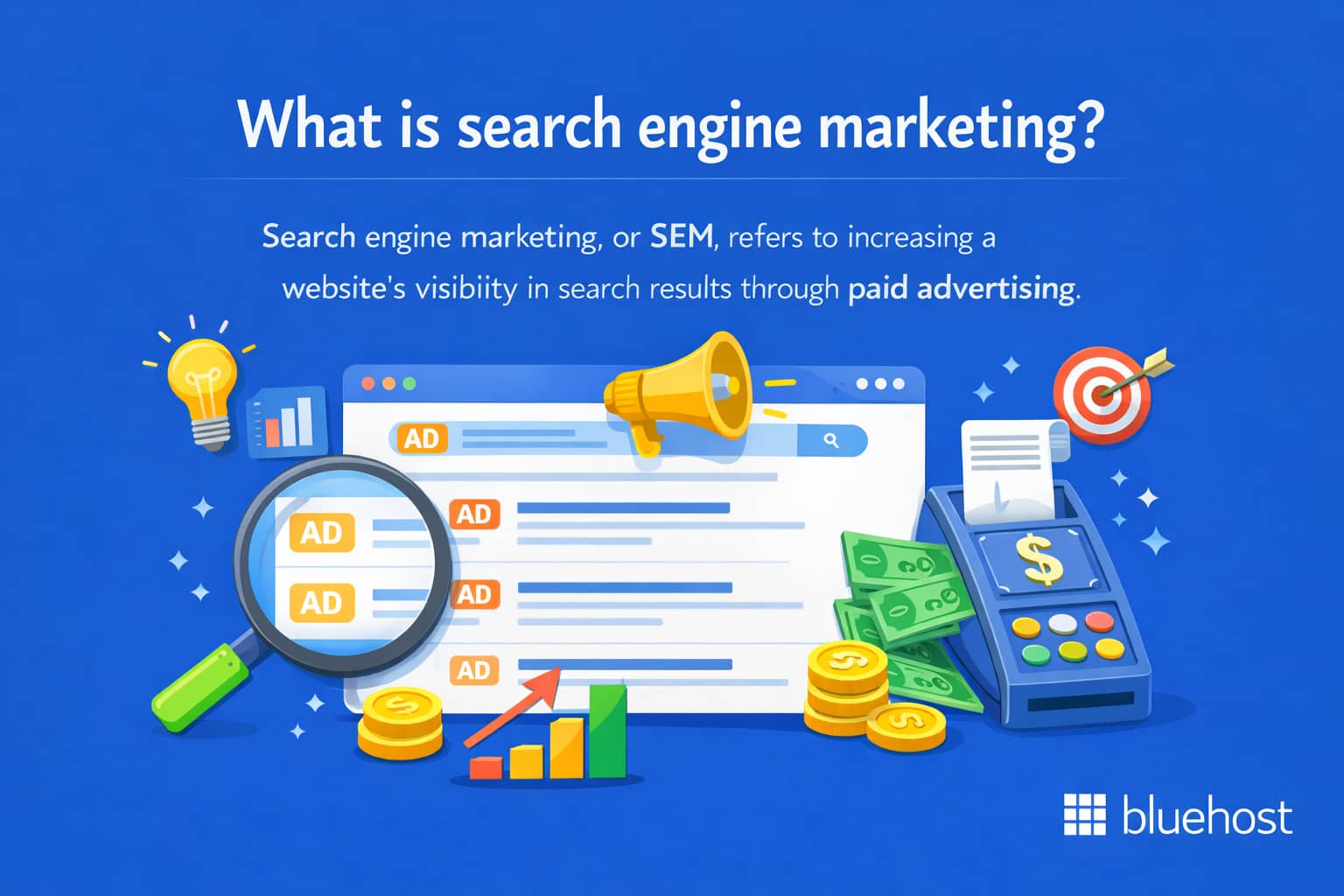
Search engine marketing, or SEM, refers to increasing a website’s visibility in search results through paid advertising. While some historical definitions of SEM included organic strategies, the term today primarily refers to pay-per-click (PPC) advertising on platforms such as Google Ads and Microsoft Advertising.
With SEM, businesses bid on specific keywords and create ads that appear at the top or bottom of search engine results pages (SERPs). These ads are labeled as “Sponsored” but occupy premium search real estate, giving businesses immediate visibility for high-intent queries.
What are the common types of SEM campaigns?
- Search ads: Text-based ads that appear when users search for relevant keywords, the most direct form of paid search
- Shopping ads: Product-based ads displaying images, prices and product names directly in search results, particularly effective for eCommerce businesses
- Display ads: Visual banner ads shown across Google’s Display Network, often used for brand awareness and retargeting
- Remarketing campaigns: Ads targeted specifically at users who have previously visited your website, designed to re-engage and convert
What are the key benefits of SEM?
- Delivers immediate visibility and traffic as soon as campaigns launch
- Provides precise targeting by keyword, location, demographics and device
- Offers real-time performance data for rapid optimization
- Gives full control over budget, bid strategy and campaign scheduling
- Highly effective for time-sensitive promotions, product launches and seasonal campaigns
How does SEM work?
SEM operates through an auction-based system. Each time a user enters a search query, search engines run an instant auction to determine which ads appear and in what order. Understanding this process is essential to running effective paid campaigns.
The SEM auction process: Step by step
- Keyword research and selection: Advertisers identify the specific search terms their target audience uses and structure campaigns around those keywords
- Bid setting: Advertisers set a maximum cost-per-click (CPC), the maximum they are willing to pay for each click on their ad
- Quality Score calculation: Google assigns a Quality Score (1–10) to each ad based on expected click-through rate, ad relevance to the keyword and the quality of the destination landing page
- Ad Rank determination: Ad Rank combines your maximum bid with your Quality Score and additional factors such as ad extensions. A high Quality Score can secure better placement at a lower cost, rewarding relevance over raw spending power
- Performance monitoring: Effective SEM requires ongoing analysis of key metrics including click-through rate (CTR), conversion rate, cost-per-acquisition (CPA) and return on ad spend (ROAS)
Unlike SEO, SEM produces results within hours of launching. However, traffic stops the moment you pause spending. This fundamental difference sits at the core of the SEO vs SEM comparison.
What are the essential search engine marketing tools?
Running effective SEM campaigns requires the right set of tools to research keywords, build ads, track performance and refine your targeting. These platforms do the heavy lifting, giving you clear data to act on without needing a specialist to interpret every metric.
- Google Ads: The primary platform for paid search campaigns, Google Ads lets you create text, shopping and display ads that appear across Google’s search network. Its campaign dashboard centralizes bid management, audience targeting and performance reporting in one place.
- Google Keyword Planner (Same as above): A free tool within Google Ads that generates keyword ideas, shows monthly search volume estimates and provides competitive bid ranges, essential for building a focused and cost-effective keyword strategy.
- Microsoft Advertising: Extends your paid search reach to Bing, Yahoo and DuckDuckGo users. It mirrors much of Google Ads’ functionality and often delivers lower cost-per-click in less competitive auctions.
- Google Analytics: Tracks what happens after a user clicks your ad, including bounce rate, session duration and conversion events. Connecting it to Google Ads reveals which campaigns drive real business outcomes, not just traffic.
- SEMrush or Ahrefs: Competitive intelligence tools that reveal which keywords rivals are bidding on, estimated ad spend and landing page strategies, helping you identify gaps and opportunities before committing budget.
Together, these tools give you the visibility and control needed to allocate budget confidently and continuously improve campaign performance.
How SEO and SEM work together?
Although SEO vs SEM is often framed as a comparison, the two strategies are often more effective when used together. SEO supports long-term organic growth, while SEM helps businesses respond quickly to immediate opportunities.
How SEM supports SEO?
- SEM tests keyword value quickly: Paid campaigns can show which queries drive clicks, leads or sales before a business invests heavily in SEO content.
- SEM provides immediate visibility: If a business is not yet ranking organically for important terms, paid ads can help it appear in search results right away.
- SEM reveals effective messaging: Ad copy performance can highlight which headlines, offers or value propositions resonate most with searchers.
How SEO supports SEM?
- SEO strengthens landing pages: Fast, relevant and well-structured pages improve the experience for paid visitors after the click.
- SEO reduces pressure on paid spend: As organic rankings improve, businesses may be able to rely less on ads for every important keyword.
- SEO creates lasting visibility: While SEM delivers immediate reach, SEO helps maintain discoverability over time.
How both work better together?
- Together they increase search presence: Appearing in both paid and organic results can improve visibility for high-value queries.
- Together they support better decisions: Insights from both channels can refine keyword targeting, content strategy and conversion optimization.
Understanding how does SEO work and how does SEM work is especially valuable here.
SEO works by building visibility over time through relevance, authority and site quality. SEM works by securing immediate placement through paid bidding and ad relevance. When used together, they help businesses balance short-term performance with long-term growth.
SEO vs SEM: Key differences at a glance
When evaluating SEO vs SEM, it is important to compare both strategies across the dimensions that matter most to your business: cost, speed, longevity and control. Before comparing each factor in detail, here is a quick side-by-side view of how SEO vs SEM differs across the areas that matter most to businesses.
| Comparison factor | SEO | SEM |
|---|---|---|
| Cost model and financial investment | Earned traffic through investment in content, technical optimization and site authority | Paid traffic through a pay-per-click model where visibility is purchased |
| Speed of results and implementation | Slower to build, often requiring several months for meaningful results | Fast to launch and capable of generating traffic soon after ads go live |
| Longevity and sustainability | Can continue driving traffic over time after rankings are established | Visibility lasts only while campaigns remain active and funded |
| Average click-through rates (CTR) | Organic listings typically capture a larger share of total clicks | Paid listings usually capture a smaller share of total clicks |
| Trust, credibility and brand authority | Often perceived as more credible and authoritative by users | Marked as sponsored, which can reduce perceived trust for some users |
| Targeting precision and campaign control | Limited direct control, with visibility shaped by search engine algorithms | High control over keyword targeting, audience settings, location, device and timing |
| Scalability and compounding returns | Scales gradually and can produce compounding returns as authority grows | Scales quickly through increased budget and bid adjustments |
Now, let’s understand these SEO vs SEM key differences a bit in depth.
1. SEO vs SEM: Cost model and financial investment
SEO functions as an “earned” media strategy, meaning you do not pay a direct fee to search engines to secure traffic.
Instead, your budget is allocated toward long-term assets like high-quality content creation, technical website optimization and strategic link-building. In contrast, SEM is a “paid” media model governed by pay-per-click (PPC) mechanics.
In this system, every visitor represents a direct financial cost that is determined by the competitiveness and auction price of your target keywords.
- SEO: Focuses on earned traffic through investment in site authority and content quality.
- SEM: Operates on a paid model where visibility is purchased on a per-click basis.
2. SEO vs SEM: Speed of results and implementation
When comparing SEO vs SEM, the timeline to achieve measurable results differs significantly between the two strategies.
SEM is built for speed and immediate impact, allowing businesses to appear at the top of search results and generate traffic within hours of a campaign launch. SEO, however, is a marathon strategy. It typically requires a commitment of three to six months—and potentially up to a full year in competitive industries—before a site achieves high organic rankings and sustainable traffic growth.
- SEM: Delivers near-instant traffic and visibility as soon as ads are approved.
- SEO: Requires a long-term implementation phase before organic growth becomes significant.
3. SEO vs SEM: Longevity and sustainability
SEO is designed to build long-term digital equity and lasting brand visibility.
Once a page has earned a top ranking, it often continues to attract visitors even if active optimization is paused for a period. SEM traffic is purely ephemeral. The moment the daily budget is reached or the campaign is turned off, the website’s visibility in the paid search results disappears immediately, resulting in an instant loss of traffic.
- SEO: Provides sustainable, long-lasting visibility that persists over time.
- SEM: Offers temporary visibility that is strictly tied to active daily spending.
4. SEO vs SEM: Average Click-Through Rates (CTR)
User behavior data consistently shows a strong preference for organic search results over paid placements.
Research suggests that organic listings account for roughly 70–80% of all clicks on a search results page, while paid advertisements capture only the remaining 20–30%. This gives SEO a clear advantage in traffic volume potential, as users are more naturally inclined to click on the results they perceive as the most relevant organic matches.
- Organic results: Capture the vast majority of user clicks (70–80%).
- Paid advertisements: Account for a smaller portion of total search traffic (20–30%).
5. SEO vs SEM: Trust, credibility and brand authority
There is a distinct psychological difference in how users perceive search results.
Many searchers instinctively trust organic listings more than paid ads, which carry a “Sponsored” label. This confers a significant credibility advantage to SEO, particularly in research-intensive markets where users prioritize authoritative information and expertise over a direct sales pitch, helping to establish the brand as a leader in its field.
- Organic SEO: Enhances brand authority and builds deeper trust with the audience.
- Paid SEM: Can be perceived as less objective due to its clearly labeled promotional nature.
6. SEO vs SEM: Targeting precision and campaign control
SEM provides advertisers with an exceptional level of control over who views their content.
Campaigns can be fine-tuned based on specific geographic locations, device types, times of day and even detailed audience demographics. SEO offers much less direct control in this regard, as search engine algorithms ultimately determine which pages are displayed based on their own assessment of organic search intent and relevance.
- SEM: Offers granular control over targeting parameters and ad delivery.
- SEO: Relies on algorithmic interpretation of content to reach the target audience.
7. SEO vs SEM: Scalability and compounding returns
SEM is highly and instantly scalable; increasing your traffic volume is often as simple as increasing your advertising spend.
While SEO scales more slowly, it offers the benefit of compounding returns. As your website’s overall domain authority increases, it becomes progressively easier to rank for new keywords, which effectively lowers your cost-per-acquisition as the total volume of organic traffic scales upward over time.
- SEM scaling: Achieved instantly by adjusting budget and bid levels.
- SEO scaling: Results in compounding returns and improved ROI as site authority grows.
What are the cost considerations in SEO vs SEM battle?
When evaluating SEO vs SEM, the cost difference comes down to how each channel is funded, how quickly spend turns into visibility and whether results continue after that investment slows down.
SEO cost considerations
- Investment goes into long-term assets: SEO budgets are typically spent on content creation, technical optimization, site improvements, SEO tools and strategic support.
- You do not pay for each click: Once a page begins ranking, it can continue attracting traffic without a direct charge for every visitor.
- Costs are often front-loaded: Early investment is usually higher because businesses need to strengthen site quality, build content depth and establish authority before rankings improve.
- Returns build cumulatively over time: As authority and visibility grow, SEO can become more efficient and reduce dependence on ongoing acquisition spend.
SEM cost considerations
- Investment goes into active campaign spend: SEM budgets are tied directly to keyword bidding, ad delivery, campaign management and landing page performance.
- You pay for visibility as campaigns run: Each click has a cost, and traffic is closely tied to the amount you are willing to spend.
- Costs begin immediately: SEM can start driving traffic quickly, but results depend on keeping campaigns funded and optimized.
- Spend is continuous rather than compounding: Once campaigns pause, paid visibility disappears, which means traffic does not continue in the same way it can with SEO.
For businesses asking how does SEO work from a cost perspective, SEO works by building organic visibility through assets that can continue delivering value over time.
For those asking how does SEM work financially, SEM works by purchasing immediate search visibility through a live auction model tied to ongoing spend.
| Strategy | Best fit when |
|---|---|
| Choose SEO | You want to build durable visibility, can invest in long-term growth and are prepared to wait for returns to build. |
| Choose SEM | You need faster results, want tighter spend control and can actively manage campaign economics. |
| Use both | You want short-term traffic now while building a more cost-efficient acquisition channel for the future. |
SEO vs SEM: Which strategy is right for your business?
The choice between SEO and SEM is rarely absolute. The right answer depends on your objectives, budget, competitive landscape and how quickly you need measurable results. Use the following framework to guide your decision.
Choose SEO if:
- You are building a long-term digital presence and can invest time in gradual, sustainable growth
- Your budget is limited and you need a cost-efficient channel that compounds in value over time
- You operate in a niche with moderate competition where organic ranking is achievable within a reasonable timeframe
- Your products or services have a long sales cycle where trust and brand recognition are critical factors
- You are a blogger, content creator or small business looking to establish industry authority
Choose SEM if:
- You need immediate traffic and leads, for example, during a product launch or seasonal promotion
- You operate in a highly competitive market where achieving organic rankings for key terms would take years
- You want to test new offers, landing pages or messaging quickly before committing to a long-term content strategy
- Your business model depends on high transaction volumes and you can define a clear return on ad spend
- You are running a time-sensitive campaign with a defined start and end date
Use both SEO and SEM if:
- You want to dominate both paid and organic placements for high-value, competitive keywords
- You are using SEM performance data, such as which keywords convert best, to inform your SEO content strategy
- You need short-term revenue generation while your organic presence is still being established
- Your business is scaling and you have the resources to invest in both channels simultaneously
In practice, the most successful businesses treat SEO and SEM not as competing strategies but as complementary ones. SEM provides the immediate visibility needed to generate early traction while SEO builds the lasting foundation that reduces paid advertising dependency over time.
What are the technical foundation that powers both strategies?
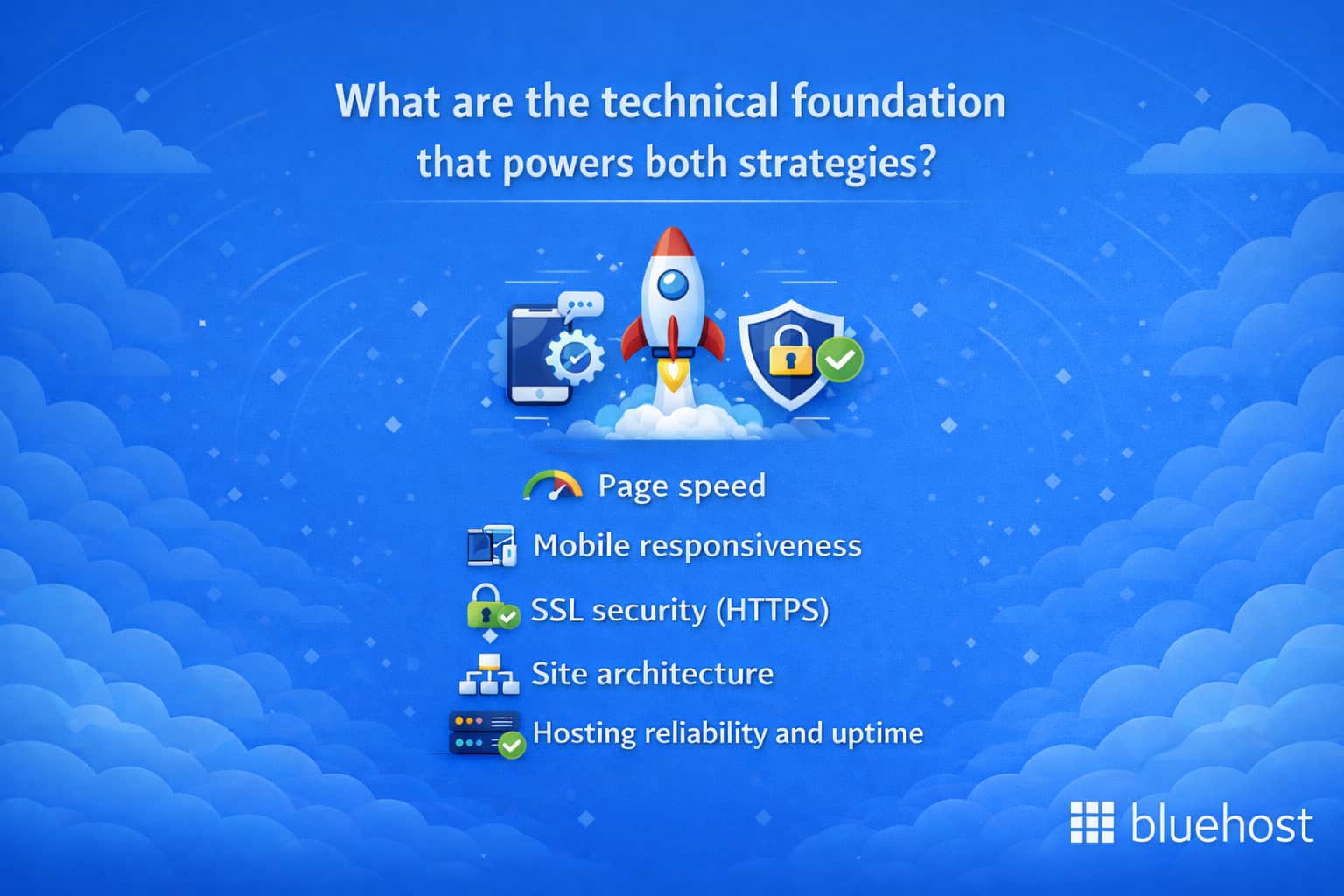
Regardless of whether you choose SEO, SEM or a combination of both, every effective search strategy requires a solid technical foundation. Your website’s performance directly impacts your organic rankings and your SEM Quality Score, making hosting infrastructure and site health a shared priority for both channels.
Technical factors that affect both SEO and SEM performance
- Page speed: Slow-loading pages hurt organic rankings and increase bounce rates for paid ad visitors, reducing the return on every dollar spent
- Mobile responsiveness: Google’s mobile-first indexing penalizes non-mobile-friendly sites in organic search, and poor mobile experience directly reduces SEM Quality Scores
- SSL security (HTTPS): A secure website is a confirmed Google ranking signal and builds user trust, essential for converting both organic and paid visitors
- Site architecture: Clear, logical site structure supports search engine crawlability and ensures users can navigate easily after clicking your ads
- Hosting reliability and uptime: Consistent uptime ensures your site is always available to search engines and visitors, downtime can result in lost rankings and wasted ad spend
SEO vs SEM: What future trends should businesses watch?
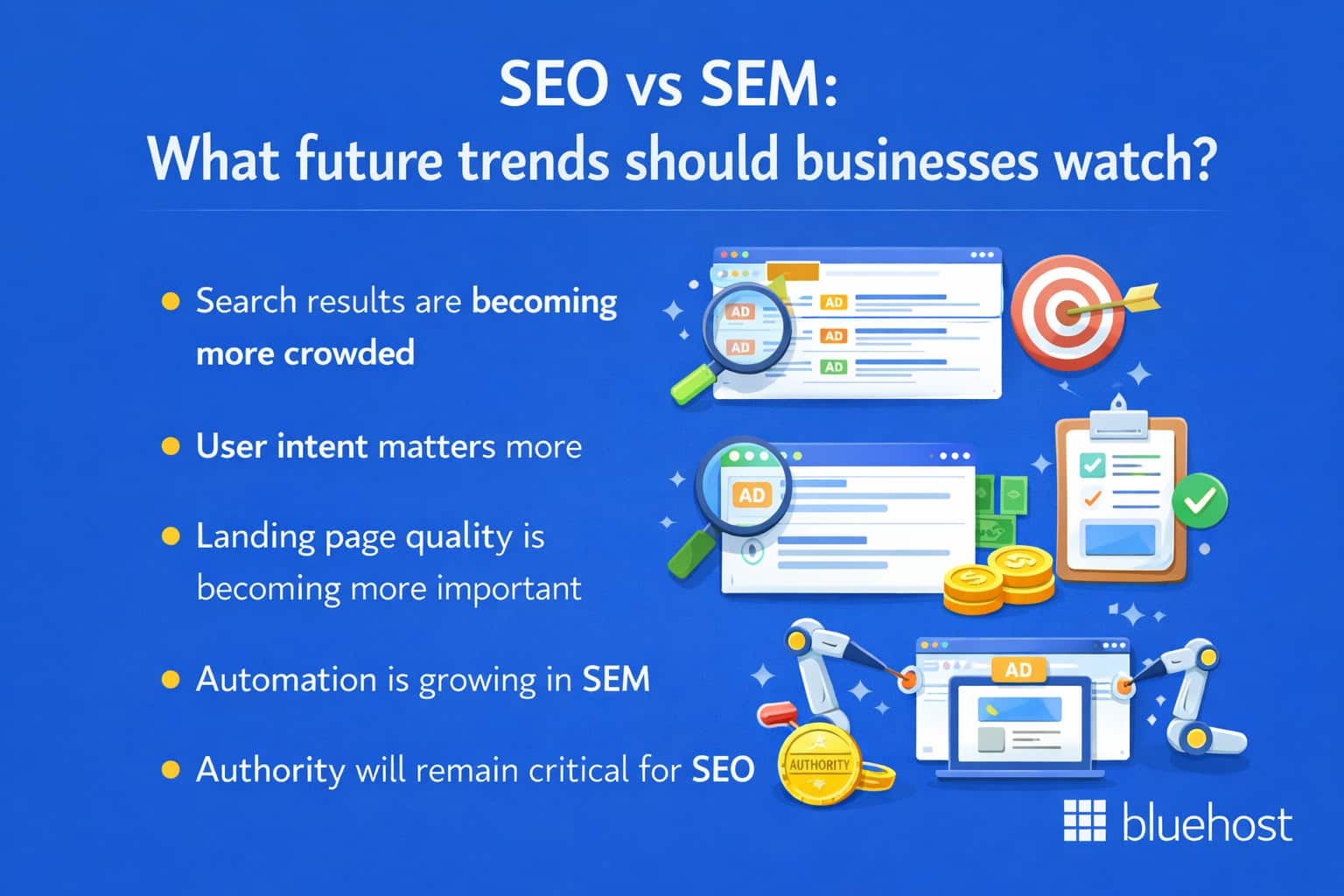
Search is evolving quickly, which means the SEO vs SEM decision is becoming more connected over time.
Key trends to watch include:
- Search results are becoming more crowded: Ads, local packs, shopping listings and AI-generated results are all competing for attention.
- User intent matters more: Both SEO and SEM are shifting toward stronger alignment with what users actually want, not just exact keyword matches.
- Landing page quality is becoming more important: Fast, relevant pages will play a bigger role in both organic visibility and paid performance.
- Automation is growing in SEM: Bidding, targeting and ad delivery increasingly rely on machine learning and accurate conversion data.
- Authority will remain critical for SEO: Businesses with useful, well-structured content will be better positioned to earn long-term visibility.
As search changes, SEO vs SEM will become less about choosing one over the other and more about using both effectively.
How can Bluehost Full Service + SEO support your search strategy?
For businesses seeking the benefits of both SEO and expert website management, Bluehost Full Service + SEO is an all-in-one solution for small and medium-sized businesses that need a professional online presence without the hassle of building and maintaining it themselves.
It combines custom website design, SEO support and ongoing maintenance in a fully managed experience focused on visibility, performance and growth.
What Bluehost Full Service + SEO includes:
- Custom WordPress website design: The service includes a five-page WordPress website with a home page, about page, contact page, two service pages, up to 25 images and a built-in blog.
- Project consultation and brand-based design: Customers meet with a marketing expert for keyword research and content creation input, complete a questionnaire for business goals and design preferences and have the site designed using their existing logo, colors and images.
- SEO-friendly website content: Bluehost’s team creates up to five pages of SEO-friendly content, including keyword phrases, image alt tags, meta tags and title tags.
- Built-in SEO tools and support: The offer includes Website Analytics, Simple SEO, two hours per month of expert on-page SEO through SEO Assist, 10 local citation links through SEO Backlinks, monthly strategy discussions with a dedicated online marketing account manager through Pro SEO Support Plus and ongoing Pro Support for site updates and maintenance.
- Ongoing website updates: After launch, the service supports unlimited website changes such as copy, image, product and design tweaks, up to five new pages per month with one page of content creation included and up to 10 blog transfers per month. It also includes updates to design-approved plugins and WordPress core.
- Optional eCommerce add-on: Bluehost offers an eCommerce add-on that includes WooCommerce setup with up to 10 products and payment gateway configuration.
By combining custom website design, SEO support and ongoing maintenance, Bluehost Full Service + SEO helps businesses stay visible online while saving time behind the scenes.
Final thoughts
The SEO vs SEM debate lacks a one-size-fits-all answer. SEO is a long-term investment in visibility and credibility, while SEM serves as a precision tool for generating immediate, targeted traffic.
Understanding how SEO (crawling and ranking) and SEM (bidding and Ad Rank) function allows for smarter strategic decisions. Most effective growth strategies leverage SEM for early momentum while SEO builds a compounding organic foundation for lasting results.
Start by evaluating your timeline and budget. To succeed in search, your website needs a high-performance hosting platform that ensures the speed and technical health required for high rankings.
Maximize your visibility with Bluehost Full Service + SEO. Let our experts build and optimize your search strategy so you can focus on running your business.
FAQs
SEO (search engine optimization) focuses on earning organic, unpaid visibility in search results through content quality, technical improvements and link building. SEM (search engine marketing) refers to gaining paid visibility through platforms like Google Ads. SEO builds long-term, compounding traffic while SEM delivers immediate results tied directly to ongoing ad spend.
Most businesses begin to see meaningful organic results from SEO within three to six months of consistent effort. However, the timeline varies based on competition, domain authority, content quality and technical health. Highly competitive industries may take 12 months or longer to see significant ranking improvements.
SEM can be highly effective for small businesses, particularly for time-sensitive campaigns or in competitive markets where organic ranking is difficult to achieve quickly. The key is setting a realistic budget, targeting specific high-intent keywords and continuously optimizing campaigns based on performance data to maximize return on ad spend.
Yes, and in many cases, using both is the most effective approach. SEM provides immediate traffic while your organic SEO strategy builds over time. Additionally, SEM performance data can reveal which keywords convert best, informing your long-term SEO content strategy and reducing wasted effort.
Absolutely. Website hosting directly impacts page load speed, uptime and server response times, all of which are confirmed Google ranking factors. A slow or frequently unavailable website can significantly harm organic rankings and reduce the effectiveness of your SEM campaigns by increasing bounce rates and lowering Quality Scores.
When comparing SEO vs SEM, beginners often find SEM easier to start with because it can generate traffic quickly through paid ads. However, SEO is often more sustainable for long-term growth since it builds organic visibility without ongoing ad costs. Many beginners start with SEM to test keywords and then invest in SEO to build lasting traffic.
When launching a new website, the SEO vs SEM decision often comes down to how urgently traffic is needed. SEO can take several months to build strong organic rankings, as search engines must crawl, index and establish trust in a new domain. SEM, by contrast, delivers immediate paid search visibility while the long-term SEO strategy gains momentum. Many new businesses start with SEM for fast wins and progressively shift budget toward SEO as organic presence strengthens over time.
Yes, businesses often target the same keywords in both SEO vs SEM strategies. Running SEM campaigns for important keywords can help secure immediate search visibility, while SEO efforts aim to rank organically for those same terms over time. This dual approach can increase total search exposure and improve overall traffic potential.
Competition plays a major role in the SEO vs SEM decision. In highly competitive industries, ranking organically through SEO can take significant time and resources. SEM allows businesses to compete immediately by bidding on high-value keywords. In less competitive niches, SEO may provide a faster path to visibility with lower long-term costs.
Tracking the right metrics is essential when evaluating SEO vs SEM performance side by side. In the SEO vs SEM comparison, organic search success is gauged through keyword rankings, organic traffic growth, user engagement and long-term conversion trends, while SEM performance relies on paid metrics such as click-through rate (CTR), cost per click (CPC), conversion rate and return on ad spend (ROAS). Analysing both search engine optimization and paid search data together gives businesses a complete picture of their overall search marketing effectiveness and helps guide smarter budget decisions.

Write A Comment