
In a recent SEJ Live Q1 2026 panel titled “What’s Hot, What’s Not,” three Search Engine Journal leaders came together to break down how AI is reshaping search.
The conversation focused on what has already changed and more importantly, what marketers should focus on going into Q2.
Loren Baker examined the business impact, Matt Southern broke down the shift in search behavior and Shelley Walsh focused on how content is being affected. The complete recorded discussion is available here.
At the center of the conversation was a clear question: what should experienced marketers do next?
The answers point to a deeper transformation. Search is not disappearing, but the way it works is changing fast.
Here are five facts that emerged from that discussion and reveal what is actually happening.
How this analysis was compiled
This article is based on our thorough analysis of the SEJ Live Q1 2026 panel discussion, supported by third-party research including Pew Research and Advanced Web Ranking. Our findings reflect observed trends in search behavior and should be viewed as point-in-time insights as AI search continues to evolve.
1. AI overviews are cutting traffic nearly in half
The relationship between ranking high and getting clicks is undergoing a clear structural shift. As AI becomes part of the search experience, visibility alone is no longer enough to drive traffic, a shift already explored in The End of the Click? How Generative AI Is Rewriting Google Search.
The 46% drop is real and consistent
Data shared during the Search Engine Journal Q1 2026 discussion highlights just how significant this change is.
Matt pointed to a Pew study based on thousands of real queries, which found that click-through rates drop by as much as 46% when an AI overview appears. He also noted that this is not an isolated trend, with platforms like Ahrefs and Similarweb reporting similar patterns.
Adding to this, Shelley referenced Advanced Web Ranking data showing a 32% decline in CTR across search results that feature AI overviews.
Together, these findings point to more than just temporary fluctuation. They signal a deeper change in how users interact with search.
Also read: Google AI Latest Update: What Website Owners Must Know
Why is this happening
The drop is driven by a fundamental change in how users interact with search.
AI overviews now deliver complete answers directly on the results page. In many cases, users get what they need without clicking through to a website at all.
What this means
Together, these findings point to more than temporary fluctuation.
They signal a shift where traffic is no longer guaranteed by visibility alone. Even high-ranking pages can lose clicks if the answer is already resolved within the search experience.
2. AI search is already operating at a massive scale
This is no longer an experiment. It has moved into a full-scale, commercial phase of search.
As Matt noted in the discussion, Google’s AI Mode has now crossed 100 million monthly active users, with approximately 75 million people using it daily. What was once positioned as an emerging feature is quickly becoming a primary interface for search.
But the more significant shift is not just scale. It is how people search within this environment.
Users are moving away from short, keyword-based queries and toward more detailed, conversational prompts. Instead of typing something like “best restaurants near me,” they are asking:
“Find a pet-friendly Italian restaurant nearby with vegan options and outdoor seating.”
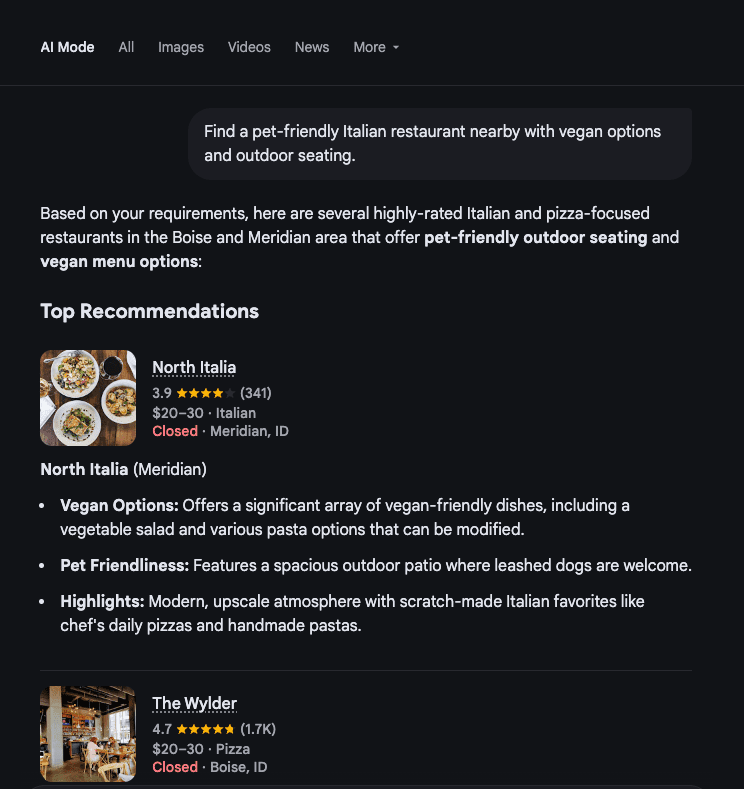
This example, also highlighted in commentary from Google leadership, reflects a broader behavioral shift from keyword matching to intent-driven interaction.
Search is becoming conversational.
And as that shift takes hold, the way content is discovered and surfaced is changing with it.
What marketers should do now?
If search is becoming conversational, your content needs to match that intent.
Stop optimizing for short keywords alone. Start structuring content around real questions, layered intent and complete answers. Think in terms of how a user would ask, not just what they would type.
This also means going beyond single-page optimization. Build content that can handle follow-ups, context and specificity, because that is how AI systems evaluate relevance.
The shift is simple to understand but harder to execute:
You are no longer writing for queries. You are writing for conversations.
3. The need to click is disappearing
For many searches, the journey now ends on the results page.
Shelley explains that for informational queries, AI can now summarize results more efficiently than a standard webpage. When the answer is already presented clearly within the search interface, the incentive to click simply disappears.
She points to a growing category of content that is losing visibility, which she describes as “replaceable informational content.” This includes pages built around answering basic queries such as “what is,” “how to,” or “best way to.” Because these can be easily synthesized, they are increasingly absorbed into AI-generated summaries.
The result is a clear pattern. Content that once drove top-of-the-funnel traffic is now being replaced at the source.
How to stay relevant in this shift
If AI can answer the basics, basic content should no longer be your growth strategy.
Use simple informational pages to support relevance and coverage, but stop expecting them to carry traffic on their own. The stronger play is to build content that adds what AI summaries cannot: original data, real experience, strong opinions, implementation detail and brand perspective, especially as generic content continues to lose value.
In other words, do not compete on what can be summarized. Compete on what is worth clicking for.
4. Ranking high no longer means being seen
Even top positions are losing their advantage.
As Matt explained, AI overviews are breaking the link between rankings and traffic by delivering complete answers before users ever reach organic results. He summed up the shift clearly:
“Being visible in search and being included in the answer are no longer the same thing.”
Shelley Walsh added that even a number one ranking can be pushed out of view by SERP “noise” like ads, carousels and AI layers, especially on mobile.
At the same time, Google’s AI Mode is moving beyond ranked lists entirely, assembling a single, synthesized response where position matters less than inclusion.
Lauren pointed out what drives that inclusion: not just links, but whether your brand is recognized as a credible entity. Strong brand signals and consistent presence increase the chances of being cited.
The shift is clear:
Visibility is no longer tied to ranking. It depends on whether your content is selected and included in the answer.
5. The shift from rankings to citation visibility
As AI-generated answers replace lists of links, the definition of success in search is shifting from rankings to citation visibility.
In AI Mode, Google is no longer presenting ranked results. It generates a single response and only a few sources are included. As Matt noted, this shifts the focus from rankings to citation visibility; whether your content is pulled into the answer and how it performs when cited.
Shelley explained what drives inclusion. She pointed to “golden knowledge,” meaning original data, first-hand experience and expert insight, as the kind of content AI cannot easily replicate.
She also noted that users still click for depth, nuance and implementation details, especially when they trust the source. In fact, branded queries can see an 18% increase in CTR, even with AI overviews present.
From a technical standpoint, Lauren added that being cited depends on how well a brand is defined as an entity. Strong brand signals, structured data and AI-readable formats increase the likelihood of being selected.
Success is no longer about ranking higher. It is about being recognized, trusted and included in the answer. The direction of search is no longer uncertain. The real question is how marketers should adapt as we move into Q2 2026.
What marketers need to do heading into Q2 2026
The discussion makes one thing clear. The shift is already underway. As you head into Q2 2026, the focus needs to move beyond traditional SEO toward AI Optimization and stronger brand authority. You will have to renew the way you measure SEO performance in 2026.
1. Rethink how you measure success
Matt pointed out that ranking positions are becoming less meaningful in an AI-driven search environment.
For you, this means shifting your focus to citation visibility. Instead of asking where you rank, start tracking when your content is included in AI-generated answers and how it performs when cited. At the same time, place more weight on conversions and actual business impact, not just traffic.
2. Create content AI cannot replace
Shelley explained that a large portion of informational content is becoming replaceable.
This is where your strategy needs to evolve. Focus on golden knowledge such as original research, first-hand experience and expert insight. Build content that adds depth, nuance and real-world application, because that is what still drives clicks beyond AI summaries.
3. Make your content easier for AI to understand
From a technical standpoint, Loren Baker highlighted how content now needs to be structured for AI systems.
For you, this means strengthening entity signals, using structured data and adopting cleaner formats that AI can easily process. The goal is not just to rank, but to increase your chances of being selected and cited.
4. Build authority beyond your website
The discussion also made it clear that AI pulls information from across the web.
To stay competitive, you need to build a consistent presence across platforms like YouTube, LinkedIn and Reddit, while positioning your website as the central hub. The stronger your cross-channel signals, the more likely your brand is to be recognized as an authority.
5. Prepare for a shift in traffic and growth
The experts also highlighted a broader change in how growth will work.
As traffic becomes less reliable, you should start investing in direct audience channels, stronger brand recall and strategies that are not dependent on search volume alone.
A simple action plan for small businesses
From what we at Bluehost are seeing across evolving search trends and customer behavior, the shift to AI-driven discovery is already changing how small businesses need to operate online.
If AI search is changing how people find and trust your business, the next step is not more content. It is better content and a stronger foundation.
We recommend you start with these actions:
- Audit your most important pages for clarity, trust and structure
- Strengthen your branded search presence so people look for you directly
- Build content that AI can cite and customers can act on
- Focus on pages that convert, not just pages that rank
Then make sure your infrastructure supports that effort.
A fast, stable hosting environment helps your site load quickly, stay available during traffic spikes and deliver a consistent experience. This plays a direct role in how users engage and whether they convert.
If you are building for long-term visibility, your platform matters just as much as your content.
What works in AI search now and what no longer does
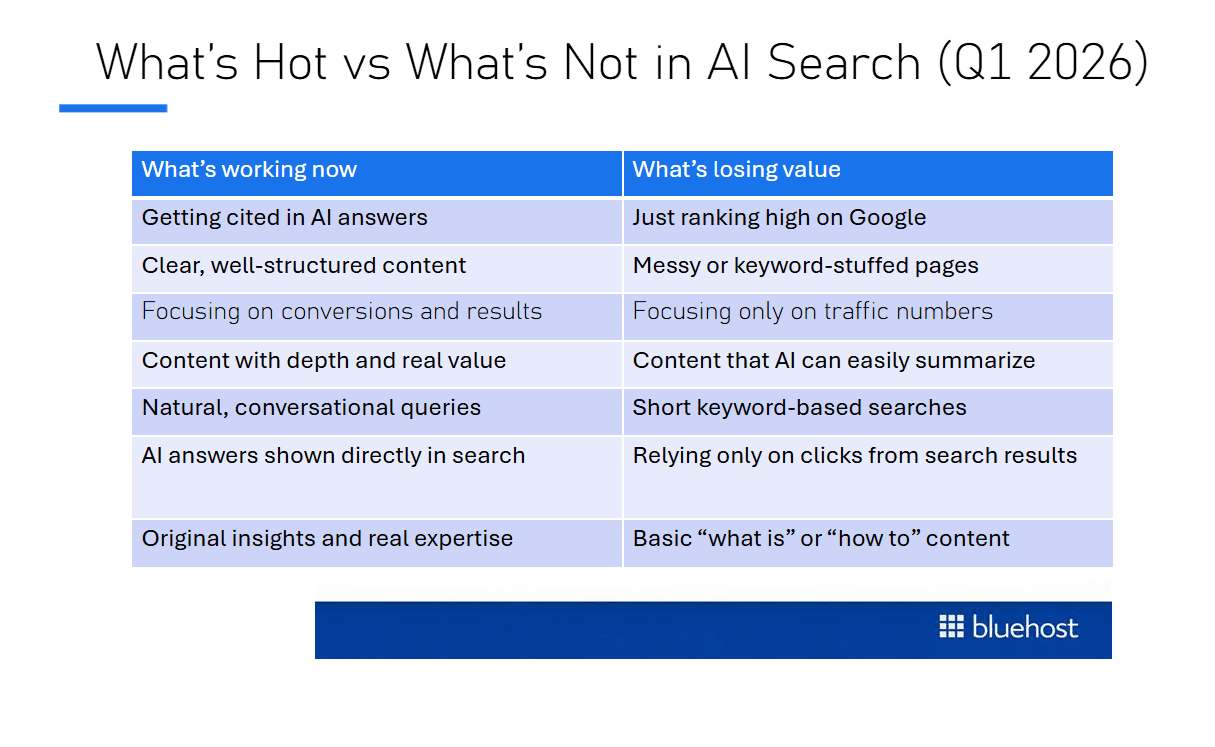
Based on our industry analysis and a detailed review of the panel discussion, AI search is shifting what success looks like. It is no longer enough to rank high or publish basic informational content. As AI answers take over the search experience, visibility depends on whether your content is selected, cited and trusted.
This means focusing on clear structure, original insights and real expertise, while moving away from keyword-heavy pages and traffic-first thinking.
The direction is clear: content that adds real value will stand out, while content that can be easily summarized will continue to lose impact.
The future of search is selection, not ranking
Our understanding of the evolving search landscape and a close reading of the SEJ panel discussion revealed that search is no longer just about discovery. It is becoming a decision layer where AI shapes what users see, trust and act on.
Ranking is no longer enough. Your content must be selected, understood and cited. That shifts the focus from volume to value. Generic content will fade. Original insight, real experience and clear structure will win.
We also see that traffic will become less reliable as a success metric. Growth will come from brand recall, trust and conversions, not just clicks.
This is not the end of SEO. It is a reset.
The winners will treat SEO as a system for building authority across channels, not just a way to rank pages.
The real question now is simple: Does your content deserve to be chosen?

Write A Comment