 ChatGPT,
 Claude,
 Gemini,
 Grok — all four for
Key highlights
- Understand the core differences between agency hosting and reseller hosting.
- Learn which hosting model fits different agency workflows and business goals.
- Compare scalability, operational management and client responsibilities.
- Explore the revenue and profitability differences between both hosting models.
- Discover when agencies should choose agency hosting, reseller hosting or a hybrid approach.
Agency hosting and reseller hosting are designed for different business goals. Reseller hosting focuses on selling web hosting services, while agency hosting focuses on simplifying multiple site management, workflows and operational scalability.
Many agencies start with reseller hosting because it creates an opportunity to offer hosting services directly to clients. This model works well for businesses focused on selling hosting under their own brand or managing separate client accounts.
However, as agencies grow, managing multiple hosting accounts, support requests and operational tasks can become increasingly complex. This is where agency hosting offers a different approach.
Understanding the difference between the two helps agencies choose the right hosting model based on client management style, technical requirements and long-term growth plans.
Agency hosting vs reseller hosting: Quick answer
Agency hosting is designed for centralized website management across multiple client sites, while reseller hosting is designed for selling hosting services through separate client accounts. Agency hosting focuses on simplifying workflows and multi-site management, while reseller hosting focuses on recurring hosting revenue and white-label hosting services.
What is agency hosting?
Agency hosting is a hosting model designed for agencies managing multiple client websites from a centralized platform. It focuses on simplifying website management, improving operational efficiency and supporting long-term scalability.
Unlike traditional hosting setups, agency hosting allows teams to manage updates, backups, performance monitoring and workflows across multiple websites from one dashboard. Most agency hosting platforms also include tools such as staging environments, cloning and bulk updates to reduce repetitive manual work.
The primary goal of agency hosting is operational efficiency. Instead of managing separate hosting accounts for every client, agencies can streamline website management and scale client portfolios without significantly increasing administrative complexity.
Agency hosting is commonly used by:
- Web design agencies
- Marketing agencies
- Freelance developers
- Businesses managing multiple WordPress websites
For example, a growing agency managing 30 client websites can use agency hosting to update plugins, monitor uptime and manage staging environments from one centralized workflow instead of handling each website individually.
While agency hosting focuses on operational efficiency and centralized management, reseller hosting follows a different business model centered around selling hosting to clients.
Also read: What Is Agency Hosting? A Complete Guide for Growing Agencies
What is reseller hosting?
Reseller hosting is a hosting model that allows agencies and businesses to sell hosting services to their clients. Instead of managing websites through a centralized platform, resellers typically create separate hosting accounts for each customer.
Many reseller hosting solutions include white-label capabilities, allowing agencies to offer hosting under their own brand. This model is commonly used by businesses looking to generate recurring revenue through hosting services while managing client accounts, billing and support.
Example:
A web design agency can create individual hosting accounts for clients, package hosting as part of its services and charge recurring hosting fees under its own brand.
Key characteristics of reseller hosting
- Separate hosting accounts for each client
- White-label hosting capabilities
- Recurring revenue opportunities
- Greater responsibility for billing, support and account management
While both agency hosting and reseller hosting support multi-client businesses, they solve different operational and business challenges. For agencies that want to build a branded hosting business, understanding how reseller hosting works in detail is critical when choosing the right hosting model.
Agency Hosting vs Reseller Hosting: What is the main difference?
The main difference between agency hosting and reseller hosting is how agencies manage websites and client hosting relationships.
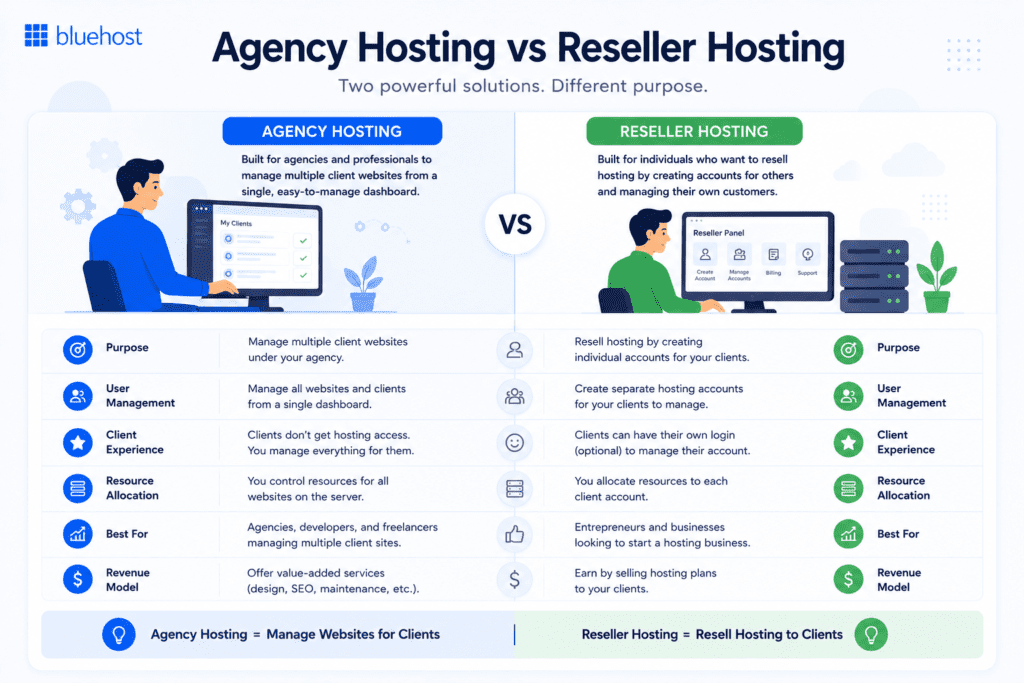
Agency hosting is typically designed for centralized website management across multiple client sites. Reseller hosting is typically designed for selling hosting services through separate client hosting accounts. For example, a WordPress agency managing 80 client websites may prefer agency hosting to simplify plugin updates, uptime monitoring and staging deployments from one platform.
In comparison, an agency selling hosting plans to clients may prefer reseller hosting because it allows separate hosting accounts, custom hosting packages and client-specific billing structures. While both hosting models support multi-client businesses, the operational responsibilities and scaling approaches are different.
Comparison note
The comparison below reflects common hosting-model patterns. Features, workflows and white-label capabilities may vary depending on the hosting provider and implementation.
Agency hosting vs reseller hosting comparison
| Feature | Agency Hosting | Reseller Hosting |
| Primary focus | Website management efficiency | Hosting resale and recurring revenue |
| Website management | Centralized dashboard | Separate client accounts |
| Operational complexity | Lower | Higher |
| White-label hosting | Limited or provider-based | Commonly supported |
| Client billing management | Usually not required | Managed by reseller |
| Workflow tools | Staging, cloning, bulk updates | Hosting account management |
| Best for | Agencies managing websites | Agencies selling web hosting services |
| Scaling approach | Multi-site operational scaling | Hosting account scaling |
How the operational approach differs?
With agency hosting, agencies typically retain centralized control over all client websites. Teams can manage updates, backups, monitoring and workflows from one environment.
With reseller hosting, every client usually operates within a separate hosting account. This provides stronger account separation but also increases management overhead related to provisioning, billing and support.
How the business model differs
Agency hosting is often chosen by agencies focused on operational efficiency, website performance and scalable workflows. Reseller hosting is commonly chosen by businesses that want to monetize hosting directly and create recurring revenue streams through client hosting plans.
Which model is simpler to operate?
For most growing agencies managing multiple websites, agency hosting is generally simpler operationally because workflows are centralized.
Reseller hosting typically requires more involvement in:
- Hosting administration
- Client account management
- Billing operations
- Technical support coordination
However, reseller hosting can provide greater flexibility for agencies that want full ownership of the hosting relationship with clients. Management complexity often becomes the deciding factor between agency hosting and reseller hosting. Understanding the day-to-day operational differences helps agencies choose the right long-term model.
Which hosting model is easier to manage?
For most growing agencies, agency hosting is generally easier to manage because it centralizes website operations into one workflow. Reseller hosting provides greater client account separation, but it also introduces additional administrative responsibilities.
The right choice depends on whether your agency prioritizes operational efficiency or hosting resale management.
Managing websites with agency hosting
Agency hosting is designed to simplify multi-site management. Agencies can manage updates, backups, monitoring and staging environments from one centralized dashboard.
This model reduces the need to switch between multiple hosting accounts and helps teams standardize workflows across client websites.
For example, an agency managing 40 WordPress websites can perform plugin updates, monitor uptime and manage staging environments from one platform instead of accessing separate client accounts individually.
Managing websites with reseller hosting
Reseller hosting separates every client into an individual hosting account. This structure provides stronger account isolation and greater flexibility for client-specific hosting plans.
However, agencies often become responsible for:
- Account provisioning
- Hosting plan allocation
- Client billing
- Support coordination
- Hosting-related troubleshooting
As the number of clients grows, these operational responsibilities can increase significantly.
Operational complexity comparison
Agency hosting is best for agencies that want:
- Centralized workflows
- Faster website management
- Lower operational overhead
- Simplified scaling
Reseller hosting is best for agencies that want:
- Separate client hosting environments
- White-label hosting services
- Greater control over hosting packages
- Recurring hosting revenue opportunities
Which option saves more time?
For agencies primarily focused on website management and client delivery, agency hosting usually saves more operational time because workflows are centralized. On the other hand, agencies focused on selling hosting services directly, reseller hosting offers more business flexibility but often requires additional time spent managing infrastructure and client accounts.
Management efficiency is only one part of the decision. Scalability also plays a major role, especially for agencies planning to grow their client portfolio over time.
Agency Hosting vs Reseller Hosting: Scalability comparison
Scalability looks different in agency hosting and reseller hosting because both models support different growth strategies. Agency hosting focuses on scaling website management across multiple client sites, while reseller hosting focuses on scaling hosting services through separate client accounts.
Scalability at a glance
| Factor | Agency Hosting | Reseller Hosting |
| Scaling approach | Add and manage more websites from one platform | Add more individual client hosting accounts |
| Management model | Centralized website management | Separate account management |
| Operational overhead | Typically grows slowly | Typically grows with each client account |
| Client onboarding | Streamlined through shared workflows | Requires account provisioning and setup |
| Billing management | Usually simplified | Managed separately for each client |
| Best suited for | Agencies managing multiple websites | Agencies selling hosting services |
| Scalability advantage | Efficient multi-site growth | Flexible hosting resale growth |
How each model scales
Agency hosting is designed to help agencies grow their client portfolios without significantly increasing administrative work. Teams can continue managing updates, monitoring, backups, staging environments and performance optimization from a single platform.
For example, an agency managing 100 WordPress websites can maintain one workflow for plugin updates, uptime monitoring and staging deployments instead of managing separate hosting environments for every client.
Reseller hosting scales by increasing the number of client hosting accounts. This model works well for agencies offering hosting services, custom hosting packages and white-label hosting solutions. However, additional responsibilities such as account provisioning, billing management, resource allocation and client support often increase as the client base grows.
Which hosting model is easier to scale?
Agency hosting is often easier to scale for agencies focused on website management because workflows remain centralized as more sites are added.
For example, an agency managing WooCommerce stores across 60 client websites can monitor uptime, deploy plugin updates and manage staging environments from one platform instead of switching between separate client accounts.
Reseller hosting can also scale effectively, but operational complexity often grows alongside the number of hosting accounts being managed.
Operational complexity by agency size
| Number of websites | Recommended approach |
| 1–20 websites | Agency Hosting or Reseller Hosting |
| 20–100 websites | Agency Hosting |
| 100+ websites | Agency Hosting with VPS or Dedicated infrastructure |
As website portfolios grow, centralized management often becomes easier to maintain than managing separate hosting accounts for every client. Scalability is only one part of the decision. Client management requirements can also play a major role when choosing between agency hosting and reseller hosting.
Which option is better for client management?
Client management works very differently in agency hosting and reseller hosting because both models are designed around different operational structures. Agency hosting focuses on centralized website management for internal agency teams. Reseller hosting focuses on creating separate hosting environments for individual clients.
The better option depends on how much control, separation and operational responsibility your agency wants to manage.
Client management in agency hosting
Agency hosting is designed for agencies that want to manage all client websites from one platform. Teams typically retain centralized access to updates, backups, staging environments and performance monitoring.
This structure helps agencies:
- Standardize workflows
- Reduce repetitive management tasks
- Simplify website maintenance
- Manage large client portfolios more efficiently
For example, an agency managing 50 client websites can monitor performance, apply updates and manage staging workflows from one dashboard instead of accessing separate hosting accounts.
Client management in reseller hosting
Reseller hosting creates separate hosting accounts for each client. This gives agencies more flexibility to offer custom hosting plans and white-label reseller hosting.
Clients may also receive individual hosting access depending on the reseller setup.
This model is commonly used by agencies that want to:
- Sell hosting directly to clients
- Offer branded hosting services
- Separate client environments completely
- Manage independent hosting packages
However, agencies often become responsible for:
- Hosting account provisioning
- Client support coordination
- Resource management
- Billing administration
Centralized vs separated management
Agency hosting is best for agencies that want:
- Centralized workflows
- Simplified website management
- Faster operational processes
- Internal team efficiency
Reseller hosting is best for agencies that want:
- Independent client hosting accounts
- White-label hosting services
- Client-level hosting separation
- Greater hosting customization
Which model offers better operational control?
Agency hosting usually provides better operational efficiency because everything is managed from one environment. Reseller hosting provides stronger account-level separation and greater flexibility for client-specific hosting services, but it often requires more administrative involvement as the client base grows.
Management structure affects day-to-day operations, but cost and profitability often become the biggest deciding factors when choosing between agency hosting and reseller hosting.
Agency Hosting vs Reseller Hosting: Cost and profitability
Cost structures differ because agency hosting and reseller hosting support different business models. Agency hosting is designed to simplify website management through predictable pricing, while reseller hosting creates opportunities to generate recurring revenue from hosting services.
Cost and profitability at a glance
| Factor | Agency Hosting | Reseller Hosting |
| Cost model | Predictable cost per site | Resource allocation across client accounts |
| Revenue opportunity | Primarily from agency services | Hosting sales and recurring revenue |
| Client billing | Typically not required | Managed by the reseller |
| Support responsibility | Typically lower | Typically higher |
| Third-party tool dependency | Often reduced with bundled features | Varies by hosting setup |
| Administrative overhead | Typically lower | Typically higher |
| Best suited for | Agencies managing client websites | Agencies selling hosting services |
How agency hosting impacts costs
Agency hosting typically uses a centralized pricing model based on the number of websites, infrastructure resources and included workflow tools. Many plans also bundle features such as backups, CDN integration, security tools and staging environments, reducing the need for additional services.
For example, an agency managing 40 websites can often estimate costs using a predictable cost-per-site model rather than managing separate hosting invoices for every client.
How reseller hosting impacts costs
Reseller hosting allows agencies to purchase hosting resources and distribute them across client accounts. This creates opportunities to generate recurring revenue through hosting packages and bundled services.
However, reseller hosting may also introduce additional costs related to client support, billing systems, account management and white-label tooling. As the number of client accounts grows, these responsibilities can increase operational overhead.
Which hosting model offers better long-term value?
The answer depends on how your agency operates.
Agency hosting is often a better fit for agencies focused on website management, streamlined workflows and reducing administrative complexity.
Reseller hosting is often a better fit for agencies that want to build recurring hosting revenue through client hosting plans and branded hosting services.
Profitability depends on several factors, including pricing strategy, support requirements, tooling costs, client retention and the amount of time spent managing hosting operations.
Which model fits your business goals?
| If your goal is to… | Consider |
| Manage multiple client websites efficiently | Agency Hosting |
| Reduce administrative overhead | Agency Hosting |
| Scale WordPress management workflows | Agency Hosting |
| Sell hosting services to clients | Reseller Hosting |
| Create recurring hosting revenue | Reseller Hosting |
Cost is only one factor in the decision. The best hosting model also depends on your agency’s workflows, client relationships and long-term growth strategy.
When should agencies choose reseller hosting?
Reseller hosting is best for agencies that want to offer hosting as a standalone service alongside website development, maintenance or digital marketing.
Instead of only managing websites, agencies using resell hosting also manage the hosting relationship with clients. This allows businesses to create recurring revenue streams through branded hosting services and custom hosting packages.
Reseller hosting is a good fit for agencies that:
Want to sell hosting services directly: Agencies can create hosting plans, bundle hosting into retainers and generate recurring monthly or annual revenue.
Need separate client hosting accounts: Every new client receives an independent hosting environment, which helps with account separation and client-specific hosting management.
Want white-label hosting capabilities: Many reputable hosting providers allow agencies to use custom branding for hosting dashboards, packages and client communication.
Manage client-owned hosting relationships : Reseller hosting works well when clients need direct access to their hosting environment or require independent account ownership.
For example: A web design agency building websites for small businesses may use reseller hosting to create branded hosting packages for every client. The agency manages billing, account setup and hosting support while generating recurring revenue from hosting subscriptions.
When reseller hosting may become operationally complex
As the number of client accounts grows, traditional reseller hosting can introduce additional administrative responsibilities related to:
- Account provisioning
- Resource allocation
- Client billing
- Hosting support
- Technical troubleshooting
For agencies focused primarily on website operations and workflow efficiency, this complexity can become difficult to manage at scale.
In summary
Reseller hosting business is typically the better option for:
- Agencies selling hosting services
- White-label hosting businesses
- Businesses focused on recurring hosting revenue
- Agencies needing separate client hosting accounts
While reseller hosting works well for agencies focused on hosting sales and client account separation, agency hosting is designed for businesses prioritizing operational efficiency and scalable website management.
When should agencies choose agency hosting?
Agency hosting is best for agencies that manage multiple client websites and want to simplify operations through centralized workflows and scalable infrastructure. Instead of managing separate hosting accounts for every client, agency hosting allows teams to manage websites, updates, staging environments and performance monitoring from one platform.
This model is designed for operational efficiency rather than hosting resale management.
Agency hosting is a good fit for agencies that:
Manage multiple WordPress websites: Agency hosting simplifies multi-site management through centralized dashboards and workflow tools.
Want to reduce operational overhead: Teams can streamline updates, backups, monitoring and maintenance without switching between multiple hosting accounts.
Need predictable scalability: Many agency hosting platforms use predictable cost-per-site pricing models, making long-term growth easier to forecast.
Prioritize workflow efficiency: Built-in tools such as staging, cloning and bulk updates help agencies manage larger client portfolios more efficiently.
For example: A digital agency managing 75 client WordPress websites can use agency hosting to centralize updates, monitor performance and manage staging environments from one workflow. This reduces administrative complexity and helps the team scale operations more efficiently.
When agency hosting becomes the better long-term option?
As agencies grow, centralized management often becomes more important than individual hosting account separation.
Agency hosting is typically better suited for:
- Growing website portfolios
- High-volume WordPress management
- Operational efficiency
- Faster internal workflows
- Simplified infrastructure management
Best fit summary
Agency hosting is usually the better option for:
- Agencies managing multiple websites
- Teams prioritizing workflow efficiency
- Businesses focused on scalable operations
- Agencies reducing operational complexity
For some agencies, the decision is not always limited to one hosting model. In certain workflows, agency hosting and resell hosting can work together to support different operational and business needs.
Can agencies use both agency hosting and reseller hosting?
Yes. Some agencies use both agency hosting and reseller hosting together to support different operational and business goals.
Agency hosting and reseller hosting are not always competing solutions. In many cases, they solve different problems within the same agency workflow. Agency hosting helps teams manage websites efficiently through centralized operations, while reseller hosting helps agencies offer hosting services directly to clients.
How agencies combine both hosting models
Some agencies use:
- Agency hosting for internal website management workflows
- Reseller hosting for client-owned hosting accounts and recurring hosting revenue
This hybrid approach allows agencies to separate operational management from hosting resale services.
Example hybrid workflow
A digital agency managing multiple WordPress websites may use agency hosting to centralize staging, updates and monitoring for managed client projects.
At the same time, the agency may offer reseller hosting to clients who want:
- Independent hosting access
- White-label services
- Separate billing structures
- Dedicated client hosting accounts
This allows the agency model to support different client requirements without relying on a single hosting model.
When a hybrid approach makes sense
Using both hosting models can work well for agencies that:
- Manage websites internally for some clients
- Sell hosting services to other clients
- Need operational efficiency and hosting revenue opportunities
- Support different client ownership structures
Potential operational considerations
While combining both models offers flexibility, it can also increase operational complexity.
Agencies may need to manage:
- Multiple hosting workflows
- Different support processes
- Separate billing structures
- Client-specific infrastructure requirements
The right setup depends on the agency’s business model, technical resources and long-term growth strategy. Choosing the right web hosting company becomes easier when agencies understand how different hosting solutions support specific growth stages and operational needs.
How Bluehost supports agencies at different growth stages?
Different agencies require different hosting solutions depending on the number of websites they manage, technical requirements and operational workflows. Bluehost offers multiple hosting options designed to support agencies as they grow.
From centralized WordPress management to advanced infrastructure environments, agencies can choose the hosting model that aligns with their business needs and scalability goals by considering the broader capabilities of Bluehost as a leading web hosting provider.
1. Bluehost Agency Hosting
Bluehost Agency Hosting is designed for agencies managing multiple websites through centralized workflows.
It helps agencies:
- Simplify website management
- Reduce operational overhead
- Scale client portfolios efficiently
- Manage updates and staging from one platform
This option is typically best for:
- Marketing agencies
- Web design agencies
- Freelance developers
- Businesses managing multiple WordPress websites
2. Bluehost reseller hosting capabilities
Bluehost also supports agencies interested in reseller-style hosting workflows through hosting environments that allow successful hosting businesses to manage and support multiple client sites.
This approach can help agencies:
- Offer hosting as part of client services
- Create recurring hosting revenue opportunities
- Manage client-specific hosting environments
- Support growing client portfolios
The right reseller setup depends on the agency’s operational structure and hosting requirements.
3. Bluehost VPS Hosting for Agency
Bluehost VPS Hosting provides dedicated resources and scalable infrastructure for agencies managing advanced applications and growing workloads.
It is commonly used by agencies that need:
- Greater server management flexibility
- Dedicated CPU and RAM
- Custom application environments
- Advanced development workflows
VPS (virtual private server) Hosting for Agency is often a good fit for technical teams managing APIs, custom applications and performance-intensive websites, and comparing Bluehost VPS hosting plans and features can help match resources to those workloads.
4. Bluehost Dedicated Hosting for Agency
Bluehost Dedicated Hosting is designed for agencies managing enterprise websites and mission-critical workloads, and agencies can compare Bluehost dedicated server hosting plan options to find the right balance of performance and control.
Dedicated infrastructure provides:
- Isolated server resources
- Advanced server control
- High-performance environments
- Greater infrastructure customization
This hosting model is commonly used for:
- Enterprise client websites
- High-traffic applications
- Performance-sensitive workloads
- Advanced hosting infrastructure requirements
Choosing the right Bluehost hosting solution
The best hosting solution depends on:
- Number of websites managed
- Operational workflows
- Technical expertise requirements
- Client management structure
- Long-term growth goals
Some agencies prioritize centralized website management, while others focus on hosting resale opportunities or advanced infrastructure flexibility. Comparing Bluehost vs Hostinger hosting providers can also clarify which underlying platform best supports these priorities. Choosing between agency hosting and shared reseller hosting ultimately depends on how your agency manages clients, operations and long-term business growth.
Best hosting model by agency type
| Agency type | Recommended hosting model |
| Freelancers managing client websites | Agency Hosting |
| WordPress-focused agencies | Agency Hosting |
| Agencies selling hosting services | Reseller Hosting |
| White-label hosting providers | Reseller Hosting |
| Large multi-site WordPress agencies | Agency Hosting |
| Agencies managing enterprise workloads | Agency Hosting + VPS/Dedicated |
How we evaluated agency hosting vs reseller hosting
This comparison is based on editorial analysis of common hosting workflows, agency operational patterns and provider documentation. The article evaluates how both hosting models differ in website management, scalability, client account structure and operational responsibilities.
Criteria reviewed
- Multi-site management workflows
- Client account management
- Support and billing responsibilities
- Scalability and operational overhead
- Fit for WordPress-heavy agency environments
Important considerations
Features, workflows and white-label capabilities vary by hosting provider and implementation. Profitability and scalability also depend on client volume, support requirements, tooling costs and operational structure.
Final thoughts: Agency Hosting vs Reseller Hosting
Agency hosting and reseller hosting support different agency goals. Agency hosting is better for businesses focused on centralized website management, operational efficiency and scalable workflows. Reseller hosting is better for agencies that want to sell hosting services and generate recurring hosting revenue through separate client accounts.
For many growing agencies, agency hosting provides a simpler long-term management model. However, reseller hosting remains valuable for businesses prioritizing white-label hosting and client-specific hosting services. The right choice depends on your agency’s workflows, technical requirements and long-term growth strategy. Simplify multiple site management and scale your agency workflows with Bluehost Agency Hosting, built for agencies managing growing client portfolios.
FAQs
Agency hosting is designed for managing multiple client websites through centralized workflows and operational tools. Reseller hosting is designed for selling hosting services through separate client hosting accounts and recurring hosting plans.
Yes. Reseller hosting is a good option for agencies that want to offer hosting services directly to clients, create recurring revenue streams and provide separate hosting accounts under their own brand.
Yes. Agencies can generate recurring monthly or annual revenue with reseller hosting by creating hosting packages, charging for website hosting and bundling hosting into client service plans.
For most growing agencies, agency hosting is better for managing multiple websites because it centralizes updates, backups, monitoring and staging workflows into one platform.
Agency hosting is generally easier to scale operationally because workflows remain centralized as more websites are added. Reseller hosting scales through separate client hosting accounts, which can increase administrative responsibilities over time.
Yes. Some agencies use agency hosting for centralized website management while also using reseller hosting to provide separate hosting accounts and hosting services for clients.
Bluehost offers multiple hosting solutions that support agencies managing and scaling client websites, including Bluehost Agency Hosting, VPS Hosting and Dedicated Hosting. Agencies looking for reseller-style workflows should evaluate hosting environments, client management requirements and operational structure based on their business needs.

Write A Comment