 ChatGPT,
 Claude,
 Gemini,
 Grok — all four for
Small business owners may be worrying about the wrong part of AI search.
A new Peec AI study conducted in 2026 suggests that changing the way customers phrase prompts in ChatGPT, Gemini or Perplexity may not significantly change which brands get recommended.
The study analyzed 37,804 AI responses across ChatGPT, Gemini, Perplexity, Google AI Overviews and Google AI Mode. Its main finding was clear: polished keyword-style prompts and casual conversational questions often surfaced the same brands.
That matters because many businesses are still thinking about AI visibility like traditional SEO. They are asking, “What should customers type?” But this study points to a bigger question: “Why would AI systems trust my brand enough to mention it at all?”
Methodology note: This article is based on findings from a Peec AI study reported in Search Engine Journal, which analyzed 37,804 AI responses across ChatGPT, Gemini, Perplexity, Google AI Overviews and Google AI Mode. The study tested how prompt wording, intent, format and funnel stage affected brand mentions in AI-generated answers. Our analysis builds on those reported findings and adds our own perspective on what they mean for small businesses, AI visibility and brand trust signals in 2026.
Prompt wording is not the variable you think it is
The study tested one simple idea: ask the same question in different ways and see whether AI engines recommend different brands.
They mostly did not.
This matches a pattern we at Bluehost are seeing more often in AI search: the system tries to understand the job behind the query before deciding which brands to mention. The wording still matters, but it matters less than the brand associations already available to the AI.
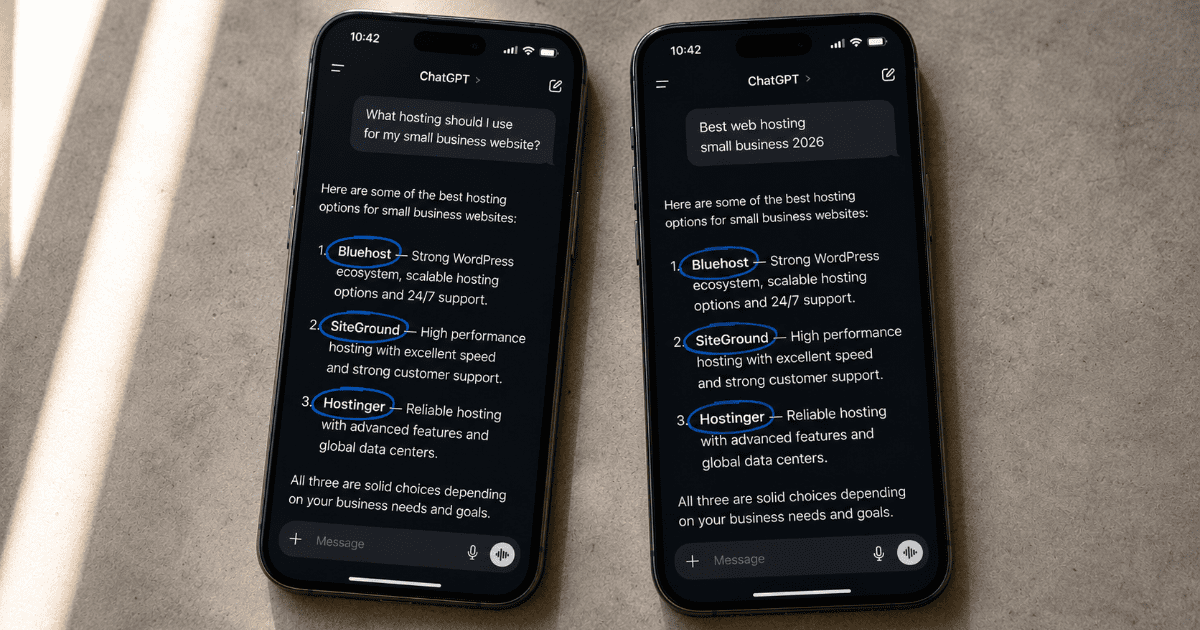
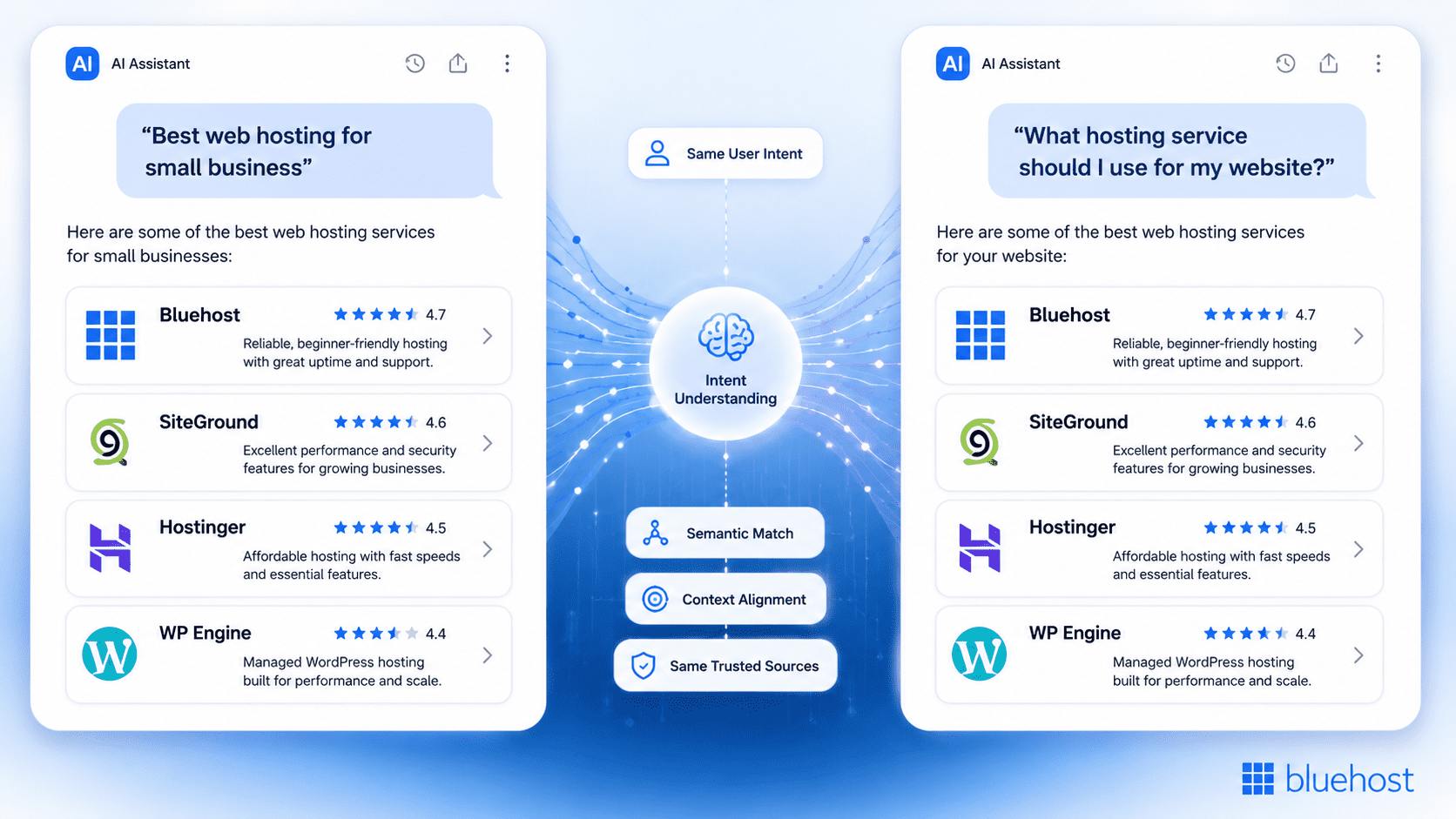
Across ChatGPT, Gemini, Perplexity, Google AI Overviews and Google AI Mode, brand recommendations stayed fairly consistent even when the prompt changed. A user asking “best web hosting for small business” and another asking “what hosting service should I use for my website” were likely to see many of the same names.
That points to an important shift. AI engines are not simply matching keywords. They are reading intent.
For business owners, that changes the visibility playbook. Trying to cover every possible customer phrasing may not move the needle much. The AI engine is already translating those variations.
What seems to matter more is whether your brand is trusted, visible and clearly associated with the problem the user wants to solve.
If changing the prompt does not significantly change the brands AI recommends, prompt wording is not the main issue. The bigger question is what signals AI systems use to decide which brands deserve a mention.
What actually decides whether AI recommends your brand?
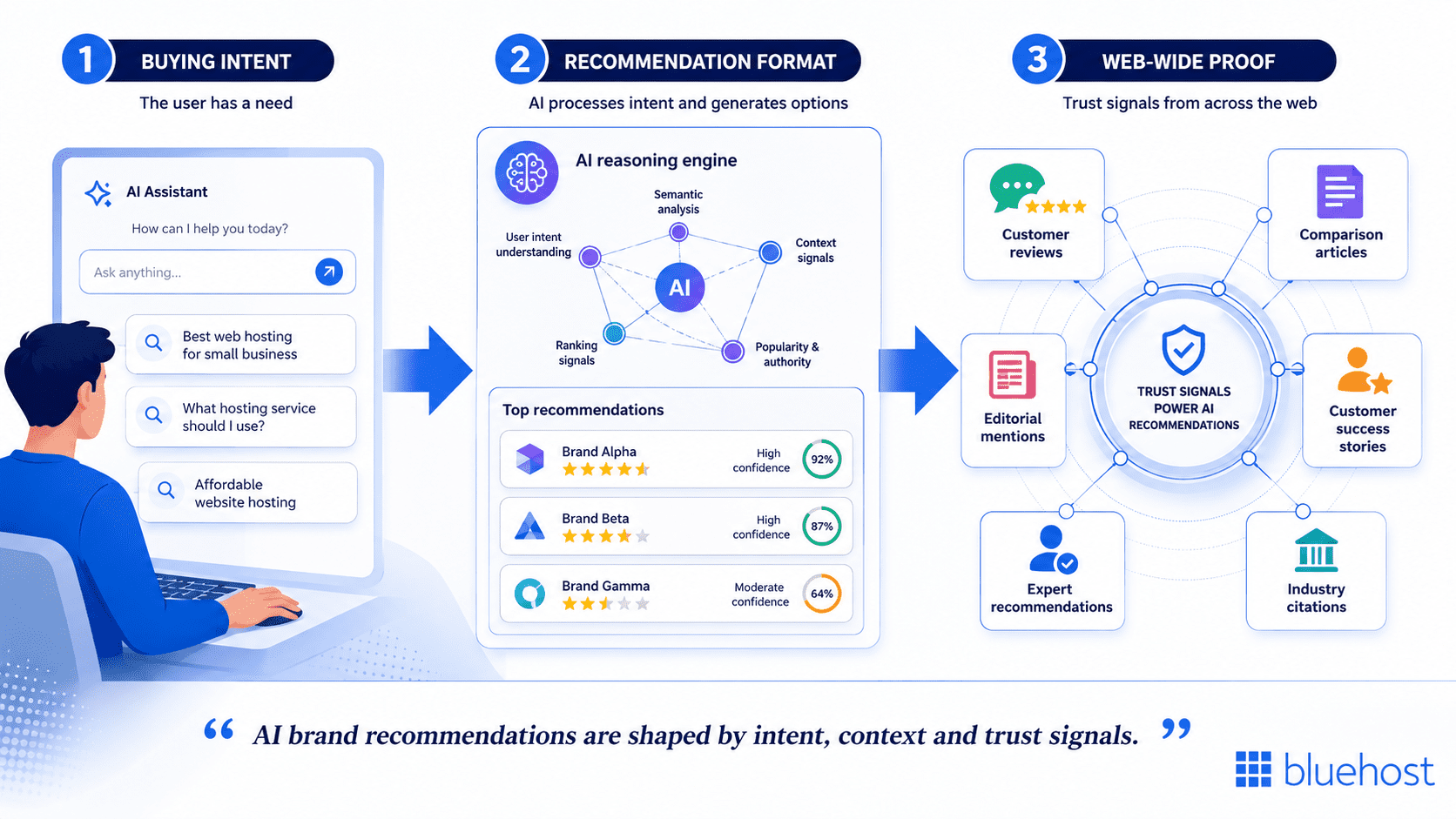
Once prompt wording became less important, the study pointed to three signals that seem to shape whether a brand gets mentioned.
1. Where the user is in the buying journey
In our experience, this is where many businesses have the biggest gap. They often have educational content, but not enough decision-stage proof that explains why their product is the right fit for a specific customer need.
AI engines gave more specific brand recommendations when the user sounded ready to make a decision.
A prompt like “which hosting plan should I buy?” is different from “how does web hosting work?” The first one asks for a choice. The second one asks for education.
That matters because AI recommendations become more brand-heavy when the user is closer to buying. In those moments, the engine needs to feel confident that a brand fits the user’s need.
For businesses, this is the real test. It is not enough for AI tools to know your brand exists. They need to connect your brand with specific use cases, problems and outcomes.
2. Whether the prompt asks for a list or a real recommendation
The study also found that prompt style changed how brands were described.
Keyword-style prompts usually produced shorter list-style answers. Conversational prompts gave the AI more room to explain why a brand was worth considering.
That difference matters. A list mention gives you visibility. A contextual recommendation gives you trust.
Brands with stronger digital footprints are more likely to benefit from that second format. If a brand has detailed reviews, comparisons, editorial mentions and clear product information, AI has more material to explain why it fits.
Brands with thin documentation may still appear in a list, but they are less likely to receive a strong recommendation.
3. How well the web explains your brand
This may be the most actionable finding for businesses.
AI engines do not rely only on what a company says about itself. They also synthesize what the wider web says about that company.
That means third-party proof matters. Reviews, comparison articles, customer stories, forum mentions, product roundups and editorial citations all help define how AI understands a brand.
Your website is still important. But it is not enough on its own.
If the broader web does not clearly explain who your brand serves, what it does well and when someone should choose it, AI engines have less reason to recommend it.
These signals become easier to understand when you break them into three parts. First, what the user wants. Second, what proof exists around the brand. Third, what context helps the AI connect the two.
A simple framework for AI visibility: Intent + proof + context
To improve AI visibility, think beyond keywords and prompts. AI engines need three things before they can confidently recommend a brand:
1. Intent match
Can the AI clearly understand which customer problem your brand solves?
2. Proof signals
Are there reviews, comparisons, case studies, expert mentions or third-party sources that support the claim?
3. Context clarity
Does the web explain when your brand is the right fit and when it is not?
For example, a hosting company does not only need content about “what is web hosting.” It also needs pages and mentions that explain:
- Best hosting for small businesses.
- Best hosting for WordPress beginners.
- Best hosting for online stores.
- Hosting for agencies managing multiple client sites.
- Hosting with support, security and scalability.
The more clearly these use cases are explained across your website and the wider web, the easier it becomes for AI systems to recommend your brand with confidence.
That turns AI visibility from a prompt-writing problem into a brand clarity problem. In 2026, the brands most likely to surface will be the ones AI systems can understand, verify and confidently match to specific customer needs.
What this means for your AI visibility strategy in 2026?
The study changes how businesses should think about AI SEO.
The goal is not to guess every possible prompt a customer might type. AI engines already understand many phrasing variations. The bigger goal is to make your brand easier to trust, explain and recommend.
In practice, we have seen one pattern clearly: bottom-of-funnel gaps are often the most common, and the easiest for businesses to overlook when optimizing for AI search. Many brands explain what they sell, but they do not give AI systems enough proof to understand when that brand is the right choice.
Stop chasing every prompt variation
You do not need a separate content strategy for every way a customer might ask the same question.
If someone asks “best hosting for small business” or “what hosting should I use for my website,” AI engines may understand both as the same intent. Repeating the same answer across dozens of slightly different pages is unlikely to create a major visibility advantage.
Build proof around decision-stage questions
Your content should help AI engines answer a more important question: “Why this brand specifically?”
That means building stronger proof around use cases, outcomes and comparisons. Reviews, customer stories, editorial mentions, third-party comparisons and clear product pages all help AI systems understand when your brand is the right recommendation.
This is especially important for bottom-of-funnel queries. If your brand is visible for “how web hosting works” but missing from “which hosting provider should I choose,” your AI visibility is weakest where it matters most.
Audit where AI recommends you and where it does not
Businesses should test their visibility across the major AI surfaces in their category, including ChatGPT, Gemini, Perplexity, Google AI Overviews and Google AI Mode.
Do not only check whether your brand appears. Check how it appears.
Is it mentioned in a list? Is it explained as a strong fit? Is it recommended for a specific use case? Is a competitor getting richer context while your brand gets a shallow mention?
Those differences matter because AI visibility is not just about being named. It is about being recommended with confidence.
But even that audit should not stop at one platform. A brand can look strong in one AI engine and underexplained in another, which makes cross-platform visibility just as important as the recommendation itself.
Treat each AI engine as a separate visibility surface
A single AI visibility strategy may leave gaps.
Different AI engines may rely on different sources, formats and retrieval behaviors. Some may surface recent citations more often. Others may lean more heavily on established web authority.
The practical takeaway is simple: do not optimize for one AI engine and assume the job is done. Track how your brand appears across each major AI surface, then strengthen the missing signals.
The challenge is that those gaps are not always obvious from traditional SEO metrics. To understand how AI systems actually see your brand, you need to test directly across the platforms where recommendations are happening.
How to test your AI visibility manually?
You can run a simple AI visibility audit without advanced tools. Start by testing prompts across ChatGPT, Gemini, Perplexity and Google AI experiences.
Use prompts from different stages of the customer journey:
Educational prompts
- “How do I choose a web hosting provider?”
- “What should a small business look for in a website platform?”
Comparison prompts
- “What are the best web hosting providers for small businesses?”
- “Compare Bluehost with other WordPress hosting providers.”
Decision-stage prompts
- “Which web hosting provider should I choose for a small business website?”
- “What is the best WordPress hosting option for beginners?”
Then document:
- Whether your brand appears.
- Where it appears in the answer.
- Whether it is listed or actively recommended.
- What reasons the AI gives for mentioning it.
- Which competitors are mentioned instead.
- Which sources or citations appear, if any.
The goal is not just to be named. The goal is to understand what AI systems believe your brand is known for.
That audit gives you more than a visibility snapshot. It shows whether AI systems have enough trust, context and proof to recommend your brand when it matters most.
AI search is becoming a trust engine, not a keyword game
This study points to a larger shift in how AI engines understand brands.
Early AI visibility often depended on whether a brand appeared often enough in the data AI systems learned from. In 2026, the picture looks more specific. AI engines are not just asking, “Have I seen this brand before?” They are asking, “Do I understand what this brand is good for?”
That is closer to word-of-mouth than traditional SEO.
A trusted friend does not recommend a restaurant because they have heard its name the most. They recommend it because they know what it is good at, who it is right for and when someone should choose it.
That is the opportunity for small businesses.
You do not need to be mentioned everywhere. You need the right signals in the right places. Your website, reviews, customer stories, comparison mentions and third-party coverage should all make one thing clear: what your brand does best and who it serves best.
The prompt your customer uses matters less than the confidence AI already has in your brand.
In AI search, the brands that win may not be the ones with the most keyword coverage. They may be the ones the web explains most clearly.

Write A Comment