 ChatGPT,
 Claude,
 Gemini,
 Grok — all four for
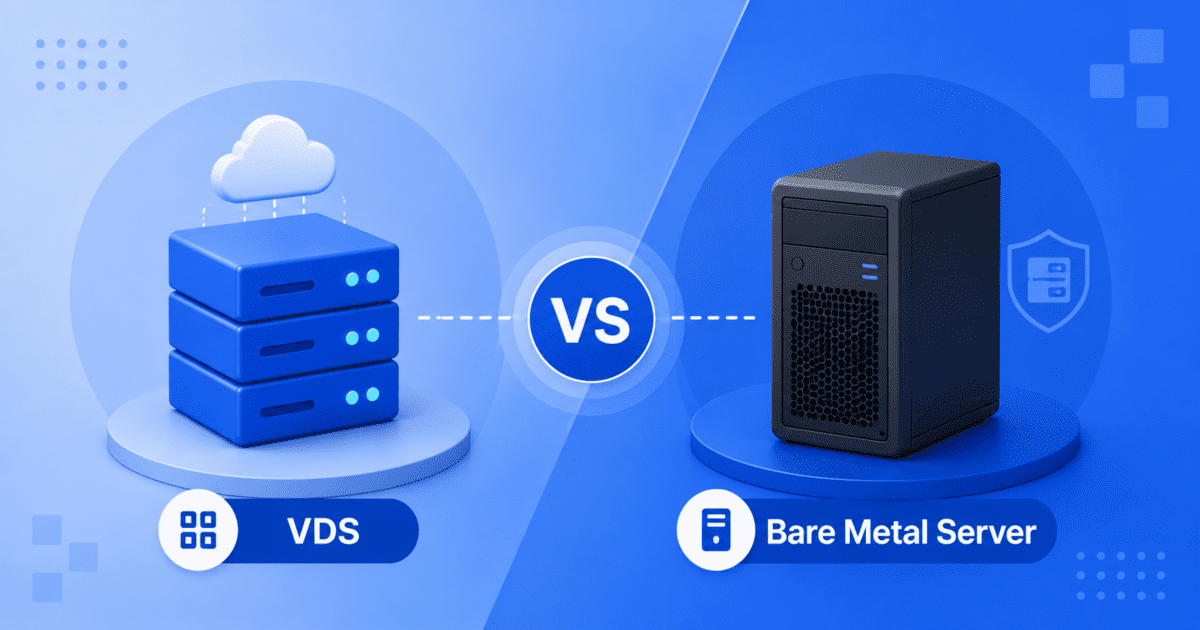
Key highlights
- A VDS gives you dedicated vCPU cores and RAM through hypervisor isolation, without owning physical hardware.
- A bare metal server gives you an entire physical machine through single-tenant hosting, with no virtualization layer.
- VDS hosting scales in minutes. Bare metal scaling often means new hardware and manual setup.
- Cost differences between the two can be significant for mid-size workloads.
- The right choice depends on your workload type, not the size of your company.
Your application has outgrown shared hosting and now you are comparing VDS vs bare metal server options. Both deliver more compute power and more control than standard VPS hosting, but they solve different problems.
A VDS gives you dedicated vCPU and RAM through hypervisor isolation, without the cost of owning physical hardware. A bare metal server gives you an entire physical machine with no virtualization layer at all.
The right choice depends on your workload, not your company size. This guide compares VDS and bare metal hosting on performance, cost and scalability, so you can pick the infrastructure that actually fits what you are running.
What is a Bare Metal Server?
A bare metal server is a single physical machine rented entirely to one customer through single-tenant hosting. There is no virtualization layer between your applications and the hardware.
This setup gives you full access to CPU, memory, storage and network resources on that machine. Nobody else shares it with you.
Some regulated environments may prefer physical hardware isolation depending on internal policies, regulatory requirements and workload-specific needs. Provisioning takes longer because a physical machine has to be configured before it goes live, so dedicated servers usually take longer to deploy than bare metal cloud servers.
What is a VDS (Virtual Dedicated Server)?
A VDS or virtual dedicated server, is a virtual server instance created inside a virtual environment that sits between shared VPS hosting and a full bare metal server. It uses hypervisor isolation to lock a fixed number of vCPU cores and a fixed amount of RAM to your instance alone.
Unlike traditional VPS environments, VDS hosting is designed to provide dedicated resource allocation at the hypervisor level. This approach helps reduce the impact of shared-resource contention commonly associated with multi-tenant environments.
VDS hosting combines dedicated resource allocation with the provisioning speed and flexibility of a cloud-based environment. For many production workloads, it can provide a balance between infrastructure consistency and operational agility.
How does a VDS differ from a Bare Metal Server?
The real difference comes down to how server resources are allocated between virtualized instances and dedicated hardware. A VDS runs on a hypervisor that allocates dedicated resources within a shared physical host, using virtual resources, while a bare metal server gives you direct access to the underlying hardware and the whole machine. In practice, VDS also avoids the noisy neighbor issues found in shared VPS.
Here is how that plays out in practice.
Resource allocation: A VDS reserves vCPU and RAM through hypervisor-level resource isolation. A bare metal server gives you everything the physical hardware has, with nothing virtualized.
Provisioning speed: A VDS can be deployed in minutes through automated platform tools. A bare metal server usually takes hours or days because a technician has to prepare the physical machine, though bare metal cloud can shorten deployment compared with traditional dedicated hosting.
Management: Most VDS plans are self-managed, meaning you handle the OS and software stack yourself with root access. Bare metal hosting can be self-managed or fully managed, depending on the provider and it lets you install your own operating system for complete control.
Scaling: Upgrading a VDS plan is a configuration change. Upgrading bare metal infrastructure often means migrating to new hardware.
VDS vs Bare Metal Server: Side-by-side comparison
The differences between VDS and bare metal hosting become clearest when you compare them side by side. Here is how the two stack up across the factors that matter most for production workloads.
| Factor | VDS Hosting | Bare Metal Server |
| Resource isolation | Dedicated vCPU and RAM via hypervisor | Full physical isolation, no virtualization |
| Performance consistency | Designed for stable resource availability in production environments | Direct hardware access designed for high-performance computing requirements |
| Provisioning time | Minutes | Hours to days |
| Scalability | Instant upgrades through the platform | Requires new hardware or migration |
| Control level | Full root access, self-managed | Full hardware-level control |
| Cost | Lower than bare metal for equivalent compute | Higher due to dedicated physical hardware |
| Best suited for | AI runtimes, SaaS platforms, automation systems | Compliance needs and specific workloads with extreme throughput |
The table makes one thing clear. For many production workloads, VDS hosting provides dedicated resource allocation, faster provisioning and greater infrastructure flexibility than traditional dedicated hardware deployments. The best option depends on workload requirements, operational preferences and budget considerations.
Also read: VPS for Automation Workflows: A Technical Founder’s Guide to Scalable Infrastructure
How do costs compare between VDS and Bare Metal Hosting?
Bare metal hosting costs more because you are paying for an entire server on a physical server, even if you are not using all of its capacity. The provider also factors in hardware maintenance and the cost of keeping that machine reserved for you alone, so VDS is often the more cost-effective server solution for workloads that do not need that level of dedicated capacity.
VDS hosting pricing tracks closer to actual usage. You pay for virtual resources such as vCPU, RAM and storage your workload needs, instead of paying for the full hardware resources reserved on bare metal.
For a mid-size production application, this difference can mean paying for hardware capacity you will never touch on a bare metal plan, compared to a right-sized VDS that matches your actual workload.
How does performance and resource allocation compare?
There is a common assumption that bare metal hosting is always faster than VDS hosting. That assumption does not hold up for most production workloads.
A VDS removes shared-resource contention through hypervisor isolation. Unlike shared virtual servers, it delivers more consistent performance because other users cannot consume its reserved compute and your vCPU cores are reserved exclusively for your instance, much like a bare metal server reserves its entire CPU for you.
Bare metal hosting still wins when high performance, raw power and direct access to hardware matter most, especially for extreme, sustained throughput scenarios like large-scale data processing or specialized hardware requirements. For many SaaS platforms, automation systems and AI inference environments, a properly sized VDS can provide the resource isolation and scalability needed to support production operations.
When should you choose a Bare Metal Server?
Choose bare metal hosting if your workload fits one of these scenarios, especially if you need a dedicated hosting option with exclusive access to physical hardware.
- Your industry requires physical hardware isolation for compliance or regulatory reasons.
- You run extreme, sustained compute loads that need every CPU cycle on the machine.
- Your application depends on installing your own operating system, supporting legacy systems or tuning the underlying hardware for specific workloads.
- You need total control and complete control over server resources at the hardware level.
If none of these apply to you, bare metal hosting is likely more infrastructure than your workload requires.
When should you choose a VDS?
A VDS server is a flexible and cost-effective server solution for many businesses that have outgrown shared hosting. Consider VDS hosting if you are running:
- AI runtimes and model serving that need dedicated vCPU without inference throttling.
- SaaS backends that serve concurrent users and need stable RAM allocation.
- Multi-tenant agency environments hosting multiple client sites or applications.
- CI/CD pipelines that need predictable build times across every commit.
- eCommerce platforms and other high traffic websites that cannot afford performance drops during peak periods.
Should you choose VDS or Bare Metal?
Choose VDS if:
- You need fast deployment
- You expect frequent scaling
- Budget matters
- Workloads fluctuate
Choose Bare Metal if:
- Compliance is critical
- Hardware customization is required
- Latency must be minimized
- Workloads are consistently resource intensive
Also read: Introducing Bluehost VDS Hosting for Predictable Performance at Scale
Which workloads benefit most from VDS hosting?
A few workload types see the clearest benefit from moving to a VDS.
AI runtimes: Dedicated vCPU allocation helps avoid the noisy-neighbor effects common when multiple virtual machines share the same host, so inference jobs do not slow down when other tenants spike their usage. Your model serves consistently, every time.
Automation systems: Background tasks and scheduled workflows run on schedule, not whenever shared resources happen to be available.
SaaS platforms: Your API response times stay stable under concurrent load because RAM is reserved, not shared.
At Bluehost, our VDS hosting plans are built as virtual server instances for exactly these kinds of workloads. Every plan includes hypervisor-locked vCPU, DDR5 RAM, full root access and dedicated server resources, so you get dedicated performance without the cost or complexity of bare metal hosting.
How do you decide between VDS and Bare Metal Hosting?
Ask yourself three questions before you decide, because the right server solution depends on your workload, control needs and deployment model.
Do you need physical-level compliance? If your industry requires hardware-level isolation for legal or regulatory reasons, bare metal hosting is the safer choice.
Is your workload sustained or bursty? Extreme, constant compute loads favor bare metal. Workloads with normal production traffic patterns are well served by a VDS.
Do you need fast scaling? If you expect to scale resources often, a VDS lets you upgrade in minutes. For faster provisioning, bare metal cloud can be more flexible than a traditional dedicated server setup, while standard bare metal scaling usually means planning ahead for new hardware.
If your answers point toward flexibility and cost efficiency, a VDS server is probably the better fit. If your answers point toward strict compliance or maximum sustained throughput, bare metal hosting makes more sense.
Choose the infrastructure that matches your workload
Most teams do not need the advantages of an entire physical server until they hit a specific compliance requirement or an extreme throughput ceiling. For everything else, from AI runtimes to SaaS backends to automation pipelines, a VDS gives you dedicated performance with faster deployment and better cost efficiency than dedicated hosting for many businesses.
If you are ready to move beyond shared VPS hosting, explore Bluehost VDS hosting plans and get dedicated vCPU, DDR5 RAM and full root access without the wait time of bare metal provisioning.
Frequently Asked Questions
For most production workloads, yes. A VDS uses hypervisor isolation to give you dedicated vCPU and RAM, removing the shared-resource contention that slows down standard VPS hosting. Because server resources are reserved, it also delivers higher stability than a standard VPS. Bare metal hosting still has an edge for extreme, sustained throughput scenarios.
Yes. VDS hosting is built for production environments like SaaS platforms, AI runtimes and automation systems. Resources are reserved at the hypervisor level, so your application performance stays consistent under load.
Generally yes. A VDS lets you pay for the compute your workload actually needs, while bare metal hosting requires paying for an entire physical machine regardless of how much capacity you use.
Most VDS plans are self-managed, giving you full root access to configure your operating system and software stack. Bare metal users can also install their own operating system for full control. Some providers also offer managed options if you prefer hands-off infrastructure management.
Yes. VDS hosting plans typically support instant resource upgrades through the platform, without requiring a migration or causing downtime to your running environment. Dedicated servers are more time consuming to upgrade because they often require new hardware preparation.

Write A Comment