 ChatGPT,
 Claude,
 Gemini,
 Grok — all four for
Key highlights
- Choose a focused affiliate niche so you know exactly who you’re helping and which products are worth promoting.
- Build a simple affiliate website so you have a reliable place to publish reviews, tutorials, comparisons and SEO content.
- Join relevant affiliate programs so you can promote products that match your audience’s needs and earn commissions from qualified referrals.
- Create content that answers real buying questions so readers can compare options, trust your recommendations and click with confidence.
- Track clicks, rankings and conversions so you can improve high-opportunity pages and turn organic traffic into affiliate revenue.
Affiliate marketing is a way to earn a commission by recommending products or services through a trackable link. When someone clicks your link and completes a qualifying purchase, you earn a payout from the company.
For beginners, the best place to start is usually a website. A website gives you a home for product reviews, tutorials, comparison posts and helpful guides that can bring in search traffic over time.
This guide explains how affiliate marketing works, how to choose a niche, how to build your first affiliate website, how to join affiliate programs and how to create content that earns clicks without overselling.
Quick answer: To start affiliate marketing, choose a niche, build a website, join relevant affiliate programs, publish helpful content, disclose your affiliate links and track which pages drive clicks and sales.
What is affiliate marketing?
Affiliate marketing is a performance-based marketing model where a person or business promotes another company’s product and earns a commission for a qualifying action, usually a sale.
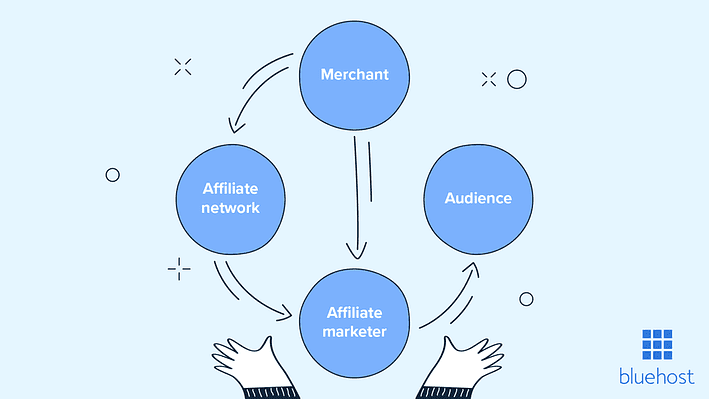
Here’s how it works:
- You join an affiliate program.
- The company gives you a unique tracking link.
- You add that link to helpful content, such as a blog post, review, tutorial or email.
- A reader clicks your link and buys the product.
- The company tracks the sale and pays you a commission.
For example, if you write a guide about starting a blog and recommend a hosting provider through your affiliate link, you may earn a commission when a reader signs up for hosting.
Also read: High-Ticket Affiliate Marketing: Beginner Guide 2026
Affiliate marketing is not instant income. It works best when you build trust, answer real questions and recommend products that match your audience’s needs.
According to Statista, the affiliate marketing industry is projected to cross 12 billion globally, which means there’s never been a better time to get started.
Join our Bluehost Affiliate Program today to begin your journey.
Is affiliate marketing worth it for beginners?
Affiliate marketing can be worth it for beginners because it has low startup costs and does not require you to create your own product. You can start with a website, publish helpful content and recommend products that solve a specific problem.
But it takes time. Most beginners need to build trust, publish consistently and learn SEO before they see steady results.
Also read: 10 Passive Income Ideas To Secure Your Financial Future
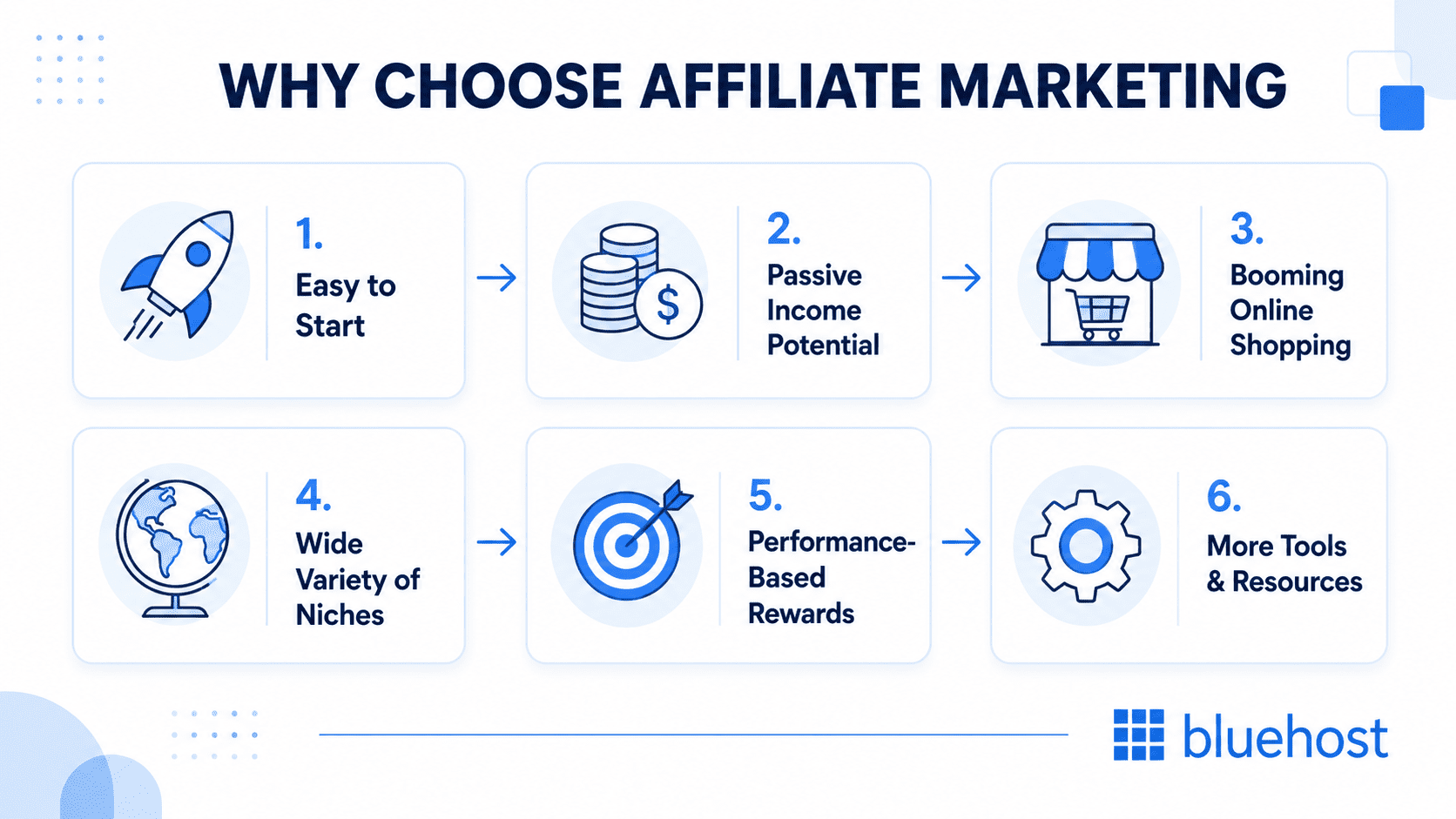
Affiliate marketing is a good fit if you:
- Like creating helpful content
- Can focus on one niche for several months
- Are willing to learn SEO and basic analytics
- Want to recommend products honestly
- Can be patient while traffic grows
Affiliate marketing may not be a good fit if you:
- Want fast income
- Plan to promote products you have not researched
- Do not want to disclose affiliate links
- Expect commissions without building traffic or trust
The best approach is to treat affiliate marketing like a content business, not a shortcut. Your job is to help readers make better decisions.
Also read: Top Affiliate Marketing Programs to Boost Your Earnings
How does affiliate marketing work?
Affiliate marketing works by connecting content creators with businesses that want more sales. You recommend a product or service using a unique affiliate link. When someone clicks that link and makes a qualifying purchase, you earn a commission.
Affiliate marketing has four main components:
| Affiliate marketing component | What it means |
|---|---|
| Merchant | The company selling the product or service |
| Affiliate | The person or website promoting the product |
| Customer | The person who clicks the affiliate link and buys |
| Tracking system | The platform that records clicks, referrals and commissions |
A typical affiliate sale looks like this:
- You publish content that helps someone solve a problem.
- You include an affiliate link where it naturally fits.
- The reader clicks the link and visits the merchant’s website.
- If the reader completes a qualifying purchase, the sale is recorded.
- After approval, you receive a commission.
Commission rules vary by program. Some programs pay a flat fee per sale, while others pay a percentage of the order value. Cookie windows, approval rules and payout timelines also vary, so always read the program terms before promoting an offer.
Also read: Back-to-School Marketing Ideas for Affiliates: Boost Sales in 2026
How much do affiliate marketers actually earn?
Affiliate marketing can be highly profitable, but how much you earn depends on five factors:
- The niche you choose
- The products you promote
- Your commission rate
- The amount of traffic your content receives
- How well your content converts readers into buyers
A beginner with a new website may earn little or nothing at first. That is normal. Affiliate marketing usually becomes more predictable after you have published enough useful content, built search visibility and learned which pages drive clicks.
For example, a page with 1,000 monthly visitors and a low conversion rate may earn very little. A page with strong buying intent, such as a comparison or product review, may earn more with fewer visitors because readers are closer to making a decision.
The goal is not just more traffic. The goal is the right traffic: people looking for information, comparisons, tutorials or recommendations related to the product you promote.
What are the different types of affiliate marketing businesses?
There are three common types of affiliate marketing:
| Type | Meaning | Best for beginners? |
|---|---|---|
| Unattached | You promote a product without much connection to the niche or audience. | Not recommended. It can feel less trustworthy. |
| Related | You promote products related to your niche or content. | Good option. |
| Involved | You promote products you have used, tested or researched deeply. | Best option for long-term trust. |
For beginners, related or involved affiliate marketing is usually the best choice. It is easier to create helpful content when the product fits your niche and your audience’s needs.
Now that you know the types of affiliate models, let’s look at the top channels you can use to grow your affiliate income in 2026.
Which affiliate marketing channels can you use in 2026?
Affiliate marketing for beginners offers endless opportunities to earn actual sales through the right platforms.
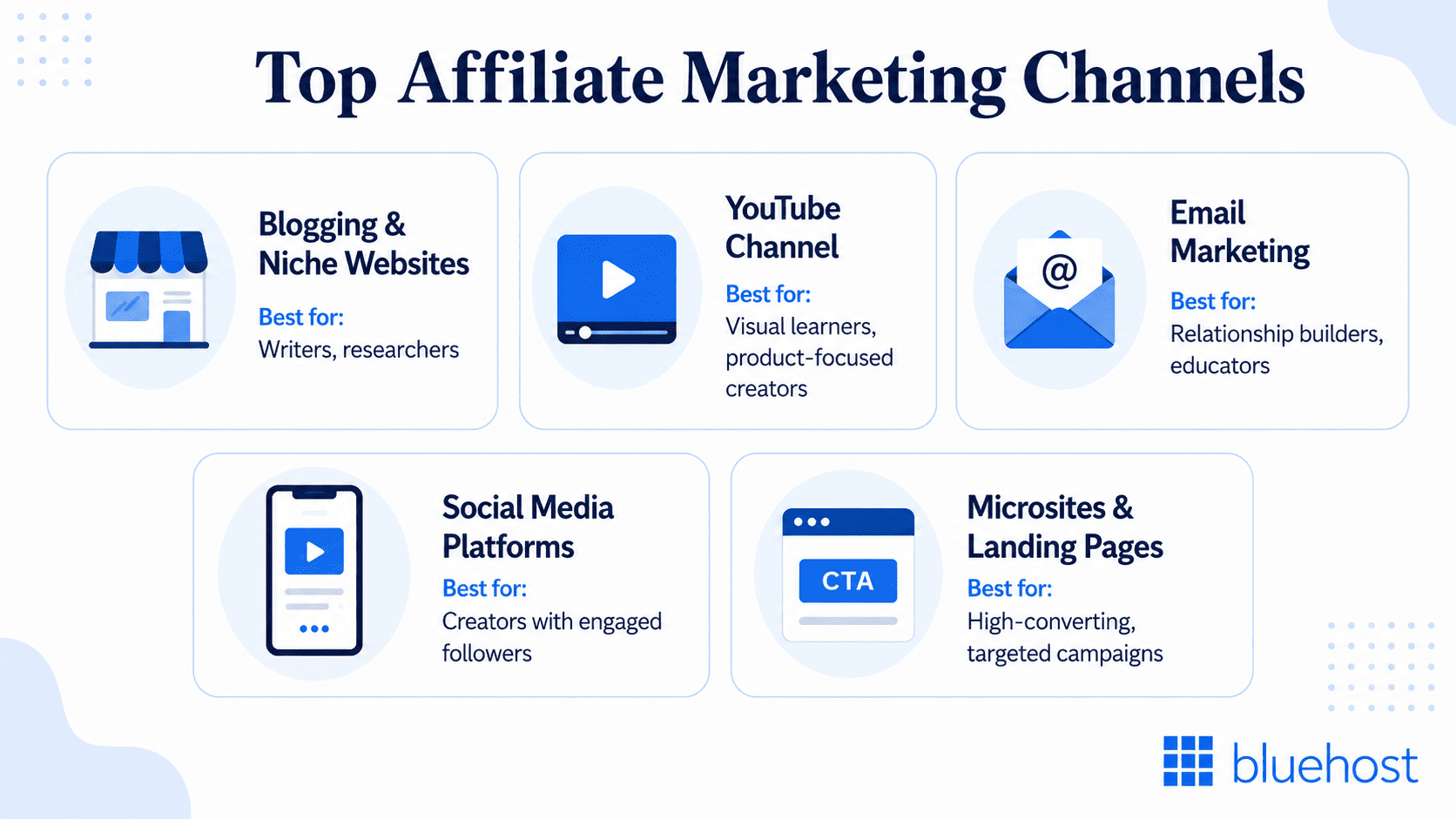
You do not need to be everywhere. Start with one main channel and add others later. Let’s see what you can begin with:
| Channel | Best for | Best content types | Revenue benefit |
|---|---|---|---|
| Website or Blog | Long-term organic growth | Product reviews, comparison posts, tutorials, buying guides | Drives consistent SEO traffic and affiliate conversions over time |
| YouTube | Visual product promotion | Product demos, walkthroughs, comparison videos | Higher engagement and conversion through video-based recommendations |
| Email Marketing | Audience nurturing and repeat conversions | Welcome emails, product recommendations, tutorials | High-converting channel with strong repeat revenue potential |
| Social Media | Fast audience engagement | Reels, stories, short-form videos, live demos | Helps drive quick clicks, visibility and affiliate traffic |
| Microsites & Landing Pages | Focused campaigns and paid traffic | Single-product pages, comparison pages, CTA-focused landing pages | Designed for higher conversion rates and targeted affiliate sales |
Also read: Common Affiliate Marketing Mistakes and How to Avoid Them
How to start affiliate marketing (Step-by-step)?
If you’ve ever wondered how to start affiliate marketing for beginners and actually make money online, you’re in the right place. Affiliate marketing is one of the fastest-growing online business models and the best part is you don’t need to create your own product. Instead, you recommend products or services people already buy and you earn a commission when someone purchases through your link.
Here are some steps to follow to start building your affiliate marketing for beginners.
Step 1: Understand affiliate marketing
Affiliate marketing is simple:
- You sign up for an affiliate program (like Bluehost, Amazon or ClickBank).
- You get a unique affiliate link.
- You share that link on your blog, YouTube channel, social media or email list.
- When people buy through your link, you get paid.
Example: You write a blog post titled “Best Affordable Hosting for Beginners” and include your Bluehost affiliate link. If someone buys hosting after reading your post, Bluehost pays you a commission.
Step 2: Choose the right niche
This is a key part of affiliate marketing. Don’t try to promote everything at once. Focus on a niche where people buy frequently and trust recommendations.
Popular niches include:
- Tech & software: hosting, AI tools, SEO tools
- Health & fitness: supplements, diet plans
- Finance: credit cards, investments
- Lifestyle: fashion, travel, beauty
For beginners, blogging and online business tools are great niches because very few people realize how much money companies like Bluehost pay affiliates.
Step 3: Pick the best affiliate programs
There are thousands of affiliate programs, but not all are beginner-friendly. Here are some popular affiliate networks and programs to consider:
- Amazon Associates: Physical products (small commission, but high trust).
- ClickBank / Digistore24: Digital products (high payouts).
- ShareASale & CJ Affiliate: Variety of brands and products.
- Bluehost Affiliate Program (Recommended): One of the highest-paying hosting affiliate programs.
Bluehost Affiliate Program Review
Bluehost is trusted by millions of websites and is officially recommended by WordPress. The program is beginner-friendly because:
- You earn $65+ per sale (sometimes even more).
- Every new customer gets free products like a free domain name + SSL certificate.
- Hosting starts at an affordable rate, which makes it easy to promote.
- They often provide a coupon code to make your offer even more attractive.
This combination (free domain + reliable hosting + big payout for you) is why Bluehost is one of the best platforms for affiliate marketing for beginners.
Step 4: Create your affiliate marketing website
If you’re wondering which platform is best for affiliate marketing for beginners, the answer is: your own website. Social media is great, but a website builds long-term authority and traffic.
Here’s how to start an affiliate marketing website for beginners:
- Buy hosting (Bluehost is an easy option because it comes with a free domain).
- Install WordPress in one click.
- Choose a simple theme.
- Write your first affiliate blog post.
Example: A beginner could start a site like TechForStarters.com and publish posts like “Best Hosting for Beginners in 2026” or “Top 5 AI Tools for SEO.” Each post would include affiliate links.
Step 5: Create content that people trust
The truth is people don’t just buy because you tell them to. They buy because your content helps them to make a decision. That’s why your focus should be on research and creating high-quality content.
Content ideas:
- How-to guides: “How to Start a Blog in 2026”
- Product reviews: “Bluehost Affiliate Program Review”
- Comparison posts: “Bluehost vs Hostinger: Which is Better for Beginners?”
- Lists: “Top 10 Affiliate Marketing Websites for Beginners”
The key part is to provide real value. If someone reads your post and thinks, “Wow, this solved my problem,” they are much more likely to click your affiliate link and buy.
Step 6: Get traffic to your website
No matter how great your content is, if nobody sees it, you won’t make sales. Here are some traffic strategies:
- SEO (Search engine optimization): Helps you rank on Google.
- YouTube: Product tutorials, reviews, comparisons.
- Social media: Instagram Reels, TikTok, Facebook groups.
- Email marketing: Build a list of subscribers and send recommendations.
Fact: According to HubSpot, businesses that blog get 55% more website traffic. That’s why affiliate marketing websites for beginners often focus on SEO-driven blogs.
Learn proven SEO for affiliates strategies to rank higher, attract buyers and create content that sells consistently with our expert masterclass.
Step 7: Track and improve
Affiliate marketing isn’t a one-time job. You need to track what’s working.
- Check which posts get the most clicks.
- Find out which affiliate products actually sell.
- Double down on the strategies that bring results.
For example, if you notice that your article “How to Start a Blog with Bluehost” gets more sales than your “AI tools review”, then you can create more related content around blogging and hosting.
Now let’s see which tool is best to build your affiliate workflow.
Also read: A Beginner’s Guide to Paid Ads for Affiliate Marketing
Step 8: What to do first to start affiliate marketing now
The biggest mistake beginners make is overplanning instead of acting. You don’t need a perfect strategy before you start – you need one focused week of real decisions. Here are six actions to complete in your first 7 days of affiliate marketing for beginners:
- Choose one niche you genuinely understand and that has proven buyer demand.
- Pick one platform – a blog or YouTube channel and commit to it fully.
- Join one affiliate program that matches your niche and audience intent.
- Publish one helpful piece of content – a review, tutorial or comparison with your affiliate link placed naturally.
- Add a clear affiliate disclosure to every page where links appear.
- Install a free tracking tool like Google Analytics to measure clicks and traffic from day one.
One productive week builds more momentum than months of research. Let real data, not assumptions, shape your next step.
Why is Bluehost the best affiliate marketing tool for beginners?
At Bluehost, we understand that affiliate marketing for beginners can feel overwhelming. You’re launching a new business, learning how to promote products and trying to figure out which platform is best for affiliate marketing for beginners. That’s exactly why Bluehost is trusted by thousands of new affiliates worldwide.

Our platform doesn’t just provide hosting. With our Bluehost Affiliate Program and hosting solution, we give you the complete toolkit to launch, grow and scale your affiliate marketing website with confidence.
What you get with Bluehost?
| Feature | Benefit for affiliate marketers |
|---|---|
| Free domain + hosting | Launch your affiliate website at a lower starting cost |
| WordPress AI Builder | Create pages, blogs and landing pages faster |
| SEO tools and Yoast integration | Improve search visibility and grow organic traffic |
| Fast and secure hosting | Better site speed, user experience and SEO performance |
| Email marketing tools | Build subscriber lists and promote affiliate offers directly |
| Affiliate-friendly plugins | Manage links, track campaigns and improve conversions |
| 24/7 support | Get help quickly without technical complexity |
Why it works for beginners
- Build an affiliate website without advanced technical skills
- Publish reviews, tutorials and comparison content faster
- Improve rankings with SEO-friendly tools and fast-loading pages
- Grow clicks and conversions with email marketing and affiliate plugins
- Scale your website as traffic and affiliate revenue grow
Bluehost Affiliate Program highlights
- Earn $65+ per qualified referral
- 30-day referral tracking window
- Access banners, tracking links and promotional assets
- Beginner-friendly setup with hosting and free domain included
Bluehost combines hosting, SEO, email marketing and affiliate tools in one platform, helping beginners focus more on content, traffic and conversions.
Who is the Bluehost Affiliate Program best for?
It is best for creators who publish content about:
- Blogging
- WordPress
- Website setup
- Small business websites
- Online stores
- Digital marketing
- SEO
- Beginner business tools
Who may not be a good fit?
It may not be the best fit if your audience is not interested in websites, hosting, WordPress or online business. Relevance matters more than commission size.
Ready to build your affiliate website?
Start with Bluehost and get the tools you need to launch your site, publish content and grow your traffic.
For any queries or questions, you can always visit our Bluehost Affiliate Program FAQs page to get detailed answers.
Affiliate content ideas that drive clicks
Not all affiliate content converts the same way. Some posts attract early research traffic, while others attract readers who are close to buying.
Use a mix of both.
| Content type | Example | Intent |
|---|---|---|
| Beginner guide | How to Start Affiliate Marketing | Informational |
| Product review | Bluehost Review for Beginners | Commercial |
| Comparison | Bluehost vs. Other Hosting Providers | Commercial |
| Tutorial | How to Start a WordPress Blog | Informational + commercial |
| Checklist | Affiliate Website Launch Checklist | Action-focused |
| List post | Best Affiliate Programs for Beginners | Commercial |
| FAQ page | Bluehost Affiliate Program Questions | Branded / commercial |
For revenue, prioritize content where the reader is choosing a product, comparing options or setting up a website. These readers are more likely to click affiliate links and complete a purchase.
How to maximize affiliate marketing commissions?
Growing affiliate revenue is not about adding more links. It comes from creating helpful content, improving visibility in search results and optimizing pages for conversions.
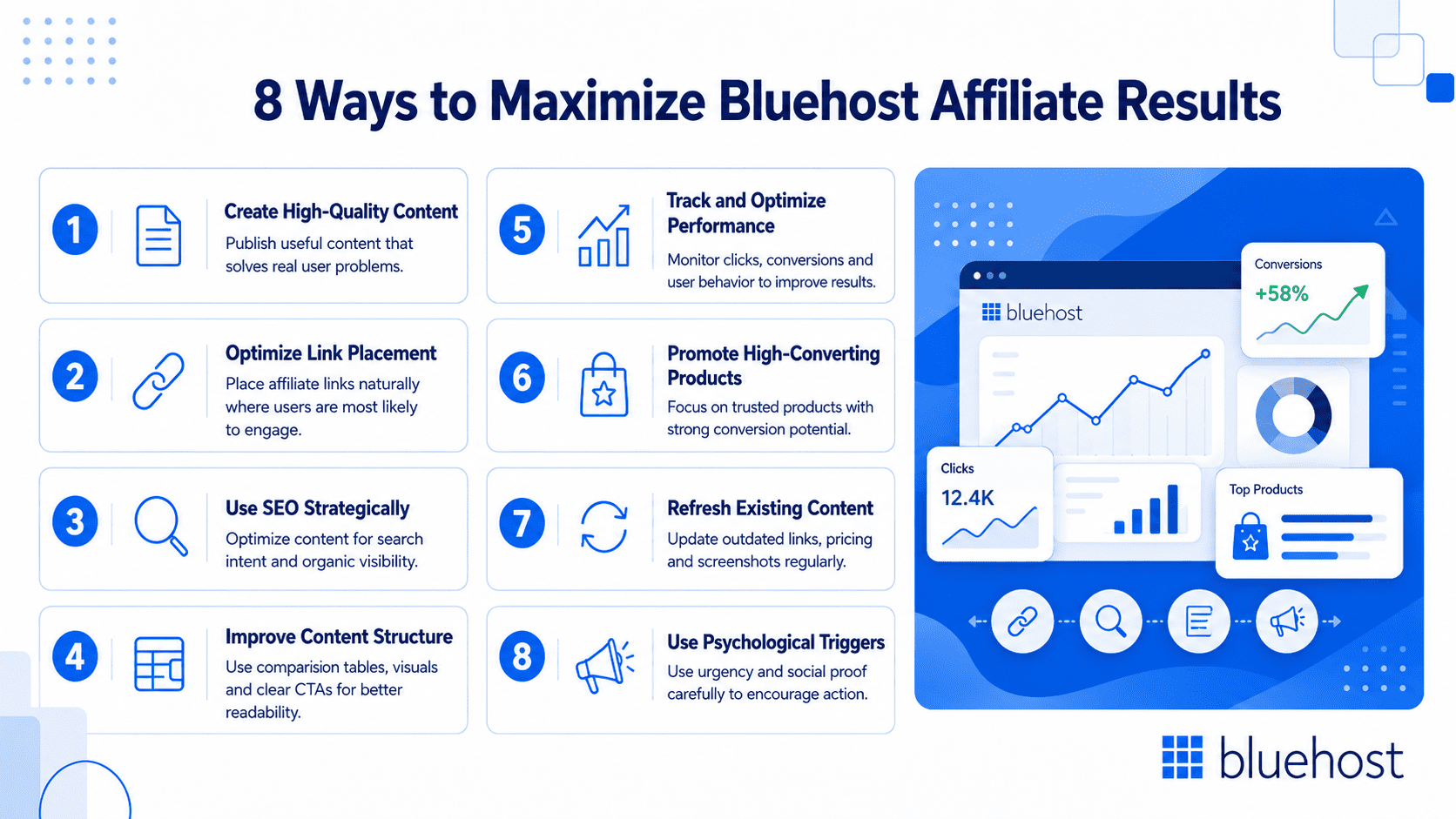
Here are the top ways you can optimize your affiliate website for maximum conversions:
| Strategy | What to do | Revenue impact |
|---|---|---|
| Create high-quality content | Publish honest reviews, tutorials, comparison posts and beginner guides that solve real problems. | Builds trust, improves SEO rankings and increases affiliate clicks. |
| Optimize link placement | Add affiliate links near CTAs, above the fold and naturally within tutorials or product comparisons. | Improves click-through rate and conversions. |
| Use SEO strategically | Target one primary keyword per page, match search intent, use descriptive headings and keep content mobile-friendly. | Increases organic traffic and long-term affiliate revenue. |
| Improve content structure | Add comparison tables, visuals, internal links and clear CTA buttons throughout the page. | Boosts engagement, readability and conversion rate. |
| Track and optimize performance | Use tools like Google Analytics, heatmaps and affiliate dashboards to test headlines, CTA placements and button styles. | Helps identify what drives the most sales and clicks. |
| Promote high-converting products | Focus on trusted affiliate programs with strong commissions, quality landing pages and audience relevance. | Improves conversion quality and affiliate earnings. |
| Refresh existing content | Update screenshots, pricing, product information and outdated links regularly. | Maintains rankings, improves SEO freshness and increases conversions. |
| Use psychological triggers | Add social proof, limited-time offers or scarcity messaging only when genuine. | Encourages action without hurting user trust. |
What are legal compliance and affiliate disclosure requirements?
If you want to keep your affiliate marketing business safe and professional, compliance matters. Being upfront about your referral links isn’t just good practice; it’s required by law in many countries, including the United States. Transparency is key; you need to disclose affiliate links to your audience as required by FTC regulations. Affiliate marketing can build trust and credibility when creators disclose affiliations.
Here’s what you need to know.
Disclose every affiliate relationship
The Federal Trade Commission (FTC) requires that you disclose any relationship where you receive a benefit, like a commission, for promoting affiliate products.
You must clearly inform users that you may earn a commission if they click and buy through your links.
Where to disclose
Always add a visible, plain-language disclosure:
- At the top of blog posts or reviews
- In the video description on YouTube
- Within email newsletters or landing pages
- Anywhere you add affiliate links or recommend products
Don’t hide it in your footer or behind another link. Make it clear and unavoidable.
What your disclosure should say
Keep it simple. Here’s an example:
“This post contains affiliate links. If you make a purchase, I may earn a commission at no extra cost to you.”
Avoid vague language. Say what the link is and how it benefits you.
Tips for staying compliant
- Create a full disclosure page on your affiliate marketing website.
- Add automatic disclosure blocks above all affiliate content.
- Use clear labels like “Affiliate Link” or “Sponsored” in buttons or CTAs.
- Keep records of your disclosures and affiliate program terms.
Being honest builds trust. And it shows your audience that affiliate marketing is legit when done the right way and has a great future.
Final thoughts
Affiliate marketing works best when you help readers make informed decisions. Start with one niche, build a website, publish useful content, disclose your affiliate links and improve your pages based on data.
For beginners, a website is one of the most reliable foundations because it gives you a place to publish reviews, tutorials, comparisons and SEO content.
If you are ready to build your affiliate marketing website, Bluehost gives you the hosting, WordPress tools and setup support to get started.
Ready to launch your affiliate website? Begin with Bluehost WordPress hosting to kick off your affiliate marketing business seamlessly.
FAQs
Affiliate marketing is when you promote a company’s product or service using a trackable link. If someone clicks your link and completes a qualifying purchase, you earn a commission.
Yes, affiliate marketing can be good for beginners because startup costs are low and you do not need to create your own product. However, it takes time to build traffic, trust and consistent commissions.
You do not always need a website, but it is one of the best options for beginners. A website lets you publish SEO content, product reviews, comparisons and tutorials that can attract traffic over time.
To start affiliate marketing for beginners, choose a niche, join trusted affiliate programs like the Bluehost Affiliate Program or Amazon Associates and create content on a blog, YouTube channel or social media. Add affiliate links, drive traffic through SEO and email marketing and track results in your affiliate dashboard.
Yes, many affiliates earn $100+ daily by promoting affiliate products consistently. Success depends on niche selection, valuable content, SEO and building an audience. Affiliate marketing tips like keyword research, email subscribers and using referral links can turn affiliate sales into passive income once you generate consistent traffic and conversions.
Affiliates get paid when referral links generate actual sales. Payments are usually tracked in the affiliate dashboard and sent through methods like PayPal, bank transfer or checks. Bluehost affiliates, for example, earn $65+ per qualified purchase, processed 45–70 days after sales to ensure valid new customers.
Yes, it’s free to start affiliate marketing, you don’t need to create your own product. You can join programs like Amazon Associates or Bluehost Affiliate Program at no cost. However, investing in a website, tools and email marketing makes sense to drive traffic, build trust and increase affiliate sales long-term.
Some of the highest-paying affiliate programs are in software, hosting and finance. Bluehost pays affiliates $65+ per sale, WP Engine offers recurring commissions and premium SaaS brands pay hundreds per referral. While Amazon’s affiliate program and amazon games pays less, high demand and audience size make it profitable for affiliate marketers.
Beginners typically earn between $0 and $1,000 per month in their first year, with many reaching $300–$500 monthly by month twelve with consistent effort. Income is tied directly to experience, niche selection and content quality. Intermediate marketers with one to three years of experience commonly earn $1,000–$10,000 per month, while advanced affiliates can reach $10,000–$100,000 monthly. Treating affiliate marketing as a long-term business – not a shortcut – is the clearest path to scaling income.
Product reviews, comparison posts, tutorials, buying guides, checklists and beginner guides usually work well because they help readers solve a problem or choose a product.
It depends on your niche, content quality, SEO, traffic and conversion rate. Many beginners need months of consistent publishing and optimization before seeing reliable results.
Yes. SEO helps your content appear when people search for answers, product comparisons and recommendations. Focus on helpful content first, then optimize titles, headings, internal links and page structure.


Write A Comment