 ChatGPT,
 Claude,
 Gemini,
 Grok — all four for
Key highlights
- Understand how ChatGPT works to generate human-like, SEO-optimized content by analyzing context, keywords and search intent using ChatGPT for SEO.
- Learn how to use tailored ChatGPT prompts for SEO to create blog topics, meta descriptions, keyword clusters and schema markup efficiently.
- Explore ChatGPT’s role in discovering content gaps, classifying search intent and boosting topical authority with structured output as part of how to use ChatGPT for SEO.
- Uncover advanced features like generative engine optimization and multimodal content creation to stay ahead of 2026 trends with ChatGPT for SEO.
Since its debut in November 2022, ChatGPT has reshaped the digital world. Within two months, it became the fastest-growing app in history, with 100 million users.
Marketers quickly realized its potential. From writing blog posts to improving Google rankings, ChatGPT for SEO is now a go-to tool. It speeds up content creation, keyword research and understanding search intent. If you’re wondering how to use ChatGPT for SEO, it starts with the right prompts.
In this article, we’ll dive into how you can use ChatGPT SEO tools to supercharge your content strategy. You’ll learn how it helps with writing better content, smarter keyword research and clearer search intent analysis. But first, let’s look at what ChatGPT is and how it works.
How ChatGPT works: The technology behind its intelligence
ChatGPT is powered by advanced AI called the Transformer, which analyzes context and predicts the next word to generate smart, human-like responses. Let us take a look an in-depth look at it.
OpenAI’s ChatGPT is an advanced AI chatbot designed to generate human-like text based on the input it receives. At its core is a powerful language model trained on a massive range of internet data, allowing it to understand context, tone and intent. This makes it a valuable tool for SEO-related tasks, from content creation to optimizing written output.
Understanding the ChatGPT process flow
This graphic breaks down how ChatGPT turns your input into a meaningful response:
- User prompt: Everything starts with you. You type a question, instruction or request. This is your prompt.
- Tokenization: ChatGPT then breaks down your prompt into smaller parts called tokens. A token can be a word, part of a word or even punctuation. This step helps the model understand the structure of your message.
- Transformer: It is the core engine that runs ChatGPT. It analyzes the tokens using a special deep learning method that understands context, relationships between words and meaning across the whole input.
- Response: Finally, based on its analysis, ChatGPT generates a human-like reply that aims to match your intent and provide useful information.
Many marketers now use ChatGPT for SEO to streamline content planning, identify keyword opportunities and complement insights from tools like Google Search Console.
How AI generated content works: Transformer NLP and Next-Token Prediction explained
To fully tap into ChatGPT’s capabilities, it’s helpful to understand how it works under the hood. As we saw, ChatGPT relies on two main components to work effectively:
- Transformer NLP: It is a neural network architecture that uses self-attention mechanisms to understand context in language for natural language processing tasks.
- Next-Token Prediction: It is the process of predicting the most likely next word or symbol in a sequence based on the preceding context.
Let us now understand the role they play in shaping ChatGPT’s output.
Powered by Transformer NLP
ChatGPT runs on a deep learning framework called the Transformer, first introduced by Google. The Transformer uses a mechanism called attention. Attention allows the model to analyze all parts of a sentence or paragraph at once. This helps it understand the relationships between words and generate coherent, meaningful responses.
Rather than reading text one word at a time, it examines the full context to determine what is most relevant.
This approach generates more accurate and natural-sounding text, which is especially helpful when precision and clarity are important.
How does next-token prediction affect SEO writing?
Next-token prediction affects SEO writing by influencing how content is structured, phrased and optimized. Since ChatGPT predicts one word at a time based on the previous text, it naturally maintains context, integrates keywords smoothly and produces coherent, human-like responses.
This helps create SEO-friendly content that aligns with user intent, improves readability and increases the chances of ranking well in search results.
It benefits SEO writing in the following ways:
- Keyword placement feels natural
- Strong context awareness
- Better topical depth
- Snippet-ready output
- Prompt quality shapes the result
Let us look at each of these benefits in detail.
1. Keyword placement feels natural
Because ChatGPT predicts words based on context, it inserts keywords in a way that seamlessly appears human. This keeps your content optimized without any keyword stuffing.
2. Strong context awareness
The model doesn’t just focus on the last word. It understands the whole prompt. This allows it to maintain topic consistency and align with user search intent throughout the content.
3. Better topical depth
ChatGPT often includes semantically related words naturally. This adds depth and improves relevance. This is especially helpful when you use ChatGPT for SEO to strengthen keyword clusters.
4. Snippet-ready output
Its step-by-step writing approach helps generate clear and structured responses. This is ideal for featured snippets and AI overviews. Using specific ChatGPT prompts for SEO can make this even more effective.
5. Prompt quality shapes results
Good input leads to better output. If you’re unsure where to start, you can source 20 to 50 smart SEO prompts for ChatGPT on the internet. You can get great templates to guide the model toward SEO-friendly responses.
By combining AI-driven creativity with reliable SEO tools, you can take your optimization strategy a step further. That’s where Bluehost’s Professional Digital Marketing comes in – an all-in-one solution that helps you monitor keywords, track rankings and improve visibility across search engines.
Along with our built-in SEO Checker, you can easily identify gaps, enhance on-page optimization and ensure every post meets the latest SEO standards.
Now, let’s explore how you can actually use ChatGPT for SEO purposes
AI for SEO: How to use ChatGPT for SEO in 2026?
ChatGPT can be used for SEO purposes to generate high-quality web content for websites, blogs and social media. It assists in developing engaging content that incorporates keywords and effectively answers user queries. Overall, ChatGPT is highly effective in improving search engine rankings.
ChatGPT for SEO helps you in the following ways:
- Generate content ideas around a keyword.
- Use it for keyword research.
- Organize keyword lists by search intent.
- Discover content gaps & questions.
- Write high-performing SEO content.
- Create meta titles and descriptions.
- Generate schema markup.
- Use RegEx to analyze SEO performance.
Let us look at each of these pointers in detail:
1. Generate content ideas around a keyword
The first step of an SEO content marketing strategy is producing ideas for your blog posts and other content marketing assets. This task demands a fine balance of competitor research and creativity.
If you’ve been working on a content optimization strategy for a while, finding new topics that will engage your audience can be challenging. Likewise, starting from scratch can feel overwhelming, making it difficult to know where to begin
With ChatGPT, you can simplify the content creation process and write about it in mere seconds.
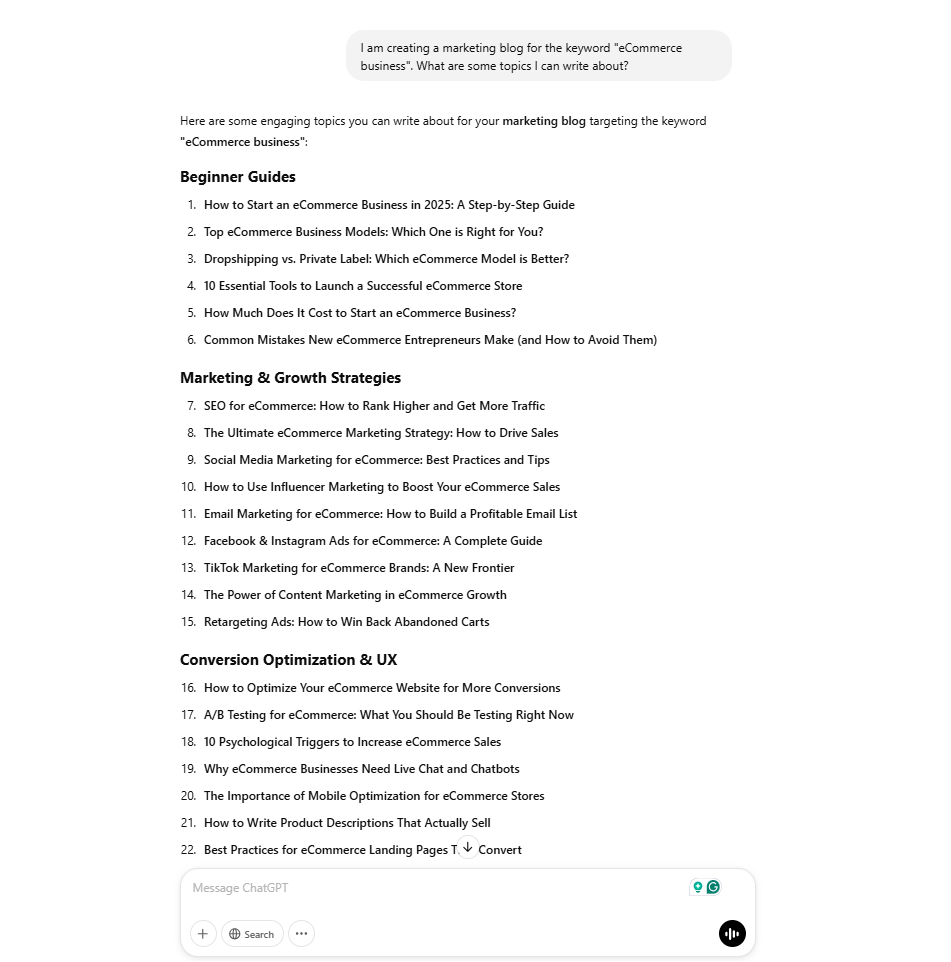
For example, you can simply provide a prompt: “I’m creating a marketing blog for eCommerce business. What are some topics I can write about?” In less than 10 seconds, ChatGPT will produce a list of topics aligned with your marketing needs.
To improve accuracy and relevance, define your target audience when writing the ChatGPT prompts. For example, you can use this prompt: “I’m creating a marketing blog for an eCommerce business targeting small business owners and entrepreneurs. What are some topics I can write about to help them grow their online sales and improve their digital marketing strategies?”
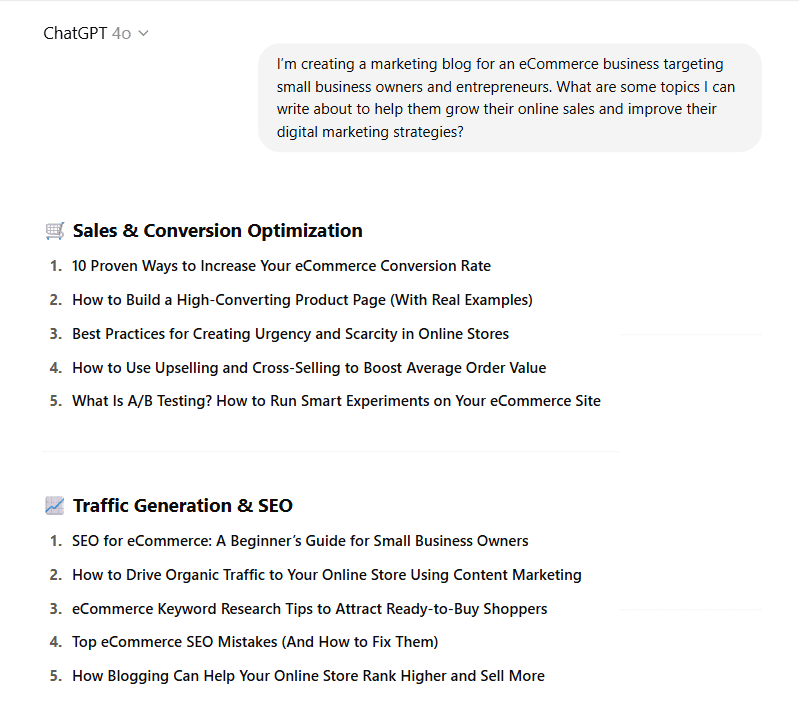
By refining your prompts with specific details, you can glean the right ideas for your marketing strategies.
Also read: 52 Amazing Website Content Ideas
2. Use it for keyword research
Once you finalize the topics you want to cover, it’s time to start your keyword research. ChatGPT is a powerful supplement to traditional tools.
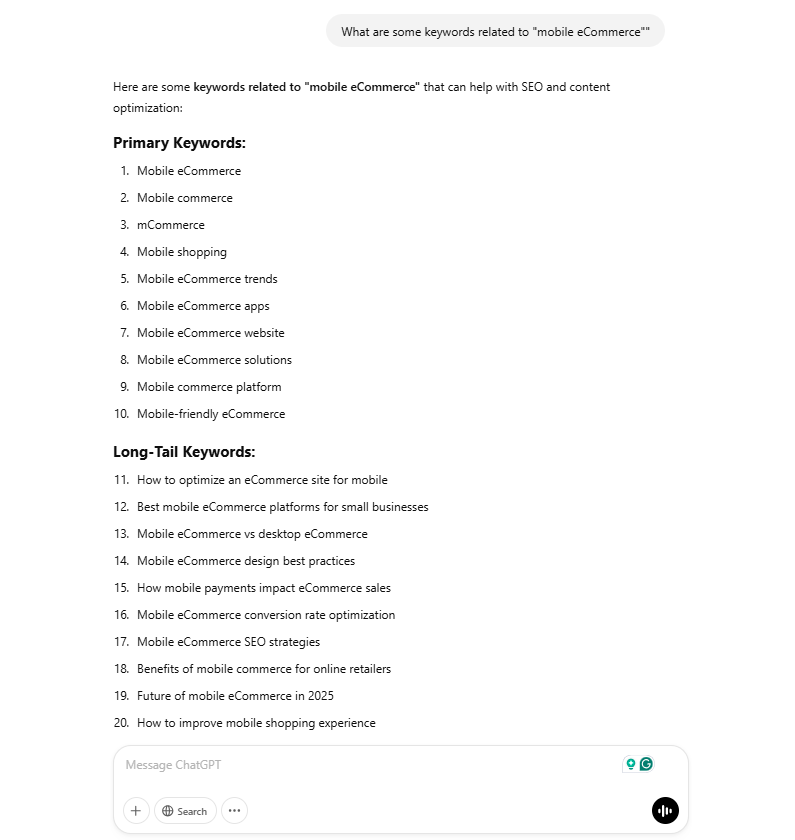
By using ChatGPT for SEO, you can identify the related keywords and gain valuable insights quickly. By putting a prompt “What are some keywords related to ‘mobile eCommerce’, you get a list of all the relevant keywords.
Also read: How to Find Keywords: Step-by-Step Guide for SEO Success
3. Classify keyword lists by search intent
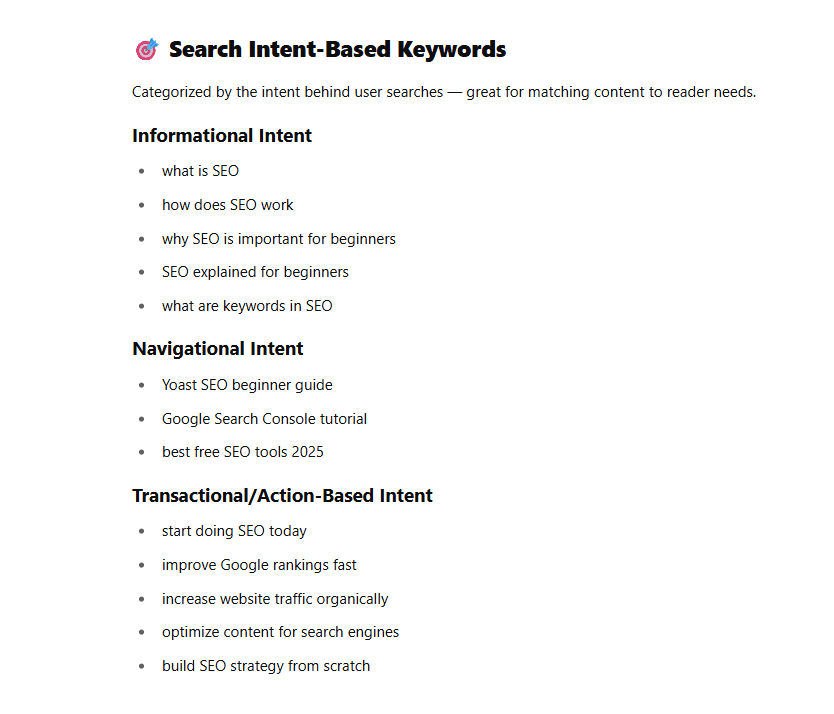
Having a great content idea is just the first step. What makes the content truly stand out is choosing the right keywords. ChatGPT assists not only in generating relevant keyword ideas but also in organizing them based on various factors like search intent, long-tail variations and relevance.
Try Bluehost’s free SEO Checker to analyze your website’s performance in real time and uncover new optimization opportunities. Our tool offers:
- Real-time SEO analysis
- Actionable SEO tips
- Insights to improve website ranking
Pairing AI keyword discovery with the SEO Checker helps you move from planning to measurable SEO results.
4. Discover content gaps & questions
One of the smartest ways to use ChatGPT for SEO is to uncover what your existing content is missing. For example, say you are writing about a topic or revising a published article. All you need to do is just paste the content or share the topic URL with ChatGPT. Then, prompt it with something like: “What key subtopics, FAQs or related questions are missing from this article?”
ChatGPT will analyze the content. It will crawl through common search engine optimization patterns, user intent and related queries and suggest relevant ideas. This helps you:
- Fill in informational gaps.
- Add sections that improve topical authority.
- Include real questions users are likely typing into search engines.
This ensures your content aligns with your audience’s search intent. By integrating this process into your regular SEO tasks, you supplement your SEO strategy with all the keywords and angles your audience cares about. Lastly, it is also a great way to refine your title tags and on-page copy based on what users expect to see.
5. Write high-performing SEO content
ChatGPT can assist with creating a variety of content. It can draft engaging content, from elaborative blog posts and engaging website copy to professional emails and compelling social media updates.
For example, you can use the prompt “Write a 150-word introduction for a blog post titled ‘10 Easy Ways to Improve Your Website’s SEO in 2025’. Use a conversational tone that matches a fun, friendly brand targeting small business owners.”. ChatGPT will produce well-optimized content that’s ready to use.
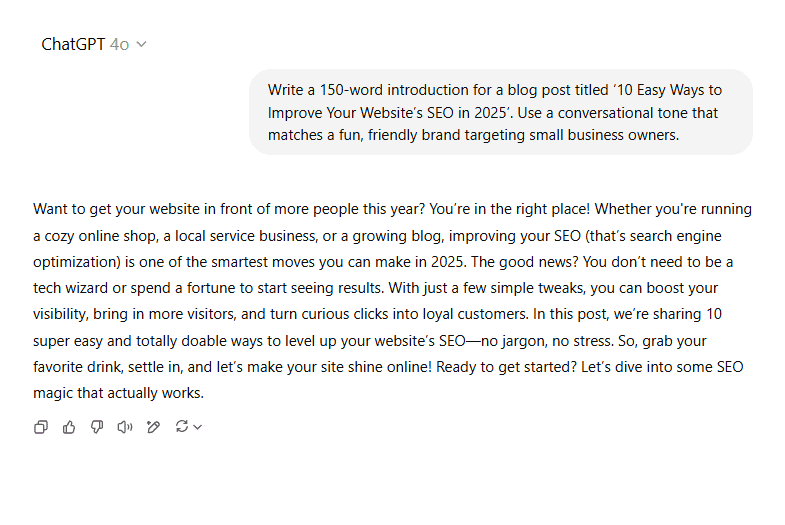
Additionally, you can get the best results by feeding it your brand’s guidelines. Want a conversational tone? Just ask! The more context you provide, the better ChatGPT can tailor the content to match your brand’s voice and engage your audience effectively.
Also read: How to Optimize Content for SEO on WordPress
6. Create meta titles and descriptions
Beyond writing blog content, ChatGPT is fully equipped to help you draft SEO metadata in a conversational style.
It can draft appropriate meta titles (title tags) and descriptions. If you’re stuck on what to write, you can simply ask ChatGPT for multiple options.
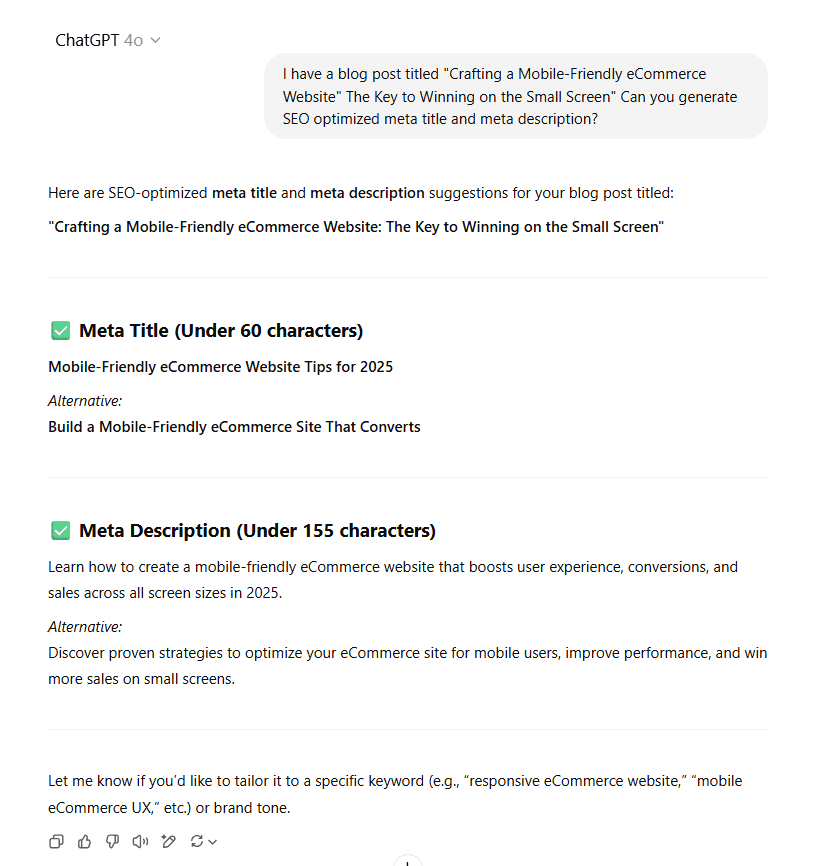
It’s a quick way to overcome writer’s block and fine-tune your SEO strategy.
7. Generate schema markup
Schema markup is a type of structured data that helps search engines better understand your content. By adding schema markup to your website’s code, you enable rich snippets. Consequently, you enhance search results that display extra details like events, reviews, products or learning videos.
Rich snippets make your pages stand out in search results, improve rankings and increase click-through rates. By implementing schema markup, your website can attract more organic traffic and inspire practical conversions.
8. Get RegEx for analyzing SEO performance
Short for regular expression, RegEx helps SEO marketers uncover deeper insights from platforms like Google Analytics and Google Search Console.
RegEx allows you to track keyword variations, partial matches and numeric patterns. It gives far more precise data analysis. Instead of manually writing complex expressions, you can let ChatGPT generate them for you.
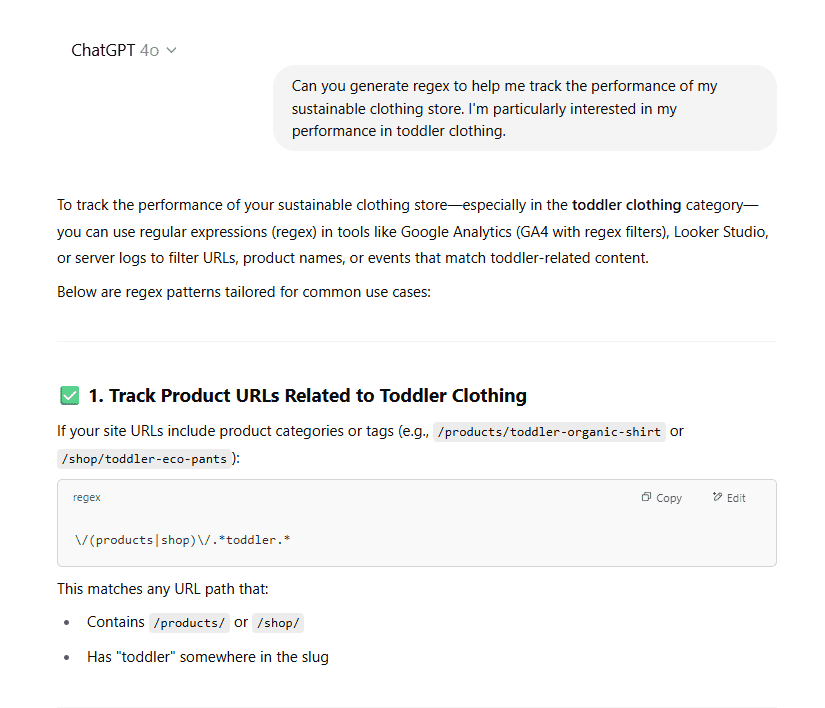
Simply copy and paste the RegEx into your analytics tools to refine your search queries and gain more detailed, actionable insights for your SEO strategy.
ChatGPT SEO optimization: Practical workflows
Let’s explore how using ChatGPT can simplify and improve your SEO tasks, especially when compared to traditional, manual methods. These real-world before-and-after scenarios highlight the practical value of AI in everyday optimization workflows.
1. Writing meta descriptions
Before (manual approach):
Before, creating meta descriptions entailed manually reading through the entire page and summarizing the content under 155 characters. It was time-consuming and often hit-or-miss, especially for beginners unsure of what search engines value.
After (Using ChatGPT): With ChatGPT, you can simply use a prompt to instantly generate multiple meta description options tailored to your page’s title, topic and audience.
Prompt: “Write a meta description (under 155 characters) for a blog post titled ‘10 SEO Tips for Local Businesses in 2026’. Make it engaging and action-oriented.”
Output: “Boost your local visibility in 2026 with these 10 simple SEO tips tailored for small and local businesses.”
Why it works:
The result is concise, informative and optimized for search intent. It encourages clicks while staying within the character limit that Google displays in search engine results.
2. Generating blog post ideas
Before (Brainstorming content manually):
Earlier, coming up with content topics required extensive competitor analysis, keyword research and creative ideation. This took hours and still resulted in content that didn’t fully satisfy target audience’s needs.
After (Using ChatGPT):
ChatGPT can generate blog ideas in seconds based on your focus topic, audience and goals.
Prompt:
“Generate 5 blog post ideas about SEO trends for 2026 that would appeal to small business owners.”
Output:
- Top 5 SEO Trends Small Businesses Can’t Ignore in 2026
- How Voice Search Is Changing Local SEO in 2026
- AI and SEO: What Small Businesses Should Know
- Quick SEO Wins for Small Business Owners in 2026
- Avoid These Common SEO Mistakes in 2026
Why it works:
These titles are timely, engaging and tailored to a small business audience. Each topic is designed to match search intent and aligns with current search engine trends. You can use them as-is or refine further based on your SEO efforts and brand voice.
To sum up, we see how ChatGPT dramatically streamlines SEO tasks. It instantly generates meta descriptions and blog ideas that once took hours. Its speed and efficiency far surpass manual methods. Yet, AI lacks the intuition and strategic nuance humans bring. It should be noted that while it is a powerful engine for execution, real impact only comes when human oversight shapes and refines its output.
Prompt engineering tips for better SEO results
Using ChatGPT for SEO is only as effective as the prompts you give it. This is where prompt engineering comes in. It simply means crafting better instructions to get more accurate, useful responses from the AI. Think of it as learning how to ask the right questions. After all, a vague prompt only gives you a vague answer.
Mastering prompt engineering helps you save time, generate SEO-optimized output and improve the quality of keyword-optimized content
When done right, you can leverage ChatGPT to produce valuable content that search engines understand and reward consistently.
How to craft effective prompts?
To write a great prompt, focus on three core elements:
- Clarity: Be specific about what you want. Avoid broad requests like “Write about SEO.”
- Context: Mention your audience, brand voice and content goal.
- Constraints: Define the word count, format, keywords or tone.
Here is how these elements come into a single prompt.
Prompt: “Write a 600-word blog post titled ‘5 Simple SEO Tips for Small Business Websites in 2026’. The tone should be friendly and encouraging, targeting non-technical small business owners who are new to digital marketing. Use the keywords ‘SEO tips for small businesses’, ‘optimize website for Google’ and ‘improve search visibility’ naturally throughout the content. Include a short introduction, 5 actionable tips with brief explanations and a 2-sentence conclusion.”
The clearer your prompt, the more focused, accurate and informative content you’ll get. You will be able to produce content that carries semantic relevance and fits search intent.
Key prompt engineering tips you cannot miss
Here are essential tips to level up your ChatGPT SEO prompt game:
- Start with the goal: Tell ChatGPT what you’re trying to achieve, such as ranking a blog, writing a product description or optimizing metadata.
- Include keywords: Mention exact keywords you want to target so they’re used naturally and meaningfully.
- Define your audience: Explain who the content is for, such as small business owners, beginners, marketers, etc.
- Specify tone and style: Whether it’s friendly, professional, technical or casual, spell it out.
- Use examples: Reference existing blog titles, formats or your brand voice to guide the AI.
These tips structure your prompts and help you generate ideas that reduce editing time and enhance your SEO workflows. Combine ChatGPT’s output with your own research for more complete and strategically sound content.
Examples: Weak vs. Strong prompts
Let’s look at how small changes in a prompt can make a big difference:
Weak prompt:
“Write a blog post about SEO.”
This is too vague. The AI doesn’t know the audience, tone, format or objective.
Strong prompt:
“Write a 500-word blog post titled ‘Beginner’s Guide to On-Page SEO’. Use simple language for new website owners and include 3 tips with examples.”
Now, the AI has a clear direction, making it easier to deliver valuable content that’s optimized for search engines and has semantic relevance.
What are the emerging AI features that impact SEO (2026)?
As AI continues to evolve, so does its role in SEO. The latest features in ChatGPT are revolutionizing how marketers optimize content, analyze search trends and engage audiences in 2026.
The following are some of the key features of AI that are impacting SEO:
- AI-powered content structuring
- Real-time search intent analysis
- Predictive SEO optimization
- Multimodal content generation
Now we will examine each feature in detail.
1. AI-powered content structuring
One of the biggest challenges in SEO is structuring content in a way that maximizes readability, engagement and search engine ranking. Using ChatGPT for SEO helps users by laying a solid foundation of structured content. It generates:
- Logical content hierarchies structured with nested headings (H1, H2, H3, etc.).
- Scannable content layouts that enhance readability.
- Strategic and contextual keyword placement ensures organic search visibility.
- Accurate internal linking suggestions strengthen website authority.
This feature ensures that your content offers value to readers, which is imperative for improving dwell time and engagement.
2. Real-time search intent analysis
In 2026, search intent has become more critical than ever in SEO. It is no longer about ranking keywords. Today, it is all about understanding what users truly want when they search.
ChatGPT now integrates real-time search intent analysis, helping content creators:
- Identify whether a search query is informational, transactional, navigational or commercial.
- Adjust content tone, structure and calls-to-action based on intent.
- Predict what kind of content format (blog, listicle, video, product page) is most likely to rank.
- Optimize content for Google’s helpful content algorithm, ensuring content remains valuable and user-focused.
This feature allows SEO professionals to create content that matches user intent, improves rankings and increases conversion rates.
3. Predictive SEO optimization
SEO is no longer reactive, it’s becoming predictive. While ChatGPT doesn’t have direct access to real-time search trends, its Predictive SEO Optimization feature analyzes patterns. It suggests potentially trending keywords and topics based on historical data and AI-driven insights.
By combining this with real-time data from tools like Google Trends or Ahrefs, SEO professionals can stay ahead of emerging search trends before they peak.
With this, you can:
- Get data-driven recommendations on emerging keywords and topics.
- Optimize for future algorithm changes before they impact rankings.
- Identify seasonal trends and industry shifts to stay ahead of competitors.
- Adjust existing content proactively, improving its longevity in search rankings.
By utilizing predictive SEO, marketers can create content that guarantees a long-term sustainable presence in search results.
4. Multimodal content generation
Search engines are evolving beyond just text. Multimodal content—which combines text, images, audio and video—is becoming a ranking factor in 2026. ChatGPT now integrates multimodal content generation, enabling:
- AI-generated infographics and visuals to supplement your text-based content.
- Video script content for YouTube and TikTok SEO.
- Podcast and voice content optimization for broader audience engagement.
- Automated content summaries for rich snippets and featured snippets.
With multimodal capabilities, ChatGPT helps SEO professionals create high ranking content. It enables creators to publish across different platforms, including Google Discover, YouTube and voice search results.
Generative engine optimization (GEO)
Generative Engine Optimization (GEO) is the practice of optimizing your content to appear in AI-generated responses from tools like ChatGPT, Google’s AI Overviews and other conversational search engines. As more users turn to AI assistants for quick answers, GEO represents the natural evolution of traditional search optimization—not a replacement for it, but a complementary strategy that extends your visibility beyond standard search results.
GEO matters most when users ask informational or comparison questions. When someone queries “what is web hosting” or “best hosting for small business,” generative engines scan the web for authoritative, well-structured content to synthesize into their answers. They prioritize pages with clear definitions, concise summaries, step-by-step instructions and FAQ sections. Your content earns citations when it’s easy to parse, factually accurate and directly addresses user intent.
To strengthen your ChatGPT SEO strategy, focus on structured formats that AI engines can easily extract and reference. Think short paragraphs, clear headings, numbered steps and bullet-pointed lists. While traditional SEO for ChatGPT efforts still drive organic traffic through Google, adding GEO ensures your content reaches audiences who rely on AI-powered search. By combining both approaches, small business owners and content creators can maximize their online presence across every search channel.
Key factors for generative engine visibility:
- Lead with clear, entity-first definitions
- Use descriptive headings and short paragraphs
- Place direct answers in the first 50-100 words
- Maintain consistent terminology throughout
- Include unique insights and real examples
- Link only to verified, authoritative sources
- Implement structured data (FAQ, HowTo schemas)
- Build internal links to related content
- Update content regularly for accuracy
Pre-publish checklist:
- Main query answered in opening
- Headings clearly describe content
- Original examples included
- Sources verified for credibility
- Key terms used consistently
Benefits of using ChatGPT for SEO content strategy
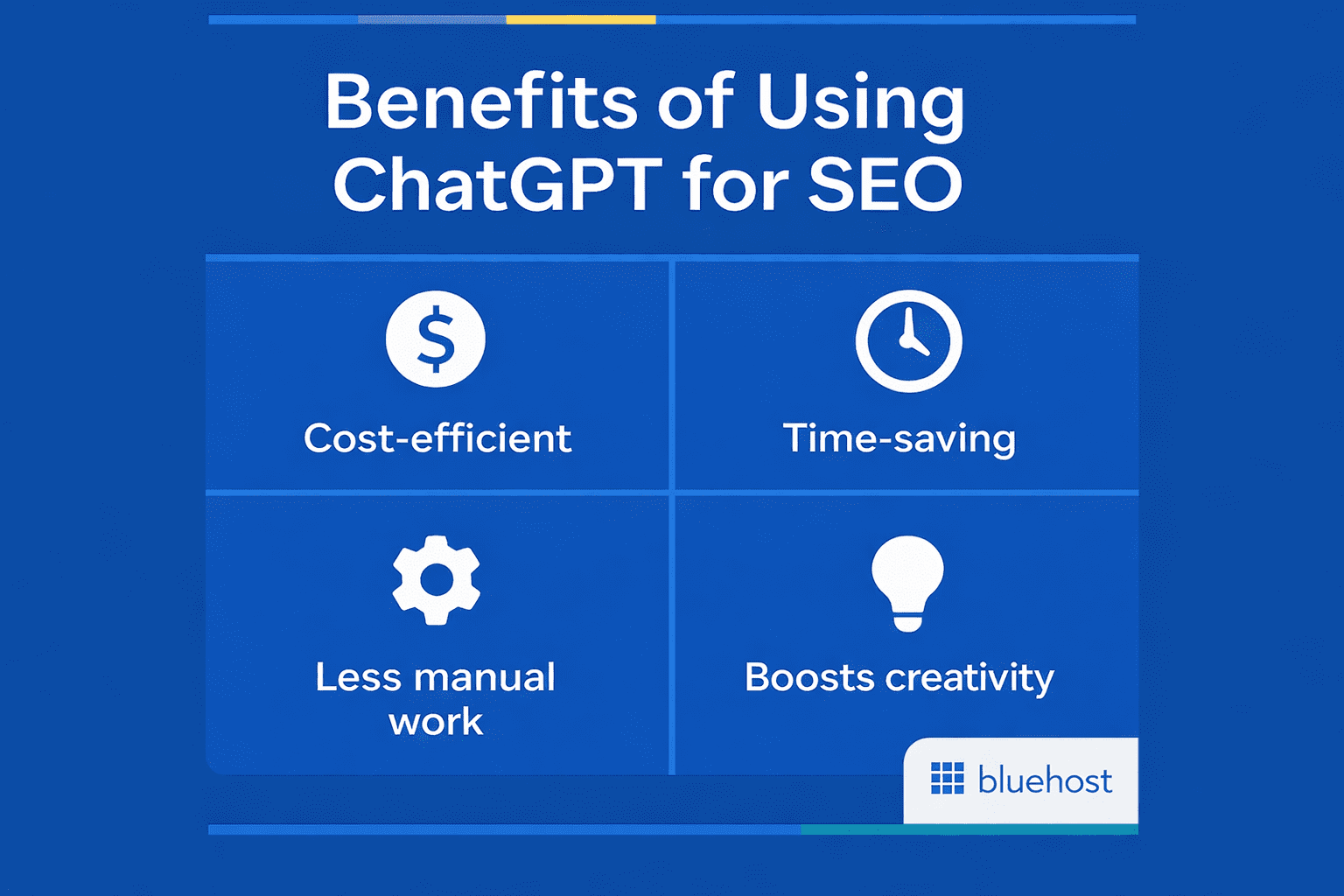
Using ChatGPT as part of your SEO content strategy offers several key advantages. Whether you’re an independent creator or part of a marketing team, ChatGPT can enhance your SEO strategy in an efficient way. Here are a few reasons to consider:
- Cost efficient
- Time-saving
- Less manual work
- Boosts creativity
1. Cost-efficient
ChatGPT reduces the need for outsourcing by handling content ideas, meta descriptions and titles. Pair it with tools like Semrush or Ahrefs for keyword research.
2. Time-saving
AI speeds up content creation and research. Even if edits are needed, it handles the heavy lifting—freeing you up for strategy and refinement.
3. Less manual work
ChatGPT automates repetitive SEO tasks like keyword suggestions and FAQs, letting your team focus on creative and high-impact work.
4. Boosts creativity
It helps break writer’s block by offering new ideas, subtopics and angles, giving your content more variety and a competitive edge.
Potential drawbacks of using ChatGPT for SEO
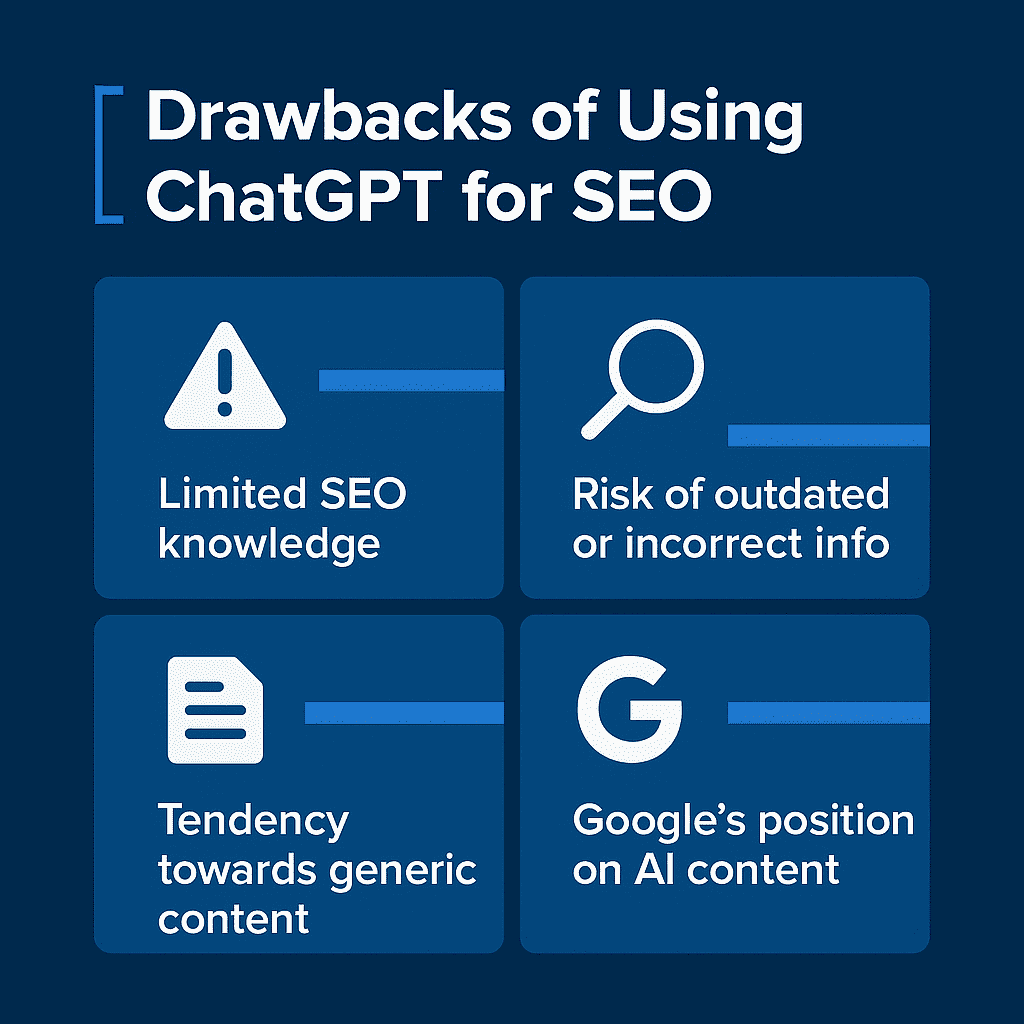
While ChatGPT is a powerful tool for SEO, it’s important to understand its limitations. Relying on AI without oversight can lead to missed opportunities or content issues. Here are some common drawbacks to keep in mind when using ChatGPT in your SEO strategy:
- Limited SEO knowledge
- Risk of outdated or incorrect info
- Tendency towards generic content
- Google’s position on AI content
Let us look at these pointers in detail:
1. Limited SEO knowledge
While ChatGPT is helpful, it’s not a replacement for experienced SEO professionals. It may overlook basic best practices, like using primary keywords in meta titles or structuring content for on-page SEO. It also may not reliably help you find keywords or properly create pages with strong SEO foundations. Human oversight is essential to ensure technical accuracy and strategic alignment.
2. Risk of outdated or incorrect info
ChatGPT’s responses are not always up to date or fully accurate. This is especially true for fast-changing topics like algorithm updates or SEO trends. Therefore, it’s important to double-check key facts with reliable sources. This is especially true when evaluating ranking factors, long-tail keywords or competitive content insights.
3. Tendency towards generic content
AI-generated writing can sound repetitive or bland, lacking brand personality. If not guided properly, it may also unintentionally produce duplicate content. To avoid this, prompt ChatGPT with specific tone and style instructions.
4. Google’s position on AI content
Google doesn’t oppose AI-generated content as long as it’s helpful. High-quality AI content can rank well if it aligns with user needs and demonstrates value. However, the drawback is that low-effort duplicate content made purely to game rankings can still be penalized. To stay on the safe side, always review AI output to ensure it meets Google’s quality guidelines.
Final thoughts
ChatGPT is a powerful ally for SEO. You can streamline content creation, keyword research and intent-driven writing. It helps marketers save time, generate ideas and craft optimized content faster than ever.
But AI alone isn’t enough. Your website’s performance plays a critical role in how well your content ranks. That’s why choosing the right hosting provider is just as important.
Bluehost’s fast, secure and SEO-friendly hosting solutions are perfect for giving your site the technical edge needed for better visibility and user experience.
Pair ChatGPT with the Yoast SEO plugin to polish metadata and ensure content alignment. Ready to take your SEO strategy to the next level?
FAQs
ChatGPT is an AI-powered language model widely used for ChatGPT SEO tasks such as content creation, keyword ideation, meta description writing and blog drafting. As a ChatGPT SEO tool, it helps marketers generate SEO-friendly outlines, organize keyword clusters and create optimized content for search engines. When used correctly, ChatGPT for SEO supports faster content planning, better topical coverage and improved efficiency for common SEO purposes.
No. While using ChatGPT for SEO can help classify keywords, suggest related terms and surface long-tail variations, it does not replace dedicated tools. Platforms like Semrush, Ahrefs and Google Search Console remain essential for real data such as search volume, keyword difficulty and rankings. ChatGPT and SEO work best together when AI supports ideation and structure, while traditional tools validate performance. This balance is key to a reliable ChatGPT seo strategy.
Yes, when used responsibly. ChatGPT SEO content is safe if it is original, reviewed and aligned with search intent. For effective chatgpt seo optimization, ensure the content includes relevant keywords, follows SEO best practices and reflects your brand’s voice. Avoid publishing raw AI output. Human review is essential to ensure accuracy, credibility and compliance with evolving search engine guidelines.
To learn how to use ChatGPT for SEO, prompts must be clear and specific. Include your topic, target audience, primary and secondary keywords, tone and formatting requirements. This approach improves results for chatgpt for content and seo workflows.
Example prompt:
“Write a 500-word beginner-friendly blog post on on-page SEO. Use a friendly tone, include the keyword ‘SEO tips for small businesses,’ apply proper headings, meta titles and bullet points.”
Clear prompts lead to stronger ChatGPT for SEO output and more relevant results.
A ChatGPT SEO tool may miss technical SEO elements such as internal linking structure, advanced schema markup or real-time performance data. ChatGPT SEO can also generate generic content if prompts lack depth. It does not replace analytics platforms, backlink tools or PPC data sources. For best results, combine ChatGPT SEO outputs with manual research, audits and expert review.
Yes. ChatGPT for SEO can generate schema markup such as JSON-LD to enhance rich results and help search engines interpret your site. It can also create RegEx patterns for filtering queries in Google Search Console, which supports faster audits and better insights. When paired with proper validation, this makes SEO for ChatGPT a practical addition to technical SEO workflows.


Write A Comment