


Headlines say search is dying. AI chatbots are replacing Google. The old model is finished.
It is a compelling story. But it is also not supported by the data.
Recent findings from the State of Search Q4 2025 report point to a quieter reality. When you strip away the noise and look at how people actually behave online, a different picture emerges.
Search is not collapsing. It is not being wiped out. It is evolving slowly and in ways that are far more predictable than the headlines suggest.
The big question everyone is asking
Is traditional Google search really being replaced by AI tools like ChatGPT?
That idea has fueled much of the recent hype. The narrative suggests a rapid takeover, where conversational AI becomes the primary way people find information and classic search results fade into irrelevance.
However, when usage data are examined across markets and over time, that narrative begins to fall apart. Even after a year of steady growth, all AI tools combined still account for well under one percent of total desktop activity. The implication is not that AI is failing, but that it is being absorbed into existing search behavior rather than replacing it outright.
Traditional search is remarkably stable
On desktop, traditional search continues to dominate user activity.
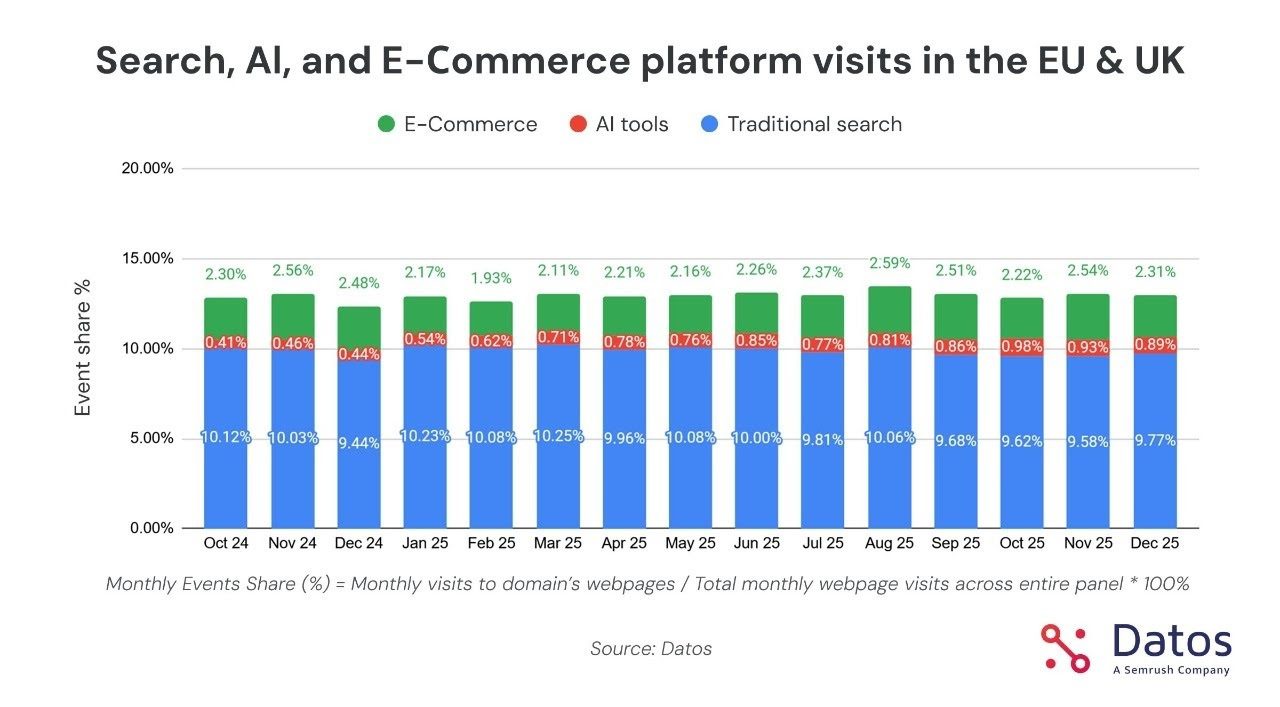
As shown in the report above, across the US and Europe, traditional search has consistently accounted for approximately 10 percent of total desktop activity for more than a year. That is not the profile of a platform in decline; rather, it is a snapshot of stability.
Within that already stable slice, Google’s position is even more striking. Its share of searches has remained above 93 percent. Despite the introduction of new tools, users are not abandoning Google at scale.
The idea that people are “ditching Google” simply is not supported by the data.
AI tools are growing, but slowly
None of this means AI is irrelevant. It just means its role is being overstated.
AI tools have grown from about 1 percent to roughly 1.5 percent of desktop activity over the past year. That is a 50 percent increase, but it is growth from a very small base. AI remains a thin slice of overall behavior.
This is not a sudden takeover. It is incremental adoption.
Even the growth curve itself is changing. The early spike appears to be leveling off into a more gradual and sustainable pattern, rather than accelerating into a dramatic hockey-stick pattern.
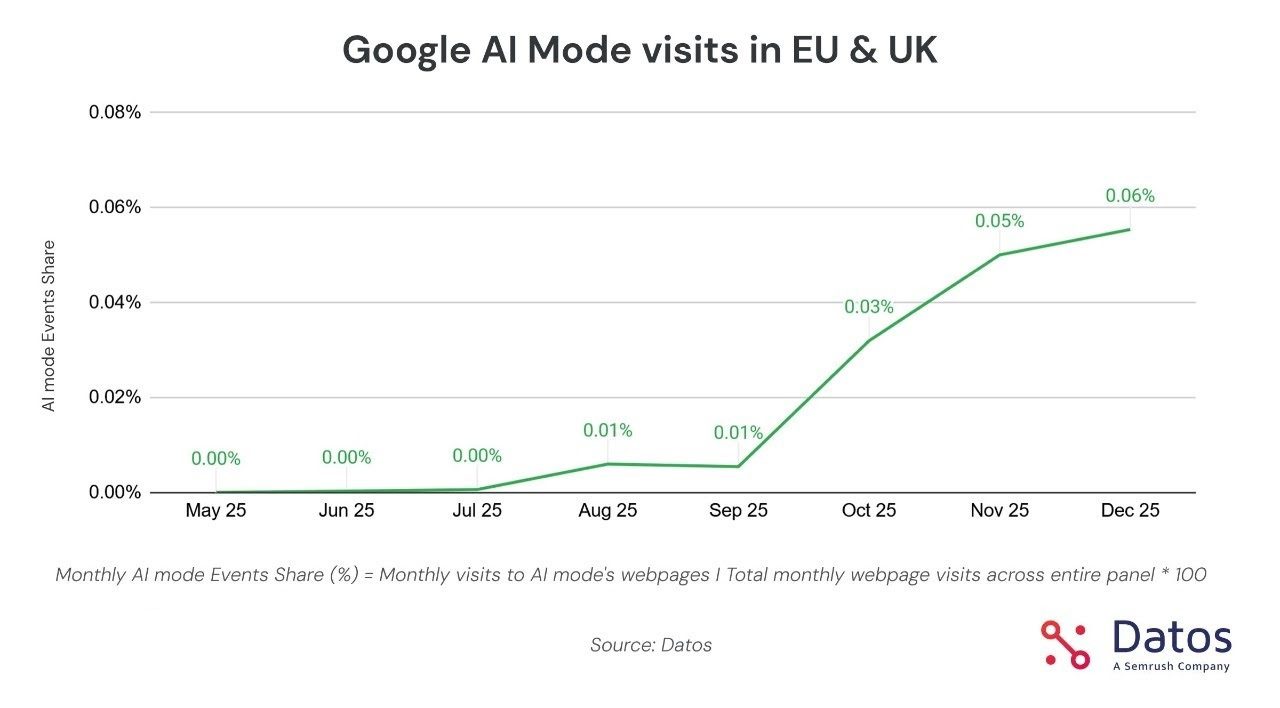
Inside Google’s own ecosystem, the pattern is similar. Google’s AI mode currently accounts for approximately 0.06 percent of total activity. The number is small, but the trend is consistent. People are experimenting, not switching overnight.
Evidently, generative AI is reshaping online search, but the change is more gradual than headlines suggest and far from signaling the end of clicks.
Search behavior has not been overturned
If AI were replacing search, the biggest signal would be a change in what people do after they search.
That change has not happened.
The report states that the percentage of users clicking on organic, non-paid results has remained strikingly stable. Despite new interfaces and AI-generated summaries, the core behavior remains intact. People search, see links and click through websites.
That basic contract of search still holds, especially for content optimization strategies focused on increasing organic traffic.
Where people go after search still looks familiar?
The destinations people visit after searching have barely changed. Clearly, the developments in AI will not radically impact the fundamentals of SEO strategies.
The top sites remain the same. YouTube. Reddit. Amazon. Wikipedia. Facebook.
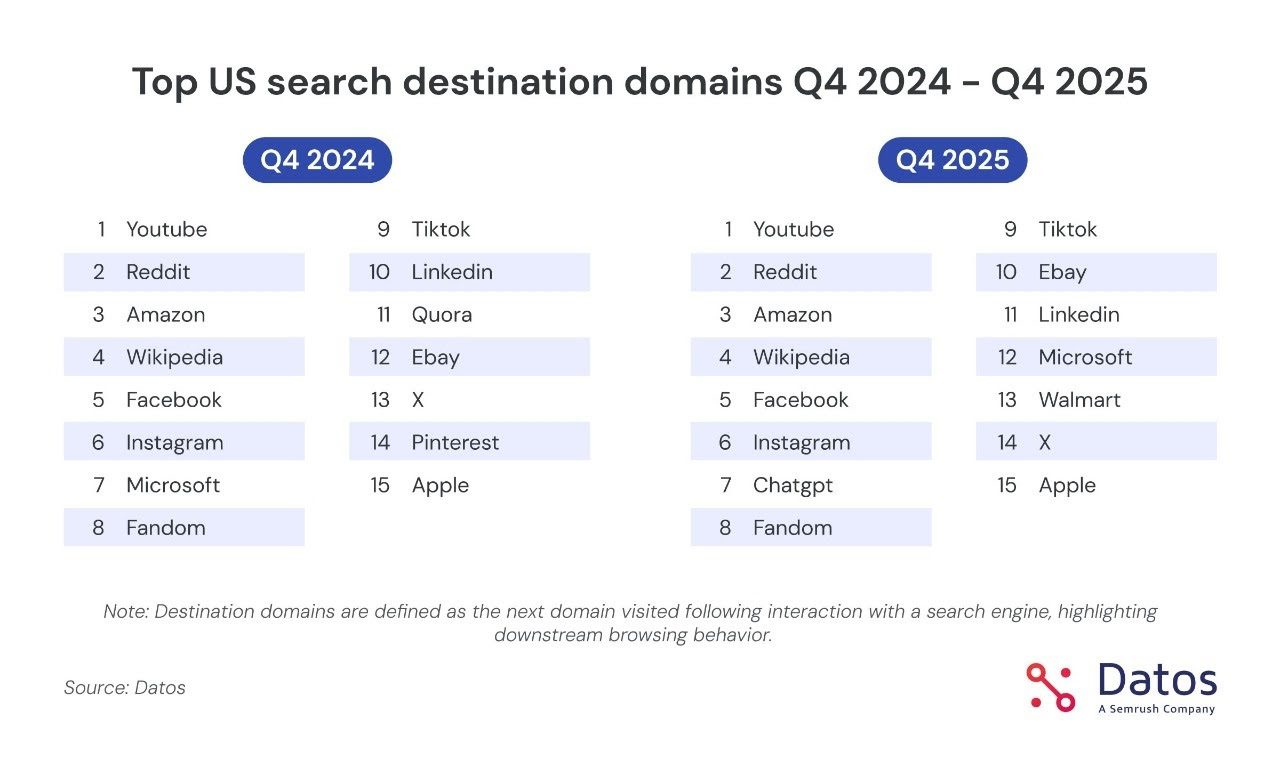
Year over year, the list is nearly identical. The giants are still giants.
But just beneath the surface, there are signs of adjustment. ChatGPT has entered the top ten destinations, ranking seventh. At the same time, platforms like Quora, once a go-to source for direct answers, have slipped out of the top tier.
In a broader sense, little has changed. Even after a year of intense AI attention, search-driven discovery continues to direct users to the same dominant platforms. ChatGPT’s rise reflects a new stop in some journeys, not a rerouting of their endpoints.
This is not a collapse. It is a reshuffling within a system that remains highly resistant to disruption.
The most meaningful shift is how people ask questions
The clearest behavioral change is not where people search, but how they phrase their searches. Longer queries are becoming more common, particularly in the six-to-nine-word range.
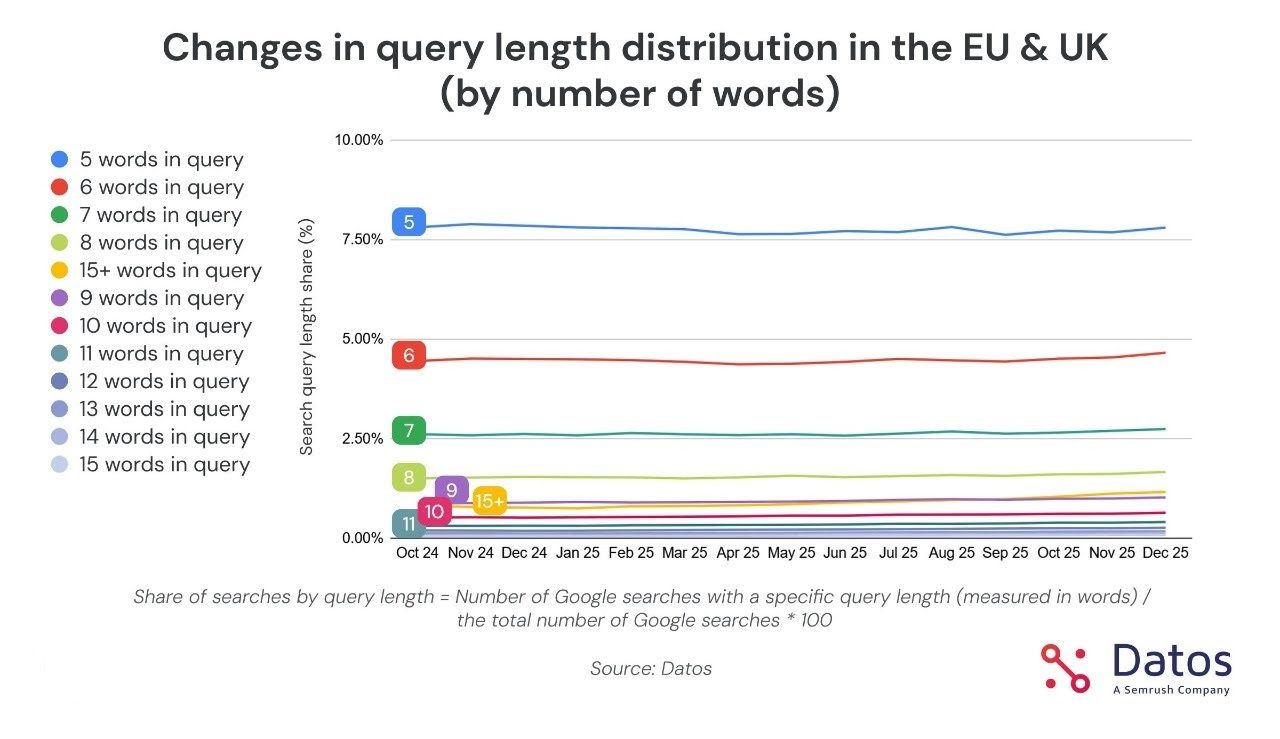
As shown in the graph above, the mid-length band increases over time, whereas five-word queries remain the most common format and change little in the EU and UK. The shift is real, but it is evolutionary rather than abrupt.
This likely reflects habits formed through AI tools. People are becoming more comfortable expressing complex intent in a single query. That behavior is now extending to traditional search.
The long tail is moving too. Very long queries (15+ words) tick up across the period, even though they still represent a small slice of total searches. That combination suggests users are not abandoning short queries. They are increasingly willing to “load” more intent into a single search when the question is complex.
When it comes to SEO strategies, this has practical implications. Visibility is increasingly tied to how well content matches nuanced, multi-part intent, not just individual keywords.
Pages that clearly answer layered questions are better positioned to benefit from this shift than those optimized solely around short, generic terms.
A search evolution, not a revolution
When all of this is taken together, the picture becomes clear.
Traditional search is holding steady.
AI is growing, but gradually.
Core clicking behavior remains stable.
The biggest change is in query complexity.
Search is not being replaced. It is expanding.
Rather than transforming into something entirely new, the search ecosystem is absorbing new behaviors and redistributing them across familiar paths. Conversational habits shaped by AI are flowing into traditional search, changing how people ask questions without changing where those journeys begin or end.
The result is not a break from the past, but a more dynamic version of it. Search is becoming more expressive, more layered and more adaptive. At the same time, it is anchored in the same underlying structures that have defined it for years.



Write A Comment