 ChatGPT,
 Claude,
 Gemini,
 Grok — all four for
Key highlights
- Discover why CentOS is no longer the standard for production VPS environments.
- Compare the leading CentOS alternatives, including AlmaLinux and Rocky Linux, to find the best fit.
- Explore the top AlmaLinux VPS hosting providers and what they offer.
- Learn how to select a VPS plan that aligns with your performance, security and budget needs.
AlmaLinux has become one of the most trusted replacements for CentOS, giving businesses and developers a stable, enterprise-ready operating system for VPS environments.
Built to maintain compatibility with Red Hat Enterprise Linux (RHEL), it makes migrating from CentOS straightforward while preserving existing workflows and applications.
With long-term support, regular security updates and an active open-source community, AlmaLinux delivers a reliable, cost-effective platform for production workloads.
Why is everyone moving away from CentOS for VPS hosting?
People are moving away from CentOS because it no longer offers the stable, predictable release cycle that production servers need. After CentOS Linux was replaced by CentOS Stream, updates became more frequent and arrived before Red Hat Enterprise Linux (RHEL) releases. This makes CentOS Stream better for testing and development, but less suitable for production workloads where stability and long-term support are priorities.
As a result, many VPS users have switched to alternatives like AlmaLinux and Rocky Linux, which provide a more predictable lifecycle and are designed as compatible replacements for CentOS Linux.
While several Linux distributions emerged after CentOS changed direction, two options consistently stand out for VPS hosting: AlmaLinux and Rocky Linux. Here’s how they compare.
What are the best CentOS alternatives for a VPS in 2026?
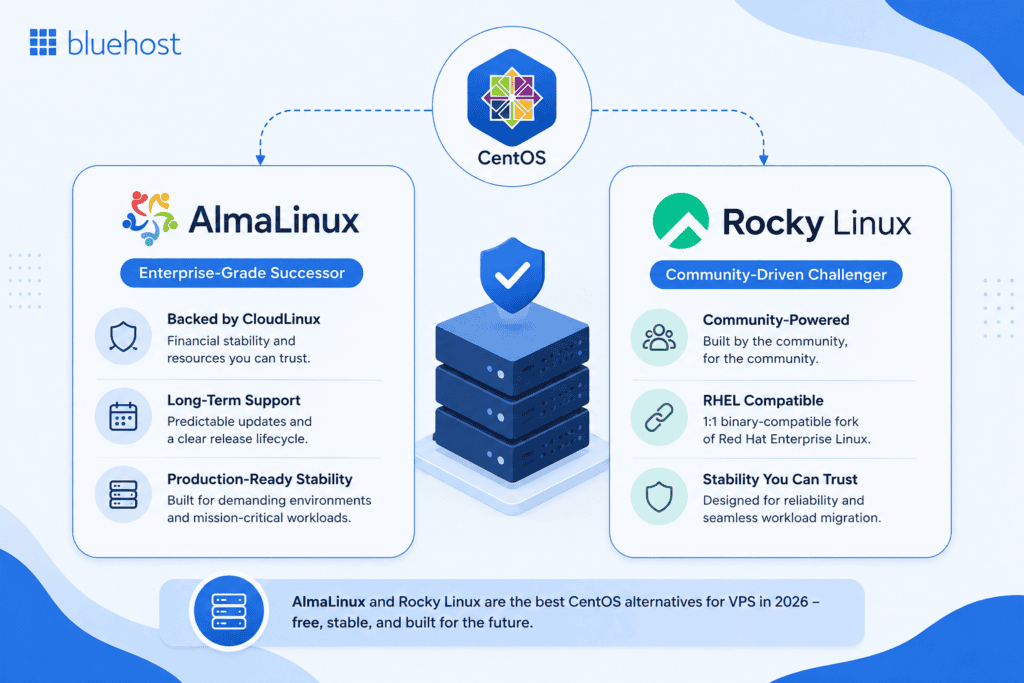
AlmaLinux and Rocky Linux are the best CentOS alternatives for VPS hosting in 2026. Both are free, stable and compatible with Red Hat Enterprise Linux. AlmaLinux is well suited to businesses that want predictable updates and long-term support, while Rocky Linux appeals to users who prefer a community-led distribution. The right choice depends on your support needs and existing server setup.
1. AlmaLinux: The enterprise-grade successor
AlmaLinux has quickly emerged as the enterprise-grade successor to CentOS, offering a seamless, reliable solution for businesses and developers alike. Designed to fill the gap left by CentOS’s shift to Stream, AlmaLinux provides the stability and long-term support that organizations depend on for mission-critical applications.
- Backed by CloudLinux: AlmaLinux benefits from the financial stability and resources of CloudLinux, ensuring its longevity and robust development.
- Long-term support: With a clear release lifecycle, AlmaLinux guarantees predictable updates, making it a dependable choice for enterprise workloads.
- Production-ready stability: Built to handle demanding environments, AlmaLinux is optimized for VPS setups, ensuring reliability and performance for critical applications.
For system administrators and technical founders, AlmaLinux is more than a CentOS alternative; it’s a forward-thinking, enterprise-grade solution tailored for 2026 and beyond.
2. Rocky Linux: The community-driven challenger
When CentOS announced its shift to CentOS Stream, the Linux community was quick to respond and Rocky Linux emerged as one of the most prominent contenders.
- Founded by Gregory Kurtzer, one of the original creators of CentOS, Rocky Linux was designed to stay true to the original mission of providing a stable, production-ready operating system.
- Its community-driven approach has resonated with system administrators and developers alike, offering a sense of continuity and trust.
- Rocky Linux is built to be a 1:1 binary-compatible fork of Red Hat Enterprise Linux (RHEL), ensuring that users can seamlessly migrate their workloads without worrying about compatibility issues.
This makes it an excellent choice for those who value stability and predictability in their server environments. However, while Rocky Linux has gained significant traction, its reliance on a volunteer-driven model can sometimes lead to concerns about long-term sustainability and support.
AlmaLinux vs. Rocky Linux: A head-to-head comparison
When choosing between AlmaLinux and Rocky Linux, understanding their differences can help you make the right decision for your VPS needs.
| Feature | AlmaLinux | Rocky Linux |
| Governance | Corporate-backed by CloudLinux | Community-driven |
| Support lifecycle | 10 years | 10 years |
| Backing | Strong corporate funding | Community donations |
| Ideal use case | Businesses needing stability and support | Community-focused projects |
Both AlmaLinux and Rocky Linux are excellent choices, but AlmaLinux stands out for organizations that prioritize predictable releases, enterprise support and long-term stability. If you’re looking for the easiest transition from CentOS, AlmaLinux is generally the stronger choice.
Once you’ve selected the right operating system, the next step is choosing a VPS provider that delivers reliable performance, scalable infrastructure and ongoing support.
Which providers offer the best AlmaLinux VPS hosting?
When it comes to AlmaLinux VPS hosting, choosing the right provider can make all the difference in performance, reliability and cost-effectiveness. Whether you’re a startup looking for budget-friendly options or a seasoned system administrator seeking high-availability infrastructure, the market offers a variety of solutions tailored to your needs. Below, we’ve compared some of the top providers to help you make an informed decision.
| Provider | Introductory price | Key features | Best for |
| Bluehost | $2.09/month (24-month term) | NVMe SSD storage, root access, scalable resources, 99.99% uptime SLA, 24/7 infrastructure support, multiple Linux OS options including AlmaLinux | Best overall value for developers, businesses and production workloads |
| Hostinger | $6.49/month | AMD EPYC processors, NVMe SSD storage, Free weekly backups, AI Web terminal | Startups on a budget |
| OVHcloud | From $8.50/month | NVMe SSD storage, Unlimited traffic (most regions), Comprehensive backup options, 99.9% SLA | High-availability infrastructure |
| ServerSpace | $4.95/month | Pay-as-you-go billing (10-minute increments), Intel Xeon Gold CPUs, Rapid deployment, 24/7 live support | Pay-as-you-go flexibility |
| Rad Web Hosting | $14.16/month (36-month term) | Premium server hardware, SSD storage in RAID 10, KVM virtualization, Multi-datacenter presence | High-performance server hardware |
Each of these providers brings unique strengths to the table, from cost-effective entry points to advanced features like pay-as-you-go billing and high-availability infrastructure. Depending on your specific requirements, you can find a solution that aligns with your technical and budgetary needs.
Why is Bluehost the right choice for your Linux VPS?
At Bluehost, we give you the performance, control and flexibility needed to run Linux workloads with confidence. Our VPS plans include NVMe SSD storage, scalable resources and a 99.99% uptime SLA, making them suitable for websites, applications, databases and development environments.
You can choose a stable Linux distribution such as AlmaLinux or Rocky Linux and manage your server with full root access. For customers who prefer additional assistance, our Managed VPS plans include 24/7 expert support and cPanel for easier server administration.
| Bluehost VPS feature | What it means for you |
| NVMe SSD storage | Faster access to website, application and database files |
| 99.99% uptime SLA | Greater availability for important workloads |
| Full root access | Control over software, settings and server configurations |
| Scalable resources | Increase server capacity as your workload grows |
| AlmaLinux and Rocky Linux support | A stable option for users moving away from CentOS |
| Free SSL and Cloudflare CDN | Added security and faster content delivery |
| Managed VPS support | 24/7 assistance and simplified management with cPanel |
Whether you are moving from CentOS, launching an application or managing multiple websites, we provide a Linux VPS environment that can grow with your needs.
What is the final verdict on choosing a CentOS alternative?
AlmaLinux is a strong CentOS alternative for businesses that need stability, long-term support and compatibility with RHEL-based workloads. Rocky Linux is also a dependable option, especially for users who prefer a community-led distribution.
The right choice depends on your existing setup, support needs and server management experience. You should also choose a VPS provider that offers reliable performance, scalable resources and support for your preferred Linux distribution.
Run AlmaLinux and other Linux workloads on a Bluehost VPS with NVMe storage, scalable resources and full server control.
FAQs
Yes, AlmaLinux is completely free to use. It is an open-source, community-driven project designed to be a 1:1 binary-compatible fork of Red Hat Enterprise Linux (RHEL). There are no licensing fees or hidden costs, making it an excellent choice for businesses and developers seeking a reliable and cost-effective CentOS alternative.
Absolutely. AlmaLinux provides a straightforward migration process using the AlmaLinux Elevate tool. This tool allows you to seamlessly transition from CentOS 7, 8, or Stream to AlmaLinux without needing to reinstall your operating system or disrupt your existing configurations.
If you stay on CentOS 7, you risk running an unsupported operating system after its end-of-life date in June 2024. This means no security updates, bug fixes, or official support, leaving your server vulnerable to security threats and compliance issues. Migrating to a supported alternative like AlmaLinux ensures your system remains secure and up-to-date.
Yes, AlmaLinux is just as secure as CentOS. It inherits the same robust security features from RHEL, including SELinux and regular security updates. Additionally, the AlmaLinux OS Foundation actively maintains and supports the project, ensuring it meets the highest security standards.
Both AlmaLinux and Ubuntu are excellent choices for eCommerce, but the best option depends on your specific needs. AlmaLinux is ideal for those who prefer RHEL-based systems, offering stability, enterprise-grade features and compatibility with cPanel. Ubuntu, on the other hand, is known for its user-friendliness and extensive software repositories. If you’re migrating from CentOS, AlmaLinux is often the smoother transition.
Yes, Bluehost supports AlmaLinux on its VPS and dedicated hosting plans. As AlmaLinux gains popularity, many hosting providers, including Bluehost, have embraced it as a reliable CentOS alternative, ensuring compatibility and support for their customers.

Write A Comment