


ChatGPT has begun testing advertisements within its interface, introducing sponsored placements directly beneath conversational responses.
The rollout is limited for now. Ads are clearly labeled and currently appear only to Free and Go users in the United States, while paid tiers remain ad-free.
On the surface, the move looks incremental: another platform experimenting with monetization.
However, the question is no longer whether AI will influence search. It’s how it will reshape the pathways users take before they even reach a website.
How do ChatGPT ads work?
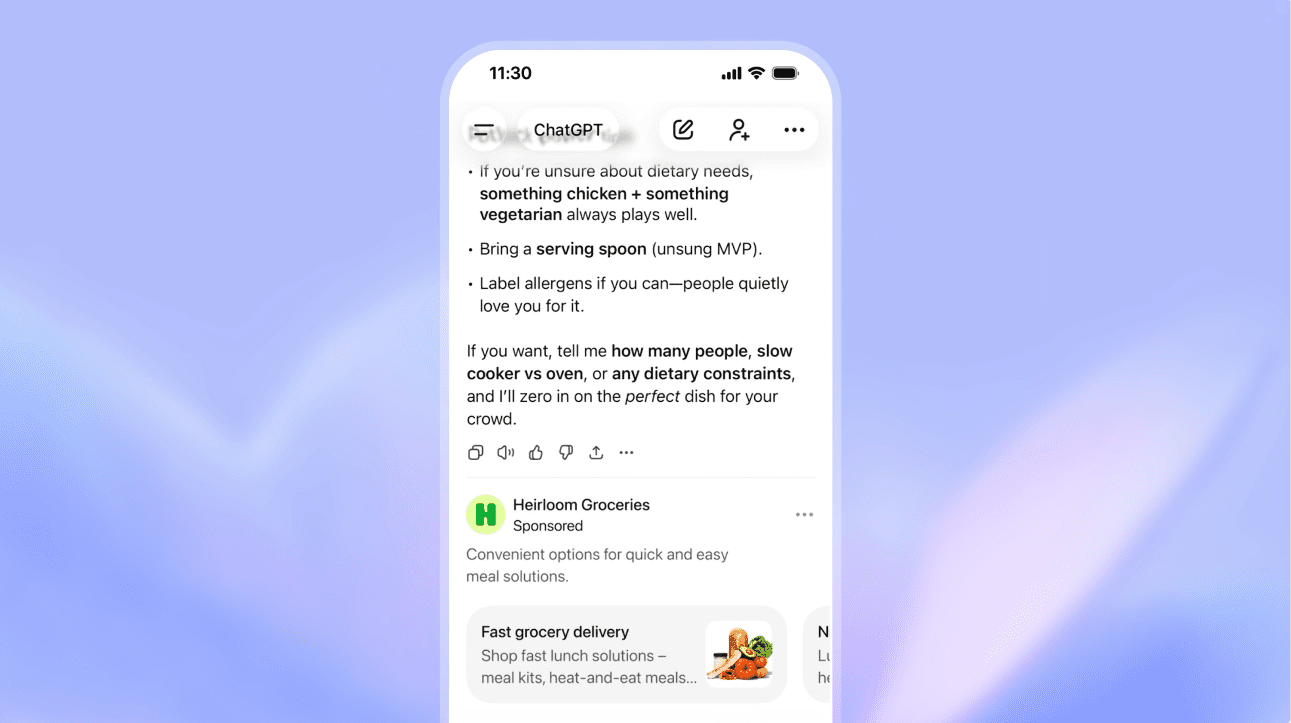
Ads appear at the bottom of ChatGPT responses. They’re visually separated from the main answer and clearly labeled as sponsored.
According to OpenAI, ad selection is contextual. Advertisers submit campaigns that are matched to the topic of a user’s conversation, along with past chat activity and prior interactions with ads.
For example, a user researching running shoes could see a sponsored ad from a sportswear brand aligned with their query.
Importantly, advertisers do not see individual conversations or personal data. They receive only aggregated performance metrics such as views and clicks.
Users have controls. Ads can be dismissed, personalization can be turned off and ad-related data can be cleared. OpenAI says ads will not appear in conversations about health, mental health or politics and they won’t be shown to accounts identified as under 18.
Free users who prefer not to see ads can opt out — but with reduced daily message limits. Go users can remove ads entirely by upgrading to a paid tier.
ChatGPT is evolving into a distribution platform
OpenAI begun testing advertisements within its ChatGPT interface. Until now, ChatGPT functioned primarily as an answer engine. It worked as a tool that synthesized information and delivered it in conversational form.
Advertising introduces monetization directly inside the conversation layer. And monetization changes incentives. Incentives shape distribution.
Once revenue flows through the interface, that interface becomes more than a tool. It becomes a platform.
Before we let our speculative mind do its work, let’s get a clear picture of the facts and what remains uncertain.
What we know so far and what’s still uncertain
The ad rollout inside ChatGPT is not hypothetical; it’s active. But it’s also limited, and that distinction is important.
Here’s what we know so far:
Ads are clearly labeled as sponsored content. They appear directly below generated responses, not embedded within them. The placements are contextual, meaning they relate to the ongoing conversation. And for now, the test is restricted to Free and Go users in the United States. Paid subscription tiers remain ad-free.
That’s the current reality.
But beyond those mechanics, much remains unclear.
What we don’t yet know:
Actual click-through rates.
How users will respond over time.
Whether the experiment expands to additional tiers or international markets. And more critically, whether monetization will influence how recommendations are surfaced.
User tolerance is especially important. Ads inside search have decades of behavioral conditioning behind them. Ads inside conversational AI do not. It’s unclear whether users will treat them as natural extensions of the interface or friction.
The structural implications are significant. The measurable impact is still emerging. Now that we know the facts and uncertainties, let us learn about how search intent is being transformed.
From search intent to conversational intent
To understand what shifts next, you have to look at how monetization models shape behavior.
Search monetizes keywords.
Social monetizes attention.
AI monetizes multi-turn context.
In search, users scan multiple results. They compare headlines. They open tabs. The friction is part of the system and publishers live inside that comparison layer.
In chat, comparison collapses.
The system synthesizes information into one response. The user doesn’t browse alternatives in parallel tabs. They just continue the conversation. Ads appear after explanation, not besides competing links.
Now, this changes the behavioral flow.
Search behavior is evaluative. Conversational behavior is guided.
And guided environments create different traffic patterns. Clearly, this development in AI is not destroying search but merely transforming it into a different space.
How is informational traffic being compressed?
Informational queries are the most exposed.
Why?
Because AI answers reduce the need to click.
When synthesis happens instantly, exploratory browsing declines. Users don’t need to visit five articles to understand a topic. They can ask follow-ups inside the same thread.
Likely outcomes:
- Fewer exploratory visits.
- Reduced long-tail traffic.
- Greater importance of brand recall.
Informational SEO was built on incremental curiosity clicks. Conversational AI compresses that curiosity into fewer sessions.
That doesn’t eliminate informational traffic. It filters it.
Only brands remembered or explicitly recommended survive the compression.
What changes for commercial intent?
Commercial behavior shifts differently. Especially for eCommerce SEO, where visibility at the moment of purchase intent traditionally depends on ranking across comparison queries.
However, high-intent users still convert. But the journey compresses.
Commercial intent inside conversational AI may:
- Resolve faster.
- Convert in fewer steps.
- Favor already recognized brands.
- Benefit from contextual targeting tied to dialogue history.
Here’s the nuance:
Total clicks may decrease.
But remaining clicks could carry higher intent.
This is not purely a traffic volume story. It’s a traffic quality story.
Fewer steps between question and recommendation can reduce friction, and friction has always been the hidden cost of search. We are likely to see new eCommerce trends emerge.
Zero-click evolves into no-search journeys
“Zero-click” used to mean users stay on the search engine results page.
They still initiated a search. They still saw the links. They just didn’t click. Conversational AI introduces something deeper.
Imagine a user researching project management software.
In 2022, they might have searched:
“Best project management tools for remote teams.”
They would scan articles. Open comparison pages. Visit vendor sites. Read reviews.
In 2026, that same journey might begin differently:
“What’s the best project management tool for a 15-person remote startup using Slack and Notion?”
The system synthesizes options.
The user asks follow-ups.
An ad appears beneath the response.
The conversation narrows toward a decision.
No traditional search results page is ever involved. This is not the end of the click. It means that discovery happens inside the dialogue.
Websites no longer sit one click away from curiosity. They sit one recommendation away.
Traffic is fragmenting across AI layers
The modern discovery stack is no longer linear.
Search → discovery
AI Overviews → summarization
Chat interfaces → guided recommendation
Vertical assistants → transaction
Each layer inserts mediation between the user and the website.
Consider someone researching noise-canceling headphones.
They might begin with a Google search. An AI Overview summarizes the top models. They open a chat interface to ask which option is best for remote work and travel. The conversation leads the user to two brands. A vertical assistant or marketplace completes the purchase.
At no point did they browse ten websites.
The pattern is consistent:
More interpretation. Less direct exploration.
Publishers are no longer competing solely for ranking. They’re competing for inclusion inside layered interfaces.
The real risk is distribution dependency
Here’s the sharper issue.
If discovery happens inside AI and monetization happens inside AI then visibility depends on inclusion inside someone else’s interface.
That introduces three risks:
- Algorithm risk: Your inclusion depends on opaque selection systems.
- Interface risk: UI changes can reduce or expand exposure instantly.
- Monetization policy risk: Ad models may prioritize paid placement over organic recommendations.
Distribution dependency isn’t new. Social platforms have already created it.
But conversational AI concentrates on it further because the interface also synthesizes the answer.
You are not just competing for attention. You are competing to be summarized.
Who wins in an AI-driven discovery system?
Not all publishers are equally exposed.
Signals that will matter more in AI-mediated distribution:
- Clear positioning language AI can interpret.
- Strong entity authority across the web.
- Recognizable brand signals.
- Original data and proprietary research.
- Fast, stable-owned infrastructure.
- Direct audience captures beyond third-party platforms.
And one big strategic shift:
You must pptimize for being recommended, not just ranked. This is because ranking assumes lists and recommendation assumes trust.
That difference will define the next cycle of web traffic.
Final thoughts: Discovery is changing and so must traffic strategy
The web isn’t disappearing. But the path users take to reach it is changing.
ChatGPT testing ads isn’t just a monetization experiment. It signals that conversational AI is becoming a distribution layer, situated between intent and destination.
Traffic strategies that worked in 2020 won’t work the same way in 2026.
The winners won’t be the ones chasing clicks. They’ll be the ones building for recommendation.

Write A Comment