


AI traffic may still account for only a sliver of the web, but it is starting to reveal a major shift in how people discover websites.
SE Ranking’s March 2026 research found that ChatGPT still drives nearly 80% of AI referral traffic, yet Gemini has begun closing the gap with unusually fast growth over the past few months.
This article takes that research as its foundation and pushes the analysis further. It explores what the numbers say about platform power and changing referral patterns. It eventually serves as a fascinating window into the growing role AI could play in shaping the future of web discovery.
Methodology note
This article is based primarily on SE Ranking’s research and traffic analysis. We used that reporting as the foundation for the data, trends and timeline discussed here. To extend the analysis, we also used LLM tools including NotebookLM to help interpret the numbers, surface patterns and explore broader implications.
ChatGPT is still the clear leader in AI referral traffic
AI traffic may still be a small part of the internet, accounting for around 0.24% of global traffic, but its growth is accelerating fast. In 2025, AI referral traffic was 0.15%. By January 2026, it had already grown 1.6 times, pointing to a much bigger shift underway.
And within that growing slice of web traffic, ChatGPT is not just in first place. It is overwhelmingly dominant, driving nearly 80% of AI traffic to websites.
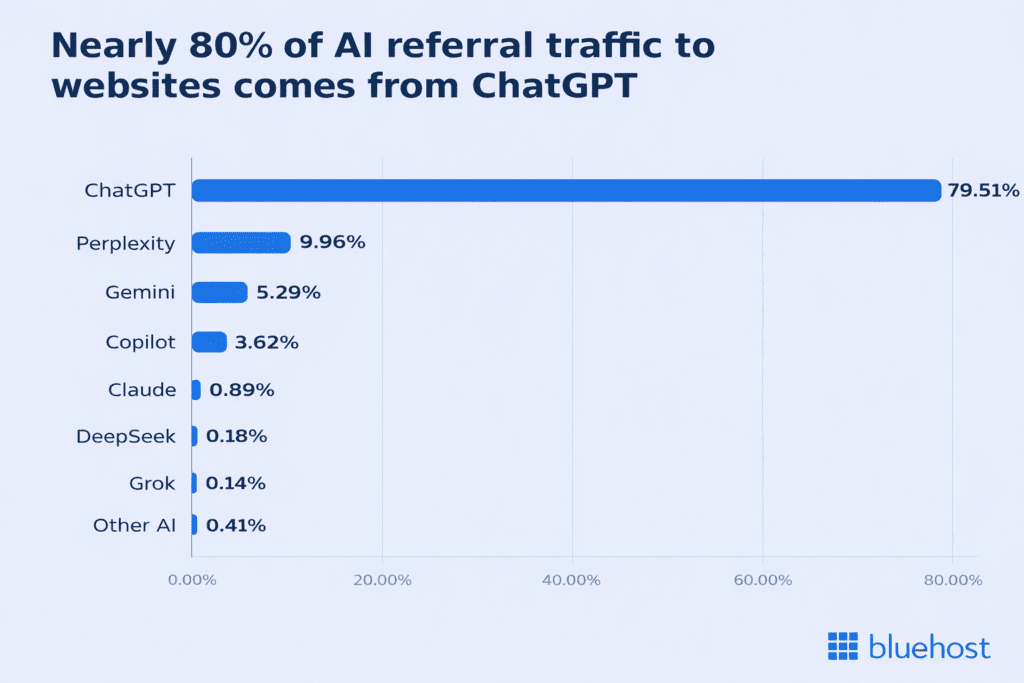
What looks like a simple AI traffic chart tells a much bigger story. ChatGPT is not just ahead. It drives nearly 80% of AI traffic to websites. It is absorbing nearly four out of every five AI-driven visits, which means “AI traffic” in practice still largely means “ChatGPT traffic.”.
Perplexity, Gemini and Copilot may appear as challengers, but they sit far behind. While the rest barely register as meaningful traffic drivers. That shifts the way this graph should be read.
It is not really a snapshot of model popularity. It is a snapshot of who controls the path between AI answers and the open web.
For now, the graph leans heavily toward ChatGPT. But over the past few months, Gemini has begun to close the distance and the month-by-month details reveal a much more dynamic story.
Gemini is emerging as a surprise challenger in the AI traffic battle
In September, the AI traffic story took a sudden turn. Every major platform saw referral traffic surge, pointing to a broader shift across the category.
According to the research, ChatGPT rose 53.8%. One likely driver behind ChatGPT’s jump was the August 7 launch of GPT-5, which expanded access for free users and helped push ChatGPT to around 700 million weekly active users.
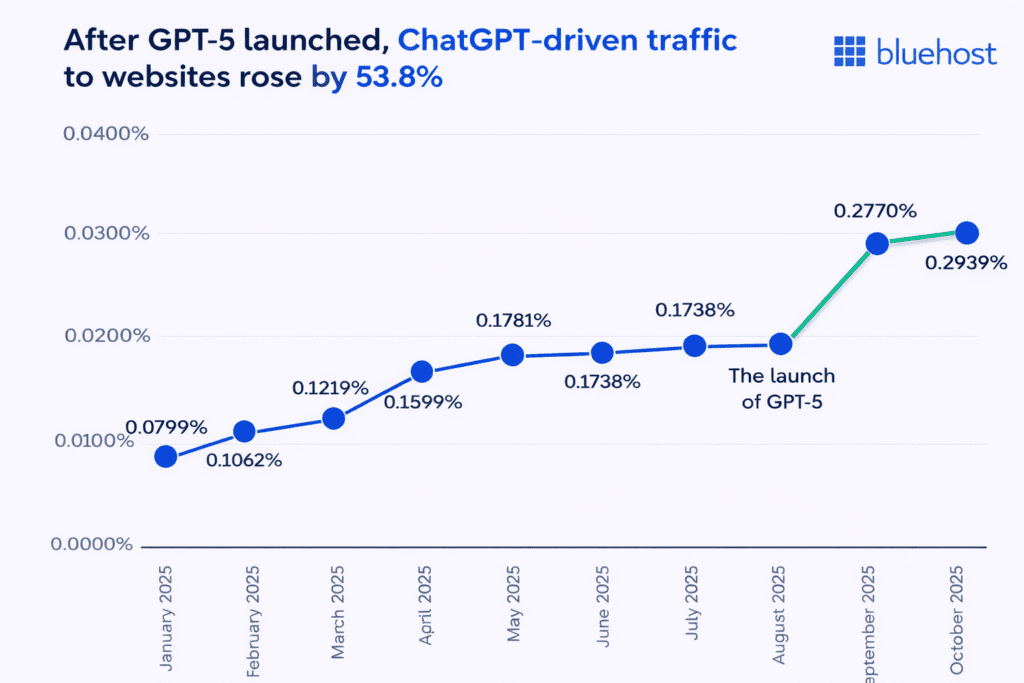
At the same time, Gemini climbed even faster at 63.9%, making the spike hard to ignore. This was not just a one-platform boost. It was a sign that rising interest in AI was starting to lift multiple players at once.
And that is what makes Gemini so important here. While ChatGPT’s surge looks tied to a clear product moment, Gemini’s sharper growth points to a platform gaining momentum as the market broadens.
In other words, ChatGPT may have sparked the spike, but Gemini is starting to look like the clearest sign that AI traffic is becoming a more competitive, multi-platform story.
December 2025: Gemini suddenly takes off
The research states that ChatGPT hit its peak in SE Ranking’s dataset in October 2025, accounting for 0.2939% of all global web traffic. But that peak didn’t last long. Even after the slight recovery in January, ChatGPT was still 22% below its October peak.
While ChatGPT was declining, Gemini finally started growing. And fast.
For most of 2025, Gemini had grown at a modest ~4% per month. Then, over December 2025 and January 2026, things changed dramatically.
In just two months, Gemini more than doubled its traffic (+115%), which is around 12x faster than its previous growth period (January-October 2025).
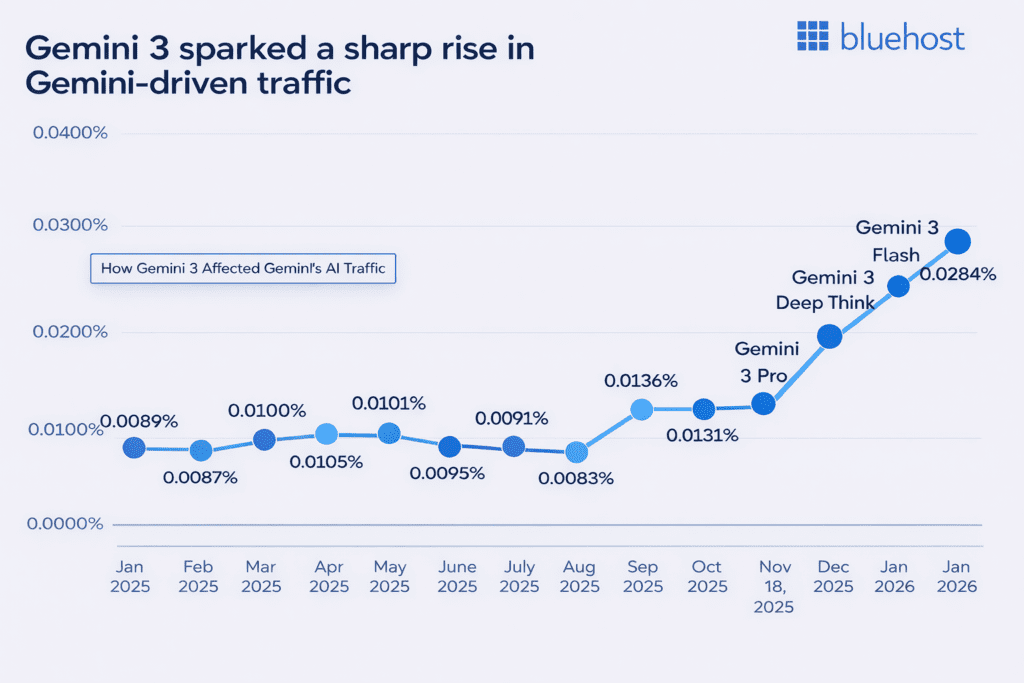
The timing isn’t a coincidence. This surge lines up almost perfectly with the rollout of Google’s Gemini 3 models. Gemini’s traffic did not just rise after Gemini 3. It changed shape.
Once Gemini 3 Flash became the default across Google’s AI surfaces, the line broke sharply upward and traffic more than doubled in two months. That pattern points to something bigger than a normal product bump.
It suggests Google did not just improve Gemini. It amplified it through distribution. In other words, Gemini’s surge looks less like users suddenly choosing a better model and more like Google turning everyday search and AI interfaces into a powerful referral channel.
January 2026: Gemini overtakes Perplexity
As we go deeper into the research, we see that by January 2026, Gemini hit another milestone: for the first time, it surpassed Perplexity in global AI traffic.
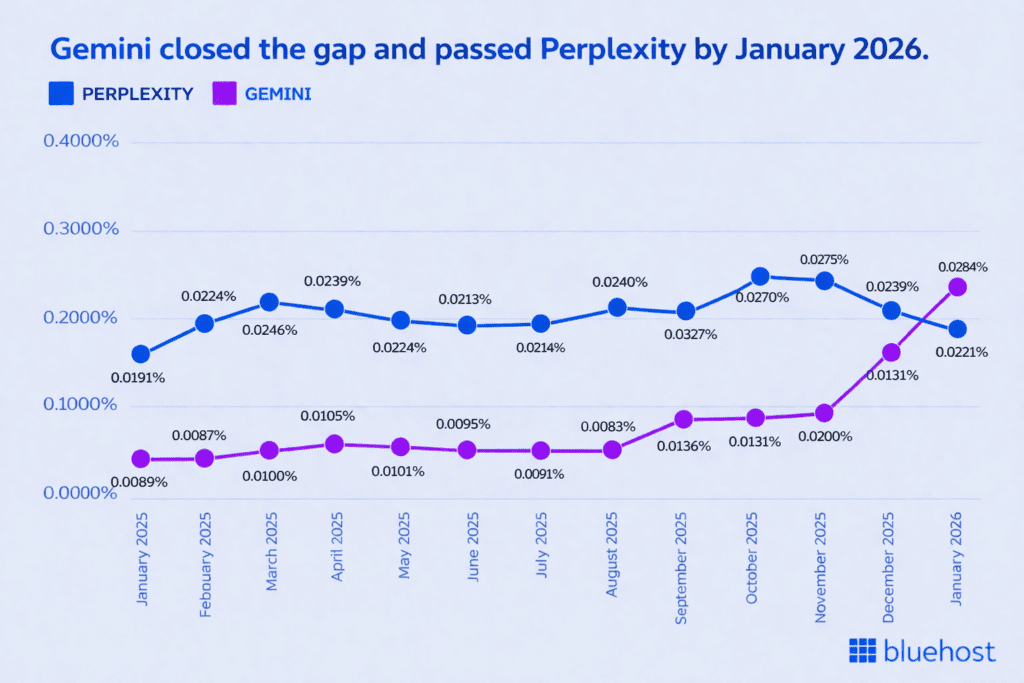
Perplexity’s curve looks mature and steady, while Gemini’s curve starts to look like a platform benefiting from a new distribution advantage. Perplexity had been winning through consistency, but Gemini overtook it through sudden scale.
That suggests Gemini’s growth was not just better month-to-month performance. It was likely powered by Google turning Gemini into a much stronger traffic engine inside its wider ecosystem.
So, the above chart reveals more than a rank change. It shows a shift in market structure. Gemini stops being just another AI tool and starts emerging as the clearest challenger to ChatGPT by converting Google’s reach into referral momentum.
ChatGPT vs Gemini: The present state
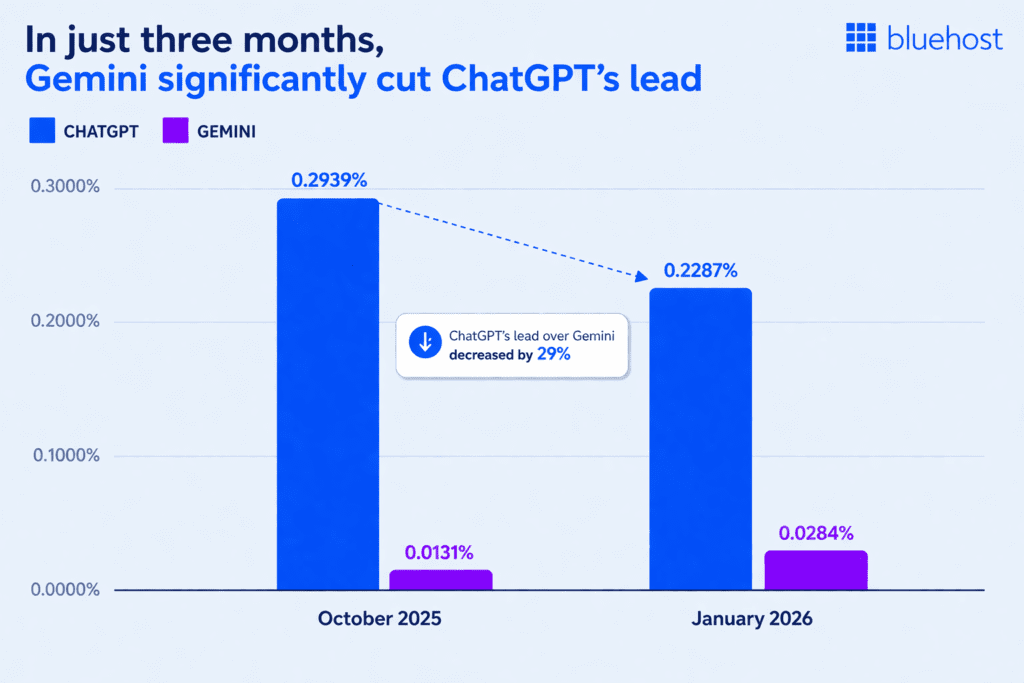
The chart shows that ChatGPT is still firmly in control, but the more revealing shift is happening underneath that dominance.
Between October 2025 and January 2026, the gap narrowed by 29% not because ChatGPT suddenly lost relevance, but because Gemini started growing fast enough to change the shape of the race.
ChatGPT fell from 0.2939% to 0.2287% of global web traffic, but Gemini more than doubled from 0.0131% to 0.0284% over the same period.
That makes the 29% gap reduction more than a simple statistic. It marks the point where ChatGPT’s lead stopped looking unchallenged and Gemini started looking like a platform with real competitive momentum.
If the recent trends continue, there is a possibility that Gemini could catch ChatGPT by October 2026
Where could the ChatGPT vs Gemini traffic race go next?
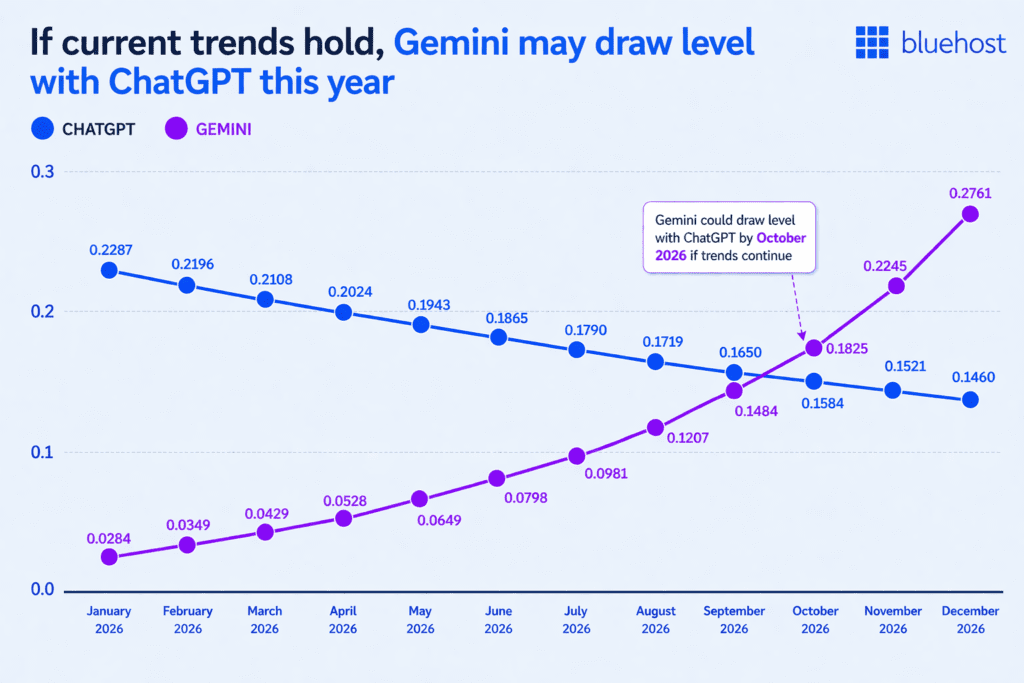
The forecast is worth watching, but it should be read as a possibility, not a promise. It assumes ChatGPT will keep losing referral share while Gemini continues rising at a rapid pace, enough to catch up by October 2026.
That could happen, especially if Google keeps pushing Gemini deeper into Search, Android and other everyday user touchpoints. But AI traffic does not usually move in straight lines. ChatGPT could regain momentum with new updates or stronger outbound linking, while Gemini’s surge could slow once the initial rollout effect fades. This possibility makes ChatGPT’s growing role in SEO and content optimization even more relevant for brands trying to understand where AI is already influencing visibility.
So, the most believable takeaway is not that a crossover will definitely happen on schedule, but that the gap is no longer fixed. Changes in product strategy, platform defaults and distribution could alter the race much faster than expected.
Why distribution may decide the next phase of AI traffic?
The next phase of AI traffic may not be decided by better models alone. It may be decided by better placement. ChatGPT still leads AI referrals by a wide margin, but Gemini’s recent rise points to something bigger than product momentum. For brands, that shift is not just about referral volume. It is also changing how visibility works inside AI-led search experiences.
It suggests AI traffic is starting to follow ecosystem power. As Google places Gemini across more everyday surfaces, from Search to mobile to productivity tools, its reach could expand quickly. The race then starts to look less like a pure chatbot contest. It becomes a fight over who controls the paths people use to discover the web.
That is what makes this shift so important. The future of AI traffic may depend not just on which assistant people prefer, but on which one is built into their daily digital habits.

Write A Comment