 ChatGPT,
 Claude,
 Gemini,
 Grok — all four for
Key highlights
- Learn how small law firms use generative AI for due diligence to review documents faster and focus more time on legal analysis.
- Understand what generative AI for due diligence is and how does AI help with due diligence in document-heavy legal work.
- See how AI streamlines legal due diligence by organizing files, extracting clauses, flagging risks and supporting diligence reports.
- Explore the benefits of generative AI for due diligence, including faster review, lower costs and more consistent output.
- Protect confidential workflows by learning how AI handles confidential legal documents and where Bluehost Privacy+ for Law Firms can support private drafting, summarization and internal review.
A typical corporate acquisition brings a mountain of paperwork, including complex contracts, disclosure schedules and compliance files. When a compact legal team tackles this mountain manually, the document review process slows to a crawl. Learning how small law firms use generative AI for due diligence explains how these practices now keep pace with much larger competitors without expanding their headcount.
Dedicated legal tool reads, categorizes and summarizes massive document sets. While lawyers still make every final decision, the time spent examining repetitive clauses drops sharply, allowing attorneys to focus on strategic negotiation. Legal professionals widely expect these digital assistants to reshape the daily landscape of the profession.
The following sections explore the mechanics of digital review, the specific areas where small practices find the most value, methods for protecting sensitive client data and tips for selecting the right tool for your team.
What is generative AI for due diligence?
Generative AI (GenAI) refers to AI systems that produce text, summaries and analysis from large volumes of unstructured data. Unlike basic search tools, GenAI reads documents and generates responses in natural language.
In a legal context, an attorney can upload a full data room of contracts and ask the AI to find all indemnification clauses. The AI reads every document, identifies the relevant language and returns a structured summary.
How generative AI applies to legal due diligence?
Legal due diligence involves reviewing large document volumes to assess risks, obligations and legal exposure. GenAI tools speed up the process by automating the most time-intensive steps: reading, extracting and summarizing.
Legal document analysis systems can review contract language, identify clause types, flag missing provisions and generate summary memos from the underlying documents.
Why due diligence is a strong use case for AI in law firms?
Due diligence suits AI well because the work is document-heavy and pattern-driven. Many tasks, such as checking for change-of-control clauses or assignment restrictions, follow consistent rules across contracts.
AI applies those rules consistently across hundreds of documents. Attorneys benefit most by offloading the repetitive review, then focusing their time on analysis that requires legal judgment.
Why small law firms are adopting generative AI?
Small firms operate under tighter resource constraints than large practices. An attorney at a boutique firm may handle the same due diligence scope as a team of four at a larger firm, but with less time and no review department.
AI tools reduce that gap by doing more with fewer hands on deck.
What are some common due diligence challenges for small firms?
Small law firms face recurring pressure points during due diligence assignments. The most common ones include:
- Limited attorney bandwidth for large due diligence document sets
- No dedicated due diligence review staff or paralegals
- Tight client timelines on M&A and financing transactions
- Higher risk of human error during manual due diligence review
- Difficulty tracking due diligence issues across hundreds of contracts
Every efficiency gain matters when a team is small. AI does not eliminate these pressures, but it significantly reduces the manual load on each attorney.
How AI helps small firms compete with larger law firms?
Large firms run document review with teams of associates and contract attorneys. Small firms rarely have that option. AI levels the playing field by giving a two-partner firm access to the same document analysis speed a large firm gets with ten reviewers.
Clients see faster turnaround, cleaner summaries and more organized issue spotting, regardless of firm size.
Why AI supports, rather than replaces, legal judgment?
AI tools identify what is in a document. They do not decide what it means for your client’s deal.
Legal judgment involves context: negotiating leverage, commercial risk tolerance and client priorities. AI flags a problematic clause; the attorney decides how to respond to it. The two roles are complementary, not interchangeable.
Also read: The Best AI Assistants in 2026 (Tested and Compared)
How does AI help with due diligence?
AI contributes across several specific tasks in due diligence. The value is not theoretical; it shows up in measurable time savings and more consistent output.
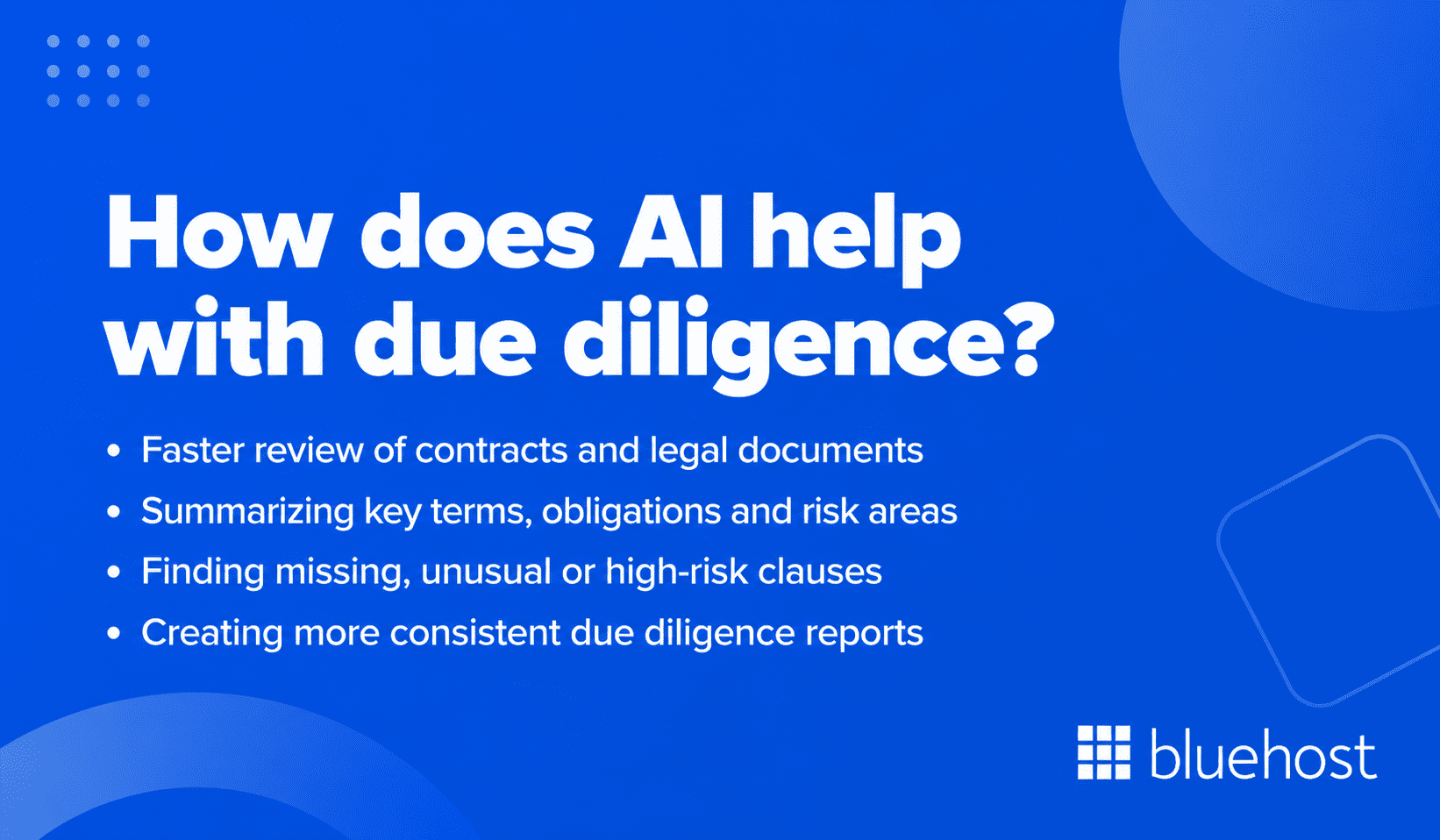
1. Faster review of contracts and legal documents
AI can process a 200-page purchase agreement in seconds. A human attorney reading the same document carefully takes several hours.
On a deal with 300 contracts, that difference compounds dramatically. Recent McKinsey research on M&A reports roughly 20% average cost reductions and 30% to 50% faster deal cycles among some gen-AI users.
2. Summarizing key terms, obligations and risk areas
Instead of building a summary memo from scratch, attorneys can ask AI to generate a first draft. The AI pulls key dates, payment obligations, termination rights and warranty terms from each contract.
The attorney reviews and refines that AI output. A detailed due diligence memo that previously took half a day can now be drafted in under an hour.
3. Finding missing, unusual or high-risk clauses
AI tools check every contract against a standard playbook. If a vendor agreement is missing a limitation-of-liability clause, the AI flags it immediately.
Gap analysis is easy to miss during manual review, especially under deadline pressure. AI catches the absence of language, not just the presence of risk terms.
4. Creating more consistent due diligence reports
When multiple attorneys review different contracts, output format and detail level often varies. AI applies the same analytical framework to every document in the set.
That consistency matters when clients review the final diligence report. Issues are presented in a uniform structure, making it easier to assess risk across the entire deal.
Also read: 30 Best AI Marketing Tools to Grow Your Business in 2026
How AI streamlines legal due diligence workflows?
Beyond individual document analysis, AI changes how the entire due diligence workflow operates, from document intake through to attorney review and client reporting.
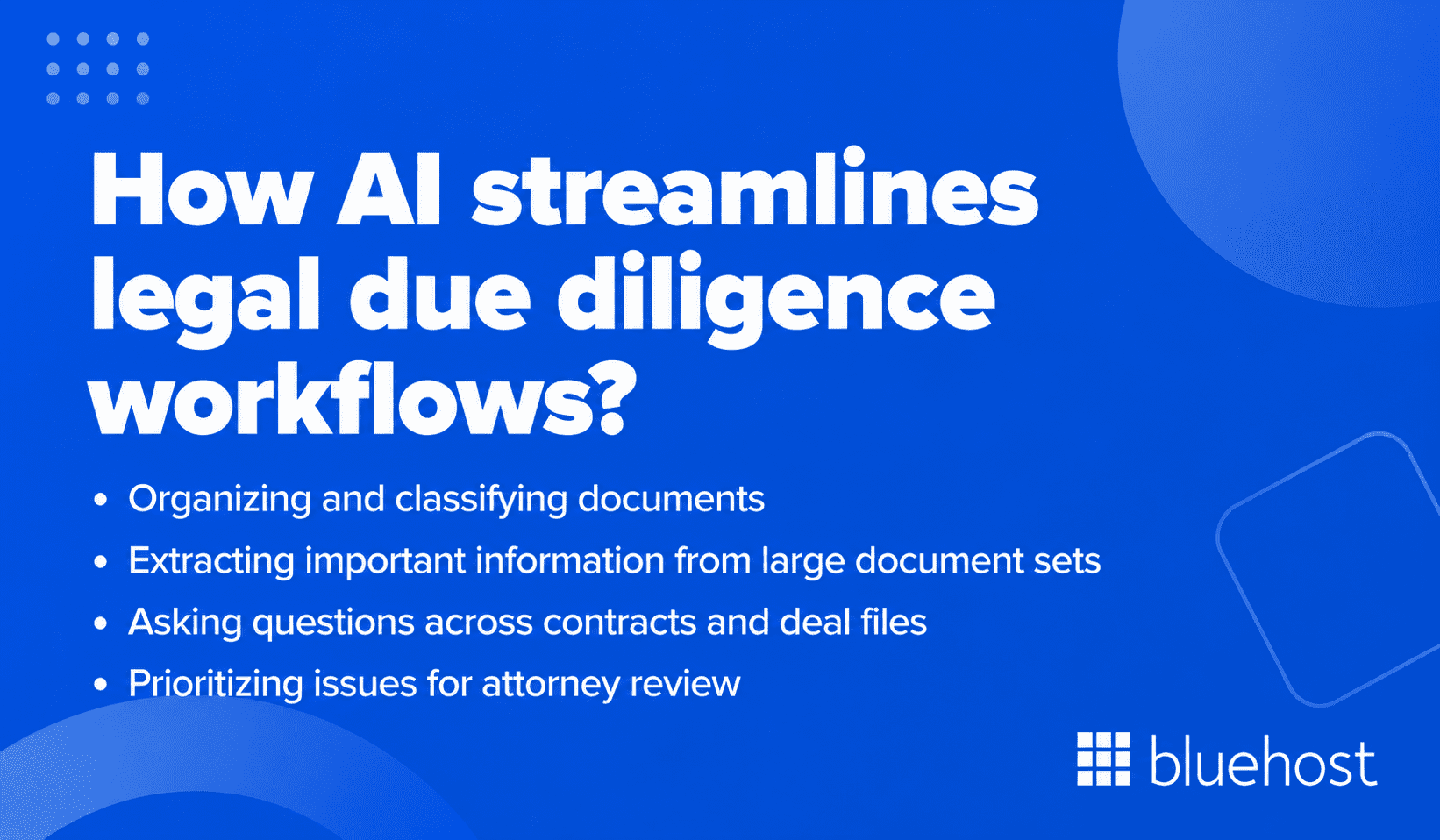
1. Organizing and classifying documents
Data rooms for legal due diligence in M&A transactions often arrive disorganized. Contracts, resolutions, licenses and financial records land mixed in folders.
AI tools classify documents by type automatically. An attorney does not need to sort 400 files manually before review begins. The AI creates a structured index within minutes.
2. Extracting important information from large document sets
Once documents are classified, AI extracts specific data points across the entire set. An attorney can request all termination clauses, all governing law provisions or all payment terms in a single query.
The AI returns a structured table with that information pulled from every relevant document. Building the same table manually would take many hours.
3. Asking questions across contracts and deal files
Modern legal AI tools support natural language queries. An attorney types “Which agreements require third-party consent on assignment?” and the AI searches all uploaded documents for an answer.
Pro tip: In AI-assisted due diligence, frame queries as specific legal questions rather than broad topics. “Which contracts have cure periods shorter than 10 days?” returns far more useful output than “What are the termination terms?
4. Prioritizing issues for attorney review
Not all flagged items are equally urgent. AI tools assign risk scores or priority levels to identified issues, so attorneys see the most critical items first.
Generative AI for due diligence still documents lower-priority flags without diverting time from the deal’s biggest risks.
AI for legal due diligence in small firms: key use cases
AI applies across several practice areas where small firms regularly handle due diligence work. The use cases below represent the highest-volume applications attorneys are adopting today.
1. M&A due diligence
Mergers and acquisitions generate the largest document sets in legal practice. AI tools are especially valuable here because volume and time pressure are both high.
Small firms can now handle buy-side or sell-side due diligence on mid-market transactions that would previously have required more attorney resources than most small practices can deploy.
2. Contract review and risk identification
Outside of M&A, contract review is the most common due diligence task. AI identifies non-standard terms, unusual indemnification language and one-sided clauses across large contract portfolios.
Vendor agreements, commercial leases, licensing deals and employment contracts are all well-suited to AI-assisted review.
3. Corporate records and compliance review
Buyers need to know that a target company’s governance is in order. AI reviews corporate minutes, board resolutions and cap table documents quickly and with a consistent eye for gaps.
Compliance reviews, including data privacy assessments and license checks, also benefit from AI document scanning across large file sets.
4. Litigation, real estate and regulatory due diligence
Litigation due diligence involves reviewing pending cases, settlement agreements and litigation history. AI extracts case names, amounts and status from large document sets efficiently.
Real estate work benefits from AI-assisted lease abstraction and title document review. Regulatory due diligence uses AI to cross-check current filings against applicable requirements.
What are the key benefits of generative AI for due diligence in small law firms?
For small firms, generative AI for due diligence offers practical advantages in four areas. Each one addresses a real constraint that limits what small firms can take on and deliver.
1. Saving time on manual document review
Time is the scarcest resource at a small law firm. AI reduces hours-per-document significantly, making larger deals feasible without adding headcount.
A deal that once required 40 attorney hours of review may now require 15 to 20. AI handles the initial pass, and the attorney focuses on analysis.
2. Reducing costs for firms and clients
Faster review means lower billable hours for routine tasks. Small firms can offer competitive pricing on due diligence work without cutting into margins.
When AI speeds document-heavy legal due diligence, clients benefit from lower fees. Firms can handle more matters in the same working period.
3. Improving accuracy and consistency
Human reviewers get tired. AI does not. Document sets reviewed by legal AI tools show fewer gaps in clause identification and more consistent flag criteria across the entire set.
Accuracy does not mean perfect; AI makes errors too. The combination of AI review and attorney oversight can improve consistency, but firms still need verification before relying on AI output.
4. Helping lawyers focus on strategy and client advice
By speeding up due diligence document review, AI gives attorneys more time for higher-value work: advising clients on deal structure, negotiation strategy and risk mitigation.
That shift benefits both the firm and the client, and it is one of the most meaningful changes AI introduces to small firm practice.
How AI handles confidential legal documents?
Confidentiality is the most important concern attorneys raise about using AI in legal work. The answer depends entirely on which tool you choose and how you configure it.
Why confidentiality matters in AI due diligence for law firms
Due diligence files contain sensitive financial data, trade secrets and privileged communications. Uploading those files to a consumer AI product creates real professional responsibility risks.
Bar associations across the U.S. have issued guidance warning attorneys about using public AI tools with client data. The American Bar Association’s Formal Opinion 512 (2024) directly addresses competence and confidentiality obligations when using AI.
Security features small firms should look for
The right tool for legal due diligence must include specific security protections. Key features to verify before selecting any platform include:
- End-to-end encryption for legal documents uploaded to the generative AI tool
- No use of client data to train the AI model
- Data residency controls and geographic hosting restrictions for legal due diligence documents
- SOC 2 Type II or ISO 27001 certification
- Role-based access controls for matter-level permissions in due diligence reviews
Vendors who cannot answer these questions directly should not handle client due diligence data.
Protecting privilege, client data and sensitive deal information
Attorney-client privilege does not automatically disappear when AI reviews a document. Sharing privileged content with a third-party vendor may create waiver risks if the vendor’s terms are not carefully reviewed.
Small firms should require data processing agreements from AI vendors. Internal policies should also specify which matter types are approved for AI-assisted review.
What are the risks and limitations of AI due diligence for law firms?
AI tools produce real value, but they also introduce specific risks. Understanding these limitations before relying on AI output in a client matter is essential.
1. Hallucinations, missed context and incorrect summaries
During legal due diligence, AI can generate confident-sounding summaries that are factually wrong, sometimes “hallucinating” clause language or misstating contract terms.
In due diligence, a missed clause or incorrect summary can affect a client’s deal decision. Every AI output must be verified against the source document before it enters a client deliverable.
2. Data privacy and vendor security concerns
Some AI platforms may retain uploaded documents or use user inputs for improvement, depending on the product tier, settings and vendor terms. That retention creates regulatory and confidentiality risks, particularly under GDPR or CCPA frameworks.
When using generative AI in due diligence, review vendor privacy policies carefully. Confirm documents are deleted after sessions end and no data trains models.
3. Why human attorney review is still essential
AI identifies issues; attorneys assess them. A limitation-of-liability cap flagged by AI is only meaningful when an attorney evaluates it against the deal’s full commercial terms.
AI may miss current case law, local jurisdiction nuances or a client’s specific risk profile unless the tool is properly configured and attorney review remains central. These gaps make attorney oversight non-negotiable.
How small law firms can use generative AI for due diligence safely?
Safe AI adoption in legal due diligence comes down to clear processes, the right tools and consistent oversight. Small firms that build these habits early avoid the most common problems.
1. Start with a clear due diligence scope
Define what the AI will review before uploading any documents. A clear scope reduces the risk of AI reviewing materials outside the intended engagement.
Focused instructions also improve output quality. AI performs better with specific, well-defined review tasks than with open-ended requests.
2. Use legal-specific AI tools instead of public AI platforms
Products like Harvey AI, Kira Systems and Luminance are built for legal document analysis. They include the security architecture and legal-specific training that consumer tools lack.
Consumer AI platforms should not be used for confidential legal documents unless the firm has reviewed the tool’s privacy, retention, training and confidentiality terms.
3. Review AI outputs against the source documents
Verify every summary, flag and extracted clause against the original document. Build this verification step into the due diligence workflow as a non-negotiable checkpoint.
Tip: Assign one attorney to spot-check AI output on every matter. Consistent verification prevents errors from reaching client deliverables.
4. Create an internal AI policy for due diligence matters
Document which tools are approved for use, which matter types qualify for AI-assisted review and what verification steps are required before client delivery.
A written policy gives attorneys clear guidance and protects the firm if questions arise about AI use on a specific matter.
Choosing the right AI tool for legal due diligence in small firms
The market for legal AI tools is growing quickly. Not every product suits small firm needs or document-heavy due diligence workflows.
Legal AI features that matter most for due diligence
When evaluating legal AI tools, prioritize capabilities that streamline high-volume document review during due diligence. The following features have the most practical impact for small firms:
- AI-powered contract upload and clause extraction across multiple confidential legal document types
- Custom due diligence playbook or checklist configuration for your practice area
- Natural language query support to streamline legal due diligence across document sets
- Automated issue summaries with source citations from legal documents
- Matter-level access controls and document isolation in generative AI due diligence tools
Features like AI chat assistants or template generation are useful additions, but core document review capability should drive the selection decision.
Questions to ask about security, accuracy and data use
Before choosing generative AI for due diligence, ask vendors these questions directly:
- Does the generative AI platform retain uploaded due diligence documents after the session ends?
- Is client due diligence data used to train or improve the AI model?
- What certifications does the AI platform hold for handling confidential legal documents (SOC 2, ISO 27001)?
- How does the AI platform handle errors or incorrect output?
- Does the vendor provide a data processing agreement that explains how sensitive legal documents are handled?
A vendor that hesitates or gives vague answers to these questions is not ready to handle legal due diligence data.
Pricing and practical fit for small law firms
Legal AI tools range from a few hundred dollars per month to enterprise-level contracts. Small firms should look for per-matter or per-user pricing rather than firm-wide minimums.
Test any tool with a real but lower-stakes matter before using it on a high-value deal. Kira Systems and Ironclad both offer pricing structures that can work for smaller practices.
The future of generative AI for due diligence in small law firms
AI capabilities in legal work are advancing rapidly. The changes expected in the next two to three years will expand what small firms can offer significantly.
AI-enabled deal rooms and smarter document review
Virtual data rooms will integrate AI analysis directly into the deal room interface. Attorneys will flag issues, ask questions and generate summaries without leaving the document repository.
Several virtual data room providers are beginning to integrate AI review features directly into their platforms.
Faster client reporting and better risk insights
AI will generate first drafts of due diligence reports automatically. Attorneys will review and finalize those drafts, cutting the gap between document review and client delivery.
Risk scoring will also become more sophisticated. AI will prioritize issues not just by clause type but by the client’s deal-specific risk profile.
Why small firms that adopt AI carefully can gain a competitive edge
Small firms that adopt AI now will be positioned to win more competitive work. Clients increasingly expect faster turnaround on due diligence, and speed will become a differentiator.
The advantage does not come from using AI alone. It comes from combining AI’s speed with attorney judgment that large firms, with heavy associate turnover, sometimes lack.
Where Bluehost Privacy+ for Law Firms fits into your legal AI workflow?
When you use generative AI for due diligence, you are not just choosing a faster way to draft, summarize or organize information. You are also deciding how your firm will manage sensitive prompts, client details, internal notes and document-heavy workflows.
Bluehost Privacy+ for Law Firms is relevant if you want a centralized AI workspace with added privacy controls for legal work. You get access to ChatGPT, Claude, Gemini and Grok in one dashboard, which can help you compare outputs and choose the model that best fits the task at hand.
You can use it to support parts of your due diligence workflow such as:
- Drafting first-pass summaries from matter notes or records
- Organizing facts into a chronology or review timeline
- Preparing internal notes from intake or document review
- Drafting client update emails for attorney review
- Comparing outputs across different AI models
- Keeping AI use in one workspace instead of moving between separate platforms
For privacy, you get prompt sanitization for sensitive legal details, encrypted conversations, Privacy Mode with context sanitization, Incognito Mode, private LLM routing for sensitive content and protections that keep user and organization details hidden from external LLMs. Even with privacy controls, you still need attorney review. Treat AI summaries, draft notes and client updates as starting points, then verify them against source documents before using them in a final diligence report.
Bluehost Privacy+ for Law Firms can support drafting, summarization and internal review, while legal judgment stays with your attorneys.
Final thoughts
Small law firms doing due diligence manually are working harder than necessary. How small law firms use generative AI for due diligence comes down to a simple idea: let AI support the repetitive parts of document review so attorneys can spend more time on risk analysis, strategy and client advice.
The key is disciplined adoption. Use legal-focused AI workflows, verify every output and create clear internal rules before using AI with sensitive client information. When firms combine AI speed with attorney oversight, they can handle more work with the same team while maintaining quality and control.
As you evaluate AI for due diligence, privacy should be part of the decision from the start. A centralized workspace with privacy-focused controls can help your team use AI more consistently for drafting, summarization and internal review support.
To explore that kind of workflow, review Bluehost Privacy+ for Law Firms as part of your firm’s AI evaluation process.
FAQs
Legal generative AI systems read, analyze and summarize large volumes of legal documents. These tools extract key terms, flag risks and generate structured reports, helping attorneys review contracts and deal files faster and with greater consistency than manual review alone.
AI helps by automating the document-heavy parts of due diligence: reading contracts, extracting specific clauses, flagging missing or high-risk language and generating summary memos. Attorneys review and act on AI output rather than building every summary from scratch.
AI improves legal due diligence workflows by classifying documents automatically on intake, extracting data points across large document sets, answering natural language queries across uploaded files and surfacing the highest-priority issues for attorney review first.
AI due diligence tools are safe when firms choose legal-specific platforms with strong security certifications, data retention controls and no model training on client data. Consumer AI tools should not be used with confidential client documents under any circumstances.
The main benefits include faster document review, lower client-facing costs, more consistent clause identification across large document sets and more attorney time available for strategy and advice rather than manual page-by-page review.
Legal AI platforms protect confidential documents through end-to-end encryption, matter-level access controls and strict data retention policies. Attorneys should confirm that vendors do not retain or use uploaded files for model training and should require a data processing agreement before use.

Write A Comment