



Key highlights
- Understand the core difference between page authority and domain authority and why each metric plays a distinct role in determining how your content performs in search results.
- Learn how search engines evaluate individual pages versus entire domains so you can decide where to focus your SEO efforts for the greatest impact.
- Explore proven link building strategies that strengthen both your PA and DA scores and give your content a better chance of ranking for competitive keywords.
- Know which authority metric to prioritize based on your specific SEO goals, whether you are targeting a single high-value page or building long-term domain credibility.
- Uncover practical ways to track, compare and improve your authority scores using reliable SEO tools that provide a clear picture of your site’s overall search visibility.
If you’ve ever searched “why isn’t my website showing up on Google,” you’ve likely stumbled across two acronyms that seem deceptively simple: PA and DA, page authority and domain authority. These two metrics are among the most talked-about in SEO, yet they’re also among the most misunderstood.
This guide breaks down the page authority meaning, how domain authority and page authority differ. We will also explore how each one impacts your search rankings and, most importantly, how to improve them through link-building strategies.
Whether you’re a small business owner trying to get found online or a marketing professional looking to sharpen your SEO knowledge, this post is for you.
What is page authority? and why it matters?
Page Authority (PA) is a score developed by Moz that predicts how likely a specific web page is to rank in search engine results pages (SERPs). The score ranges from 1 to 100, with higher scores indicating a greater likelihood of ranking well.
Think of page authority as a grade for a single page on your website not your entire site, just one URL. For example, your homepage, a blog post or a product page each has its own PA score.
What influences page authority?
- Backlinks to that specific page: The more high-quality, relevant websites that link to a particular page, the higher its PA tends to be.
- Content quality and relevance: Pages with well-structured, authoritative content tend to earn more natural backlinks.
- Internal linking: How other pages on your own site link to this page also contributes.
- Social signals and engagement: While not a direct ranking factor for Google, these indirectly influence how many people discover and link to your content.
What is domain authority?
Domain authority (DA) is also a Moz metric, but instead of evaluating a single page, it assesses the overall strength and credibility of your entire website (domain). Like PA, it’s scored from 1 to 100.
A high domain authority tells search engines and SEO tools that your website, as a whole, is trustworthy, credible and worth ranking. New websites typically start with a DA of 1 and climb over time through consistent SEO efforts.
What influences domain authority?
- Total number of backlinks: How many external sites link to any page on your domain.
- Referring domains: The number of unique domains linking to your site (diversity matters more than sheer volume).
- Quality of linking domains: A link from a high-DA news site like Forbes is worth far more than ten links from low-quality directories.
- Domain age: Older domains often have more accumulated links and credibility.
- Site structure and technical SEO: Clean architecture, fast load times and mobile-friendliness support DA growth.
Page authority vs domain authority: Key differences
So how do PA vs DA actually differ? While both metrics use the same 0–100 scale and are created by the same company (Moz), they measure very different things. Here’s a side-by-side breakdown:
| Factor | Page authority (PA) | Domain authority (DA) |
| What it measures | Strength of a single page | Strength of the entire domain |
| Score range | 1–100 | 1–100 |
| Influenced by | Backlinks to that page, content quality | Total backlinks, referring domains, domain age |
| Best used for | Ranking individual pages | Comparing overall site strength |
| Changes with | Page-specific link building | Site-wide SEO efforts |
| Who created it | Moz | Moz |
The simplest way to think about it: domain authority is like the reputation of an entire school, while page authority is like the reputation of an individual teacher in that school.
A school may have a strong overall reputation (high DA), but some teachers may be more well-known than others (different PA). Likewise, a teacher can be highly respected even if the school itself isn’t very famous.
Why does domain authority vs page authority matter for SEO?
Both metrics provide valuable signals, but they’re used differently depending on your SEO goals.
When to focus on domain authority?
DA is most useful when:
- You want to assess your website’s overall competitive strength in your industry.
- You’re doing competitor research (“how does my site compare to theirs?”).
- You’re building a long-term SEO strategy that improves your site’s credibility over time.
- You’re prospecting for backlink partnerships or PR placements.
When to focus on page authority?
PA is most useful when:
- You want a specific blog post or landing page to rank for a target keyword.
- You’re running a campaign around a particular product or service page.
- You’re evaluating the ROI of link building campaigns targeting individual URLs.
- You’re analyzing which pages on your site have the most SEO “juice” to pass through internal links.
Also read: Are Reciprocal Links Still a Good SEO Strategy in 2026?
Link building strategies for SEO: How to improve both PA and DA?
Now that you understand what these metrics mean, the big question is: how do you actually improve them? The answer lies in strategic link building, one of the most powerful and enduring practices in SEO.
1. Earn high-quality backlinks through content marketing
The best links are earned, not bought. Creating valuable, shareable content, original research, detailed how-to guides, industry reports and infographics naturally attracts links from other websites. This boosts both PA (for the specific page) and DA (since more quality domains are linking to your site).
2. Guest posting on authoritative sites
Writing guest articles for reputable industry publications is a tried-and-true link building strategy for SEO. When you contribute to high-DA sites in your niche, you earn backlinks that increase your own DA while driving qualified traffic to your site.
Focus on relevance over volume. One link from a highly relevant, high-DA site in your industry is worth more than 20 links from unrelated directories.
3. Build internal links strategically
Internal linking is an underrated way to distribute page authority across your site. When a high-PA page links to a newer or lower-authority page, it passes some of that authority along. Audit your existing content and add internal links from your strongest pages to the pages you want to rank higher.
4. Reclaim broken or lost backlinks
Use tools like Moz, Ahrefs or SEMrush to find broken backlinks pointing to your domain. When a linking site has broken the link (404 error), reach out to request it be updated to a live URL. This is a quick win for maintaining your backlink profile without having to create new content.
5. Digital PR and brand mentions
Getting mentioned in online news stories, podcasts, interviews and round-up articles is an increasingly important link-building strategy. A proactive digital PR approach, pitching your expertise to journalists and bloggers, can earn high-authority links that dramatically lift your DA over time.
6. Competitor backlink analysis
One of the smartest link building strategies for SEO is analyzing where your competitors are getting their links. If a site is linking to your competitor’s page on a topic you also cover, there’s a strong chance they’d be willing to link to your (better) version too. Tools like Ahrefs and Moz’s Link Explorer make this easy to research.
Also read: Off Page SEO Checklist – Complete 2026 guide
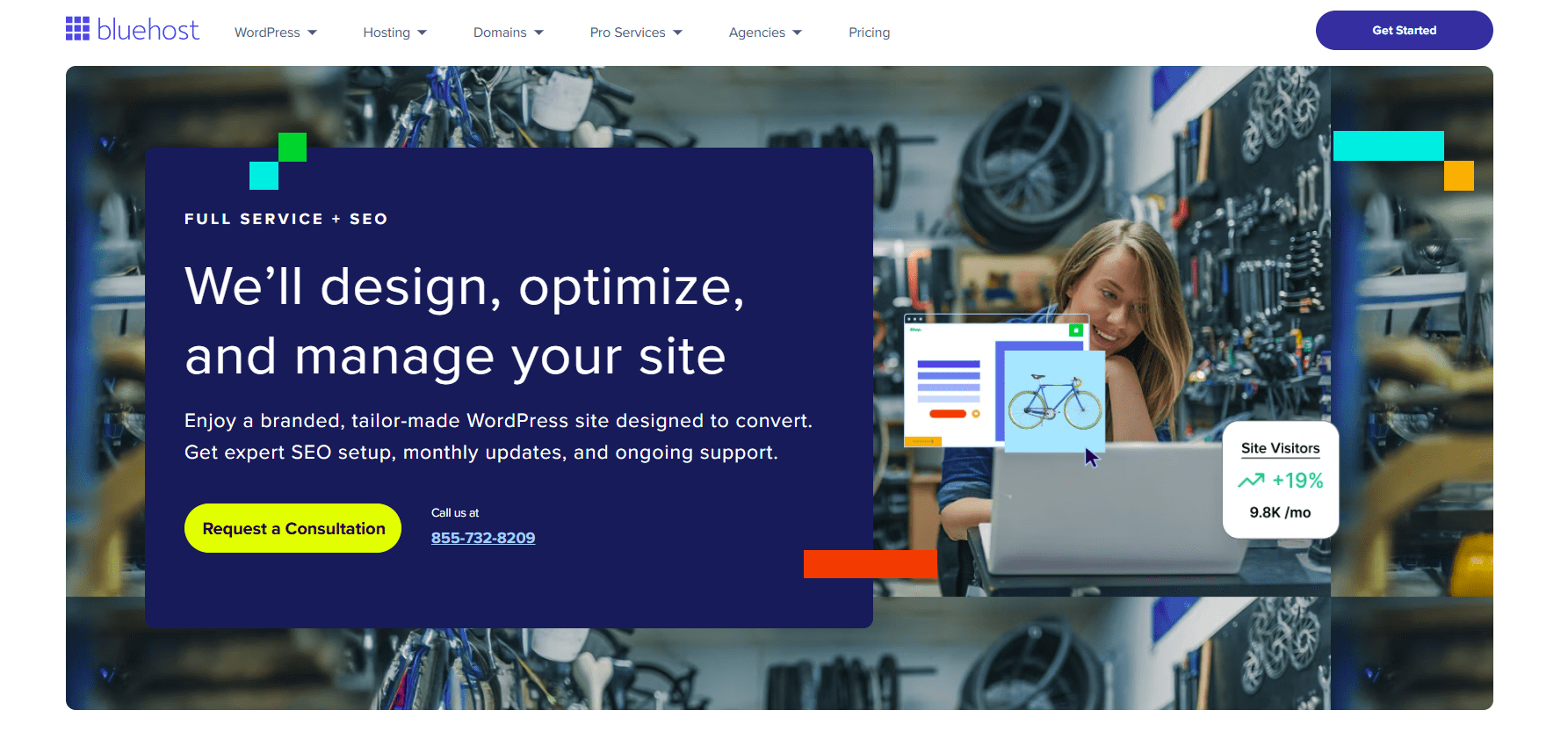
How Bluehost Full Service + SEO handles PA, DA and everything in between?
If you’re a small business owner reading this and thinking, “this sounds important, but I don’t have time to manage all of this myself,” you’re exactly who Bluehost’s Full Service + SEO is designed for.
What you get with Bluehost Full Service + SEO?
For $500/month, Bluehost’s fully managed solution delivers a comprehensive approach to building your online presence and improving your search authority:
- Custom 5-page wordPress website: Professionally designed, mobile-optimized and built with SEO-friendly structure from day one, giving every page the foundation it needs for strong PA.
- On-page SEO optimization: Your content, metadata, headings and internal links are strategically optimized to maximize your pages’ ranking potential.
- Built-in website analytics: Track how your traffic grows, where visitors come from and which pages are gaining authority.
- SEO Backlinks: Bluehost’s team actively works on building quality backlinks the #1 driver of both page authority and domain authority.
- Pro SEO Support Plus: Dedicated SEO experts who understand your industry, track keyword rankings and make ongoing improvements.
- Monthly marketing strategy calls: Regular sessions with your dedicated marketing expert to review results, adjust strategy and plan for growth.
- Ongoing website updates: Content additions, design updates and up to one new page per month, so your site keeps earning fresh links and traffic.
Unlike generic “SEO tools” offered by other providers, Bluehost’s approach is human-led, hands-on and focused on measurable results. You’re not getting a dashboard with a confusing score; you’re getting a team that actively works to grow your authority and rankings every single month.
Common PA and DA mistakes to avoid
Before we wrap up, here are some of the most common mistakes businesses make when trying to improve their PA and DA:
1. Chasing quantity over quality
Getting 100 backlinks from low-quality or irrelevant websites won’t meaningfully improve your DA and can actually hurt your site if Google perceives those links as spammy. Focus on earning links from reputable, relevant sources in your industry.
2. Ignoring On-Page SEO
You can have great backlinks, but if your page content is thin, unstructured or doesn’t address user intent, your PA won’t reflect that link value effectively. Strong on-page SEO is what allows link equity to convert into rankings.
3. Giving up too soon
Domain authority can take months to move, especially for newer websites. Many businesses invest in SEO for 60–90 days, see modest movement and abandon the strategy. SEO is a long game consistency over 6–12 months is where the compounding benefits really show up.
4. Treating DA and PA as Google ranking factors
It’s important to understand: DA and PA are Moz-created metrics, not official Google ranking factors. Google has its own proprietary scoring system (PageRank, among others). DA and PA are proxies and predictors, not direct causes. That said, they’re highly correlated with ranking performance and remain extremely useful for benchmarking and strategy.
Final thoughts
Page authority and domain authority are complementary metrics that together give you a 360-degree view of your website’s SEO strength. While PA tells you how a single page stacks up in the search results, DA tells you how your overall domain compares to competitors.
To improve both, you need a consistent, strategic approach to link building, content creation and on-page optimization. And for most small businesses, the most effective way to do this isn’t to learn it all yourself, it’s to work with experts who live and breathe SEO every day.
Ready to Grow Your Online Authority?
Stop worrying about PA scores, DA metrics and link-building strategies. Let Bluehost’s experts handle it all. Our Full Service + SEO plan includes a custom website, expert SEO, backlink building and ongoing monthly support for just $500/month. No technical skills required. No guesswork. Just results.
FAQs
The main difference between page authority (PA) and domain authority (DA) is their scope. PA predicts the ranking strength of a single webpage, while DA estimates the ranking potential of an entire domain. Both are Moz metrics based on a 100-point logarithmic scale derived from backlink data.
Page Authority (PA) is a predictive score that estimates how likely a specific page is to rank in search results. It is based mainly on the page’s backlink profile. Unlike a URL’s actual ranking, PA is only a comparative SEO metric, not a real-time position in Google results.
In link building strategies, PA and DA help evaluate the quality of backlink sources. High DA sites improve overall domain trust, while high PA pages can pass strong link equity to specific URLs. SEO strategies usually aim for a balance of both.
For individual blog posts, page authority is usually more important because it measures the strength of that specific page. However, posts on high-DA domains often gain an advantage due to the site’s overall credibility. Ideally, improving both metrics supports better rankings.
Yes, a page can have high PA even if the domain has low DA. This happens when the page earns strong and high-quality backlinks. For example, a viral article or widely cited resource can gain high authority and later help increase the domain’s overall authority.



Write A Comment