 ChatGPT,
 Claude,
 Gemini,
 Grok — all four for

Your website starts slowing down. Pages take longer to load. Traffic spikes cause downtime. You try to fix it, but the problem keeps coming back.
This is where most websites hit a limit with traditional hosting. A slow or unstable site affects more than performance. It impacts user experience, search rankings and conversions. Even a one-second delay can reduce conversions by up to 7%.
Cloud computing offers a better way forward. By moving to the cloud, your website runs on a scalable cloud infrastructure instead of a single server. You get access to flexible cloud resources, improved performance and a more reliable cloud computing environment.
If you are considering cloud migration, this shift can help you remove limitations and support long-term growth.
Quick checklist: Is it time to move to cloud hosting?
You may be ready for cloud hosting if:
- Your website slows down as traffic grows
- Traffic spikes cause downtime or errors
- You need more computing power, storage or RAM
- Shared hosting no longer gives you enough control
- You want better cloud security and data protection
- You need stronger business continuity and disaster recovery
- You want flexible cloud resources without changing your full setup
- You are planning long-term growth and need a scalable cloud infrastructure
What is cloud hosting and how it solves your problems
Cloud hosting is a way of running your website on a network of connected servers instead of a single machine.
In simple terms, your site does not depend on one server. It uses a cloud computing environment where resources are shared across multiple systems. This setup is supported by large-scale cloud infrastructure managed by cloud providers and cloud computing providers.
1. Distributed infrastructure
Cloud hosting uses distributed data centers instead of a single physical infrastructure. Your website data is stored across secure data centers. If one server fails, another takes over. This ensures better business continuity and reduces the risk of downtime.
This distributed cloud architecture is the foundation of public clouds, private cloud setups and even hybrid cloud solutions.
2. Resource scaling
One of the biggest advantages of moving to the cloud is flexibility. You can scale cloud resources like CPU, RAM and storage based on your needs. This is done through virtual machines and on-demand computing power.
Whether you are handling traffic spikes or growing steadily, cloud deployment allows you to adjust resources without disrupting your website.
3. Reliability
Cloud hosting improves reliability by removing single points of failure. With built-in disaster recovery, data protection and data encryption, your website stays secure and available. Most cloud service providers also ensure data integrity and protect against data loss.
This makes cloud hosting a strong choice for businesses that need consistent performance and enhanced security.
By combining distributed infrastructure, flexible scaling and reliable performance. Cloud hosting solves the core problems of traditional hosting and supports your cloud journey as your website grows.
Also read: What is Cloud Hosting? The Complete Beginner’s Guide
Key benefits of moving to cloud hosting
Moving to cloud hosting is not just about upgrading technology. It is about improving performance, gaining control and building a reliable cloud infrastructure that supports growth.
If you are wondering why you should move to cloud hosting, the answer lies in how cloud computing transforms your website’s performance and flexibility. Let us look at some of the benefits of cloud hosting:
1. Better performance for growing websites
As your traffic increases, performance becomes critical. Cloud-based hosting runs on a powerful cloud computing environment backed by modern cloud architecture. You get dedicated computing resources like CPU, RAM and NVMe storage.
Unlike shared hosting, your performance is not affected by other users. This results in improved performance and a better experience for users.
2. Guaranteed resources and consistent stability
With cloud-based hosting, your cloud resources are allocated to your website.
This means:
- Stable performance at all times
- No resource sharing with other websites
- Better handling of traffic spikes
This is possible because cloud infrastructure removes dependency on limited physical infrastructure and uses distributed data centers.
3. More control over your hosting environment
Cloud hosting gives you full control over your cloud environment.
With cloud-based hosting, you can:
- Access your server using SSH
- Manage operating systems and configurations
- Control access management and user access
- Handle databases, files and applications
This flexibility that cloud computing offers is essential for developers, IT teams and businesses handling software development or advanced solutions.
4. Scalability without disruption
One of the key migration benefits is the ability to scale instantly. Cloud deployment allows you to increase computing power, storage and memory without downtime. Whether you are using a public cloud server, private cloud or hybrid cloud solutions, scaling becomes simple. This supports your cloud journey and enables organizations to grow without limits.
5. Higher reliability and uptime
Cloud infrastructure improves reliability by removing single points of failure.
With a distributed cloud architecture across secure data centers:
- Your site stays stable during traffic spikes
- Your hosting supports business continuity
- Built-in disaster recovery prevents data loss
This is why most cloud providers focus on redundancy across multiple data centers.
6. Stronger security and isolation
Cloud security is a key reason businesses choose cloud hosting.
With VPS and dedicated hosting:
- Your environment is isolated from other users
- Data encryption protects sensitive data
- Access management ensures only authorized user access
Most cloud service providers also follow strict data governance practices to ensure data integrity and data protection.
7. Cost savings and efficient infrastructure
Cloud hosting reduces infrastructure costs. You no longer need to invest in physical infrastructure or manage your own data centers. Most cloud computing providers follow a pay-as-you-use cloud model, helping you save money while scaling. This leads to significant savings while maintaining performance.
8. Built for long-term growth and innovation
Cloud hosting supports digital transformation. It enables organizations to use advanced solutions like machine learning, edge computing and cloud-hosted virtual desktop environments.
You can also work across multiple clouds or hybrid cloud deployments, depending on your needs. Start with VPS for flexibility and control. Move to dedicated hosting when your workload demands higher computing power.
Moving to the cloud is not just a technical shift. It is a strategic step toward better performance, security and long-term scalability.
Signs it is time to move to cloud-based hosting
If you are unsure whether it is the right time to move to the cloud, it helps to evaluate how your current hosting environment is performing. As websites grow, traditional hosting setups can start to show limitations in speed, scalability and reliability.
The following signs indicate that your existing hosting may no longer be sufficient. They can help you assess whether cloud-based hosting is a better fit for your performance needs, traffic demands and long-term growth plans.
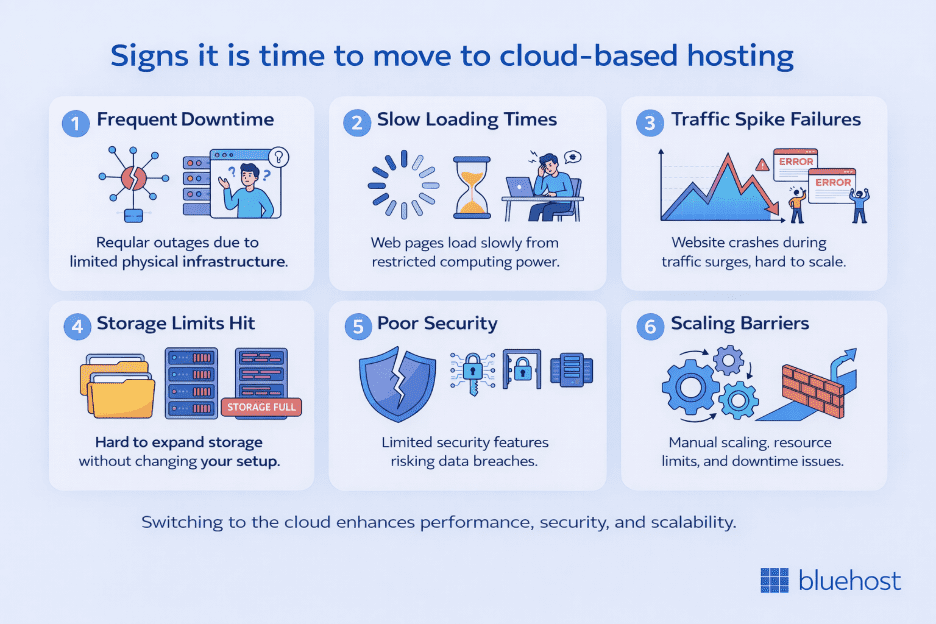
1. Frequent downtime
If your website goes offline often, your current infrastructure cannot handle demand. Traditional hosting relies on limited physical infrastructure. In contrast, cloud infrastructure uses distributed data centers to improve business continuity and reduce failures.
2. Slow loading times
Slow websites usually mean limited computing power. If your pages take time to load, your hosting is struggling to deliver enough computing resources. Moving to a cloud computing environment gives you better performance and faster response times.
3. Traffic spike failures
If your website crashes during high traffic, your system cannot scale. Cloud hosting solves this with flexible cloud resources and on-demand scaling. Whether you use public cloud services or hybrid cloud solutions, your site can handle sudden demand without breaking.
Also read: What Is Global Server Load Balancing and Why It Matters
4. Storage limits hit
Running out of storage is a common issue with traditional hosting. Cloud deployment allows you to expand storage without changing your entire setup. You can store data across secure data centers without worrying about physical limits.
5. Poor security
If you are concerned about data security, your hosting may not be enough.
Modern cloud service providers offer:
- Data encryption
- Access management
- Secure data centers
This helps ensure data protection, maintain data integrity and protect sensitive data from risks.
6. Scaling barriers
If scaling your website requires manual upgrades or downtime, your setup is outdated. Cloud computing providers make scaling simple. You can increase computing power, adjust cloud resources and support growth without disrupting your website. This is especially useful for IT teams managing growing platforms or software development projects.
If you are seeing these issues, it is a clear sign your website has outgrown its current setup. Moving to the cloud is not just an upgrade. It is the next step in your cloud journey toward better performance, security and long-term growth.
How cloud infrastructure improves your hosting (and which option is right for you)
We see cloud infrastructure as more than just a technology upgrade. It changes how your website uses computing resources.
Instead of relying on limited physical infrastructure, we run your website on a scalable cloud computing environment backed by secure data centers and modern cloud architecture. This setup improves performance, reliability and control.
The next step is choosing the right hosting model based on your needs and this is where we at Bluehost bring these cloud capabilities into practical hosting solutions.
Start with VPS hosting if you are growing
Our VPS hosting is the ideal starting point when you move from shared hosting to the cloud.
We use virtual machines within our cloud platform to give you dedicated computing resources without the cost of a full server. This makes it one of the most practical cloud service models for growing websites.
Our VPS hosting works best when you need:
- Balanced performance with guaranteed CPU, RAM and storage
- Flexibility to manage your cloud environment and configurations
- The ability to scale cloud resources as your traffic grows
It is ideal for:
- Websites moving beyond shared hosting
- Businesses managing multiple sites or applications
- Teams that need better control without complex cloud deployment
With advanced access, dynamic scaling and isolated environments, we remove the limits of shared hosting and support your cloud journey.
Move to dedicated hosting when performance is critical
Our dedicated hosting gives you full control over a physical server within our cloud infrastructure.
You get complete access to all computing power, with no resource sharing. This makes it the most powerful option among our cloud-based services for high-demand workloads.
Our dedicated hosting is the right choice when you need:
- Full server control with root access and custom operating systems
- Isolated resources for maximum performance and reliability
- Enhanced security for sensitive data and business-critical applications
It is ideal for:
- High-traffic websites and platforms
- Agencies and businesses with performance-critical workloads
- Applications that require strict data security and stability
With dedicated compute, multiple IP addresses and advanced configurations, we deliver the highest level of performance and control.
Simple way to decide
Choosing between VPS and dedicated hosting depends on your stage of growth.
- Our VPS hosting fits the growth stage, where you need flexibility, scalability and control
- Our dedicated hosting fits the scale stage, where performance, security and full control are critical
If you are starting your cloud migration, we recommend VPS as the first step. As your needs grow, you can move to dedicated hosting for maximum performance.
Cloud infrastructure enables you to scale efficiently, reduce limitations and choose the right hosting model based on real needs.
Don’t let your hosting limit your growth
Your website should support your growth, not slow it down. If you face downtime, slow speed or scaling issues, your current setup is holding you back.
With our cloud infrastructure, we give you access to flexible cloud resources, better cloud security and reliable performance across secure data centers. We also support business continuity, disaster recovery and data protection.
You can start with our VPS hosting for flexibility and control. Move to our dedicated hosting when you need more computing power and full server control.
Our cloud services are built to scale with your needs. If your hosting cannot keep up, it is time to move to our OCI-based cloud infrastructure with Bluehost VPS hosting.
FAQs
The advantages explain why to move to cloud hosting. Cloud providers offer scalable resources, improved flexibility in cloud computing and reduced dependence on underlying infrastructure. It supports cloud adoption, accelerates innovation and helps organizations modernize existing infrastructure with efficient data migration.
The main advantage of cloud hosting is flexibility. It allows organizations to scale resources on demand, reduce reliance on traditional IT infrastructure and improve performance using advanced cloud providers and modern underlying infrastructure.
Businesses migrate to the cloud to improve performance, reduce costs and support growth. Cloud adoption enables organizations to modernize IT infrastructure, work with multiple cloud vendors and accelerate innovation through flexible cloud environments and efficient migration processes.
Compared to on-premises, cloud hosting reduces infrastructure costs and improves scalability. It simplifies the migration process, supports hybrid cloud migration and allows organizations to leverage major cloud providers, flexible cloud resources and advanced solutions without managing physical infrastructure.

Write A Comment