 ChatGPT,
 Claude,
 Gemini,
 Grok — all four for
Key highlights
- Understand how ICANN coordinates domain names, IP addresses and DNS infrastructure to keep the global internet stable.
- Learn why ICANN is not a government organization and how its multi-stakeholder model ensures global accountability.
- Explore how domain names, registrars, registries and top-level domains work together under ICANN’s coordination.
- Know what authority ICANN has and why it cannot regulate internet content or shut down websites.
- Uncover how ICANN funding, transparency and accountability mechanisms support an open and interoperable internet worldwide.
Every time you type a web address into your browser or send an email, you rely on a complex system of internet infrastructure that operates seamlessly behind the scenes. At the heart of this system is the Internet Corporation for Assigned Names and Numbers, commonly known as ICANN. But who is ICANN and why does this organization play such a critical role in how the internet functions today?
ICANN is the nonprofit organization responsible for DNS management and the coordination of the internet’s unique identifier systems. Without ICANN’s coordination efforts, the seamless experience of accessing websites, sending emails and connecting across networks would not be possible.
This comprehensive guide explores ICANN’s role and structure, its history, how it manages domain names and IP addresses and why it remains essential for maintaining an open and accessible internet.
What Is ICANN?
ICANN stands for the Internet Corporation for Assigned Names and Numbers. It is a central coordinating body for the internet’s naming systems. ICANN meaning extends beyond a simple acronym. It represents the technical backbone that ensures every device, domain name and network address remains unique and accessible across the global internet.
At its core, ICANN coordinates the Domain Name System (DNS), which translates human-readable domain names like [example].com into numerical IP addresses that computers use to locate and communicate with each other. ICANN does not control internet content or access, but rather manages the technical infrastructure that keeps domain names unique and ensures the internet functions as a unified global network.
Myth vs. reality table:
| What people think ICANN does | What ICANN actually does |
|---|---|
| Controls the internet | Coordinates domain names & IP addresses |
| Can shut down websites | Only manages technical infrastructure |
| Regulates internet content | No authority over content |
| Sets domain prices | Only charges $0.18 transaction fee |
Pro Tip: “Think of ICANN as the internet’s phonebook coordinator, not its police force.”
Why was ICANN created?
Understanding when was ICANN established and why requires looking at the internet’s evolution from a research network to a global communications platform.
1. Internet growth before ICANN
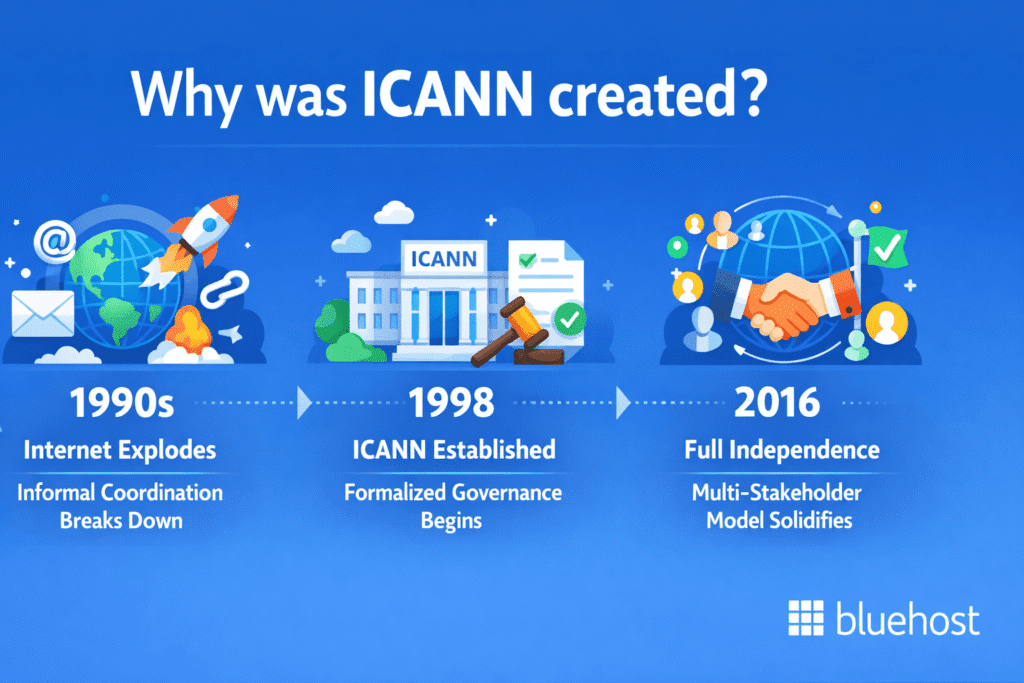
Before ICANN’s formation, the internet’s technical coordination was managed by individuals and organizations under contracts with the U.S. government. Jon Postel, through the Internet Assigned Numbers Authority (IANA), performed many core functions manually. As the internet grew exponentially in the 1990s, this informal system became unsustainable.
2. Problems ICANN was designed to solve
The rapid commercialization and globalization of the internet created several challenges. Who regulates domain names? Who assigns domain names fairly and transparently? How can the internet remain stable as millions of new users come online? These questions highlighted the need for a formalized, accountable organization.
According to the folks who regulate the net, they’re at an organization designed to address these challenges through transparent policies and global participation. ICANN was created to provide institutional stability, ensure fair access to internet resources and establish accountability mechanisms that would serve the entire global internet community.
3. When and where ICANN was formed
ICANN was established on September 18, 1998, in California, United States. Its creation represented a transition from government-led internet coordination to a private-sector, multi-stakeholder governance model that would involve businesses, technical experts, civil society and governments from around the world.
What is ICANN’s role in the domain name system (DNS)?
While ICANN coordinates the DNS at the highest level, the actual registration process involves a carefully structured hierarchy of organizations.
1. How DNS works (high-level overview)
The Domain Name System functions as the internet’s directory service. When you type a web address, DNS servers translate that name into an IP address, allowing your browser to connect to the correct server. This translation happens in milliseconds and involves multiple layers of DNS servers working together.
2. ICANN’s responsibility in DNS coordination
ICANN role centers on managing the root zone of the DNS—the authoritative directory at the top of the DNS hierarchy. ICANN coordinates changes to this root zone, ensures its security and stability and works with root server operators to maintain reliable DNS service worldwide.
3. Why DNS stability matters
DNS stability directly impacts global internet accessibility. If the DNS fails or fragments, websites become unreachable, email stops working and online services cease functioning. ICANN’s coordination role ensures that DNS remains stable, secure and universally accessible—making it foundational to internet reliability.
ICANN, domain names and TLD management
Website registration involves registering with which organization? While you register domains through ICANN-accredited registrars, understanding the broader domain management ecosystem helps clarify how the system works.
gTLDs vs ccTLDs: What’s the Difference?
| Feature | Generic TLDs (gTLDs) | Country-Code TLDs (ccTLDs) |
|---|---|---|
| Purpose | Global use, no geographic restriction | Tied to specific countries/territories |
| Examples | .com, .org, .net, .info, .blog, .app | .uk, .de, .jp, .ca, .au |
| Who can register | Anyone worldwide | Varies by country (some restricted) |
| Number available | 1,200+ | 250+ |
| Managed by | ICANN-contracted registries | National registry operators |
| Best for | International businesses, global brands | Local businesses, country-specific sites |
1. How ICANN manages top-level domains (TLDs)
ICANN oversees the creation, delegation and management of all top-level domains—the extensions that appear at the end of domain names. This includes establishing technical requirements, ensuring registry operators meet performance standards and managing the process for introducing new TLDs.
2. Generic TLDs vs country-code TLDs
ICANN coordinates two main categories of TLDs. Generic top-level domains (gTLDs) like .com, .org and .net are available globally. Country-code top-level domains (ccTLDs) like .uk, .de and .jp correspond to specific countries or territories and are typically managed by national registry operators under ICANN’s coordination framework.
3. New gTLD program explained
ICANN domain registration overview expanded significantly with the new gTLD program launched in 2012. This initiative allowed organizations to apply for customized domain extensions, resulting in hundreds of new options like .app, .blog and .tech. The program demonstrated ICANN’s commitment to innovation and competition in the domain name space.
Also read: The Ultimate List of Top Level Domains: What They Mean & How to Choose One
ICANN and domain registrars
The Internet Corporation for Assigned Names and Numbers uses companies called registrars to handle the business of registering domain names. Understanding this relationship clarifies how domains actually get registered.
1. Relationship between ICANN, registries and registrars
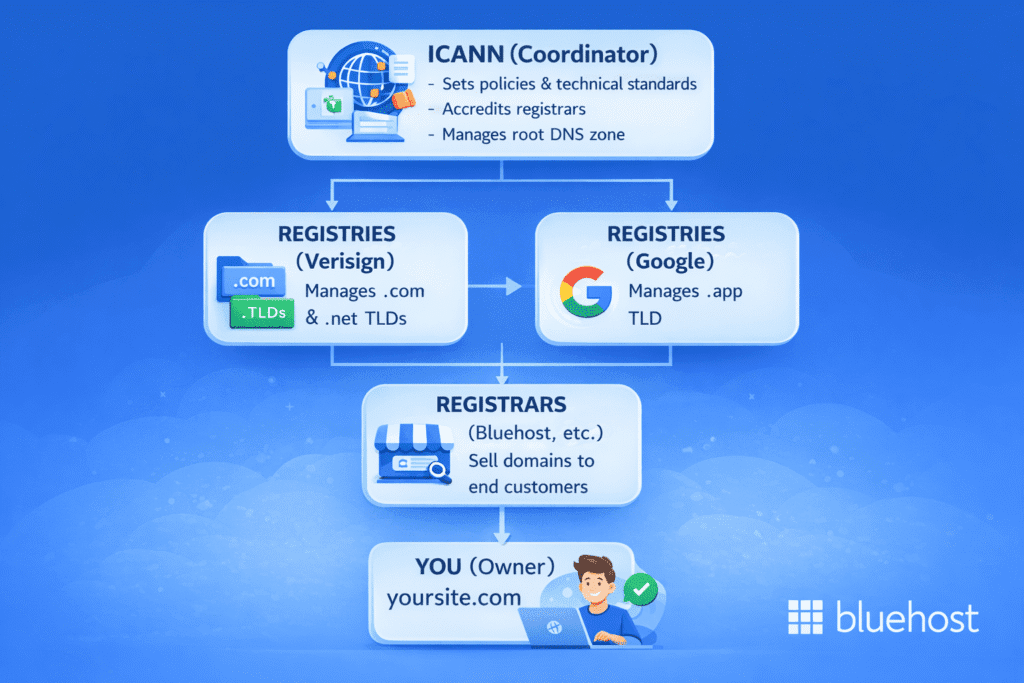
ICANN operates within a three-tier structure. ICANN sets policies and coordinates the system. ICANN-accredited registries and registrars manage specific TLDs and maintain the authoritative databases for domains within those extensions. Registrars are ICANN-accredited companies that sell domain registrations directly to end users, connecting them to the appropriate registry.
2. Why domain registrars must be ICANN-accredited?
ICANN company accreditation ensures that registrars meet technical, operational and financial standards. Accreditation protects consumers by establishing baseline requirements for data security, dispute resolution and service reliability. Only accredited registrars can register domains in ICANN-managed TLDs.
3. What ICANN does not control?
Despite common misconceptions, ICANN does not control internet content, regulate internet access or dictate how individuals use the internet. ICANN’s authority is limited to technical coordination of naming and numbering resources. It cannot shut down websites based on content, regulate prices charged by registrars (beyond accreditation fees) or determine who can access the internet.
When registering a domain, it’s important to choose an ICANN-accredited registrar. Bluehost is officially accredited by ICANN, follow established policies for domain registration, transfers and renewals, helping ensure stability and transparency for domain owners.
Domain name structure and ICANN fees
Understanding the financial aspects of domain registration helps clarify ICANN’s funding model and operational sustainability.
1. How domain names are structured?
Domain names follow a hierarchical structure from right to left. The TLD appears first (rightmost), followed by the second-level domain (your chosen name) and potentially subdomains. This structure allows the DNS to efficiently route requests and maintain uniqueness across billions of registered domains.
2. What ICANN transaction fees are?
ICANN fee 18 cents per domain transaction represents a small charge that ICANN collects for each new domain registration or renewal in gTLDs. This fee supports ICANN’s operational costs, including technical coordination, policy development and community engagement activities. The fee is collected by registries and registrars, then remitted to ICANN.
3. Do domain owners pay ICANN directly?
No. Domain owners pay their chosen registrar, which includes the ICANN fee in the total registration price. You never interact directly with ICANN for domain registration or renewal payments. The registrar collects the fee on ICANN’s behalf and remits it accordingly.
Also read: What is a Domain Name? Beginner’s Guide for 2026
What is ICANN’s role in IP address distribution?
ICANN IP address coordination represents another critical function, though it operates differently than domain name management.
1. Difference between IP addresses and domain names
IP addresses are numerical identifiers assigned to every device connected to the internet. Domain names provide human-readable labels that DNS translates into IP addresses. While you might remember [example].com easily, the underlying IP address like 192.0.2.1 is what computers actually use to establish connections.
2. ICANN and Regional Internet Registries (RIRs)
What is ICANN or RIR in terms of IP management? ICANN establishes global policy for IP address allocation, while five Regional Internet Registries distribute IP addresses within specific geographic regions: ARIN (North America), RIPE NCC (Europe/Middle East), APNIC (Asia-Pacific), LACNIC (Latin America) and AFRINIC (Africa).
3. IP address allocation works
ICANN allocates large blocks of IP addresses to RIRs based on demonstrated need and policy guidelines. RIRs then allocate smaller blocks to internet service providers and network operators within their regions. This hierarchical system ensures efficient use of limited IP address space and regional autonomy in distribution decisions.
Root servers and ICANN
Root servers represent the critical infrastructure that makes DNS function globally.
1. Understanding root servers
Root servers are the authoritative DNS servers at the top of the DNS hierarchy. There are 13 root server systems (labeled A through M), strategically distributed worldwide using anycast technology to provide redundancy and reliability. These servers respond to queries about TLD nameserver locations, enabling the entire DNS resolution process.
2. ICANN coordinates root zone management
ICANN website operations include managing updates to the root zone file—the database that root servers use to direct queries to appropriate TLD nameservers. ICANN coordinates changes, ensures technical accuracy and works with the root server operators to distribute updated zone files.
ICANN’s Organizational Structure
ICANN role and structure reflects its commitment to multi-stakeholder governance and global representation.
1. Board of directors
The ICANN Board of Directors provides strategic oversight and makes final decisions on policy recommendations. Board members come from diverse backgrounds and geographic regions, selected through processes that emphasize expertise, independence and community representation.
2. Supporting organizations and advisory committees
Three Supporting Organizations develop policy in specific areas: the Generic Names Supporting Organization (GNSO) for gTLDs, the Country Code Names Supporting Organization (ccNSO) for ccTLDs and the Address Supporting Organization (ASO) for IP addresses. Multiple Advisory Committees provide input on security, government relations and other specialized topics.
3. Other members
ICANN overview of participants includes registrars, registry operators, internet service providers, technical experts, businesses, civil society organizations, individual internet users and governments. This diverse community engages through open meetings, working groups and public comment periods to shape internet governance policies.
How does ICANN make decisions?
Understanding ICANN’s decision-making processes reveals how internet governance balances diverse interests and perspectives.
1. Multi-stakeholder model explained
Which of the following is the nonprofit organization responsible for DNS management through consensus-driven processes? ICANN pioneered the multi-stakeholder approach, where decisions emerge from collaborative discussions among all affected parties rather than top-down government mandates. This model ensures that policies reflect the practical needs and concerns of those who operate, use and are impacted by internet infrastructure.
2. Policy development process
ICANN follows formalized policy development processes that typically include: identifying issues, forming working groups, drafting policy proposals, conducting public comment periods, refining proposals based on feedback and final board approval. This transparent process ensures thorough vetting and broad community input before policies take effect.
3. Public participations
Anyone can participate in ICANN processes. Individuals and organizations can join constituency groups, attend public meetings, submit comments during public comment periods and engage in working groups. ICANN holds three international meetings annually, all open to public participation and publishes extensive documentation online.
Accountability and transparency
Following ICANN’s transition to independence, robust accountability mechanisms ensure responsible governance.
1. Who holds ICANN accountable
The organization answers to the global internet community through multiple mechanisms. The Empowered Community, composed of ICANN’s Supporting Organizations and Advisory Committees, can reject budget or strategic plans, remove board members and challenge decisions that conflict with ICANN’s mission or bylaws.
2. Accountability mechanisms
ICANN implements extensive transparency requirements including public board meetings, published decision documentation, financial audits and regular reviews of its performance. Independent review processes allow community members to challenge ICANN actions they believe violate established procedures or policies.
3. Oversight and review processes
Periodic reviews of ICANN’s Supporting Organizations, Advisory Committees and Board performance ensure continuous improvement. These reviews, conducted by independent examiners, assess effectiveness and recommend enhancements to governance structures and processes.
How is ICANN funded?
Financial independence and transparency ensure ICANN can fulfill its mission without undue external influence.
| Funding aspect | Details | Purpose & impact |
|---|---|---|
| Revenue sources | Primary income from: • Domain name transaction fees • Registry fees • Registrar fees • Contracts with TLD operators | • Directly connected to ICANN’s coordination activities • Ensures financial sustainability • Grows with the domain name system expansion |
| Registrar fees | Annual fees based on: • Number of domains managed • Accredited registrar status | • Distributes costs fairly • Charged to organizations benefiting from ICANN’s services |
| Registry fees | gTLD registry operators pay: • Fixed fees • Variable fees | • Ensures cost-sharing among direct beneficiaries • Supports coordination services |
| Financial transparency | Public disclosure includes: • Detailed financial statements • Annual budgets • Audit reports | • Required by nonprofit status • Community review and approval of budgets • Builds trust • Ensures responsible resource allocation |
| Financial independence | Revenue model based on DNS coordination activities | Enables ICANN to fulfill its mission without undue external influence |
Why ICANN is important for an open internet?
ICANN overview of its mission emphasizes maintaining the internet as a single, globally interoperable network accessible to everyone.
1. Preventing internet fragmentation
Without coordinated management of domain names and IP addresses, different regions or organizations could create incompatible naming systems, fragmenting the internet into disconnected networks. ICANN’s coordination role prevents this fragmentation, ensuring that a domain registered anywhere works everywhere.
2. Supporting global interoperability
Who owns the internet? No one and everyone. ICANN’s model embodies this principle by coordinating resources without controlling content or access. This approach maintains technical interoperability while respecting diverse cultural, legal and political perspectives across the global internet community.
3. Protecting DNS stability and security
ICANN works continuously to enhance DNS security through initiatives like DNSSEC (DNS Security Extensions), which cryptographically authenticates DNS data to prevent tampering. These security enhancements protect users worldwide from increasingly sophisticated cyber threats.
Can ICANN shut down a domain?
Understanding ICANN’s actual authority helps dispel common misconceptions about internet governance.
- ICANN cannot directly shut down individual domain names or websites. It does not evaluate content, moderate speech or enforce national laws. ICANN’s authority extends only to coordinating technical systems and accrediting organizations that participate in domain name registration.
- Domain suspension or deletion typically results from registrar actions based on: non-payment, violation of registrar terms of service, legal orders directed at the registrar or legitimate disputes through established resolution processes. Registrars, not ICANN, make these operational decisions.
- ICANN is not an internet police force, content regulator or censorship authority. It cannot regulate prices beyond its own transaction fees, does not control internet access and cannot unilaterally remove domains. Its role remains strictly focused on technical coordination of unique identifiers.
Final thoughts
The Internet Corporation for Assigned Names and Numbers fulfills an essential yet often invisible role in maintaining the internet as a unified, accessible global resource. Through its coordination of domain names, IP addresses and the root DNS infrastructure, ICANN enables billions of people to connect, communicate and access information seamlessly across borders.
Understanding ICANN helps domain owners make informed decisions when choosing a registrar. Working with an ICANN-accredited provider like Bluehost ensures your domain follows global internet standards while remaining easy to manage.
FAQs
ICANN coordinates the Domain Name System (DNS), manages IP address allocation policies, oversees the introduction of new top-level domains, accredits domain registrars and maintains the authoritative root zone of the DNS. These technical coordination functions ensure that domain names remain unique and the internet operates as a single, globally interoperable network.
No. ICANN is a nonprofit public benefit corporation, not a government organization. While it was initially established under contract with the U.S. Department of Commerce, ICANN transitioned to full independence in 2016. It now operates through a multi-stakeholder governance model involving participants from around the world, including businesses, technical communities, civil society and governments.
ICANN was created in 1998 to formalize and globalize the technical coordination of internet naming and numbering resources. As the internet grew from a research network to a global communications platform, informal coordination mechanisms became inadequate. ICANN was established to provide institutional stability, transparent policy development processes and accountability mechanisms for managing critical internet infrastructure.
ICANN’s authority is limited to technical coordination of internet naming and numbering systems. It can establish policies for domain name management, accredit or revoke accreditation of registrars, approve new top-level domains and coordinate changes to the DNS root zone. However, ICANN cannot control internet content, regulate access, censor websites or enforce national laws. Its power extends only to maintaining the technical infrastructure that keeps the internet unified and accessible.
No. ICANN does not regulate the internet in a broad sense. It coordinates specific technical functions related to domain names and IP addresses but has no authority over internet content, access, pricing (except its own transaction fees) or how individuals and organizations use the internet. Internet regulation related to content, privacy, security and commerce remains the responsibility of national governments, industry organizations and other regulatory bodies.
No. Who owns the internet infrastructure at this level? Root servers are operated by independent organizations including government agencies, universities and private companies. ICANN coordinates the content of the root zone but does not operate or control the root servers themselves. This distributed model enhances resilience and prevents single points of failure.
No. Domains are registered through ICANN-accredited registrars such as Bluehost, which handle the registration and renewal process on your behalf.
While ICANN coordinates DNS and IP address policy, Regional Internet Registries (RIRs) handle the actual allocation of IP addresses to network operators in different geographic regions. ICANN and RIRs work together to ensure coordinated management of internet number resources.

Write A Comment