 ChatGPT,
 Claude,
 Gemini,
 Grok — all four for

AI has made everyone sound like an SEO expert.
Ask any AI tool about topical authority, content gaps or keyword clustering and it will give you a polished answer. The vocabulary is right. The structure feels strategic. The confidence is convincing.
But fluency is not expertise. And in 2026, that gap is becoming expensive.
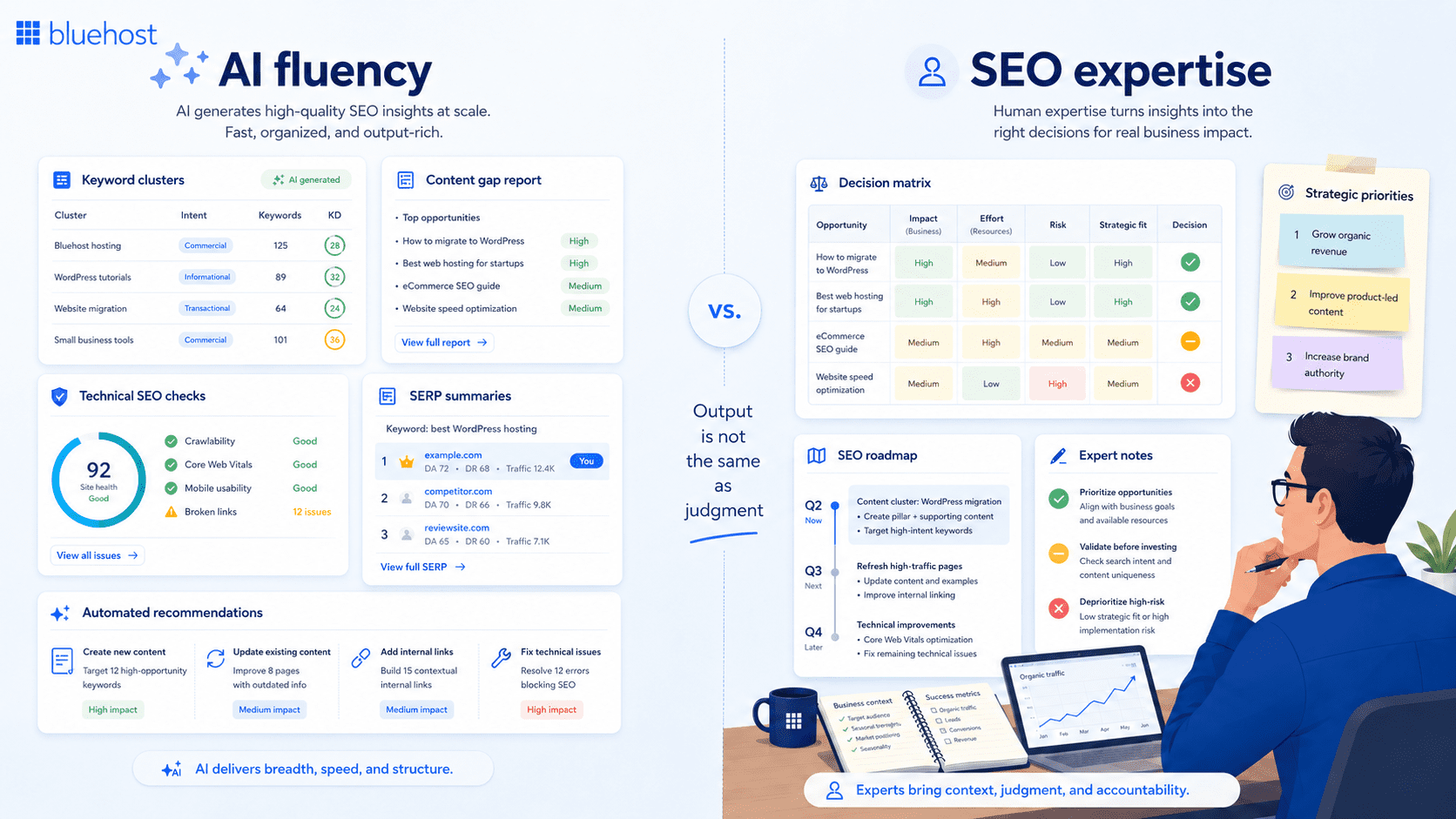
AI made SEO knowledge easy. It made judgment more valuable
AI tools can now explain Core Web Vitals, build keyword clusters, audit internal links and summarize competitor content strategies in minutes. What once required an experienced SEO professional and several platforms can now be approximated with a prompt.
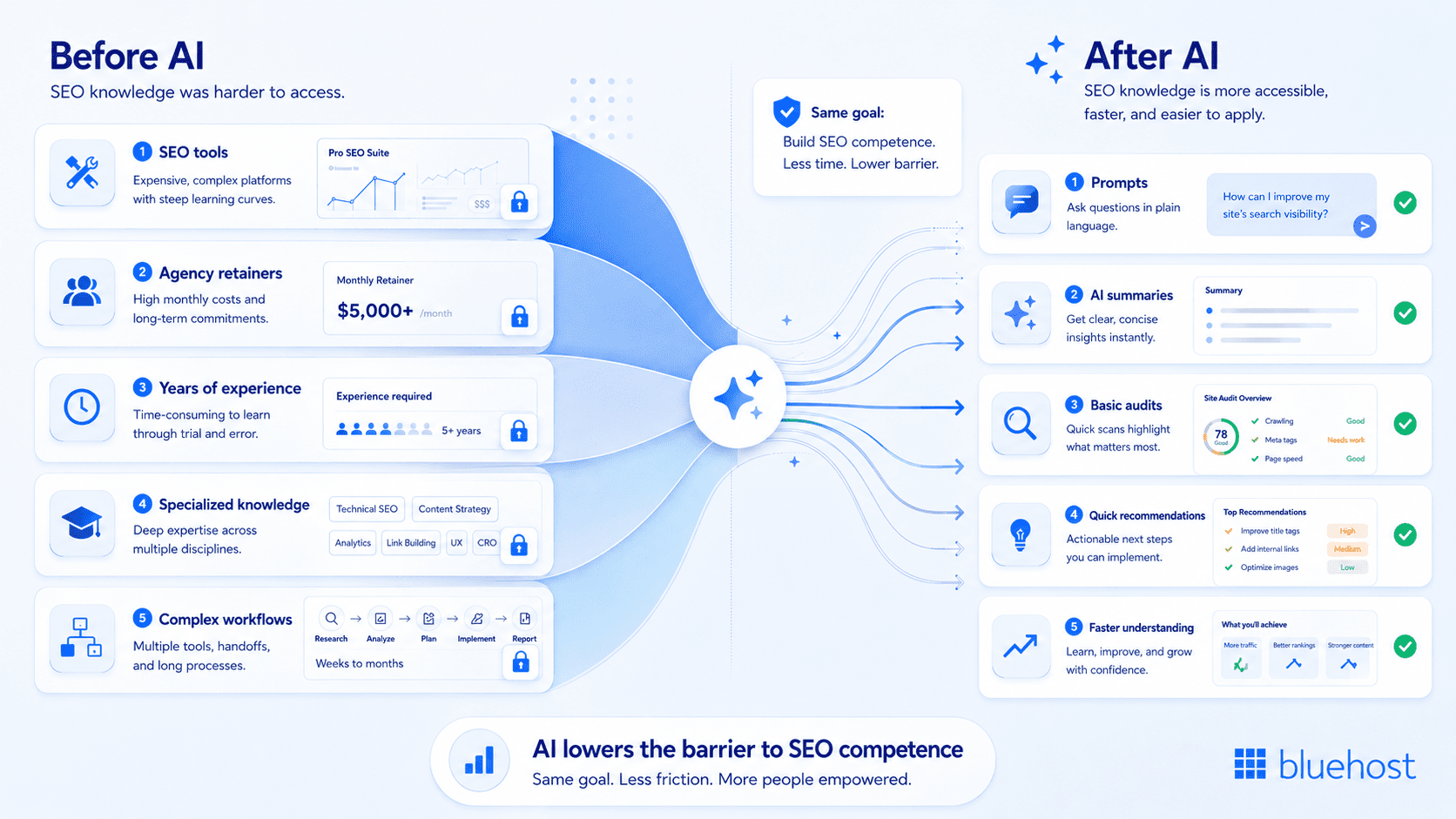
That is genuinely useful. AI lowers the floor on SEO competence. Teams that previously had limited SEO capability now have access to the same basic vocabulary, frameworks and recommendations that used to sit behind agency retainers or years of experience.
1. Access to SEO knowledge is not the same as judgment
But access to knowledge is not the same as expertise.
What AI produces is pattern retrieval. It synthesizes what has already been documented, discussed and indexed about SEO. That makes it useful for explaining established practices, but unreliable when the problem requires diagnosis, context or restraint.
This matters because the most expensive SEO mistakes are rarely caused by a lack of tactics. They are caused by applying the right-sounding tactic to the wrong problem. A site may not need more content. It may need stronger authority signals, cleaner architecture, better product differentiation or a completely different search intent strategy. AI can help surface possibilities, but it cannot reliably decide which one is true for a specific business without strong human judgment guiding the process.
For most of SEO’s history, the advantage was informational. Strong practitioners knew how search worked, where to find the right data and how to translate that data into action. That advantage has weakened. Basic and intermediate SEO knowledge is now abundant. Google’s documentation is public. SEO communities and practitioners have made high-quality thinking widely accessible. AI has made that knowledge instantly retrievable.
2. The new SEO advantage is knowing when to ignore the playbook
So the scarcity has moved. It is no longer enough to know the playbook. The real advantage is knowing when to use it, when to challenge it and when to ignore it.
The old SEO advantage was knowing the playbook. The new AI SEO advantage is knowing when the playbook no longer applies.
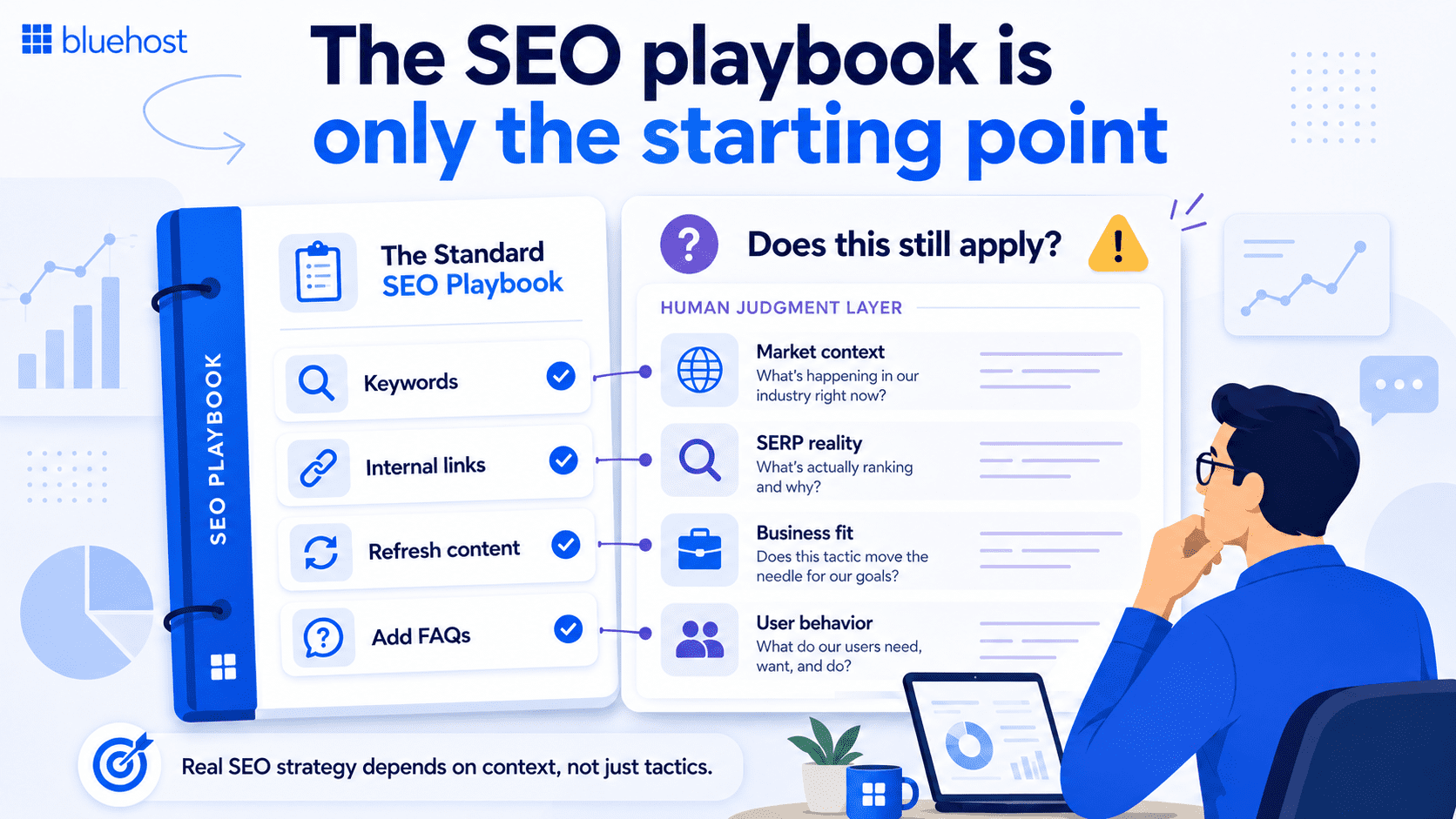
That changes what SEO expertise is for. The strongest SEO teams will not be measured by how much AI-assisted output they produce. They will be measured by the quality of the questions they ask before anything gets produced.
The risk is not AI-generated content. The risk is AI-generated certainty.
3. AI gives simulated strategic confidence
Here’s where the risk becomes concrete.
AI doesn’t just provide vocabulary. It produces structured recommendations that feel strategic. It can tell you that a page “lacks topical depth,” that your site has “thin content in the middle of the funnel,” or that your authority signals are “insufficient relative to SERP competition.” These outputs have the shape of strategy.
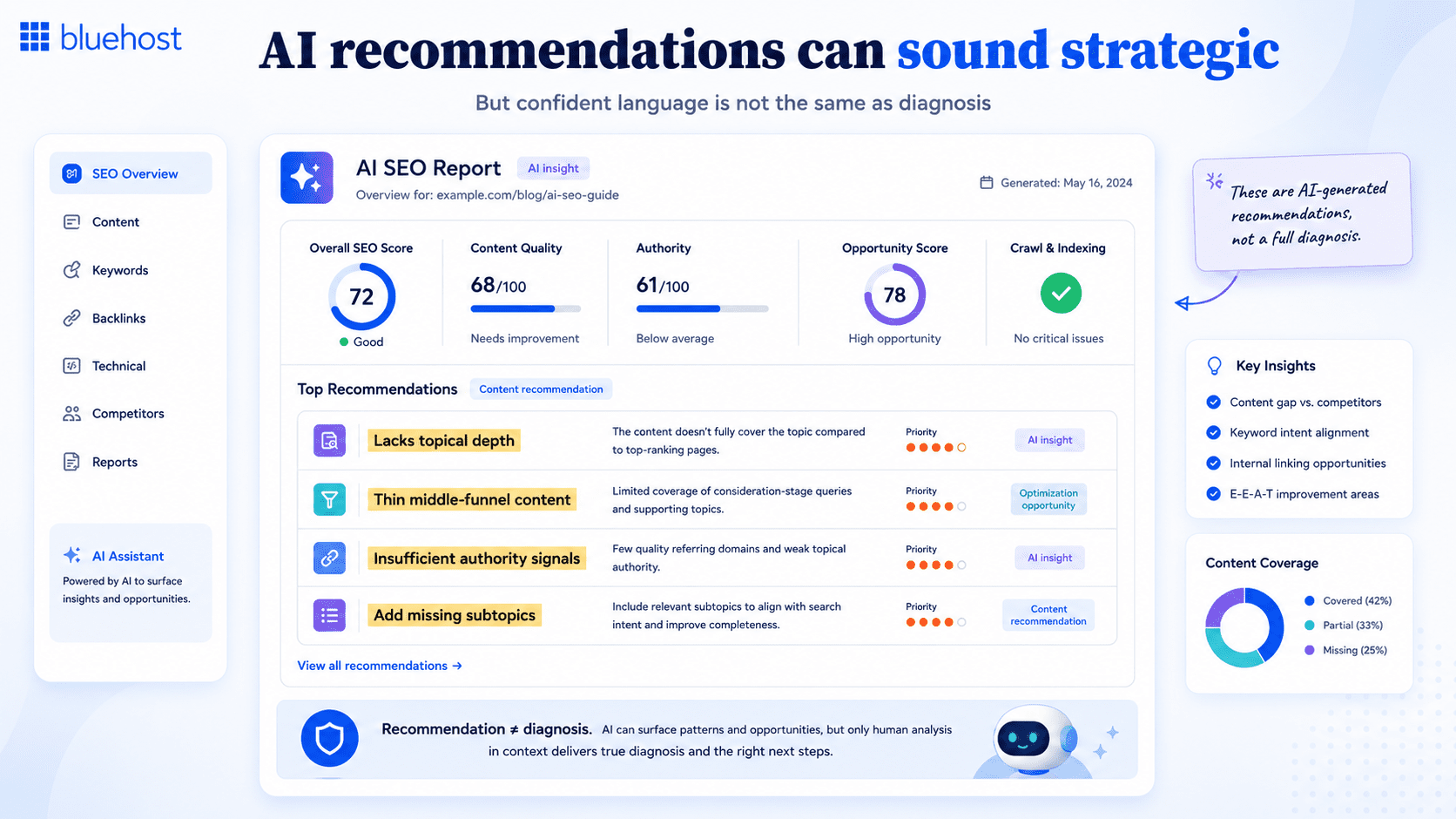
But many of them are pattern matches, not true diagnoses.
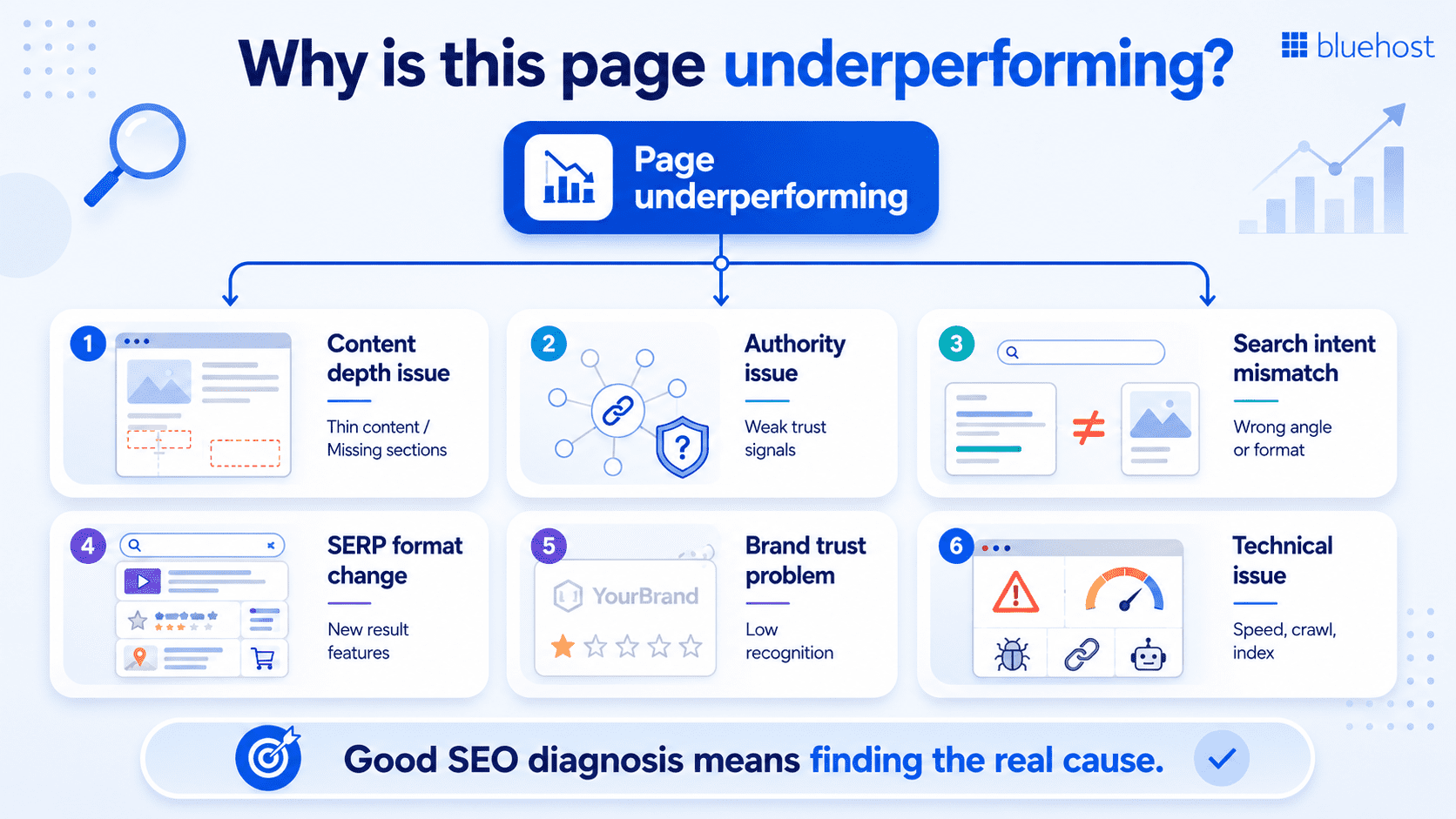
Consider what actually happens when a page underperforms. The cause might be topical depth or it might be format mismatch (the SERP now favors tools, not articles). It might be authority or it might be brand trust (users land and leave because they don’t recognize you). It might be a content gap or it might be that Google AI Overviews are now absorbing that query’s click volume entirely, making any article on the topic structurally disadvantaged.
AI will suggest all of these as possibilities. What it cannot do is tell you which one is actually happening or rank them by likelihood given your specific domain, audience and search environment. That requires judgment the kind that comes from working inside a specific market over time, not from pattern-matching across millions of indexed documents.
The danger in AI SEO is not only incorrect answers. It is plausible answers that no one thinks to question.
4. The pattern lag problem
AI is strongest where the world is already well documented. It trains on what has been written, indexed and repeated. That makes it useful for optimizing inside familiar SEO patterns, but weaker in the places where search behavior is still changing.
SEO advantage often lives where the pattern is still emerging.
That is the problem with relying too heavily on AI summaries. They are usually built from yesterday’s consensus. But search behavior is changing faster than SEO consensus can keep up. AI Overviews are changing how users interact with informational results, showing how AI search is changing the rules of search visibility. Google Discover rewards content shaped by audience interest, strong visuals and a clear point of view, not just keyword intent. Community-led results, including Reddit-style discussions, are changing what users expect to see in SERPs.
An AI system trained on older SEO thinking can give you outdated recommendations with current confidence.
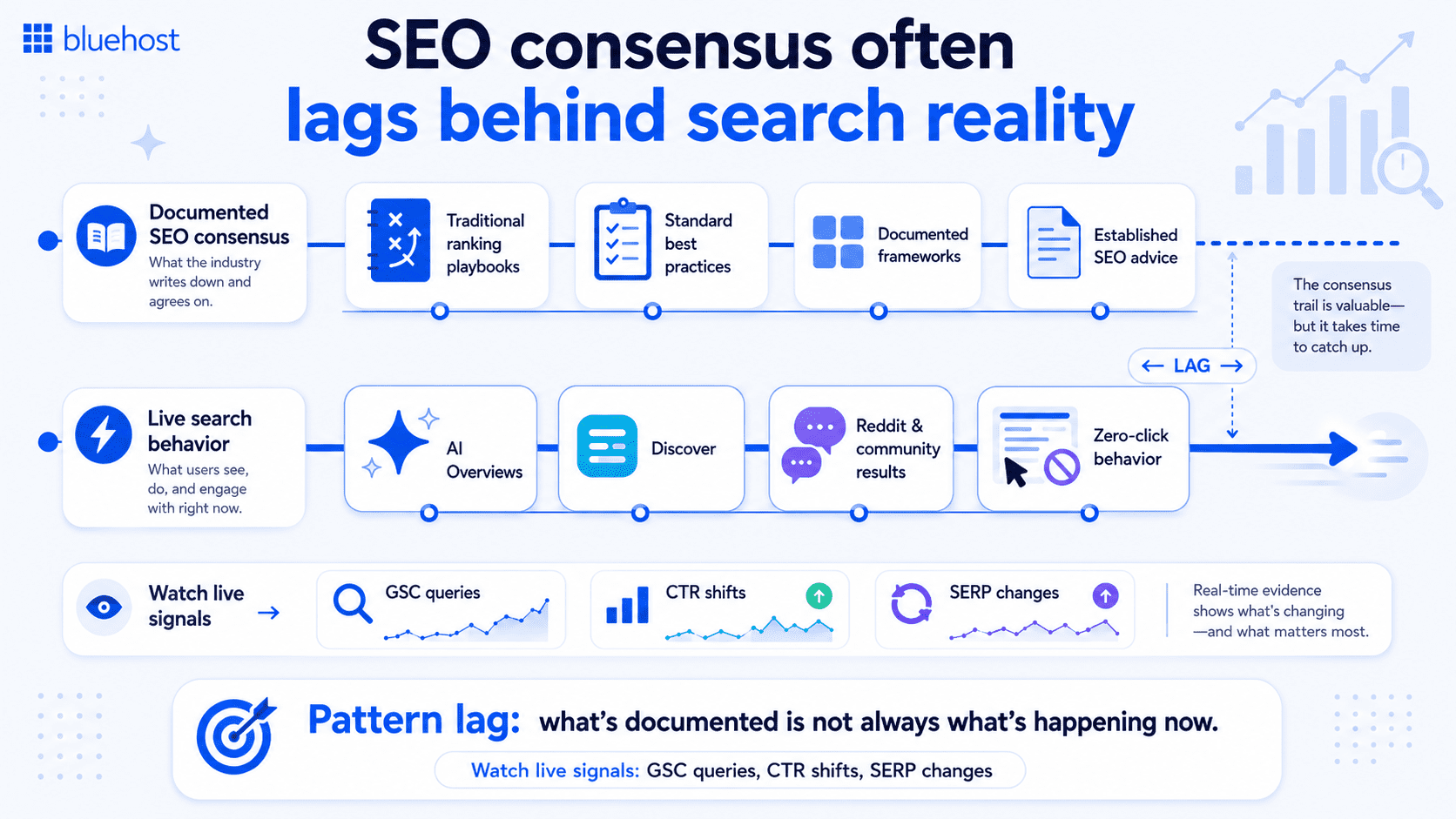
That is the pattern lag problem. AI repeats documented patterns, but emerging search behavior is not always well documented yet. The teams with the clearest advantage are the ones working with live data: Search Console queries, Discover performance, SERP changes, click-through shifts, engagement patterns and competitive movement. They are not waiting for the new consensus to be written. They are watching it form in real time.
AI can optimize inside known SEO patterns. Expertise detects when those patterns are breaking.
What AI SEO gets wrong in a real diagnosis
A simple example makes this clear.
Imagine a blog post that once drove steady organic traffic suddenly drops by 40%. An AI SEO tool reviews the page and recommends the familiar fixes: expand the content, add missing subtopics, improve internal links, refresh the title tag and strengthen the FAQ section.
None of that advice is necessarily wrong. But it may still miss the real problem.
A human SEO would first ask what changed around the page. Did rankings fall or did impressions stay stable while clicks dropped? Did the SERP change from articles to tools, product pages or community discussions? Is an AI Overview now answering the query directly? Did a competitor gain visibility with original data, stronger brand trust or a better format?
In that situation, the right answer may not be “make the article longer.” It may be to rebuild the page as a comparison tool, add first-party data, shift the page toward a stronger commercial intent, create supporting assets for a different query layer or stop investing heavily in a query where clicks are structurally shrinking.
That is the difference between optimization and diagnosis. AI can suggest ways to improve the page. SEO judgment decides whether the page is still the right answer to the search problem.
The five moves of AI SEO judgment
The answer is not to stop using AI. It is to use AI as a starting point, not a conclusion.
Strong AI SEO teams do not simply accept what AI produces. They apply judgment on top of it. In practice, that judgment comes down to five moves.
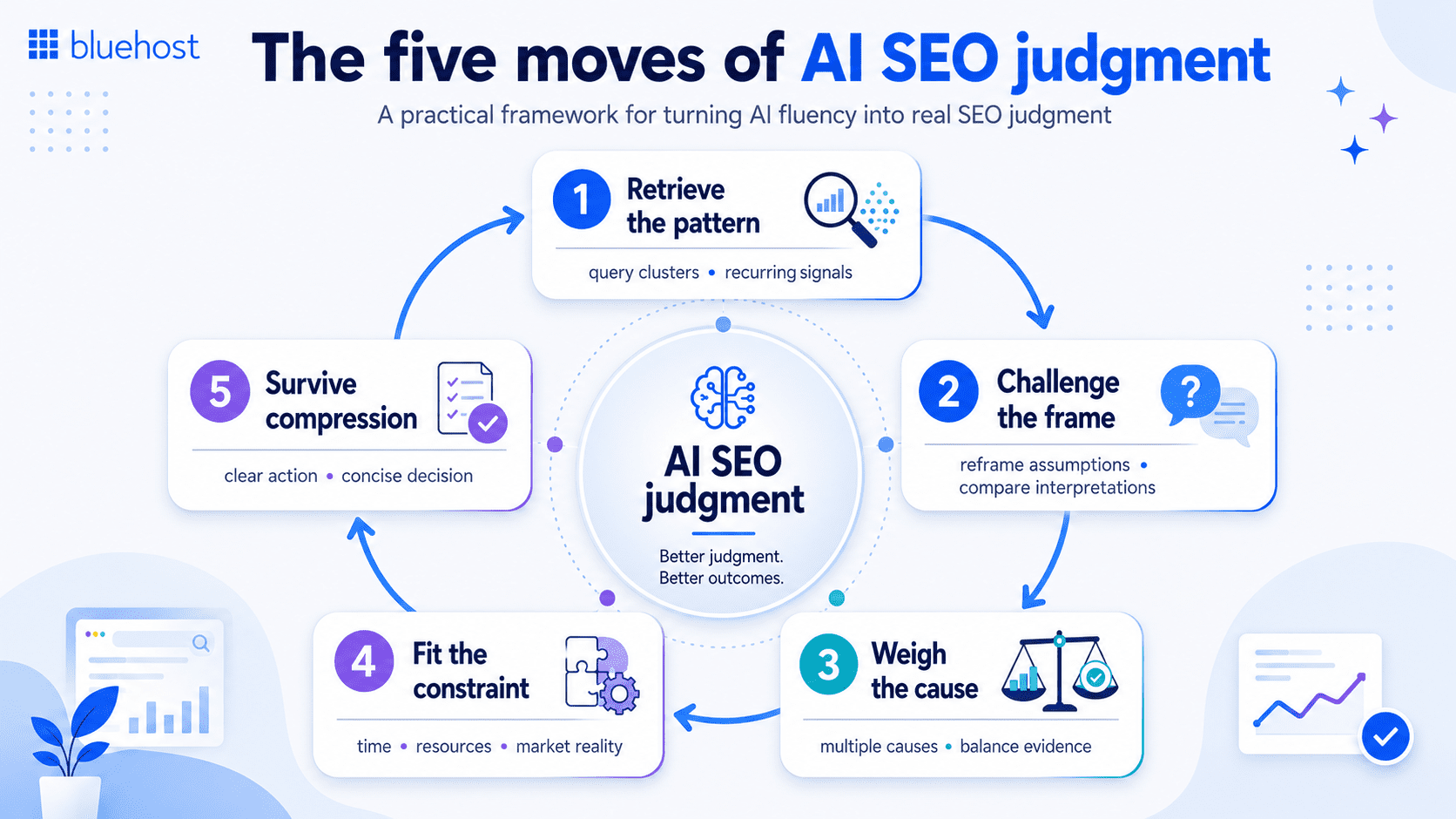
1. Retrieve the pattern
Use AI for what it does well: gathering known SEO signals, keyword opportunities, competitor patterns, SERP observations and technical checks. This is fast, useful and worth doing.
But treat the output as research, not a recommendation.
The key question is: What existing pattern is this AI output drawing from and is that pattern still current?
Mistaking retrieval for understanding is the most common AI SEO mistake. The output may sound like analysis, but often it is only a summary of what has already been said.
2. Challenge the frame
Most AI SEO mistakes start with the wrong question.
If you ask, “How do we improve this blog post?” AI will help you improve the blog post. But the better question might be, “Should this be a blog post at all?”
Before accepting an AI recommendation, challenge the frame. Is this a content issue, a technical issue, a brand authority issue, a SERP format issue or a trust problem showing up as an SEO symptom?
Solving the wrong problem efficiently only creates the illusion of progress.
3. Weigh the cause
AI can list possible reasons for a traffic drop: an algorithm update, content decay, technical changes, lost rankings, AI Overview click absorption, Discover volatility, tracking errors, competitor gains or seasonality.
SEO judgment ranks those possibilities by likelihood.
That is the difference between a list and a diagnosis. A strong practitioner looks at Search Console data, site history, category behavior and recent changes, then decides what is most likely true.
Treating every AI suggestion as equally valid spreads resources thin. Judgment decides where attention should go first.
4. Fit the constraint
A recommendation is not strategy until it can survive the organization.
Before acting on AI SEO advice, ask whether the CMS supports it, whether engineering can ship it, whether legal will approve it, whether the content team can maintain it and whether it connects to business priorities.
This is where many AI recommendations quietly die. They sound smart in a document but fail in execution.
Strong SEO judgment turns advice into something usable. It finds the fastest useful version that can actually move through the business.
5. Survive compression
In 2026, content is constantly being compressed. Users skim it on mobile. Google interprets it for relevance. AI summaries and Overviews extract key claims. Audiences remember only the strongest ideas.
So the question is no longer only, “Can this rank?”
The better question is: What will survive after this page is skimmed, summarized, cited, paraphrased and remembered?
This is where SEO overlaps with brand, editorial judgment and point of view. Content that survives compression is clear, distinct and useful even when reduced to its core idea.
The future SEO expert is an architect of discoverability
The role of SEO is expanding. It is no longer only about optimizing pages for search rankings. It is about shaping how a brand is discovered, interpreted, cited and remembered across search results, AI-generated summaries, content platforms, community discussions and market memory.
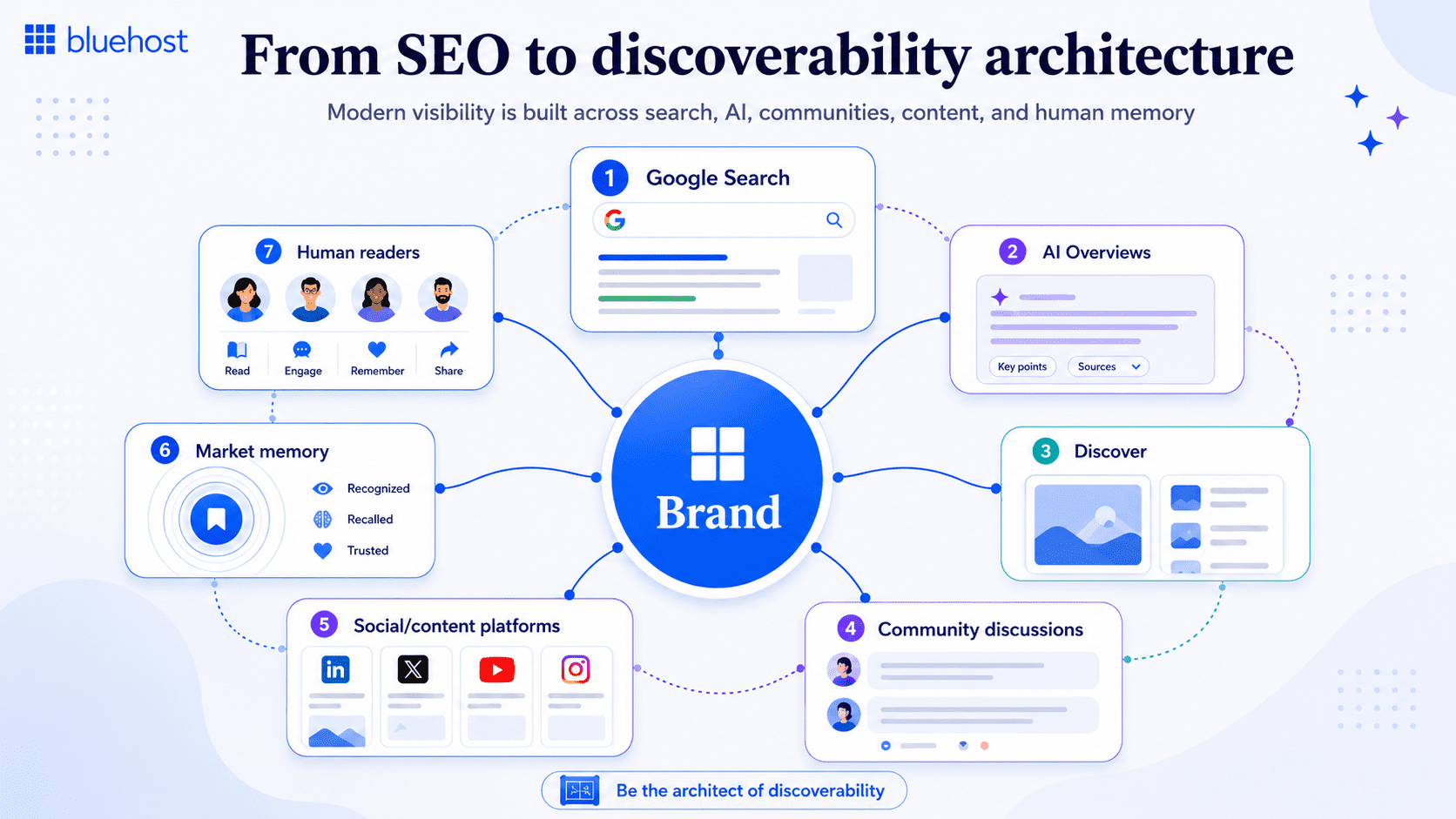
AI makes execution cheaper and faster. It also makes the execution layer more commoditized. When any team can generate a technically acceptable piece of SEO content in an hour, the advantage shifts entirely to strategy to the people who can decide what to create, why it matters, whether it will survive compression and how it fits into a brand’s long-term discoverability architecture.
The best SEO practitioners in the AI era will not simply optimize pages. They will be architects of discoverabilitythinking across channels, across content types and across the multiple systems (human readers, Google Search, AI Overviews, Discover feeds) that now determine whether content reaches an audience and whether it leaves a lasting signal.
The real challenge of AI SEO
AI makes SEO fluent.
Expertise makes SEO accountable.
Strategy makes SEO durable under compression.
The brands that will win in this environment are not the ones publishing the most AI-assisted content. They are the ones creating evidence, experience and authority that survive human attention, Google’s interpretation, AI summarization and long-term market memory.
That is a harder standard to meet than keyword coverage. It requires judgment the kind that no prompt, however well-engineered, can replace.
Methodology note
This article is based on original editorial analysis of broad AI and SEO trends. Rather than relying on a single study or specific dataset, the analysis draws on observed shifts across the search landscape, including the rise of AI-powered search experiences, changing user search behavior, increased use of AI in content workflows and the evolving role of SEO professionals.

Write A Comment