 ChatGPT,
 Claude,
 Gemini,
 Grok — all four for
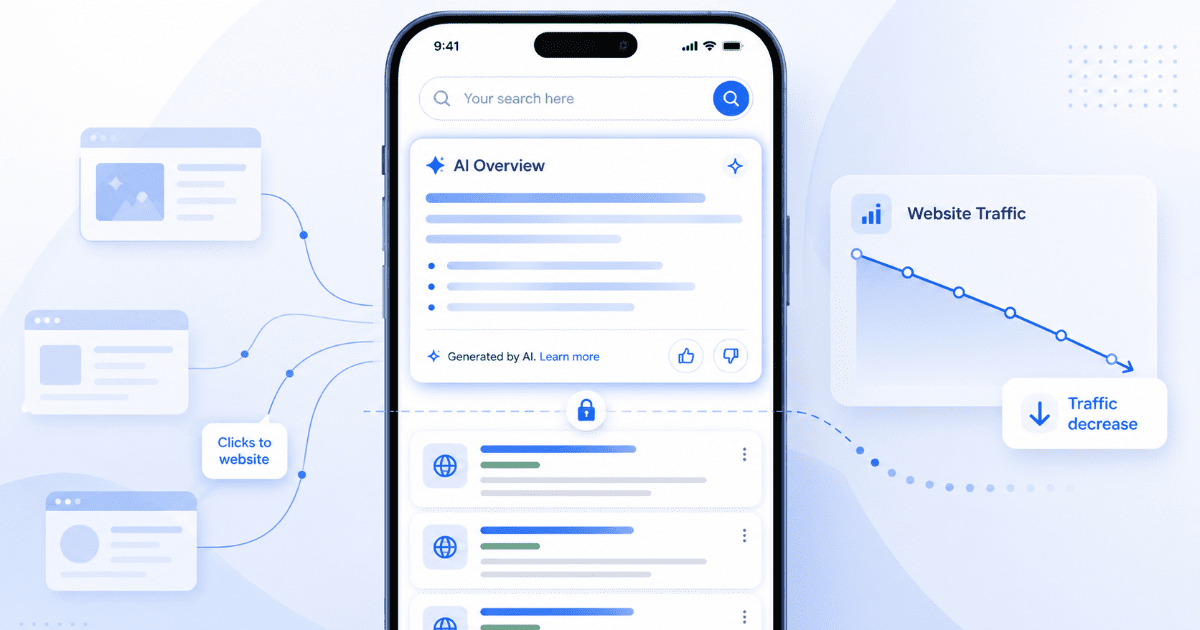
Google’s AI Overviews are forcing a new question on the web: What happens when a website helps answer a search, but never gets the visit?
That question sits at the center of a new working paper posted to SSRN this month. Titled “Google AI Overviews and Publisher Traffic: Evidence from a Field Experiment,” the paper was written by Saharsh Agarwal of the Indian School of Business and Ananya Sen of Carnegie Mellon University. The authors describe it as the first randomized field experiment to test how AI Overviews affect user behavior in a real browsing environment.
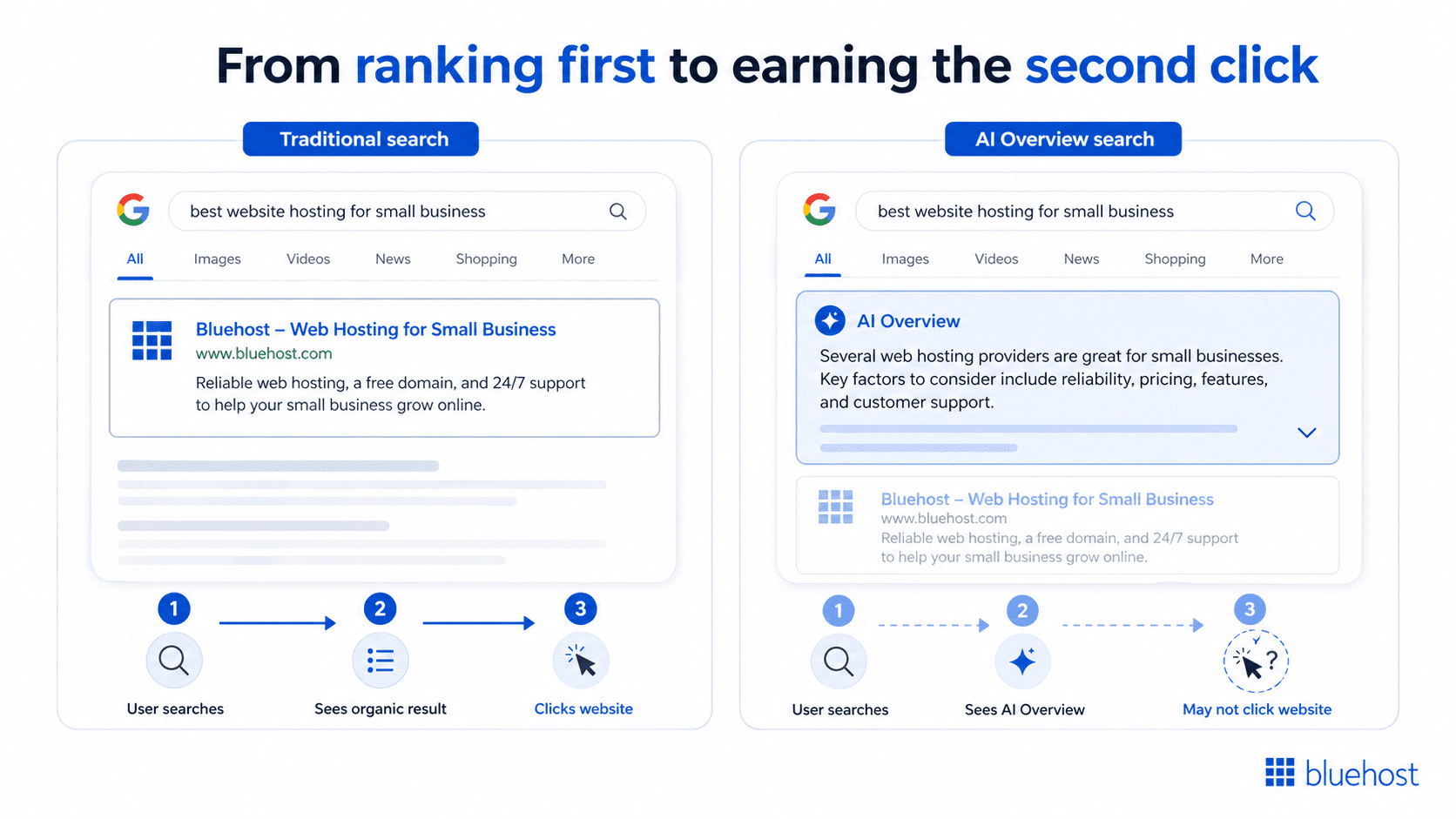
For years, the search bargain was simple. Websites created useful content, Google surfaced it and users clicked through for the full answer. AI Overviews are changing that path. They place a summarized answer above the organic listings, often before the user reaches the sources that helped shape the response.
The result is not the end of SEO. But it may be the beginning of a harder era for organic traffic, where visibility alone is not enough. Pages now have to do more than rank. They have to give users a reason to click after the answer has already appeared.
This article draws on our analysis of the working paper to unpack what the findings suggest for AI Overviews, top-ranking pages and the SEO strategies website owners may need next.
Methodology
This article is based on our close reading and analysis of the working paper “Google AI Overviews and Publisher Traffic: Evidence from a Field Experiment” by Saharsh Agarwal and Ananya Sen. The statistics, study findings and numerical claims referenced in this article come from the paper, including data on outbound clicks, zero-click searches, AI Overview placement, user search behavior and satisfaction scores.
The interpretation, strategic framing and SEO recommendations are original insights from Bluehost. We use the paper’s findings as the evidence base, then analyze what they may mean for website owners, publishers, marketers and SEO teams adapting to AI-generated search results.
Initial findings: AI Overviews are already shifting search clicks
The first signal from the working paper “Google AI Overviews and Publisher Traffic: Evidence from a Field Experiment” is hard to ignore: when AI Overviews appeared, users were less likely to leave Google for an external website.
Why this matters now
This is not just an academic question anymore. AI Overviews are already appearing across a meaningful share of search results, and the report suggests they may be changing how often users move from Google to the open web.
In the study, AI Overviews were triggered in about 42% of the organic queries observed, making them a significant part of the search experience the paper examined.
What the click data shows
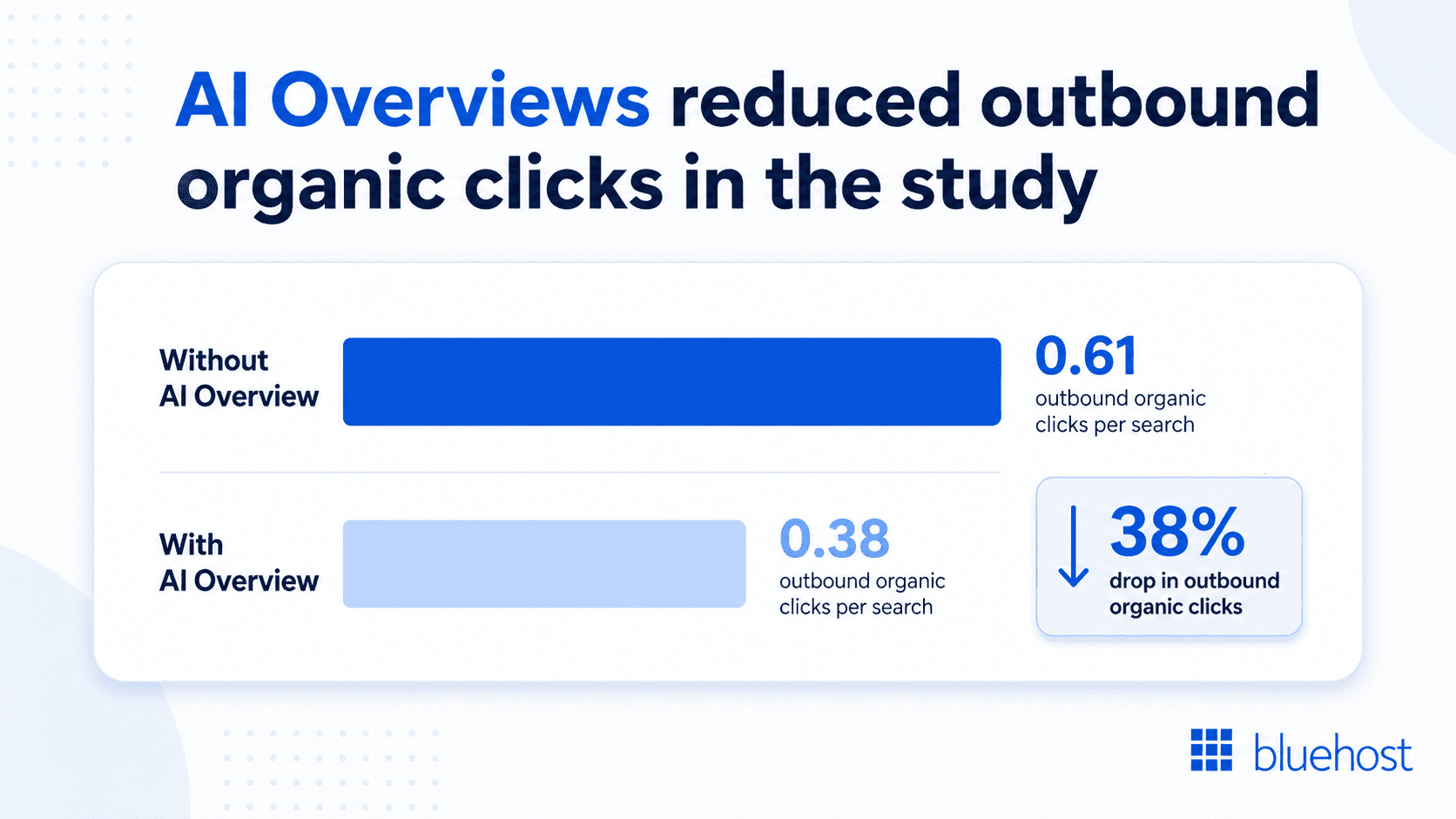
The traffic shift was clear. For queries that triggered an AI Overview, average outbound organic clicks fell from 0.61 to 0.38 per search. That works out to a 38% drop in clicks to external websites.
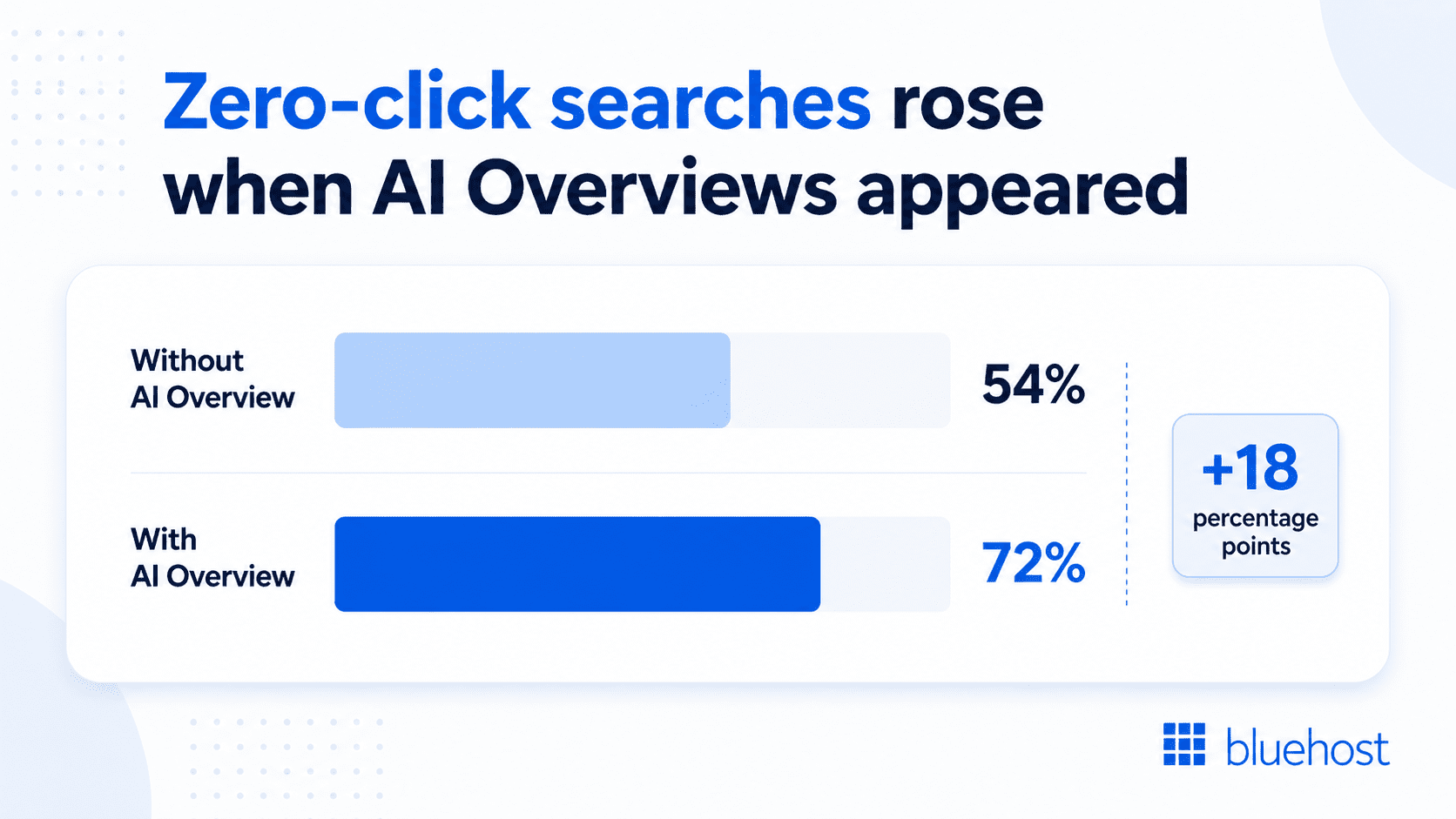
Zero-click searches rose too. When an AI Overview appeared, the chance that a user would not click any external organic result increased from 54% to 72%.
Based on findings from Google AI Overviews and Publisher Traffic, AI Overviews led to a 38% drop in outbound organic clicks.
For publishers, marketers and website owners, this is the core concern Bluehost sees. AI Overviews are not just changing what users see at the top of search. They are changing whether users move beyond the search results page at all.
That does not always mean users are unhappy. In many cases, it may mean the AI Overview gave them enough information to stop searching. But that is exactly why the finding matters. A search can feel complete for the user while still sending fewer visits to the websites that helped make the answer possible.
For site owners, that is the shift to watch. If useful content helps power the answer but does not earn the visit, organic search becomes less predictable. AI Overviews are no longer just a search feature. They are becoming a traffic distribution issue.
Position matters: AI Overviews have the biggest impact when they appear first
The next finding adds important nuance to the traffic story. The report does not suggest that every AI Overview affects clicks in the same way. Its impact depends heavily on where the AI summary appears on the results page.
Why Position 0 changes the search journey
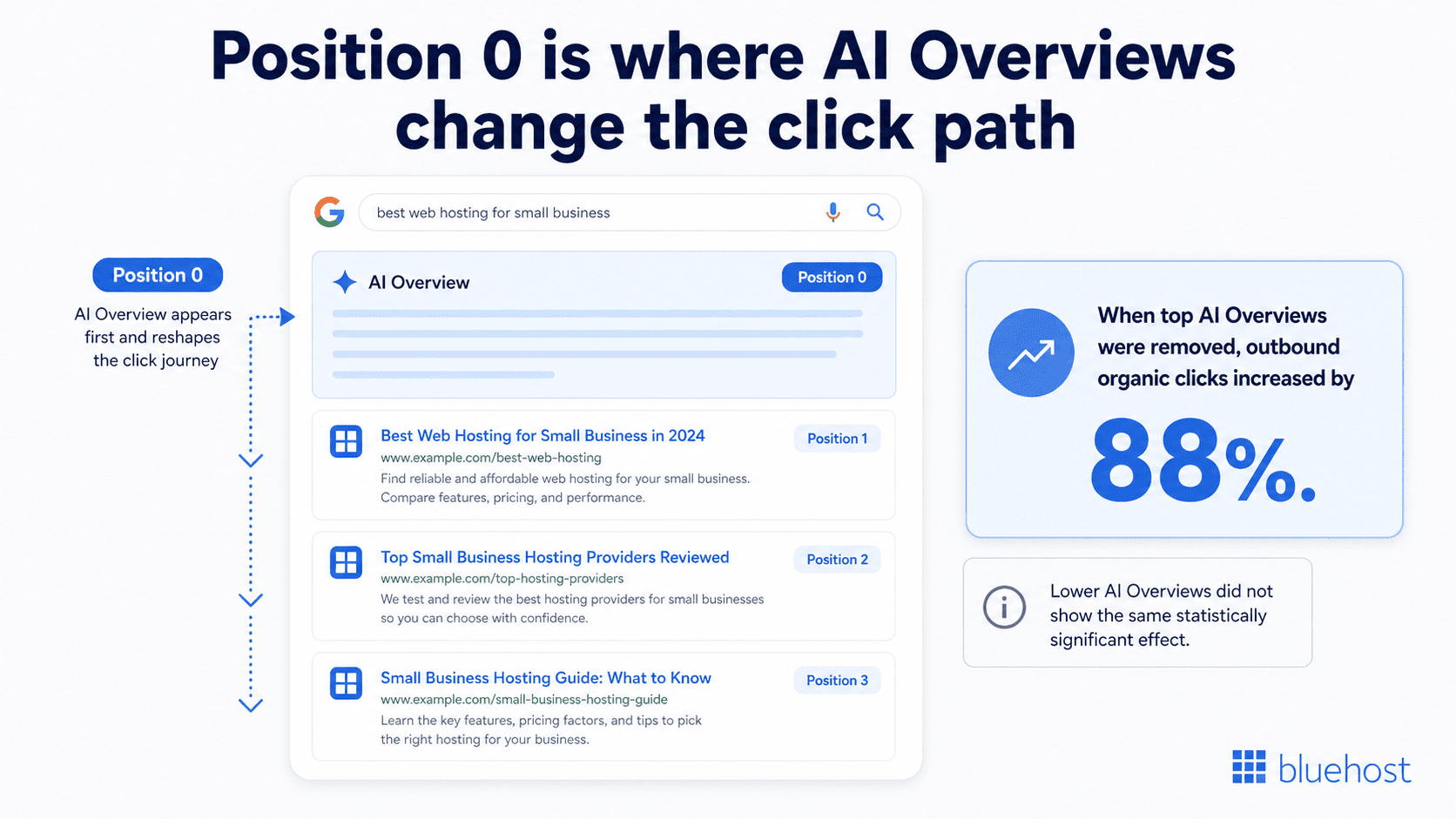
According to the working paper, more than 80% of observed AI Overviews appeared above all organic results, making them the first major answer many users saw on the search results page.
That placement matters. When an AI Overview appears first, it becomes the first answer a user sees. Before the user reaches the top organic result, they may already have a summary, context and enough information to stop searching.
For website owners, this changes the old search path. A page may still hold the first organic ranking, but it is no longer necessarily the first result a user sees or engages with.
What happened when top AI Overviews were removed
The report found a sharp difference when these top-of-page AI Overviews were removed. Outbound organic clicks to external websites increased by 88%.
That is one of the clearest signals in the study. It suggests that the AI Overview is not just sitting above the results as an extra feature. In many cases, it may be absorbing clicks that would otherwise go to external websites.
At Bluehost, we see this as a critical distinction for SEO teams. The issue is not only whether a page ranks well. It is whether that ranking sits below an AI-generated answer that has already satisfied part of the user’s intent.
Lower AI Overviews did not behave the same way
The report also found that placement lower on the page did not have the same effect. When an AI Overview appeared below some organic results, it had no statistically significant impact on user click behavior.
That detail matters because it keeps the finding precise. The traffic concern is not simply that AI Overviews exist. It is that they often appear first, before the organic listings that publishers and businesses have spent years trying to earn.
In other words, the top placement turns AI Overviews from a search enhancement into a possible traffic gatekeeper.
Top-ranking pages may feel the impact first
The report also found that the loss of traffic was concentrated among the highest-ranked organic links. Results in positions 1, 2 and 3 saw the largest increase in clicks when the AI Overview was removed.
That finding challenges one of SEO’s oldest assumptions: that ranking in the top three reliably translates into the strongest traffic advantage.
It does not mean top rankings no longer matter. They still do. But when an AI Overview appears above them, top-ranking pages may be more exposed to click loss. That is because, in a traditional search layout, these pages are most likely to receive the user’s attention.
For SEO teams, the takeaway is clear. Ranking reports now need context. A page can hold a top-three position and still lose clicks if an AI Overview appears first. The next step is to measure rankings, click-through rates and AI Overview presence together, not separately.
What users did next: Fewer clicks did not mean more searches
The report’s next set of findings looks beyond the first click. If AI Overviews reduce outbound traffic, one possible explanation is that users might search more often, explore more queries or shift their attention to paid results.
The working paper does not find that kind of offset.
AI Overviews did not increase search frequency
According to the report, there was no meaningful difference in the total number of searches conducted by users with or without AI Overviews.
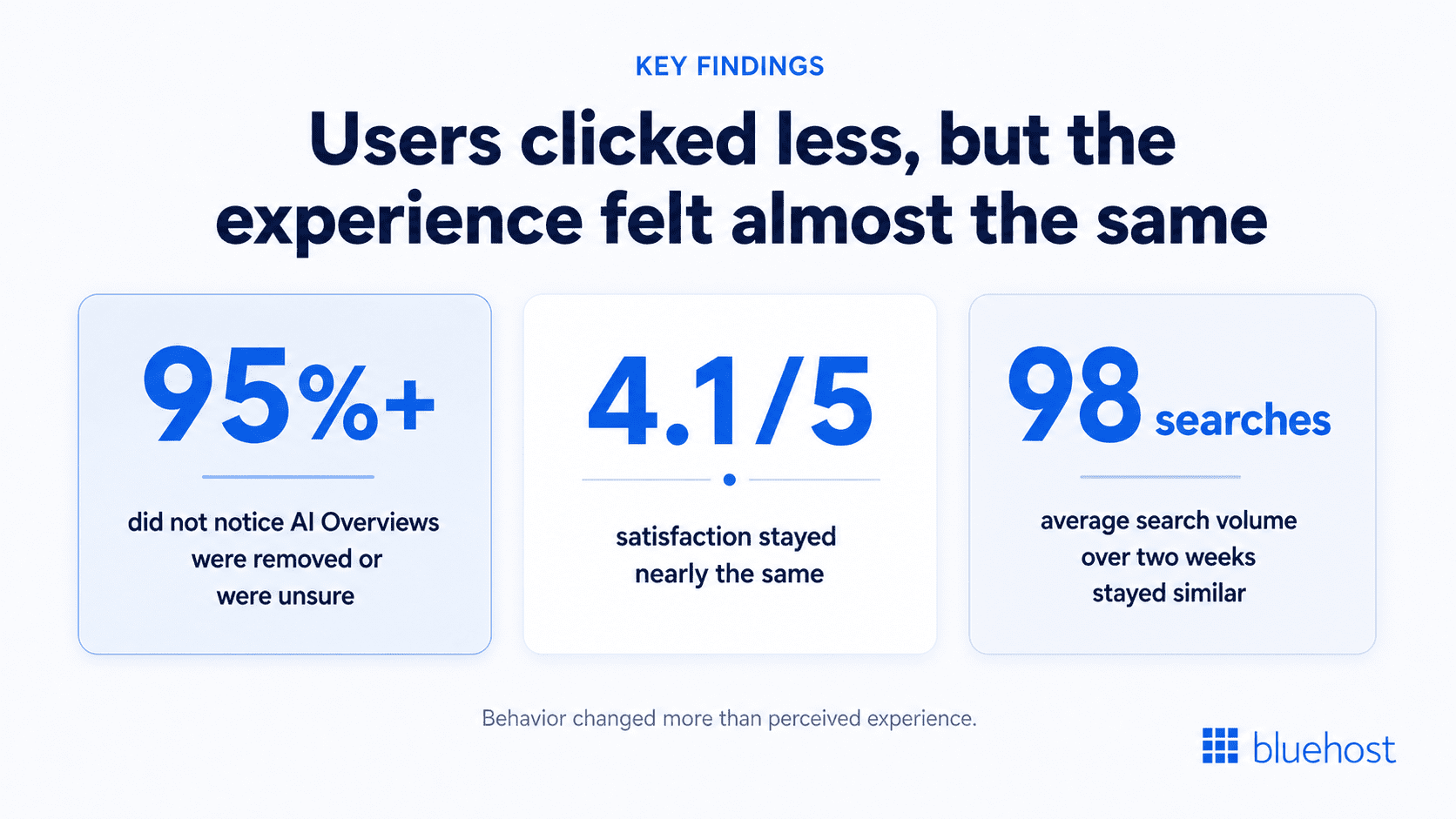
Users averaged about 98 searches over two weeks, regardless of whether AI Overviews were visible or hidden.
That matters because it weakens the idea that AI Overviews reduce clicks on one search but encourage more browsing overall. From Bluehost’s reading of the findings, the pattern is more direct: users clicked fewer organic results, but they did not appear to compensate by searching more often.
For publishers and website owners, that makes the traffic concern harder to dismiss. If clicks fall and search volume does not rise, the pool of available organic visits may shrink for the queries where AI Overviews appear.
Paid links did not see a clear lift either
The report also found no significant change in clicks on sponsored links when AI Overviews were present.
That means the click loss did not appear to shift clearly from organic results to paid ads. In the study, AI Overviews did not create a measurable “halo effect” for sponsored listings.
For SEO and marketing teams, this is another important signal. The issue is not simply that users are moving from organic results to ads. The report suggests that, in many cases, users may be leaving the results page without clicking any external link at all.
Users barely noticed when AI Overviews were removed
The most surprising finding may be how little users seemed to notice the absence of AI Overviews.
In the group where AI Overviews were hidden, more than 95% of users either did not notice they were gone or were unsure whether anything had changed.
That finding adds a sharp twist to the traffic story. AI Overviews may reduce clicks to external websites, but users in the study did not appear strongly aware of whether the feature was present.
At Bluehost, we find this especially important because it separates user behavior from user awareness. Users may click less when AI Overviews appear, even if they do not consciously register the feature as a major part of their search experience.
Satisfaction stayed nearly the same
The report also found nearly identical satisfaction scores across users who saw AI Overviews and users who did not.
On a five-point scale, users reported overall satisfaction at about 4.1, while ease of finding information stayed around 4.0, regardless of whether AI summaries were visible.
That does not mean AI Overviews have no value. But it does suggest that, in this study, the traffic impact was clearer than the satisfaction gain.
For website owners, this is the key tension: AI Overviews may reduce the need to click without making users feel dramatically more satisfied. A search can feel normal to the user while sending fewer visits to the open web.
AI Mode may deepen the zero-click pattern
The working paper also includes exploratory data on a fully conversational, Gemini-powered AI Mode.
In that environment, the probability of a zero-click search rose to about 70%. That suggests conversational search interfaces could push the same trend further by keeping more of the search journey inside the AI experience.
But the report also adds an important caveat: users in AI Mode reported lower satisfaction, around 2.9 out of 5, compared with the traditional search interface.
That makes the future less settled than it may appear. AI Mode may reduce external clicks more sharply, but it still has to prove that users prefer the experience.
For SEO teams, the lesson is not to panic over one interface. It is to prepare for a broader direction in search: more answers may appear before the click, and websites will need to work harder to earn visits after users receive an AI-generated summary.
Also read: Future of Google Search: Sundar Pichai on AI Mode and Agentic Search
Bluehost insight: The next SEO advantage is earning the click after the answer
The working paper points to a shift that website owners should take seriously: AI Overviews are changing website traffic, and they are also changing what a click has to prove.
For years, SEO strategy was built around visibility. If a page ranked high enough, traffic usually followed. But the report suggests that this relationship is becoming less predictable. A page can still rank in the top three and lose attention if an AI Overview appears above it. A user can still find the answer useful and never leave Google. A search can feel complete without creating a website visit.
At Bluehost, we see this as the beginning of a new SEO challenge: Websites now have to compete for the second click, not just the first impression.
The first answer may happen on Google
AI Overviews are designed to satisfy the initial query quickly. That means the basic answer, definition or summary may increasingly happen before the user reaches a website.
For site owners, this changes the job of content. A page cannot rely only on answering the first question. It has to help with the next one.
A user may already know what something means after reading an AI Overview. But they may still need help choosing a product, comparing options, setting something up, solving an error, understanding trade-offs or taking action. That is where websites can still win.
The opportunity is to build content that starts where the AI summary stops.
Ranking high is no longer the full measure of success
The report’s findings on top-ranking pages are especially important. If positions 1, 2 and 3 are most exposed when AI Overviews appear above the results, then SEO teams need to rethink how they evaluate performance.
A top-three ranking may still look strong in a ranking report. But if clicks are falling, the page may be losing practical visibility.
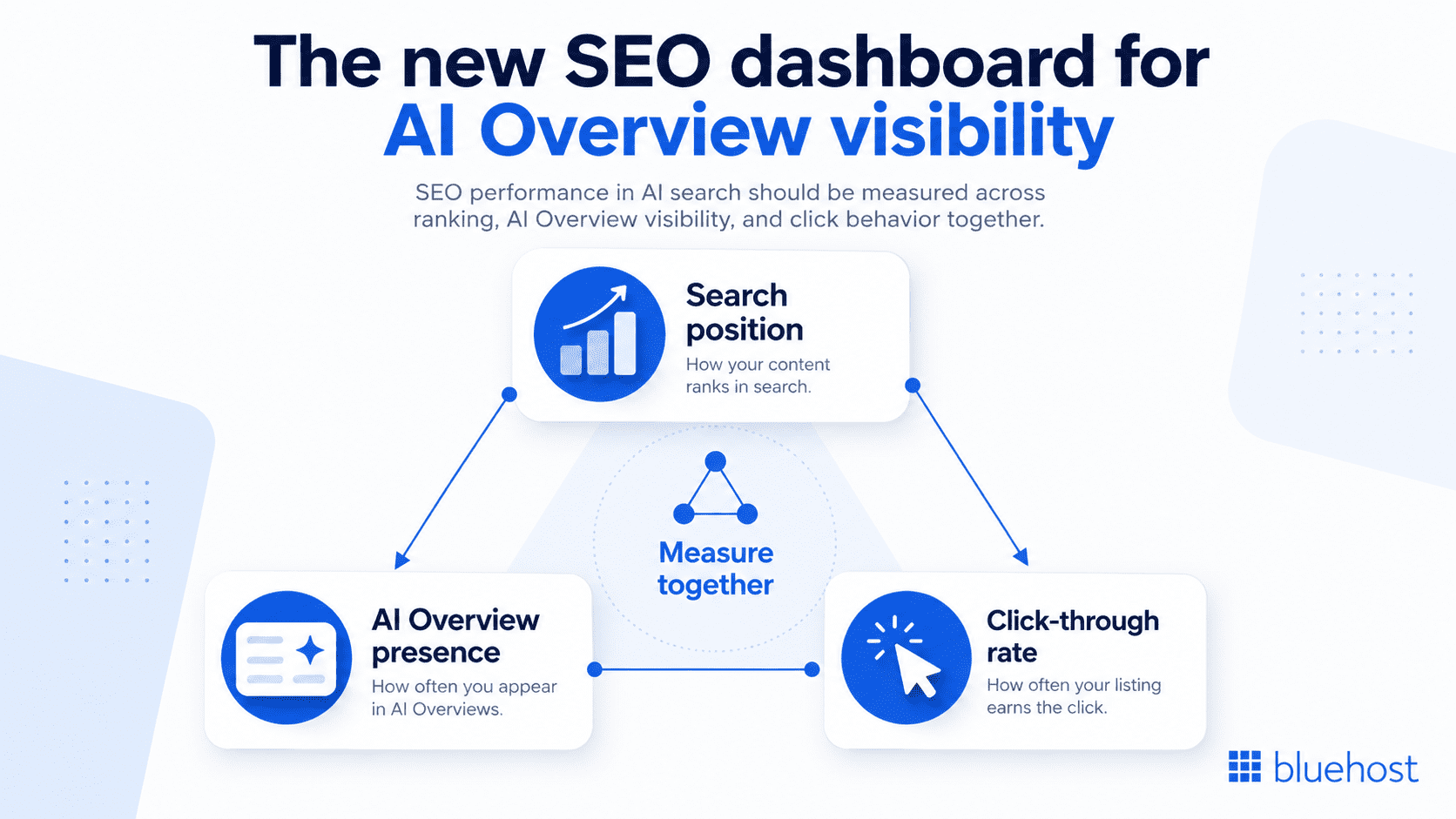
That means the next SEO dashboard should not treat rank as the final win. It should connect three things:
- Search position.
- AI Overview presence.
- Click-through rate.
When those three metrics are viewed together, the picture becomes clearer. A page that ranks first but loses clicks may need a stronger reason to visit. A page in position 4 that still earns clicks may reveal deeper user intent that the AI Overview did not fully satisfy.
The content that wins will be harder to summarize
The report’s findings suggest that simple informational content is most vulnerable. If a page mainly provides a short explanation, an AI Overview may be able to satisfy that need directly on the results page.
That does not make informational content useless. It means basic information needs to become more useful.
The strongest pages will offer something harder to compress into a short AI answer: original examples, first-hand experience, comparison tables, expert analysis, screenshots, checklists, templates, calculators, product workflows and decision support.
For a small business website, this could mean turning a basic “what is” article into a practical guide. For an eCommerce site, it could mean adding comparison-led buying advice. For a service business, it could mean explaining costs, timelines, use cases and common mistakes in more detail.
The goal is not simply to write longer content. The goal is to create a page that remains worth visiting after the user has already seen a summary.
Direct audience building becomes part of SEO resilience
The report also found that fewer organic clicks were not offset by more searches or a clear lift in paid clicks. That makes one lesson hard to ignore: businesses cannot treat Google traffic as the only path to audience growth.
Search will remain important. But SEO resilience now depends on what happens after the first visit.
Website owners should use organic traffic to build direct relationships through email lists, downloadable resources, communities, customer portals, repeat-use tools and brand-led content. The more users remember and return to a site directly, the less exposed that site becomes to changes in the search results page.
At Bluehost, we see this as a practical shift from traffic capture to audience ownership. A search visit should not be treated as a one-time win. It should become the start of a relationship that can continue outside the search result.
The new SEO test: Why should users go deeper?
AI Overviews are not making websites irrelevant. They are making shallow content easier to ignore.
If Google can answer the first question on the results page, your website has to answer the next one better than anyone else. That means original insight, real experience, useful comparisons, practical tools and clear next steps.
The old SEO goal was to rank first.
The new goal is harder: be worth visiting even after the answer appears.
That is the real question for every website owner now:
If Google gives users the summary, what reason does your site give them to go deeper?

Write A Comment