 ChatGPT,
 Claude,
 Gemini,
 Grok — all four for
For a while now, the digital world has been full of the same refrain: search is changing. But much of that conversation has stayed vague. Athena’s State of AI Search 2026 report gives that shift something more concrete. It shows, at scale, how AI is changing the way visibility is earned online.
Drawing on millions of responses across six AI models over six months, and using a 1 million response cap per model after Athena found that larger sample sizes did not materially alter the pattern, it shows how AI is changing the way visibility is earned online.
The clearest takeaway is that search is no longer just about ranking on a results page and waiting for the click. It is increasingly becoming a system where AI engines decide which brands, sources, and pieces of content are worth pulling into the answer itself. That is a major shift, and it helps explain why so many familiar SEO assumptions are starting to feel less stable.
This article explores what that shift actually looks like in practice. Drawing on Athena’s research, it explores how AI search is reshaping visibility, what kinds of content these systems appear to trust and why brands now need to think beyond rankings alone if they want to stay discoverable.
To understand what that shift really means, it helps to look at the patterns Athena’s data brings into focus.
Methodology
This article is based on findings from Athena’s State of AI Search 2026 Q1 report. The analysis section draws directly from Athena’s published data and benchmarks to interpret how AI search is reshaping visibility, source trust and content preference. The strategic recommendations in the “Bluehost playbook” section are our own interpretation of those findings and are intended as an original response framework for brands adapting to this shift in search.
What Athena’s data reveals about AI search visibility
The broader AI search landscape points to one clear pattern: visibility is concentrating around a much smaller group of brands. As Athena’s State of AI Search 2026 Q1 report shows, the average brand appears in just 17.24% of prompts, while top players reach 56.71%. That is a wide gap, and it shows that AI search is not spreading attention evenly. It is favoring a smaller set of brands that it appears to trust more consistently.
This is what makes generative visibility feel so different from traditional search. In a ranking-based system, several brands can still compete across a page of results. In an answer-based system, the leaders take a much larger share of the attention.
1. Brand websites still matter, but they are not enough
Further in the report, we learn that AI cites a brand’s own domain in 14.98% of responses on average. That points to two realities at once: brand-owned content still matters, but AI is building answers from a much broader mix of sources.
For brands, that means publishing on your own site is only part of the job. On-site authority, technical structure and clear content architecture still matter, but visibility also depends on how your brand appears elsewhere online.
2. Blogs are becoming key AI entry points
The same report also shows that when AI enters a brand’s site, it most often lands on the /blog, which accounts for 44.59% of entry paths. That is far ahead of /home at 19.07% and /products at 13.33%.
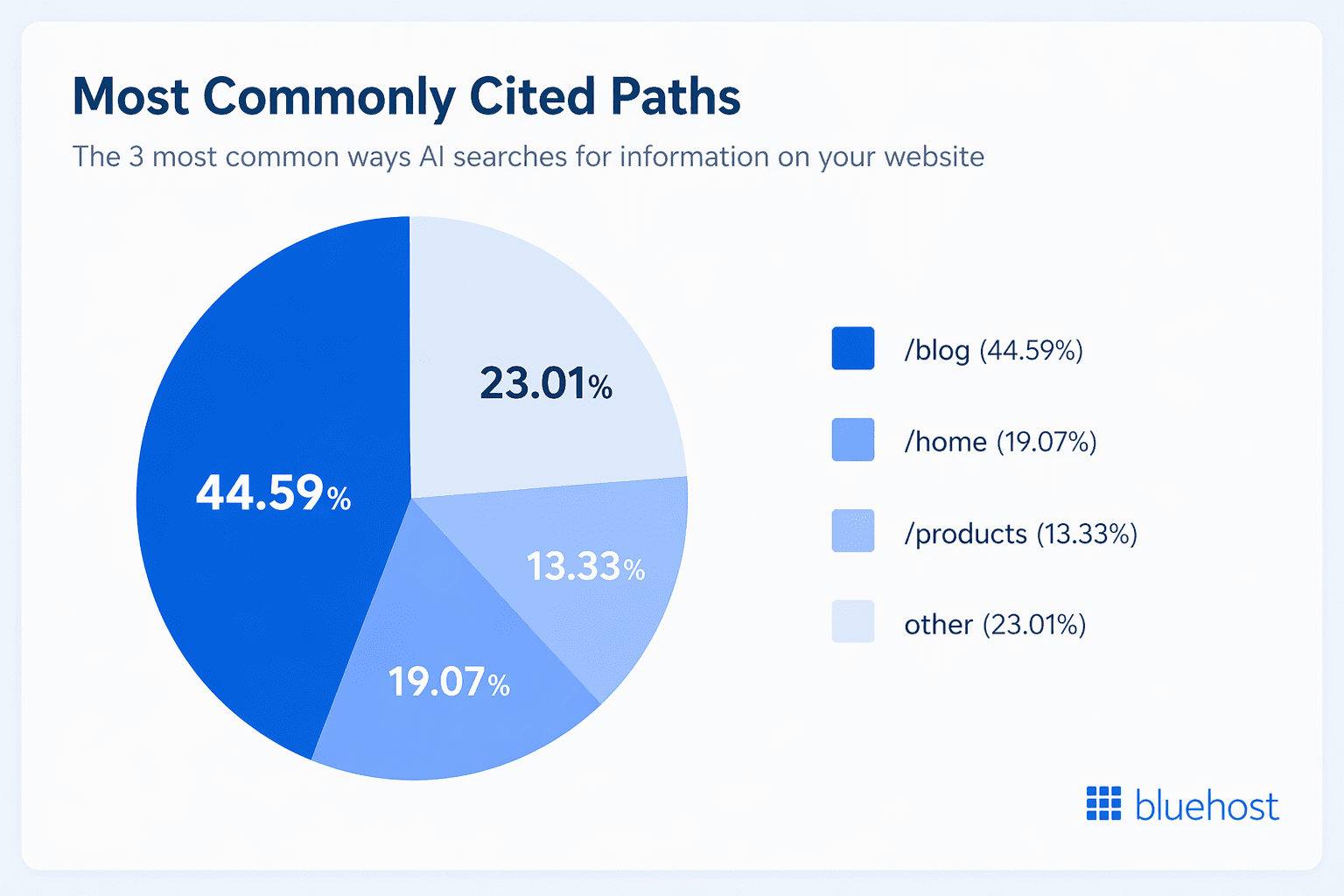
That matters because it shows AI is looking for pages that explain and unpack ideas, not just pages that sell. Strong editorial hubs, useful articles and clear navigation are becoming more important in generative search.
3. AI favors content that helps people decide
Athena’s data also shows a clear pattern in content intent. Informational content leads at 34.28%, followed by Comparative/Selection at 23.82% and Acquisition/Obtaining at 16.44%.
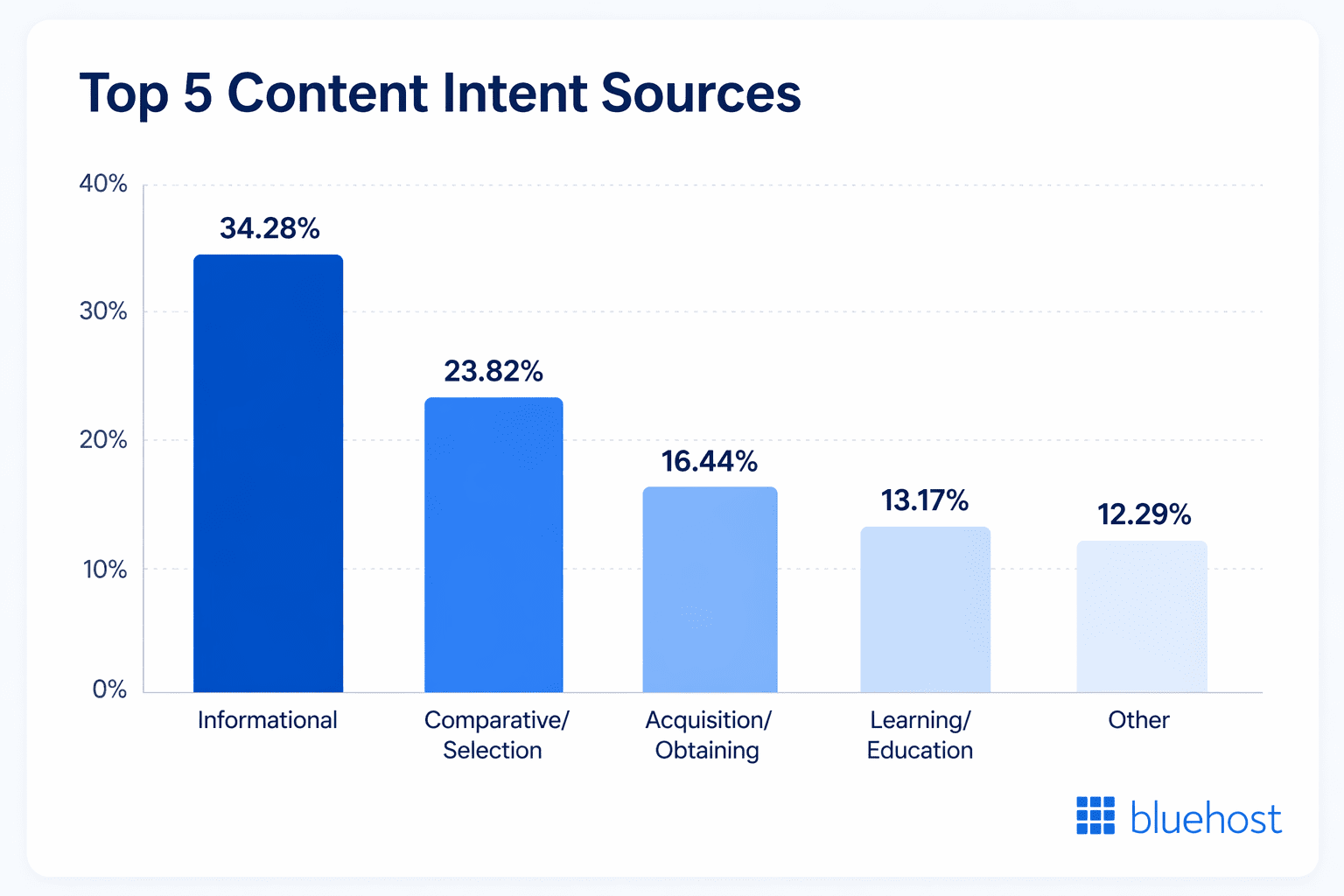
That mix tells us something important. AI search leans most heavily on content that educates, compares and supports decisions. Pure marketing language is less useful in this environment because AI systems seem to reward content that helps users make sense of their options. For brands, that raises the value of explainers, comparison pages, practical guides and other content built to inform real choices.
Taken together, these patterns do more than show what AI search prefers. They reveal a visibility model that is changing what brands need to do to stay discoverable.
What the new visibility landscape means for brands
For brands, Athena’s benchmark data sharpens the picture further. It shows that the new visibility landscape is not just changing. It is becoming more concentrated, more dependent on external sources and more fragmented across AI models.The benchmark chart brings those shifts into sharper focus. It shows not just that AI search is changing, but how that change is taking shape.
1. The visibility gap is steeper than it looks
The chart also makes clear that AI visibility is not distributed evenly. The top-ranked brand holds an average share of voice of 32.39%, while the second drops to 19.17% and the third to 13.68%.
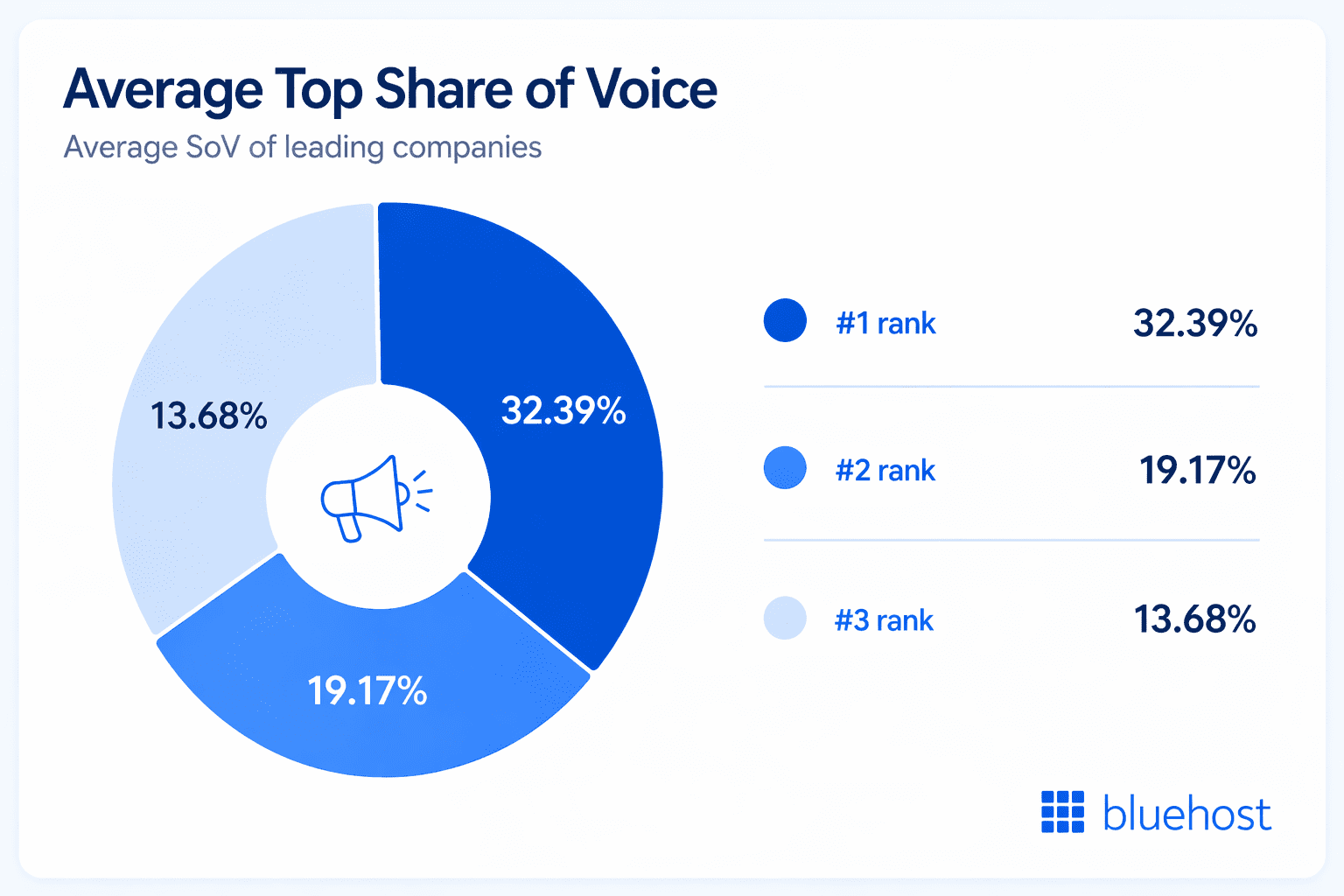
That is a sharp fall. It suggests that once a brand becomes a preferred source in AI search, it can move well ahead of the rest of the field. In an answer-driven environment, there is less room to be one of many options.
For brands, that means AI visibility is becoming harder to win incrementally. Once a competitor becomes a preferred source, catching up may require more than small SEO improvements.
2. Trust is being built across external ecosystems
The chart also shows where AI gets its supporting evidence from. The top cited external source is Reddit at 22.99%, followed by YouTube at 14.53%, Wikipedia at 6.41%, Forbes at 4.70% and LinkedIn at 4.02%.
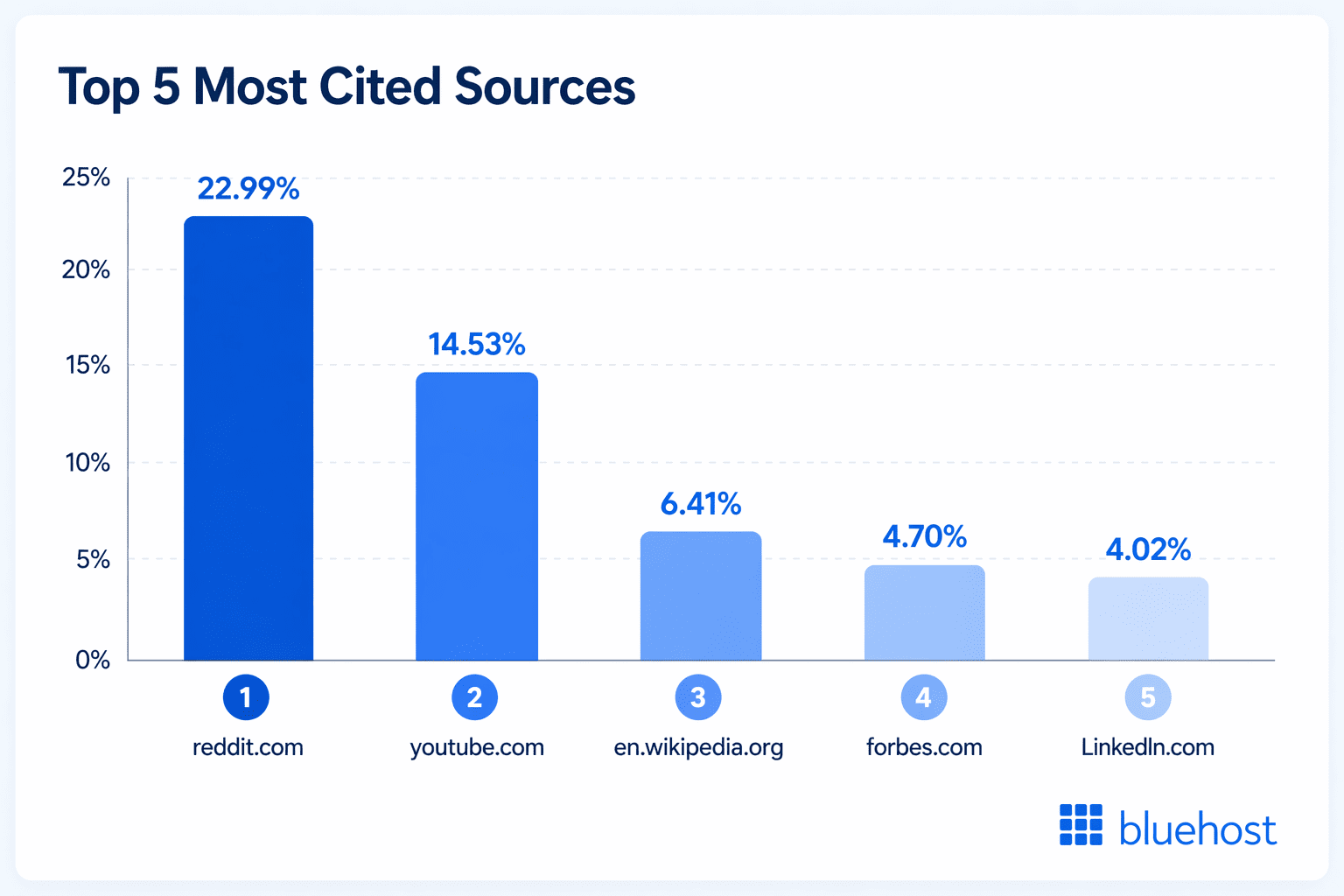
This shows that AI is not relying only on official brand websites. It is drawing from community discussion, expert perspectives, public reference sources and editorial coverage to build answers. That changes how authority works. A brand’s visibility now depends not only on what it publishes on its own site. It also on how it appears across the broader web.
3. AI models do not all build answers the same way
Athena’s State of AI Search 2026 Q1 report adds another important layer here: different AI models draw on very different numbers of sources when building a response. Grok leads at 16.05 distinct domains per response, followed closely by ChatGPT at 15.07. Google AI Search sits in the middle at 11.62, while Gemini and Perplexity are more selective at 9.96 and 9.53 respectively. Across all models, the average sits at 11 source citations per response.
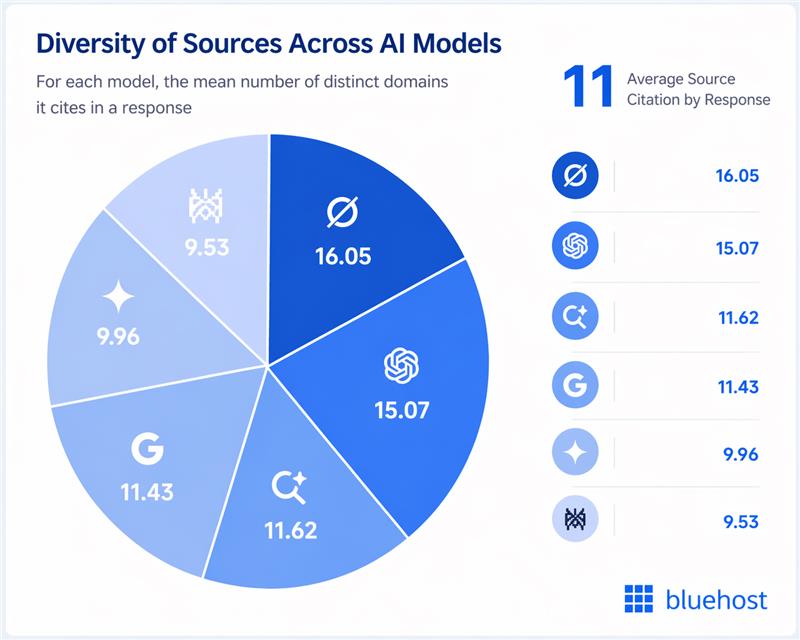
That spread matters because it shows there is no single AI search formula. Some models build answers from a broader pool of sources, while others rely on a narrower set. For brands, that makes AI visibility a cross-model challenge. A strategy that improves visibility in one system may not translate cleanly to another, which means discoverability now depends on building content that travels well across multiple AI environments.
These patterns do more than describe a new search environment. They point to the need for a different kind of visibility strategy, one built for how AI systems now surface and assemble information.
A brief Bluehost playbook for the new rules of search visibility
After studying Athena’s State of AI Search 2026 Q1 report, Bluehost’s view is clear: if AI search is shifting visibility from rankings to answer inclusion, then the old SEO playbook is no longer enough on its own.
Rankings still matter, but they no longer tell the full story. A page can rank well and still be absent from the answers people actually see.
That is why brands need a broader way to think about discoverability now, and why this brief Bluehost playbook focuses on what to measure beyond traditional SEO.
As Krinal Mehta, SEO Director at Bluehost, puts it: “In AI search, the citations users see are only part of the picture. What matters is whether your content is clear enough to be retrieved and understood, and whether the broader web reinforces it strongly enough to trust. The brands that win will combine clarity on-site with consensus off-site.”
That idea sits at the heart of the Bluehost playbook below: Brands need to strengthen both what they publish on-site and how they are validated across the wider web.
1. Stop treating rankings as the whole goal
Traditional SEO trained teams to chase position. In AI search, position matters less than inclusion. The real question is not just whether your page ranks, but whether your brand, insight or explanation is being pulled into the answer.
That means success can no longer be judged only by keyword positions. Brands need to look at whether they are showing up in AI-generated responses at all, and how often they are being surfaced compared with competitors.
What to measure instead:
- Brand mentions in AI answers
- AI share of voice across priority prompts
- Presence in high-intent generative responses
2. Build for citation, not just for clicks
The old model assumed the main job of content was to win the click. AI search changes that. Now content also needs to be easy to extract, trust, and cite.
That raises the bar for structure. Strong pages are no longer just optimized pages. They are pages with clear claims, direct answers, visible expertise and a format that makes information easy for AI systems to interpret.
What to measure instead:
- Citation frequency of your domain in AI outputs
- Which pages are being cited most often
- Whether key pages are being cited accurately and consistently
3. Treat blogs as strategic infrastructure, not support content
For years, many brands treated blogs as secondary content. Athena’s data suggests that view is now outdated. If blogs are the most common on-site entry point for AI systems, then editorial content is not peripheral. It is part of the core visibility engine.
This changes the job of the blog. It is no longer just a publishing channel for awareness. It is where brands can explain concepts, frame comparisons, answer nuanced questions and build the kind of context AI systems rely on.
What to measure instead:
- Blog-level citations and mentions
- Which educational articles appear most often in AI answers
- Entry-point performance of editorial pages versus product pages
4. Expand authority beyond your own site
Traditional SEO often treated authority as something built mainly through backlinks and on-site strength. AI search is broader than that. The report makes clear that external ecosystems like Reddit, YouTube, Wikipedia, LinkedIn and publisher platforms are shaping how answers get assembled.
That means brands need to think beyond owned media. Visibility now depends in part on whether your brand shows up in the places AI models appear to trust when they synthesize information.
What to measure instead:
- Brand presence across high-trust external platforms
- Frequency of third-party mentions in AI-cited ecosystems
- Sentiment and depth of discussion around your brand outside your site
5. Match content to decision stages, not just keywords
One of the clearest findings in the article is that AI search leans toward informational and comparative content. That should change how content is planned. Many SEO programs still over-prioritize keyword coverage and under-prioritize decision support.
In AI search, content wins when it helps people understand, compare and evaluate. Brands should build around real decision journeys, not just search volume.
What to measure instead:
- Coverage across informational, comparative and acquisition intent
- Visibility by decision stage, not just by keyword cluster
- Competitive gaps in comparison, alternatives and explainer content
6. Optimize for model diversity, not one search behavior
Traditional SEO was built around learning the logic of a few search engines. AI search is more fragmented. As the data shows, different models rely on different numbers of sources and build answers in different ways. That means there is no single optimization playbook that works everywhere.
The better strategy is to build content that travels well across systems. Use clear structure, strong sourcing and consistent terminology. Add useful explanations and enough depth to support retrieval across models with different behaviors.
What to measure instead:
- Visibility across multiple AI platforms, not just one
- Differences in citations and mentions by model
- Consistency of brand inclusion across ChatGPT, Grok, Google AI Search, Gemini and Perplexity
The future of search belongs to trusted sources
The bigger shift here is not just tactical. It is philosophical. For years, traditional SEO was built around one question: how do we rank? AI search is replacing it with a more demanding one: why should this source be trusted enough to shape the answer?
That question changes everything. It changes how visibility is earned, how authority is built and how content needs to perform in a world where AI systems increasingly decide what gets surfaced first. As the Athena report makes clear, visibility is becoming more concentrated. Trust is also spreading across a wider web of sources. At the same time, answer inclusion is starting to matter as much as, and sometimes more than, the click itself.
The brands most likely to stay discoverable will not be the ones chasing every ranking signal the longest. They will be the ones that become easiest to trust, easiest to cite and hardest to ignore. In the next era of search, the real winners may not be the pages that rank highest, but the sources that become part of what the internet says is true.
In the age of AI search, the most valuable position may no longer be number one. It may be becoming the source the answer cannot be built without.

Write A Comment