


Key highlights
- Discover how the benefits of cloud hosting keep your site online even during unexpected traffic spikes.
- Learn why enterprises already use cloud services and how small businesses are following fast.
- Explore ten core advantages of cloud hosting including uptime, speed, scalability, security and sustainability.
- Understand how cloud hosting cuts infrastructure costs by 40–60% while improving performance.
- See how Bluehost Cloud helps businesses scale confidently with predictable pricing and 24/7 expert support.
Did you know that just one minute of website downtime can cost an average business over $5,600? Imagine your marketing campaign goes viral, but instead of record sales, your site crashes under the pressure, sending frustrated customers straight to your competitors.
You can protect your company from security risks by using the benefits of cloud hosting.
By leveraging the strategic benefits of cloud hosting, you transform your website into a resilient powerhouse. This decentralized network of servers ensures that if one fails, another instantly takes over, providing fast, reliable experiences for every visitor without the massive enterprise price tag.
In this article, we’ll explore how this resilient infrastructure is essential for maintaining a competitive edge and driving business growth through 2026.
What is cloud hosting and why businesses choose it?
Cloud hosting stores your website data across a network of connected cloud hosting servers rather than on a single physical server. Think of it as having multiple backup generators for your business instead of relying on one power source.
When one server experiences issues, another automatically takes over. This redundancy eliminates the single point of failure that impacts traditional hosting solutions.
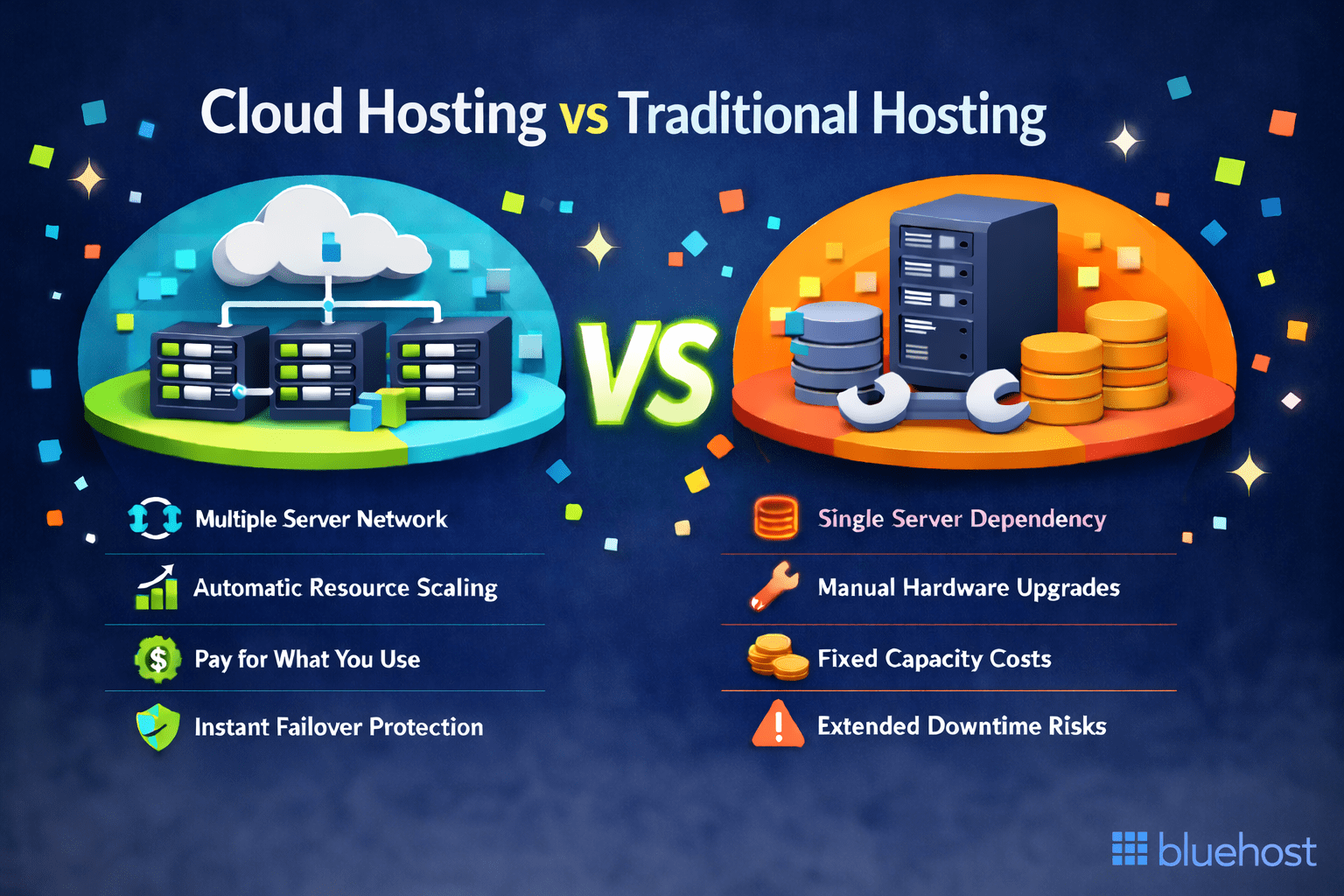
Here’s what makes cloud hosting different:
- Multiple server network vs single server dependency
- Automatic resource scaling vs manual hardware upgrades
- Pay-for-what-you-use pricing vs fixed capacity costs
- Instant failover protection vs extended downtime risks
In recent cloud computing surveys highlighted by CloudZero:
- Over 90% of enterprises now use cloud services, with small businesses rapidly following suit as adoption continues to accelerate across industries.
- 60% of organizations run more than half of their workloads in the cloud, reflecting the growing reliance on scalable, enterprise-grade cloud computing environments at cost-effective pricing.
The reason is simple! Cloud service providers deliver enterprise-grade cloud computing environment at small business prices, unlike third party providers offering limited solutions.
Top 10 benefits of cloud hosting for your business
Cloud hosting delivers measurable advantages across reliability, performance and cost efficiency. These benefits directly impact your bottom line through improved uptime, faster loading speeds and reduced operational expenses.
The following table summarizes the core advantages of cloud hosting that make it essential for growth-oriented businesses:
| Benefit | Impact | Business value |
| High network uptime | Eliminates planned downtime | Protects revenue streams |
| Automatic scaling | Handles traffic spikes instantly | Supports business growth |
| Cost efficiency | Pay-as-you-grow pricing | Reduces infrastructure costs 40-60% |
| Superior performance | Lightning-fast load times | Improves conversion rates |
| Disaster recovery | Multi-location backups | Ensures business continuity |
| Enterprise security | Advanced threat protection | Reduces security incident costs |
| Global reach | Worldwide content delivery | Enables international expansion |
| Remote collaboration | Anywhere access data capabilities | Increases team productivity by 25% |
| Environmental impact | 65% carbon footprint reduction | Supports sustainability goals |
| Expert support | 24/7 technical assistance | Eliminates IT staffing needs |
These cloud hosting benefits tackle common business challenges and drive operational efficiency. Let’s examine how these advantages translate into real-world business outcomes.
1. Guaranteed reliability and uptime (99.99% availability)
Downtime devastates business operations more than most owners realize. For small businesses, downtime typically costs between $137 and $427 per minute.
In contrast, larger enterprises can face downtime expenses typically $300,000–$1M+ per hour for mid-to-large enterprises, even during brief outages. Every second of unavailability sends customers directly to competitors who remain accessible.
How cloud hosting achieves superior reliability:
Cloud hosting solves this critical vulnerability through redundant cloud servers that operate seamlessly together. Unlike traditional hosting that relies on a single physical server, cloud hosting uses multiple servers to automatically assume the workload without manual intervention or service interruption. This failover process happens instantly and invisibly to your customers.
2. Instant scalability for traffic spikes
Cloud hosting scalability means your hosting provider infrastructure adapts automatically to changing traffic demands. It can scale computing resources up or down in real-time without service interruptions. This flexibility ensures optimal server performance during both peak and low-traffic periods.
Also read: Website Performance: Handling High Website Traffic
Real-time scaling advantages:
- Instant resource adjustment based on actual demand
- Zero service interruptions during scaling events
- Automatic system response without capacity planning requirements
- Usage-based billing that aligns costs with actual demand
3. Pay-as-you-grow cost efficiency
Cloud hosting transforms IT spending from unpredictable capital expenditure to manageable operational expenditure. You pay for cloud resources you actually utilize instead of maintaining expensive physical infrastructure that sits idle during off-peak periods.
The pay-as-you-scale model aligns infrastructure costs directly with business growth. Start with basic resource allocation and expand automatically as your business develops. No more paying for unused server space or making emergency hardware purchases during traffic surges.
Cost structure benefits:
- Operational expenses align with business growth
- No upfront hardware and software resource investments required
- Reduced IT staffing needs and maintenance costs
- Predictable monthly billing based on actual usage
4. Superior performance and speed
Performance optimization in cloud hosting delivers faster page loading speeds through distributed infrastructure and global content delivery networks. Unlike dedicated hosting that relies on single-server resources, cloud infrastructure leverages virtual servers distributed globally for optimal speed.
Superior performance directly correlates to higher conversion rates, improved search engine rankings and enhanced user satisfaction.
Page loading speed directly impacts your bottom line. A one-second delay in page load time reduces conversions by 7%. Cloud hosting delivers the performance needed to maximize sales and user satisfaction.
Performance advantages:
- Global CDN reduces latency worldwide
- Optimized WordPress infrastructure for maximum compatibility
- Geographic distribution serves content from nearest locations
5. Automatic disaster recovery and backups
Disaster recovery in cloud hosting provides automatic data storage protection and business continuity without additional configuration. Your data replicates across multiple geographic locations, ensuring recovery from any type of failure or disaster with minimal business disruption.
The global average cost of a data breach is $4.4 million USD, marking a 9% decrease compared to the previous year. Cloud hosting provides automatic disaster recovery and backup systems that operate continuously in the background. You never need to worry about losing critical business data or website content.
Disaster recovery features:
- Geographic data replication across multiple locations
- Automatic failover to backup systems
- Continuous background protection without manual intervention
- Rapid recovery times measured in minutes, not hours
6. Enterprise-grade security without enterprise costs
Cybersecurity threats cost small businesses an average of $254,445 per incident, often forcing closure due to financial impact. Enterprise security typically requires dedicated teams, expensive infrastructure and ongoing monitoring that smaller businesses cannot afford. and ongoing monitoring that smaller businesses cannot afford.
Cloud hosting delivers advanced security features at premium pricing levels. You receive comprehensive protection included in standard cloud hosting services without additional fees or technical expertise requirements.
Built-in security features:
- DDoS protection and attack mitigation
- WAF (Web Application Firewall) security
- Automated security updates and patches
- Continuous threat monitoring
7. Global reach with content delivery networks
Expanding internationally becomes simple with cloud hosting’s global infrastructure. Your business can serve customers worldwide with consistent performance and reliability, eliminating geographic barriers to growth.
Global infrastructure benefits:
- Worldwide data center locations for optimal performance
- Local-speed delivery regardless of business location
- Edge computing capabilities for reduced latency
- International expansion support without physical presence
International visitors experience local-speed performance regardless of your business location. A company based in Chicago can serve customers in London with the same speed as local users, eliminating geographic performance barriers.
8. Enhanced collaboration for remote teams
Collaboration features in cloud hosting enable seamless teamwork from any location with Internet connection. Remote teams can access shared resources without technical barriers, improving productivity and operational efficiency while supporting modern workforce flexibility.
Remote work requires reliable access to business applications and data. Cloud hosting eliminates VPN complications and connection reliability issues that plague traditional hosting infrastructure solutions.
Collaboration advantages:
- Real-time synchronization across devices and locations
- Simplified application integration for unified workflows
- Reliable remote access without VPN complications
Also read: VPS Security Tips and Best Practices to Secure your Server
9. Environmental sustainability and green hosting
Environmental benefits of cloud hosting include reduced carbon footprints through shared infrastructure and renewable energy commitments. Cloud providers achieve energy efficiency that individual businesses cannot match independently, supporting corporate sustainability goals without performance sacrifices.
Cloud hosting reduces carbon footprints by 72% to 98% compared to traditional data centers. Shared infrastructure maximizes energy efficiency across multiple customers, creating environmental benefits at scale.
Sustainability features:
- 65% carbon footprint reduction vs traditional hosting
- Renewable energy commitments from leading cloud providers
- Advanced cooling technologies for energy efficiency
- Shared infrastructure optimization across customers
10. Expert 24/7 support and managed services
Cloud hosting provides immediate access to expert technical teams available 24/7 for assistance. You receive comprehensive support for technical issues, performance optimization and security concerns without internal staffing expenses or expertise gaps.
Support advantages:
- 24/7 priority support with WordPress experts
- Proactive monitoring identifies issues before impact
- Immediate assistance minimizes downtime
- Managed services reduce IT staffing requirements
While these benefits highlight the significant advantages of cloud hosting for modern enterprises, the optimal choice depends on your specific operational needs. To determine if this technology aligns with your goals, you must evaluate these benefits within the context of your unique business requirements and long-term scalability plans.
How to decide if cloud hosting is right for your business?
Evaluating hosting needs requires honest assessment of current requirements, growth projections and organizational capabilities. This strategic framework guides decision-making by examining critical factors that impact long-term success.
- Growth trajectory assessment: Does your business experience seasonal traffic variations or rapid growth? If you experience regular traffic spikes or steady growth exceeding 20% annually, cloud hosting advantages support expansion more effectively than traditional alternatives.
- Budget considerations: Can you shift from capital-intensive infrastructure to a more flexible operating model? Cloud hosting eliminates large upfront hardware costs and reduces maintenance expenses while maintaining performance and scalability.
- Technical requirements: Do you need advanced features like global CDN, automated backups and enterprise security? Cloud hosting includes these features as standard offerings rather than expensive add-ons.
- Migration readiness: Can you migrate during low-traffic periods with minimal disruption? Cloud hosting providers offer migration assistance and tools that simplify the transition process.
Use this checklist to evaluate cloud hosting readiness:
- Website receives over 10,000 monthly visitors
- Business experiences seasonal traffic variations
- Revenue depends on website availability
- Current hosting causes performance issues
- Technical support needs exceed current provider capabilities
- Business plans international expansion
If you checked three or more items, cloud hosting likely benefits your business operations and growth objectives.
With this understanding of whether cloud hosting fits your needs, let’s explore what sets Bluehost Cloud apart from other hosting solutions in the market.
What makes Bluehost hosting different?
Unlike many providers, Bluehost runs all its hosting plans on Oracle Cloud Infrastructure (OCI). This includes Shared Hosting, VPS Hosting, Dedicated Hosting and Bluehost for Agencies. No matter which plan you choose, your website is powered by enterprise-grade cloud infrastructure designed for performance and resilience.
Top features at a glance:
- Free website migration for smooth, hassle-free transfers
- All hosting plans hosted on OCI cloud platform
- Reliable 24/7 customer support from experienced hosting experts
- Jetpack integration for added security, backups and performance
- High-performance NVMe storage for faster data access and improved site speed
- Built-in CDN and advanced caching for optimized performance
As businesses scale and require greater control, dedicated resources and enhanced performance, VPS hosting becomes the next step. Powered by the same Oracle Cloud Infrastructure (OCI), Bluehost VPS provides isolated environments, scalable resources and full root access. This makes Bluehost VPS ideal for growing websites, eCommerce stores and performance-intensive applications that demand consistent speed and reliability.
Final thoughts
Cloud hosting represents the future of web infrastructure for growing businesses. The combination of reliability, performance, security and cost efficiency makes it essential for companies serious about online success. With Bluehost hosting powered by Oracle Cloud Infrastructure, you get enterprise-grade performance across every plan, backed by expert support and seamless scalability.
Ready to unlock the benefits of cloud-powered hosting? Explore Bluehost VPS hosting plans and discover how reliable, scalable infrastructure can support your business growth today and in the future.
FAQs
Cloud hosting provides superior uptime (100%), automatic scaling, enhanced security, global performance and cost efficiency. Businesses benefit from enterprise-grade infrastructure without enterprise-level investments.
Small businesses typically save 40-60% compared to equivalent traditional infrastructure. You eliminate hardware purchases, maintenance costs and reduce IT staffing requirements while gaining superior performance.
Yes, cloud hosting offers enterprise-grade security including DDoS protection, SSL certificates, automated updates and 24/7 monitoring. Security measures exceed what most businesses can implement independently with on premises infrastructure.
Cloud hosting scales automatically in real-time based on demand. You don’t need to predict traffic patterns or manually provision resources. Scaling happens instantly without service interruptions.
Cloud hosting benefits most websites, especially those experiencing growth, traffic variations or requiring high availability. eCommerce stores, SaaS applications and content sites particularly benefit from cloud infrastructure.


Write A Comment