


Key highlights:
- Discover how open-source AI agent frameworks are transforming the way developers build autonomous, reasoning-driven systems.
- Explore top frameworks like LangGraph, AutoGen, CrewAI, OpenAI Agents SDK, Semantic Kernel and Google ADK, each built for distinct developer needs.
- Choose the right AI agent framework based on your architecture goals, integration requirements and production readiness.
- Leverage multi-agent collaboration, LLM orchestration and workflow automation as the defining capabilities of leading frameworks in 2026.
Building AI agents is no longer experimental. Developers and engineers are now expected to deliver production-ready autonomous systems quickly and framework selection plays a central role in how efficiently those systems are built. With dozens of open-source options now available across the ecosystem, evaluating the right foundation can be challenging without a clear comparison.
Each framework approaches agent development differently, with varying strengths in orchestration, tool integration, memory management and multi-agent coordination. Understanding these differences is important when selecting a framework that fits your architecture and development goals.
This guide explores the 7 best open-source AI agent frameworks developers are using in 2026. It highlights what makes each framework distinct and helps you identify the one that best fits your use case.
What is an AI agent framework?
Building a capable AI agent from scratch is harder than it looks. Frameworks exist to handle that complexity and the choices developers make at this layer directly shape what an agent can and cannot do in production. Getting familiar with the core concepts makes evaluating the available options much easier.
Starting with the underlying structure gives the clearest picture of what these frameworks are actually built to do.
1. Core components of an AI agent framework
An AI agent framework is a software toolkit that provides the structural components needed to build, deploy and manage intelligent agents. The core components typically include a reasoning engine (which drives decision-making by interfacing with an LLM), memory systems (which store context across interactions), tool integrations (which connect agents to external APIs, databases and services) and workflow orchestration (which coordinates the sequencing and execution of multi-step tasks). Together, these components define the AI agent framework architecture and determine how capable and flexible an agent can be in production environments.
Knowing what each component does is only part of the picture; understanding why frameworks package them together is where the real value becomes clear.
2. How does the framework simplify AI agent development?
Without a framework, developers would need to manually implement agent state management, memory retrieval, tool-calling logic and error handling from the ground up. AI agent frameworks provide these capabilities through standardized abstractions and reusable modules, significantly reducing development time and cognitive overhead. This is particularly valuable for Python developers, given that most leading frameworks offer first-class Python support and well-documented APIs. The result is a faster path from concept to deployment without sacrificing control over agent behavior.
That efficiency advantage plays out differently depending on the type of framework a developer reaches for.
3. What are the different categories of AI agent frameworks?
AI agent frameworks generally fall into three categories, each serving a distinct purpose:
- Orchestration frameworks focus on sequencing and controlling how an agent processes inputs and produces outputs. LangGraph is a prominent example.
- Multi-agent collaboration frameworks enable multiple specialized agents to communicate and coordinate on shared tasks. AutoGen and CrewAI fit this category.
- Automation and execution frameworks prioritize running agents against real systems and workflows. OpenClaw is purpose-built for this, operating as an autonomous agent that executes tasks locally across messaging platforms and external services.
Identifying which category fits your project is the starting point. That decision also raises a broader question about why open-source frameworks have become the default foundation for developing production AI agent.
Why are open-source AI agent frameworks becoming essential?
Open-source AI agent frameworks have evolved from niche developer tools into foundational infrastructure for building production-grade AI systems. To understand why, it helps to examine how AI agents have evolved, what it actually takes to build them and what the modern ecosystem now enables.
Before exploring the top frameworks available in 2026, it’s useful to understand how AI agents emerged and why choosing the right framework is critical to building reliable systems.
The evolution from chatbots to autonomous AI agents
AI systems have undergone a significant transformation in recent years. Early conversational interfaces were largely reactive. They responded to user prompts but could not initiate actions or execute complex task sequences.
Modern agentic AI systems operate very differently. Today’s AI agents can plan tasks autonomously, execute multi-step workflows and interact with external tools, APIs and data systems with minimal human intervention. This shift from passive assistants to proactive agents distinguishes AI agents from traditional AI assistants. It has created a growing demand for frameworks capable of supporting these more complex systems at scale.
As AI agents become more capable, the infrastructure required to build and manage them becomes increasingly important.
Why do developers rely on frameworks for building AI agents?
Building an AI agent from scratch involves managing significant technical complexity. Developers must orchestrate agent behavior, maintain memory and context across interactions, integrate external tools and services and coordinate automated workflows reliably.
AI agent frameworks address these challenges by providing structured components for orchestration, memory management, tool integration and workflow automation. By abstracting much of the underlying infrastructure, these frameworks allow engineers to focus on building applications rather than managing foundational systems.
Understanding how AI agent frameworks operate is therefore essential before choosing one, since a framework’s architecture directly influences the flexibility and control developers have when building agent-based systems.
The growing ecosystem of open-source AI agent frameworks
The rapid advancement of large language models has accelerated the development of frameworks specifically designed for agent-based architectures. As a result, the ecosystem of open-source AI agent frameworks has expanded significantly.
Today, different frameworks specialize in different capabilities, including agent orchestration, multi-agent collaboration and automated task execution. While this expanding ecosystem gives developers more flexibility, it also makes choosing the right framework more nuanced.
Understanding the types of frameworks available and what each one does best is the first step in selecting the right foundation for an AI agent system. Choosing the right framework, however, begins with understanding what an AI agent framework actually is at its core.
Quick comparison of the best open-source AI agent frameworks
When evaluating open-source AI agent frameworks, the key factors are core capabilities, architectural design, ease of use and integration depth. The table below compares all seven frameworks covered in this guide across those dimensions.
| Framework | Primary focus | Architecture style | Multi-agent support | Best for | Python support |
|---|---|---|---|---|---|
| OpenClaw | Workflow automation execution | Runtime-based | Partial | Production automation systems | Yes |
| LangGraph | Graph-based orchestration | Stateful graph | Yes | Complex reasoning workflows | Yes |
| AutoGen | Multi-agent conversation | Message-passing | Yes (core feature) | Research and experimental agents | Yes |
| CrewAI | Role-based agent teams | Role delegation | Yes (core feature) | Collaborative automation | Yes |
| LangChain | LLM application development | Chain-based | Partial | LLM app development | Yes |
| OpenAI Agents SDK | Lightweight agent orchestration | Tool-centric | Limited | OpenAI-native applications | Yes |
| Semantic Kernel | Enterprise AI orchestration | Plugin-planner model | Yes | Enterprise AI solutions | Yes (.NET primary) |
Now that you have a side-by-side view, the sections below break down each framework in detail so you can identify the best fit for your specific use case.
7 Best open-source AI agent frameworks developers are using today
Open-source AI agent frameworks have become the foundation for developers building autonomous, multi-step AI systems in production. Each framework covered here takes a distinct approach to agent orchestration, from graph-based workflows and role-based collaboration to enterprise-grade planning systems. The right choice depends on your architecture, team and deployment requirements, so understanding what each one does best is the practical starting point.
1. OpenClaw
OpenClaw is an AI agent runtime designed to execute automation workflows across real systems. Unlike frameworks primarily focused on conversational or experimental agent behavior, OpenClaw is built around the idea of running persistent, structured agents that interact with live infrastructure. It is positioned as a production-first framework that treats AI agent workflow automation as a first-class concern rather than an afterthought.
Key capabilities
- Structured workflow definitions that enforce reliable task sequencing
- Persistent agent state management across sessions and system boundaries
- Native integrations with external APIs, databases and enterprise services
- Modular architecture that supports custom tool and trigger configurations
Best use cases
OpenClaw is best suited for internal automation systems, operational AI workflows and scenarios where agents must interface reliably with production systems. Developers building AI-driven process automation, IT operations tooling or backend workflow orchestration will find OpenClaw’s runtime-first design particularly well-suited to their requirements.
Running OpenClaw effectively also requires infrastructure capable of supporting persistent agents, external integrations and continuous workflow execution. Since AI agents often operate with system-level access and maintain long-lived state, reliable infrastructure and controlled deployment environments become essential considerations when moving from experimentation to production.
For teams that want to run OpenClaw with full control over infrastructure and data, deploying it on a self-managed VPS provides a practical approach. With our Bluehost VPS One-Click OpenClaw, developers can deploy a self-hosted OpenClaw environment and run private AI agents directly within their own infrastructure. This setup allows teams to build internal AI automation systems while maintaining complete control over execution logic, integrations and sensitive data.
Explore how to deploy OpenClaw on a VPS and start building your own AI automation workflows today.
Also read: What Is OpenClaw AI? The Open-Source AI Agent Explained
2. LangGraph
LangGraph is a graph-based agent orchestration framework that extends LangChain with stateful, cyclical workflow capabilities. Rather than linear chain execution, LangGraph models agent behavior as a directed graph, enabling loops, branching logic and complex conditional reasoning. It is one of the most widely adopted frameworks for building sophisticated agentic workflows in 2026.
Key capabilities
- Graph-based execution model supporting cycles and conditional branching
- Persistent state management across multi-step agent interactions
- Deep integration with the LangChain ecosystem and tool libraries
- Support for human-in-the-loop checkpointing and workflow interruption
Best use cases
LangGraph excels in complex reasoning workflows where agents must revisit decisions, handle branching logic or maintain state across extended task sequences. It is a strong choice for developers building research assistants, document processing pipelines and multi-step analytical agents.
3. AutoGen
Developed by Microsoft Research, AutoGen is a multi-agent conversation framework that enables multiple AI agents to collaborate through structured message passing. It is designed around the concept of agents as conversational entities that can reason, delegate and respond to one another autonomously. AutoGen vs LangGraph comparisons frequently highlight AutoGen’s strength in agent-to-agent communication versus LangGraph’s strength in structured workflow control.
Key capabilities
- Multi-agent coordination through asynchronous message-passing architecture
- Support for mixed human-agent conversation flows
- Flexible agent role definition and behavior customization
- Built-in support for code execution and tool-calling within agent conversations
Best use cases
AutoGen is particularly well-suited for research agents, experimental multi-agent systems and scenarios where developer teams want to prototype collaborative agent behavior rapidly. Its conversational architecture makes it a natural fit for exploratory AI development and academic research contexts.
4. CrewAI
CrewAI introduces the concept of role-based multi-agent teams, in which each agent in a system is assigned a specific role and a set of responsibilities. This framework models collaborative agent workflows similarly to how human teams operate, with agents capable of delegating tasks, sharing context and coordinating toward a shared objective. In the CrewAI vs LangChain comparison, CrewAI is distinguished by its native emphasis on agent collaboration over individual agent orchestration.
Key capabilities
- Defined agent roles with associated goals, backstories and tool access
- Task delegation between agents based on role assignment
- Sequential and parallel task execution within agent crews
- Straightforward Python API with a low barrier to entry for new developers
Best use cases
CrewAI is best applied to collaborative automation systems where multiple specialized agents must coordinate. Content generation pipelines, competitive research workflows and automated reporting systems are common examples. Its role-based structure also makes it approachable for developers building their first multi-agent system.
5. LangChain
LangChain remains one of the most widely recognized names in the LLM development ecosystem. Originally popularized as a framework for building LLM-powered applications through composable chains, it has evolved to support agent construction, tool calling and integration with an extensive library of connectors. For Python developers entering agentic AI development, LangChain often serves as the starting point due to its large community, comprehensive documentation and breadth of integrations.
Key capabilities
- Extensive library of pre-built tool integrations and data connectors
- Support for structured tool calling and function-based agent actions
- Modular chain composition for building multi-step LLM workflows
- Active open-source community with frequent updates and framework releases
Best use cases
LangChain is most effective for LLM application development, retrieval-augmented generation systems and scenarios where developers need rapid access to a broad integration ecosystem. It is a practical choice when speed of development and community support are higher priorities than architectural purity.
6. OpenAI Agents SDK
The OpenAI Agents SDK is a lightweight orchestration framework released by OpenAI to simplify the development of agents built on OpenAI’s models. It provides a streamlined interface for defining agent behavior, managing tool usage and orchestrating agent workflows without the overhead of a larger framework. For teams already committed to the OpenAI platform, it offers the most direct path to production.
Key capabilities
- Native integration with OpenAI’s model APIs and function-calling capabilities
- Built-in support for tool definition, handoff between agents and guardrails
- Minimal setup requirements with an intentionally simple developer interface
- First-party support from OpenAI with aligned release cycles
Best use cases
The OpenAI Agents SDK is ideal for teams building applications on top of OpenAI’s model stack who want an officially supported, low-friction framework.
7. Semantic Kernel
Semantic Kernel is an enterprise-oriented AI orchestration framework developed by Microsoft. It bridges the gap between AI model capabilities and enterprise software systems through a plugin-based architecture and integrated planning systems. While it supports Python, its primary user base includes .NET and enterprise development teams embedding AI into existing business applications.
Key capabilities
- Plugin-based architecture enabling modular skill and function integration
- Built-in planner components for autonomous goal decomposition
- Native support for Azure OpenAI, OpenAI and Hugging Face model backends
- Strong integration with Microsoft enterprise services, including Azure and Microsoft 365
Best use cases
Semantic Kernel is best aligned with enterprise AI solutions where agents must integrate deeply with existing business systems, identity platforms and organizational data. It is a leading choice for enterprise developers building AI-enhanced productivity tools and business process automation within the Microsoft ecosystem.
Now that you have a clear picture of what each framework offers, the next step is knowing which criteria to apply when evaluating them against your specific project requirements.
What are the key factors to consider when choosing an AI agent framework?
Not all AI agent frameworks are built the same and the differences become critical once you move past experimentation. Selecting the wrong one can mean rebuilding your stack mid-project due to poor scalability, limited integrations or an orchestration model that does not fit your use case. Below are the three core factors to consider before you settle on a framework.
1. Architecture and orchestration capabilities
The architectural design of a framework determines how agents make decisions, sequence tasks and handle errors. Orchestration-heavy frameworks like LangGraph offer fine-grained control over agent execution flow, while conversation-first frameworks like AutoGen prioritize flexibility in agent interaction. Developers should evaluate whether a framework’s orchestration model matches the complexity of their target use case before committing to an implementation.
2. Integration ecosystem and extensibility
The practical value of an AI agent framework depends significantly on how easily it connects to the tools and services an agent needs to interact with. Frameworks with rich plugin ecosystems, API connectors and extensible tool interfaces reduce the amount of custom integration work required. LangChain and Semantic Kernel both stand out in this regard, though the right choice depends on which specific services and platforms your agents will need to access.
3. Scalability and production readiness
For teams moving beyond prototyping into deployed systems, infrastructure reliability becomes critical. A framework that performs well in a development environment may not handle concurrent agent execution, long-running tasks or failure recovery at production scale. Frameworks like OpenClaw are built specifically around production execution requirements, while others are better suited to experimentation and iteration before production deployment.
With these factors clearly defined, identifying the framework that best fits your specific use case is the immediate next step.
The evolution of open-source AI agent frameworks
Open-source AI agent frameworks are evolving toward deeper automation, multi-agent coordination and infrastructure-level execution. As AI agents move into production systems, frameworks must support reliable workflows and long-running tasks.
Organizations are increasingly deploying AI agents inside internal tools, operations platforms and business workflows. This shift requires frameworks that support persistent agents, structured workflows and dependable integrations.
Two directions in modern AI agent frameworks
Some frameworks focus primarily on reasoning and agent orchestration. Others focus on executing automated workflows across real systems and services.
OpenClaw represents this emerging execution-focused approach. It is designed to run structured automation workflows and integrate AI agents directly with operational systems. Teams building production AI automation systems often prefer self-hosted deployments for greater control over infrastructure.
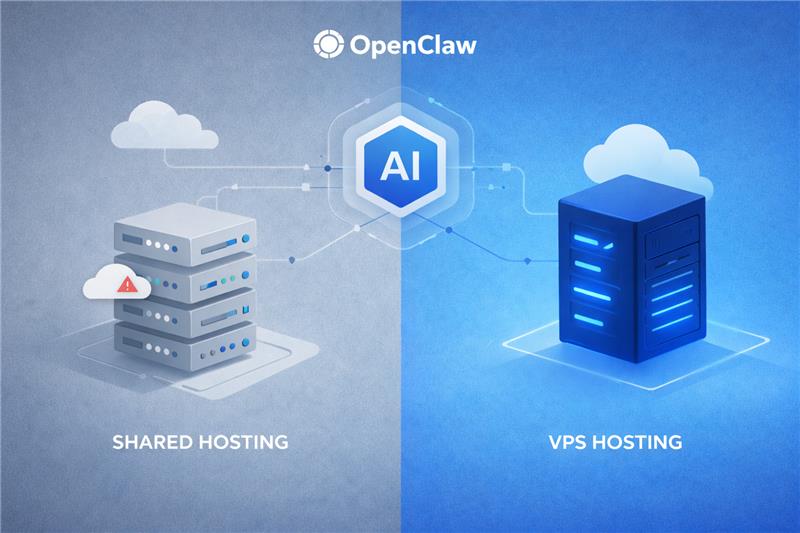
Running OpenClaw on a VPS
Running OpenClaw on a VPS enables developers to run private AI agents in their own environment. Further, with our Bluehost VPS One-Click OpenClaw, teams can deploy OpenClaw quickly and run automation workflows on the infrastructure they control.
This provides a practical starting point for building production-ready AI automation systems.
Final thoughts
The best open-source AI agent frameworks in 2026 reflect a diverse and rapidly maturing ecosystem. Each framework addresses different needs in orchestration, collaboration and production automation.
LangGraph and AutoGen focus on agent orchestration and multi-agent collaboration. CrewAI simplifies role-based agent teams, while LangChain offers broad integrations for LLM applications. OpenAI Agents SDK provides a lightweight option for OpenAI-native projects. Semantic Kernel supports enterprise systems that require deeper business integrations. OpenClaw focuses on executing structured automation workflows in production environments.
Choosing the right framework depends on architecture, integrations and operational requirements. Teams planning production automation often prefer running agents on reliable infrastructure.
For teams ready to operationalize OpenClaw, infrastructure also becomes an important consideration. At Bluehost, we offer self-managed VPS One-Click OpenClaw, making it easy to deploy OpenClaw and run private AI agents on infrastructure you control. Start deploying OpenClaw and build your AI automation workflows on a VPS environment designed for it.
FAQs
AI assistants respond to user inputs and provide information or recommendations, but they do not act autonomously beyond the conversation. AI agents, by contrast, can plan multi-step tasks, execute actions against external tools and systems and operate autonomously toward a defined goal without requiring continuous human instruction.
CrewAI and LangChain are generally recommended for developers new to agentic AI development. Both offer well-documented Python APIs, active community support and a relatively low barrier to entry. CrewAI’s role-based model is particularly intuitive for developers approaching multi-agent systems for the first time.
LLM orchestration refers to the process of coordinating how a large language model is prompted, how its outputs are processed and how it interacts with tools, memory and other agents within a system. Effective orchestration is essential for building AI agents that behave reliably across complex, multi-step workflows rather than producing inconsistent or unpredictable outputs.
Open-source AI agent frameworks offer greater flexibility, transparency and customization than commercial platforms, with no licensing costs and the ability to modify source code directly. Commercial platforms may offer managed infrastructure, dedicated support and faster onboarding for non-technical teams. The choice depends on your team’s technical capabilities, budget and the level of control required over the agent’s underlying architecture.
Yes, it is possible to combine frameworks within a single project. For example, using LangChain for tool integrations while leveraging LangGraph for stateful workflow orchestration, since the two are designed to work together. However, introducing multiple frameworks increases architectural complexity and maintenance overhead, so this approach is best reserved for cases where a single framework cannot adequately address all of a project’s requirements.

Write A Comment