 ChatGPT,
 Claude,
 Gemini,
 Grok — all four for

Most people blame the internet when an online experience feels slow.
A game freezes. A website stalls. A checkout button takes too long to respond. A dashboard lags after a click.
But a 2025 systems research paper suggests the connection is only part of the story.
The paper, Dissecting and Streamlining the Interactive Loop of Mobile Cloud Gaming, was presented at NSDI ’25, the USENIX Symposium on Networked Systems Design and Implementation. Researchers from Tsinghua University, USC, UIUC and Ant Group studied why mobile cloud gaming still feels delayed, even under good network conditions.
Their finding was surprising.
The network was not the biggest problem.
In many cases, the real delay came from inside the cloud system itself. Processing, rendering, encoding, virtualization and synchronization created most of the delay users felt on screen.
That makes the study important beyond gaming.
It offers a useful lesson for anyone who runs a website, eCommerce store, SaaS product, app or AI-powered tool in the cloud.
Speed is no longer just about how fast data moves across the internet. It is also about what happens after that data reaches the cloud.
Methodology note: This article is based on Bluehost’s analysis of the 2025 NSDI paper, Dissecting and Streamlining the Interactive Loop of Mobile Cloud Gaming. We reviewed the study’s findings on network latency, non-network latency, VSync delays and cloud-side processing. We then interpreted those findings through the lens of cloud hosting, website performance and modern cloud infrastructure. The study focused on mobile cloud gaming, not website hosting, so its results should not be read as a Bluehost performance benchmark.
The study that changes the cloud performance conversation
The NSDI ’25 paper focused on mobile cloud gaming, where games run on cloud servers and stream the result to a user’s mobile device.
That makes cloud gaming one of the toughest tests for cloud performance. Every tap, swipe or movement must travel to the cloud, get processed, render a visual response and return to the device fast enough to feel instant.
The researchers worked with a commercial mobile cloud gaming platform and measured the full interactive loop. They looked beyond network travel time and studied the full path from user input to visible response.
For a smooth experience, interactive latency usually needs to stay below 100 milliseconds. But the researchers found that current mobile cloud gaming platforms often missed that mark.
Measured latency ranged from 112 milliseconds to 403 milliseconds. Even the fastest mobile cloud gaming platform in the study was slower than the slowest console cloud gaming platform.
At first, that sounds like a network problem.
But the deeper analysis showed something more surprising.
The network was not the biggest bottleneck
The most important finding was simple: the network was only a small part of the problem.
Network latency accounted for only about 17% of total interactive latency on average. The rest came from non-network latency, which means the delays were created after the user’s input had already reached the cloud system.
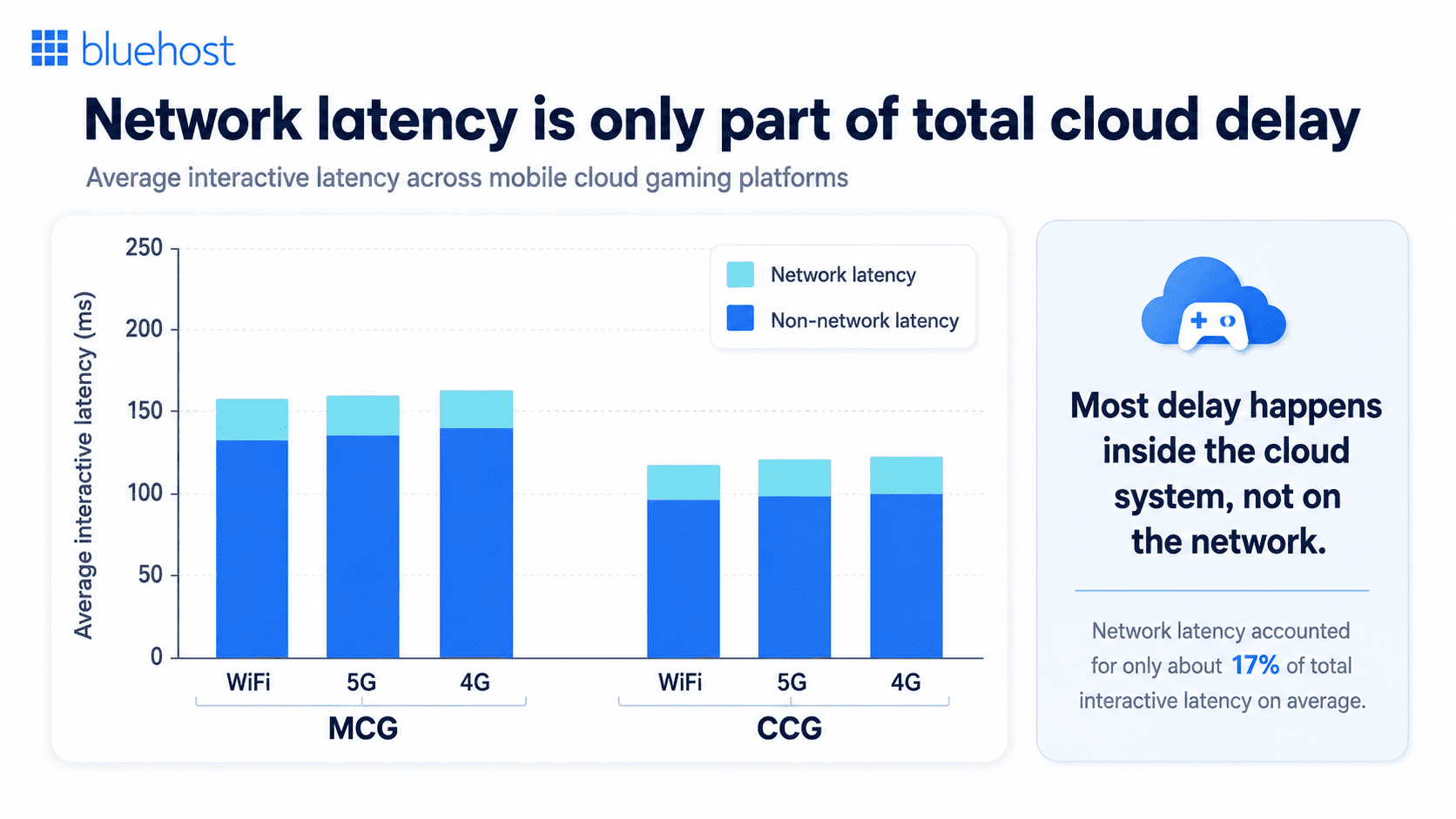
That included cloud-side processing, virtualization, graphics rendering, encoding and synchronization.
This challenges one of the biggest assumptions in cloud performance.
For a long time, the default performance conversation has focused on faster internet connections, lower network latency, more bandwidth, servers closer to users and CDN coverage.
Those things still matter. But the study shows they are not the whole story.
Even with strong network conditions, cloud applications can still feel slow if the underlying infrastructure path is too complex.
That lesson applies directly to cloud hosting.
A website may use a fast connection and still struggle if the hosting environment cannot process requests efficiently. An eCommerce store may have strong bandwidth and still slow down during traffic spikes if resources are not allocated well. An AI-powered app may have low network latency but still feel delayed if the backend stack has too many processing layers.
Performance is not only about movement across the internet. It is also about what happens inside the cloud.
Small delays can turn into much bigger problems
The study also found a “butterfly effect” inside cloud systems.
In some cases, a tiny network jitter of 2 milliseconds or less could trigger a much larger latency fluctuation of 10 milliseconds or more.
That sounds counterintuitive. A small delay should create a small slowdown. But cloud systems often depend on tightly timed processing stages. If one frame, request or operation misses its timing window, the entire pipeline can wait for the next synchronization point.
That is what happened in mobile cloud gaming.
The researchers found that the VSync mechanism, which is used to prevent screen tearing, created multiple waiting points across the interactive loop. These synchronization events were useful in normal mobile graphics pipelines. But in a cloud gaming environment, they added extra delay and made the system sensitive to tiny timing changes.
This is where the study becomes bigger than gaming.
Modern cloud infrastructure is full of dependencies. A request may pass through load balancers, containers, virtual machines, databases, caching layers, APIs, security checks and application logic before the user sees a response.
When everything is aligned, the experience feels fast. When one stage stalls, the slowdown can spread.
For website owners, this is why cloud performance optimization cannot focus only on one metric. A fast network helps, but the full request path matters more. Every layer in the stack can either reduce friction or add delay.
The lesson is that cloud performance is often less predictable than it appears. As the researchers discovered, even simple workloads did not always perform better.
Simple workloads did not always perform better
Another surprising finding was that simple 2D games sometimes performed worse than complex 3D games.
That challenges another common assumption.
Most people expect lightweight applications to perform better than demanding ones. But the study found that some simple games had higher latency because the cloud platform allocated resources unevenly. More complex games often received stronger GPU priority, while lighter workloads were treated as less demanding and received fewer resources.
The result was unexpected: the simpler experience could feel worse. This has a clear cloud hosting lesson.
Performance is not determined only by how “heavy” a workload appears. It is also shaped by how resources are assigned, scaled and protected.
A small business website can still slow down if it sits in a constrained environment. A lightweight landing page can still struggle if traffic spikes suddenly. A simple WooCommerce store can still underperform if database queries, plugins or backend processes compete for limited resources.
A site does not need to be massive to need consistent resources. It only needs a moment where real demand rises: a campaign, a sale, a product launch, a viral post or a busy checkout window. Cloud hosting performance depends on matching resources to real workload behavior, not just assuming that smaller sites have smaller needs.
The hidden cost of general-purpose cloud architecture
The study found one major source of delay: VSync.
VSync is a timing mechanism. It helps screens show frames cleanly, without visual tearing.
On a phone, that makes sense. The device needs to coordinate graphics and display timing. But in cloud gaming, the same process created extra waiting points.
Instead of helping the experience feel smoother, it added delay across the cloud pipeline.
The study found that VSync had the highest mean latency among all measured categories, at 43.9 milliseconds. Multiple synchronization events could add up to 83 milliseconds of extra delay.
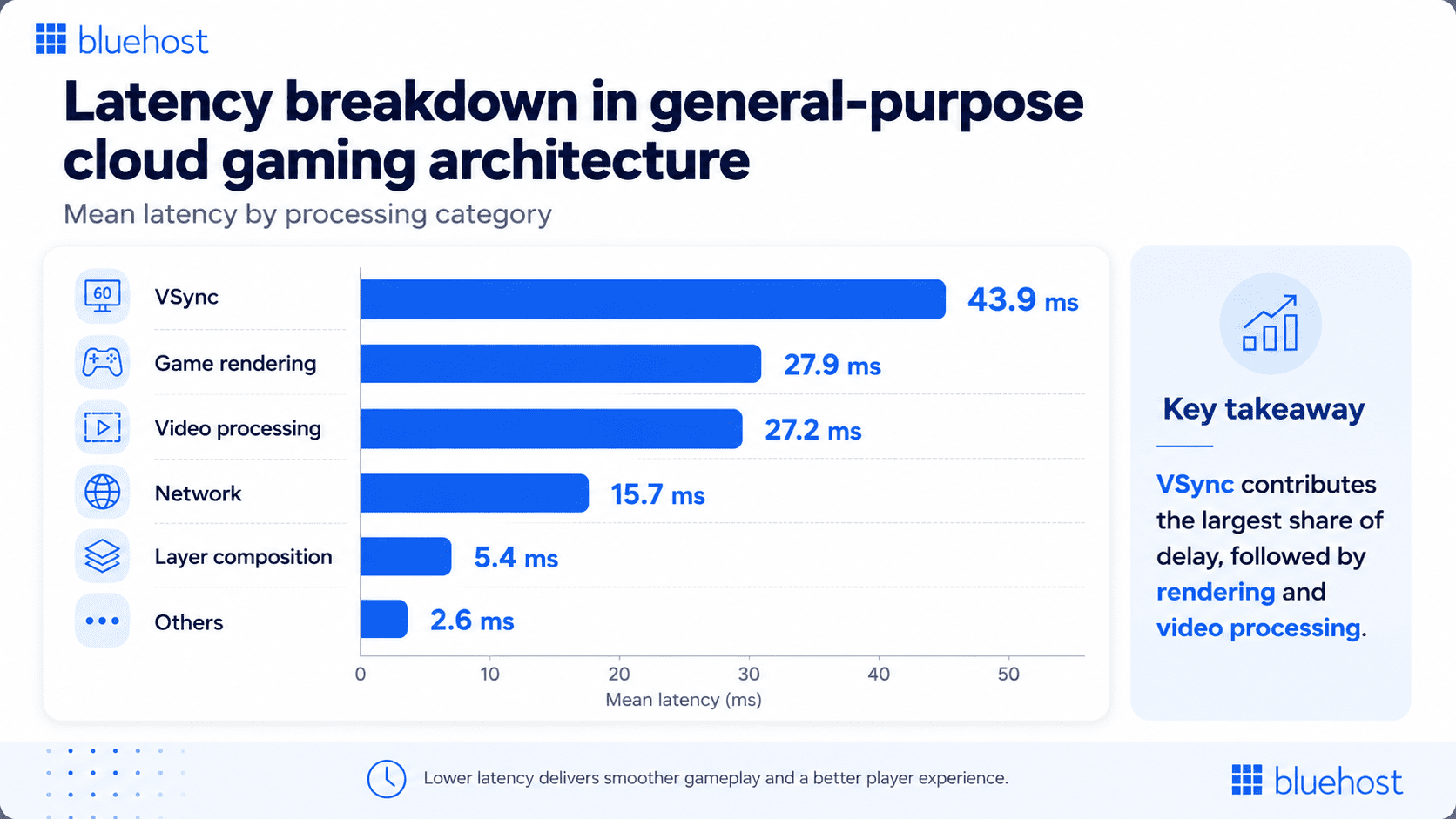
The researchers also found that multiple synchronization events could add up to 83 milliseconds of extra delay across the pipeline.
For a gamer, that delay feels like lag. For a website owner, the lesson is broader.
A system can be technically powerful and still feel slow if too many steps sit between the user’s action and the final response. The same idea applies to websites.
A visitor clicks “Add to cart.” The request may pass through the server, database, plugins, payment logic, cache rules and security checks before the page updates.
Each step may be small. But together, they shape how fast the site feels. That is why cloud performance is not only about raw server power.
It is about how efficiently the full environment handles real user actions.
Why does this matter for websites and online businesses?
Most business websites are not cloud games. They do not need every interaction to return in under 100 milliseconds.
But users still judge digital experiences by how fast they feel.
A slow website can hurt engagement. A delayed checkout flow can affect conversions. A sluggish admin dashboard can reduce productivity. A laggy application can make users question reliability.
The same performance principles apply.
The network matters, but it is not the full picture. Cloud-side processing can become the real bottleneck. Small inefficiencies can compound across the stack. Resource allocation affects simple and complex workloads. Architecture choices shape the final user experience.
For business owners, this means cloud hosting should be evaluated by more than storage, bandwidth or headline CPU numbers.
The better question is:
How well does the hosting environment support the real workload your website or application needs to run?
That includes traffic handling, scalability, isolation, caching, database performance, server responsiveness and infrastructure reliability. Site owners do not want to debug every infrastructure layer. They want a hosting foundation that helps their site stay available, responsive and ready for growth
What should cloud hosting solve now?
Cloud hosting exists because modern websites need more flexibility than traditional static hosting environments can provide.
A growing site may need to handle sudden traffic increases. An eCommerce store may need consistent performance during campaigns. A content-heavy site may need faster delivery across regions. A business application may need dependable backend processing. An AI-powered workflow may need more stable compute resources over time.
The new cloud performance lesson is clear: speed is not only about how quickly users connect. It is about how efficiently the cloud environment responds once they do.
At Bluehost, we see a similar pattern in hosting environments.
Site speed is rarely about one factor alone. A slow page may involve server response time, database queries, plugins, caching, traffic spikes, image weight or backend processing.
That is why the study is useful for website owners. It shows a broader cloud performance truth: users feel the full system, not just the network.
Strong cloud hosting should help site owners handle changing traffic patterns, reduce performance bottlenecks, support dynamic website workloads, keep applications responsive, scale resources as demand grows and improve reliability during busy periods.
For website owners, the goal is not to understand every layer of cloud infrastructure. The goal is to choose a hosting foundation that gives their site room to perform as traffic, content and business needs grow.
The study does not prove that one hosting provider is faster than another. It is not a website hosting benchmark. But it does reinforce a practical lesson for site owners: cloud performance depends on the full infrastructure path, not bandwidth alone.
For growing websites, eCommerce stores and online businesses, Bluehost Cloud Hosting provides a scalable foundation for traffic, dynamic content and changing workload needs.
What happens after the click matters most
The study began with one question: Why do games still feel laggy when the connection is good?
The answer reaches beyond gaming.
Cloud performance is no longer just about getting data to the server. It is about what happens next.
Processing, synchronization, virtualization and resource allocation can all shape what users feel.
For gamers, that feels like lag. For shoppers, it feels like checkout hesitation. For business owners, it feels like a site that cannot keep up.
People do not experience bandwidth. They experience the full system.
As websites, cloud applications and AI tools become more interactive, performance will depend on more than faster networks.
It will depend on smarter infrastructure that responds quickly after every click.

Write A Comment