



Key highlights
- Understand the differences between .com vs .net to choose the right domain extension for your website.
- Explore how each domain extension affects SEO, branding and audience trust.
- Learn when it’s best to select a .com or .net domain based on your industry and website purpose.
- Discover practical strategies for securing alternative domain names if your preferred .com is taken.
- Find out how Bluehost simplifies domain checking, registration and protection to get your website started quickly.
Choosing the right domain extension is important; it can affect your brand’s visibility, trust and how easily people find you online. As of the end of Q4 2025 total domain registrations reached 386.9 million domain names, with .com and .net totaling 173.5 million.
Different types of businesses and websites benefit from different domain extensions. For instance, eCommerce platforms, tech startups and professional service providers often prefer .com due to its widespread recognition and trustworthiness. On the other hand, .net is often used by ISPs, tech firms and online communities, reflecting its original network-focused purpose.
Understanding the nuances between .com vs .net can help you align your domain choice with your brand’s objectives and audience expectations. This guide covers the pros and cons of each extension to help you choose the right one for your online venture.
What is a Top-Level Domain (TLD)?
A Top-Level Domain (TLD), also known as a domain extension, is the part of a website address that comes after the dot. For example, in [bluehost].com, the .com is the TLD.
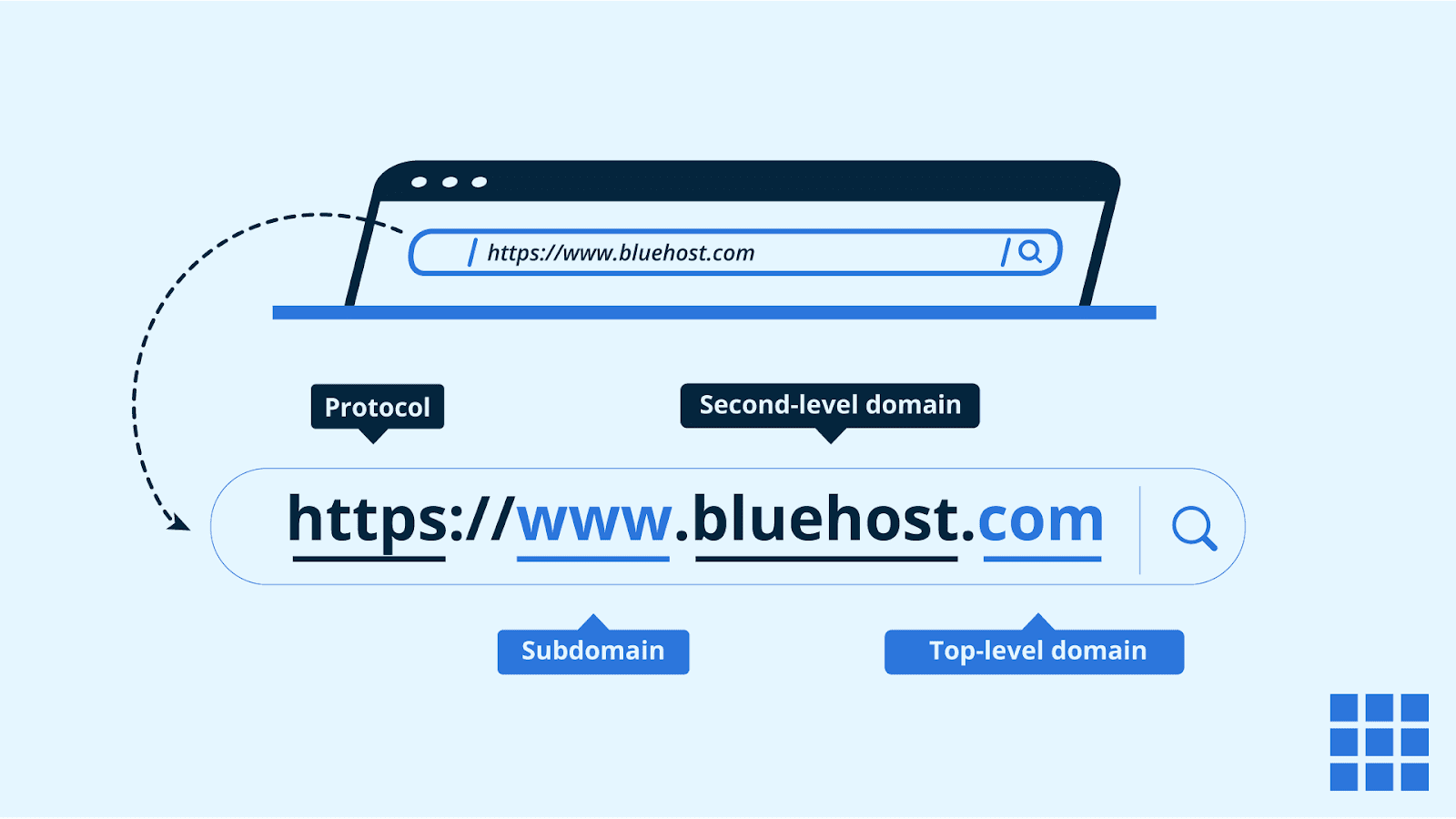
TLDs play an important role in how the internet organizes websites. They also influence credibility and branding because users and search engines can easily categorize websites based on extensions.
Popular domain extensions
- .com: Originally for commercial sites, now the most widely used and trusted.
- .net: Traditionally for networking and technology-related websites.
- .org: Often used by non-profit organizations.
- .edu: Reserved for educational institutions.
- Country-code TLDs (ccTLDs): Like .us, .uk, .ca, used for websites targeting a specific country.
- New/Industry-specific TLDs: Such as .tech, .ai, .store, which are popular for modern branding.
Also read: The Ultimate List of Top Level Domains
What does .com mean?
.com stands for “commercial.” It’s the most recognized and trusted domain extension, used across all industries. Ideal for businesses, brands and professionals looking for credibility and visibility.
What does .net mean?
.net stands for “network.” Originally for tech and internet companies. It’s now a strong alternative to .com, especially for developers, startups and networking-related sites.
How do you choose between .com vs .net for your website?
When choosing between .com vs .net, consider your site’s purpose, audience trust and long-term branding strategy carefully. A .com domain is ideal for businesses, professionals and brands seeking credibility, visibility and higher user click-through rates. A .net domain works best for technology companies, developers, or organizations involved in networking services when the .com option is unavailable.
When launching a WordPress site, online business, portfolio or blog, choosing between .com and .net can affect how users perceive your brand. If you’re creating a commercial website or professional service platform, the domain extension you choose can either reinforce your brand or cause confusion.
Below, we break down key differences to help you make an informed decision based on your goals and the type of website domain you’re building.
1. .com vs .net: Pros and cons
To fairly compare these domain extensions, here’s a quick breakdown of their strengths and limitations:
| Domain extension | ✅ Pros | ❌ Cons |
| .com | Most widely recognized and trusted by web users. Preferred choice for commercial businesses and online businesses. Stronger global branding potential and memorability. Often easier to recall when users type your web address. | Limited domain availability; many popular names are already taken. Potentially higher domain registration prices for premium names. |
| .net | Often more available than .com, providing a better chance for your desired domain name. Ideal for tech companies, network services or internet service providers. Good choice if your business or site has a networking or technical focus. | Less recognized as a general-purpose domain compared to .com. Some users might accidentally type your domain with “.com” instead. |
While .com dominates in recognition, .net offers more flexibility and availability, especially for tech or networking-related brands.
2. Availability and popularity trends
.com remains the most popular domain, accounting for a significant portion of domain registrations. Due to its high popularity, finding your preferred domain with .com can be challenging.
.net, on the other hand, offers better domain name availability. If your first-choice business name is taken with .com, a .net domain can be an excellent viable alternative.
3. Pricing differences
Domain prices usually vary by popularity and demand. Generally, .com domains cost slightly more because of their broad recognition and global appeal.
- .com pricing: $12.99 for the first year.
- .net pricing: $18.99 for the first year.
With selected Bluehost web hosting plans, you get a free domain registration (including .com or .net) for the first year, along with added benefits like domain privacy protection and reliable support.
Pro tip: Always review renewal fees when choosing the right domain extension. Pricing may differ depending on the registrar, registration period and desired domain name.
Whether you are weighing the global recognition of a .com against the functional appeal of a .net, registering your domain with Bluehost provides the perfect foundation for your online brand. With a seamless setup process and a reputation for reliability, Bluehost ensures your chosen extension is secure, professional and ready for growth. Register your domain with Bluehost today.
When should you use a .com vs .net domain?
Selecting between .com vs .net depends primarily on your site’s purpose, industry and overall branding strategy.
| Feature | .com | .net |
| SEO ranking potential | High (due to trust and CTR) | High (if well optimized) |
| User trust / Clickability | Very High | Moderate to High (depends on niche) |
| Branding recognition | Most recognized globally | Strong in tech and networking fields |
| Domain availability | Low (many taken) | Higher flexibility |
| Best for | General, business, global use | Tech, SaaS, networking, ISPs |
Let’s explore when each domain extension is most suitable.
Ideal use cases for .com
A .com domain is best for:
- Commercial businesses and general-purpose websites seeking global reach.
- Blogs, portfolios or personal websites aiming for maximum visibility.
- Online businesses are planning to build strong, recognizable brands.
- Any organization wants the most trusted and widely recognized web address.
Since .com is the default choice for many internet users, it tends to be easier for audiences to remember.
Ideal use cases for .net
A .net domain is ideal for:
- Internet service providers, hosting companies and network-related businesses.
- Tech companies and software developers targeting a tech-savvy audience.
- Websites focused on networking, communities or collaborative projects.
- Situations when your desired domain name is already taken with a .com extension.
If your business relates to internet services or technology, choosing a .net extension communicates relevance and professionalism.
What if both are available?
If your preferred domain name is available with both .com and .net, choosing the .com version is usually the safest decision. However, securing both extensions can protect your brand, ensure visitors find you easily and avoid confusion if users mistakenly type the wrong extension. Owning multiple extensions of your business name also prevents competitors from creating similar domains to capture your traffic.
Although .com is usually the first choice, .net remains valuable for tech, networking and internet services. If your preferred domain name isn’t available, you can explore other domain extensions that align with your brand and industry.
How does choosing .com vs .net affect SEO?
Both .com and .net are treated equally by Google, but user trust and clicks make a difference. Choosing the right domain extension impacts credibility, branding and indirect SEO performance.
- .net can rank equally when backed by strong content, branding strategy and technical SEO.
- Google treats .com vs .net equally; rankings depend on content, backlinks and optimization.
- .com often performs better because it’s widely recognized and trusted by internet users.

Let’s clarify the facts.
1. Does Google prefer .com over .net?
Search engines like Google treat both .com vs .net equally when ranking sites. Google’s algorithms focus on content relevance, authority and quality, not the specific domain name extension.
However, because .com is more widely recognized, users may naturally trust and click on these domains more frequently. Higher click-through rates can indirectly boost rankings and improve visibility.
2. Indirect SEO benefits of .com domains
Choosing a .com domain can indirectly enhance your SEO. It’s often the default choice people type into their browser, helping you capture more direct traffic. This familiarity can lead to more backlinks and references from other sites, especially from reputable sources and established commercial websites. These factors positively influence your domain’s overall authority, which can help you rank higher in search results over time.
3. .net domains rank as well as .com
Yes, a .net domain can perform equally well in SEO if you produce valuable, relevant content optimized for your target audience. A strong content strategy, clear user intent, quality backlinks and proper technical optimization outweigh the domain extension in terms of SEO performance.
While .com often earns more trust and traffic, both .com vs .net can rank equally with the right content strategy. To maximize visibility, always choose the best domain extensions for SEO that align with your brand and audience.
Is a .net domain reliable for your website?
Many website owners worry that a .net domain might appear less trustworthy compared to a .com vs .net. But is this true? Let’s clear up some common misconceptions.

1. Trust and brand recognition
Yes, a .net domain names is reliable. Initially, .net was originally intended for internet service providers and tech-related organizations. This background gives it credibility, especially among tech-savvy audiences.
Today, major tech companies and reputable brands use .net domains successfully. Opting for a .net domain won’t harm your site’s reliability or credibility, as long as you focus on delivering high-quality and authoritative content.
Also read: How to Build a Brand in 2026: Simple, Smart and Strategic
2. Common misconceptions about .net domains
There’s a myth that .net websites rank lower in search engine optimization or attract less traffic. This isn’t accurate. Google treats .com and .net equally in terms of SEO ranking.
However, because .com domains are more common and widely recognized, users sometimes default to them instinctively. This may slightly affect direct traffic. Still, if your preferred domain name isn’t available as a .com, using a .net remains a solid and reliable alternative.
3. Building credibility with a .net domain
Wondering if a .net domain can establish trust like a .com? The answer lies in how you build your brand. A user-friendly design, a professional website with high-quality content goes a long way. Add transparency through clear contact details, visible policies and strong security features like SSL.
These elements boost credibility regardless of your domain extension. Many successful blogs, tech startups and online businesses use .net without issue. Ultimately, trust comes from the experience you create not just the letters after your domain name.
What should you do if your .com domain is already taken?
If your desired domain name with .com is taken, don’t panic, there are reliable alternatives to secure your brand identity. Explore purchase options, domain variations, or other extensions.
- Check if the owner will sell your preferred domain name through a registrar or domain marketplace.
- Tweak your domain with keywords, industry terms, or location to create a unique, professional website address.
- Explore other domain extensions like .net, .org, country-specific TLDs, or industry-specific extensions for availability.
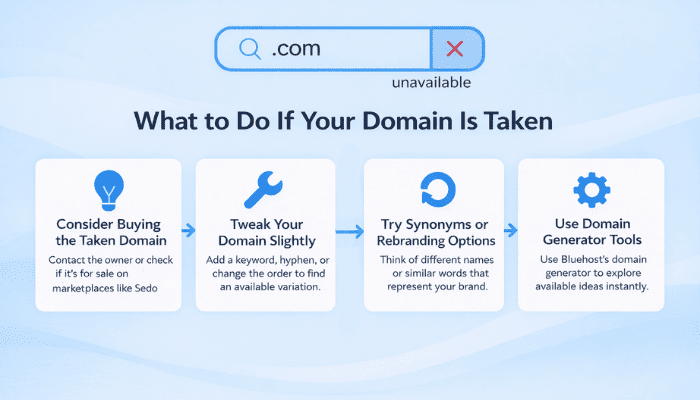
Here’s how you can find strong alternatives:
1. Consider buying the taken domain
First, see if the current owner of your preferred domain name is willing to sell it. Many domain registrars provide tools to help you reach out and make an offer.
Buying your exact business name or brand as a .com can be worth the investment, depending on your budget and goals.
Also read: How to Buy a Domain Name That’s Taken
2. Tweak your domain slightly
If buying the existing domain isn’t viable, try slightly modifying your original idea. Add relevant keywords, your industry or location to make the website domain name unique.
For example, if your original idea is “[TechWorld].com,” consider “[TechWorldHub].com” or “[TechWorldOnline].com.”
3. Try domain synonyms or rebranding options
Another approach is using synonyms, related words or even considering minor rebranding. Tools like domain generators help you find available alternatives quickly. If your exact domain name availability is limited, a slight rebrand or synonym can provide a catchy, memorable and unique alternative.
4. Use domain generator tools
Use our AI-powered domain search to quickly find available domains across multiple extensions, including .net, .org and a variety of new options.

Domain generators save time and often provide creative, unexpected ideas that align closely with your brand identity and objectives. Once you’ve found the right domain name, the final step is checking its availability and completing the registration process.
How to check domain availability and register .com or .net?
Securing your perfect website domain name involves checking its availability and then completing your domain registration.
Here’s how you can easily do both.
Tools for domain name search
To check your desired domain name, use our domain search tool to check the availability of your desired domain. The tool quickly tells you if your preferred online address is available.

Simply enter your chosen name into the search bar. We’ll instantly show if your domain is available across multiple extensions like .com, .net, .org domain and even new domain extensions.
If your ideal business name isn’t available, you’ll receive immediate suggestions for alternative, relevant names that are available.
How to register your preferred .com or .net domain?
Follow these straightforward steps to register your chosen domain:
- Choose your domain: Confirm the exact domain name and the right domain extension (.com, .net, etc.) through our domain checker.
- Add domain privacy protection: Consider adding domain privacy protection to protect your personal information from public WHOIS records.
- Complete your registration: Follow the prompts to complete your domain registration and payment. Bluehost includes free domain registration for the first year with selected hosting plans.
- Connect your domain to hosting: Easily connect your new domain to your Bluehost hosting account and start building your website immediately.
We simplify the process at Bluehost, so you can feel confident that your perfect domain is secured and ready for your website.
Also read: How to Register a Domain Name
.com vs .net: making your final choice
Before you register your domain, ask yourself a few key questions to arrive at a confident final choice. This practical framework helps you weigh the difference between .com and .net based on your specific business strategy rather than general popularity alone.
- What is the primary purpose of your website? Determine if your site is commercial and informational or strictly tech and network-focused.
- Who is your target audience? Consider whether you are targeting the general public who instinctively types .com or a tech-savvy niche.
- Is your preferred .com available? If your first choice is taken, ask if a well-chosen .net would serve your brand just as effectively.
- What are your long-term branding goals? Assess if you need global mass recognition from day one or if you are building niche authority.
- Should you register both extensions? Decide if you should secure both domains to strengthen brand protection and prevent competitor confusion.
Ultimately, the question isn’t always is .com better than .net, but rather which fits your specific vision; rest assured that both are strong choices when matched to your goals and audience.
Final thoughts
Deciding between a .com vs .net extension involves evaluating your brand identity, long-term business goals, and the expectations of your target audience. While .com remains the most recognized and authoritative TLD for commercial ventures, a .net domain serves as a highly professional alternative, particularly for organizations within the technology, networking, and infrastructure sectors.
While your specific domain extension does not directly influence search engine rankings, it plays a vital role in user perception and click-through rates. A .com extension is often the default choice in a user’s mind, which can enhance brand recall, whereas a .net extension can help establish a specialized niche presence and build credibility within technical communities.
Ready to secure your place on the web? Register your domain with Bluehost today.
FAQs
No. Search engines treat .com vs .net equally as generic top-level domains. Rankings depend on website’s content, backlinks and optimization, not the extension. However, .com is more widely recognized, so users are more likely to click on it, which boosts traffic and trust.
Yes. The .net domain extension, managed by the Internet Assigned Numbers Authority (IANA), is still relevant. It’s widely used by technology companies, internet service providers, hosting services and online communities, making it a good domain for network-related businesses and tech-focused organizations.
Yes. You can switch from .net to .com with <a href=”https://www.bluehost.com/blog/how-to-redirect-website-url/” target=”_blank” title=”How to Redirect a URL (301, 302 & More) – Beginner’s Guide”>301 redirects</a> and careful SEO management. This preserves rankings, domain authority and direct traffic. Many business websites upgrade to .com as their preferred domain name while keeping the .net registered for protection.
Yes. Owning multiple extensions like .com and .net strengthens your brand identity, protects against competitors and avoids user confusion. Many commercial businesses also secure the .org domain extension, country-specific TLDs and industry-specific extensions for broader marketing efforts and brand protection.
Yes. If your desired domain name with .com is taken, .net is a reliable alternative. Users see .com as more professional for commercial websites and personal sites, but .net websites are reliable for tech companies, network services and internet infrastructure projects.
The .net extension means “network.” Originally intended for internet infrastructure and network-related businesses, it’s now popular with hosting providers, technology companies and developers. A .net domain name is a good domain if your website’s content focuses on network services or when your preferred domain with .com isn’t available.
Yes. .net websites are reliable when backed by secure domain registration, HTTPS and hosting providers. While .com is more widely recognized by internet users, .net extension is credible in technology companies, hosting services and online communities, especially for network-related sites and professional websites.
Yes. At Bluehost, we offer a free domain name for the first year with selected web hosting plans. Both .com and .net are included in this offer. When comparing with other domain extensions like .org, .blog, or industry-specific TLDs, always review the long-term renewal cost to avoid surprises.
The best domain extensions for SEO are those trusted by your target audience. .com works best for commercial entities and online businesses, .org is ideal for non-profit organizations and country-specific TLDs help local targeting. Modern industry-specific extensions like .ai or .tech also boost marketing efforts when aligned with your website’s content.
Yes. .net is a good domain for network-related businesses, internet services and technology-focused sites. While .com is still preferred by commercial businesses and personal websites, .net domain names are reliable alternatives, especially when your desired domain with .com is already registered.
The main difference between .com and .net lies in their intended use and audience perception. While .com is the global standard for commercial businesses seeking maximum brand recognition, .net is primarily designed for network services and technology companies. Your choice depends on whether you prioritize broad consumer trust or industry-specific authority within the tech sector.
You should choose a .net extension if your business focuses on technology, internet services, or networking, as it validates your expertise to a tech-savvy audience. It is also a strategic option if your desired .com name is taken or significantly overpriced, allowing you to secure a memorable brand name without compromising quality. Many businesses also register the .net version to protect their brand presence alongside their main site.
The primary pro of a .net domain is higher availability, making it easier to secure your exact brand name compared to the saturated .com market. It also specifically targets tech audiences who recognize the extension’s association with network infrastructure. A potential con is that users may accidentally type “.com” when looking for your site, resulting in lost direct traffic if you do not own both versions.
These extensions serve distinct purposes: .com is for commercial visibility, .net implies technical expertise, and .org is the trusted choice for non-profits and community organizations. While .com signals you are open for general business, .org establishes your platform as a mission-driven cause rather than a profit-centric entity. Choosing the right extension helps define your brand identity before a visitor even loads your page.


Write A Comment