



Key highlights
- Understand the difference between content marketing and SEO and how each strategy contributes to long-term digital growth.
- Learn how to create valuable content that attracts and engages your target audience.
- Improve your search visibility by applying essential SEO principles and optimization techniques.
- Combine content marketing and SEO to generate consistent organic traffic and qualified leads.
- Strengthen your digital strategy with tools like the Bluehost Website SEO Checker and expert support from Bluehost Professional Digital Marketing Services.
When analyzing the synergy between content marketing vs SEO, the data highlights a clear advantage for active creators: Businesses that publish consistent blog content generate 67% more leads per month than those that do not. Yet many marketers still treat content marketing and SEO as competing strategies.
Understanding content marketing vs SEO is critical for building a sustainable digital presence.
These two disciplines are not rivals. They are partners. When used together, they drive organic traffic, build brand authority and convert readers into loyal customers.
In this content marketing vs SEO guide, you will learn:
- What is content marketing and how it works
- What is search engine optimization and why it matters
- The core difference between content marketing and SEO
- How to combine both strategies for long-term growth
Let’s dive in!
What is content marketing?
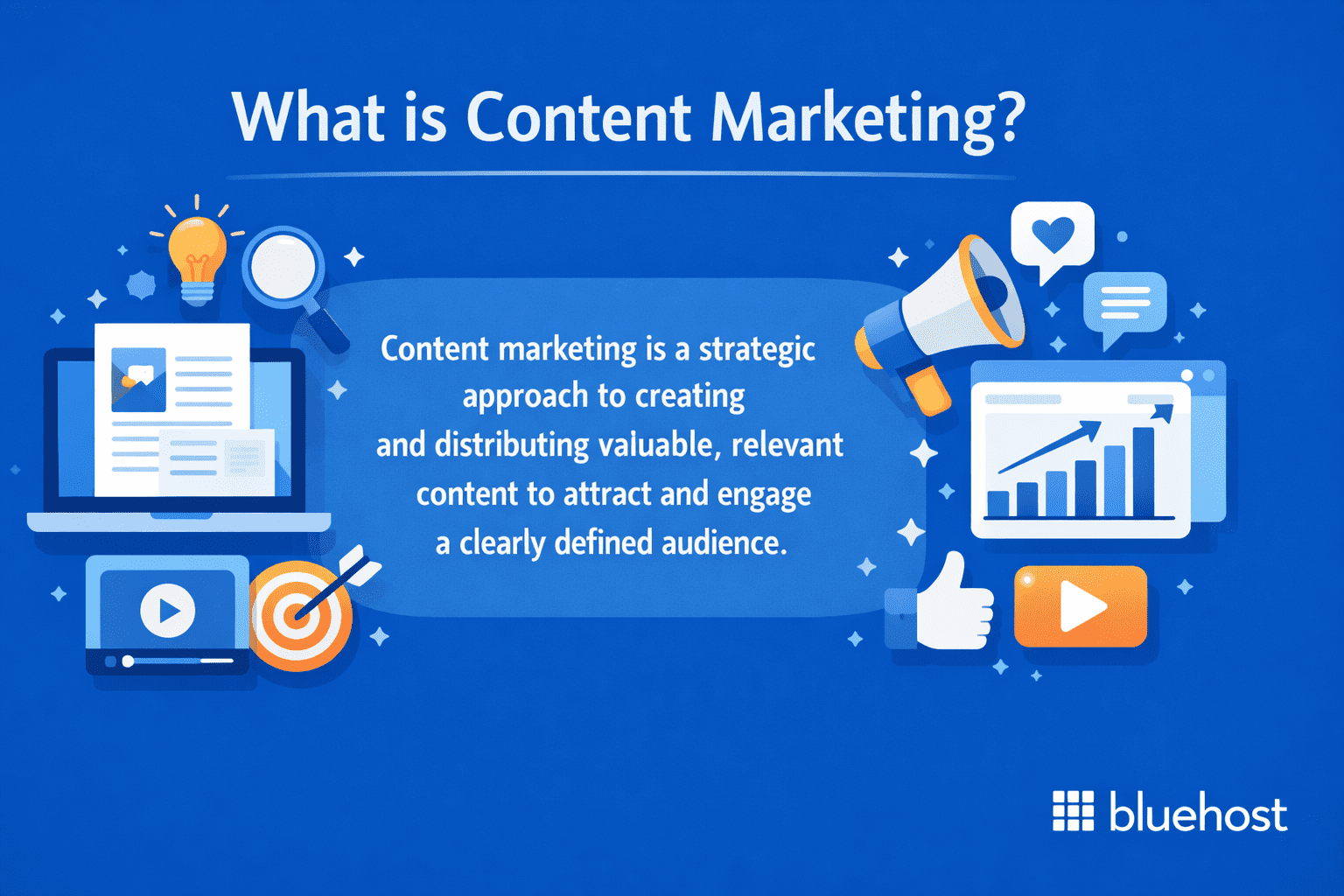
Content marketing is a strategic approach to creating and distributing valuable, relevant content to attract and engage a clearly defined audience. The goal is to build trust and authority over time so potential customers choose your brand when they are ready to take action.
Unlike traditional advertising, content marketing does not focus on immediate promotion. Instead, it prioritizes educating, informing or entertaining the audience before asking for a sale.
This approach helps businesses connect with potential customers throughout the entire buying journey. Informational content attracts new audiences, comparison content helps evaluate options and decision-stage content encourages conversions.
What are the core elements of content marketing?
Content marketing uses multiple formats and channels to reach audiences effectively. Each type of content serves a different purpose in attracting, educating and converting potential customers.
- Blog posts and long-form guides: Answer questions, solve problems and build topical authority in search engines.
- Videos and webinars: Demonstrate concepts, explain complex ideas and increase audience engagement.
- Infographics and visual content: Present data or ideas clearly while improving shareability across platforms.
- Email newsletters and drip campaigns: Nurture subscribers with helpful insights and bring readers back to your website.
- Case studies and white papers: Showcase expertise, research and real-world success to support purchasing decisions.
- Podcasts and audio content: Allow audiences to consume insights while commuting or multitasking.
Using multiple content formats expands reach and helps businesses connect with audiences across different platforms and preferences.
What are the benefits of content marketing?
A well-executed content marketing strategy provides long-term benefits that go beyond generating website traffic.
- Builds brand awareness: High-quality content introduces your brand to new audiences searching for relevant information.
- Generates qualified leads: Educational resources attract potential customers earlier in their buying journey.
- Establishes authority and credibility: Consistently publishing valuable insights positions your brand as a trusted industry expert.
- Strengthens customer relationships: Helpful content keeps existing customers engaged and informed.
- Supports the sales process: Blog posts, guides and case studies help educate prospects and address common objections.
Over time, content marketing compounds in value as your library of resources continues attracting and engaging new audiences.
Also read: Content Optimization: SEO Strategies That Drive Rankings
What is search engine optimization?
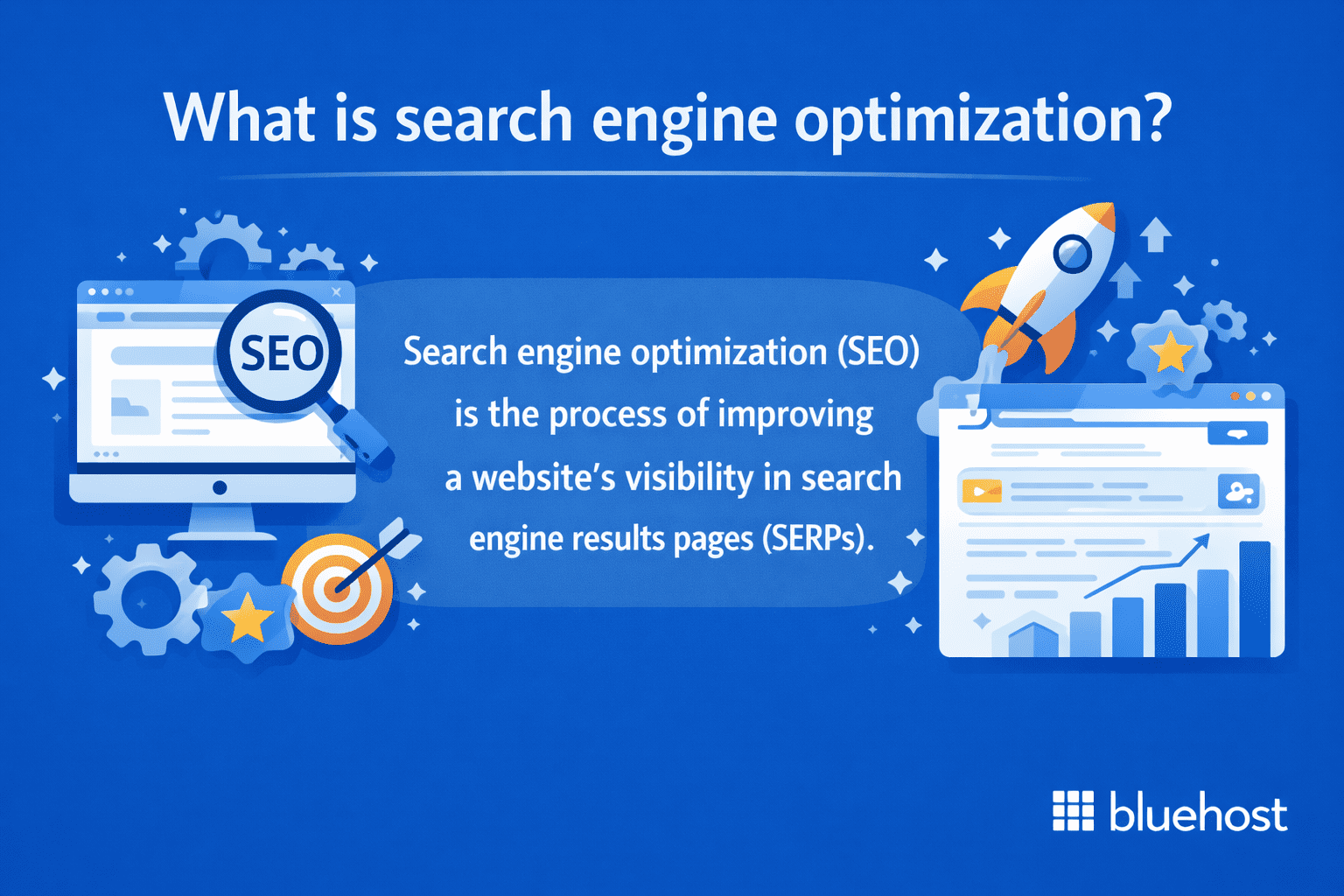
Search engine optimization (SEO) is the process of improving a website’s visibility in search engine results pages (SERPs). It helps your content appear when people search for topics, questions or solutions related to your business.
By optimizing your website and content for search engines, SEO increases the likelihood that your pages will rank higher for relevant keywords. Higher rankings lead to more organic traffic without relying on paid advertising.
Effective SEO focuses on understanding both search engine algorithms and user intent. The goal is to ensure that your content is easy for search engines to crawl, understand and present to users searching for relevant information.
What are the core elements of search engine optimization?
SEO involves several key components that work together to improve search rankings and website visibility.
- On-page SEO: Optimizing page titles, headings, keywords, meta descriptions and content structure to match search intent.
- Off-page SEO: Building authority through backlinks, brand mentions and citations from credible external websites.
- Technical SEO: Improving site speed, mobile responsiveness, secure HTTPS connections and overall crawlability.
- Internal linking: Connecting related pages to help search engines understand site structure and distribute authority.
- Content optimization: Creating high-quality, relevant content that answers search queries thoroughly.
When these elements work together, search engines can more easily evaluate and rank your website for relevant searches.
What are the benefits of search engine optimization?
SEO offers sustainable growth by helping businesses attract visitors who are actively searching for information, products or services.
- Increases organic traffic: Higher search rankings lead to more visitors discovering your website naturally.
- Reduces long-term marketing costs: Unlike paid advertising, SEO continues generating traffic without ongoing ad spend.
- Improves brand credibility: Websites that rank at the top of search results are often perceived as more trustworthy.
- Enhances user experience: Faster loading pages, mobile-friendly design and clear navigation improve usability.
- Drives long-term business growth: As more pages rank and earn backlinks, your website’s overall authority strengthens.
Over time, strong SEO builds a reliable stream of organic traffic that continues delivering value long after content is published.
Also read: SEO Fundamentals: 2026 Beginners Guide
The difference between content marketing and SEO
The difference between content marketing and SEO lies in their primary focus. Content marketing focuses on creating and distributing valuable content. SEO focuses on making that content discoverable through search engines.
A simple way to understand the distinction:
- Content marketing asks: “What should we create and who is it for?”
- SEO asks: “How do we get people to find what we’ve created?”
Here is a side-by-side comparison of both strategies:
| Aspect | Content marketing | SEO |
|---|---|---|
| Primary goal | Engage and educate the audience | Improve search visibility and rankings |
| Primary output | Blog posts, videos, guides, emails | Optimized pages, backlinks, technical fixes |
| Timeline | Long-term brand and relationship building | Ongoing ranking and visibility improvement |
| Success metrics | Engagement, leads and social shares | Rankings, organic traffic and click-through rate |
| Strategy driver | Audience interests and business goals | Keyword data and search behavior |
Both strategies deliver value independently. But their real power emerges when they operate together as one cohesive approach. Now, lets understand these content marketing vs SEO aspects in detail.
Primary goal
- Content marketing: The primary goal is to engage, educate and build trust with your audience. It focuses on creating valuable resources that help people solve problems, learn something new or make informed decisions. Over time, this builds credibility and strengthens the relationship between your brand and potential customers.
- SEO: The primary goal is to improve visibility in search engine results so the right audience can discover your content. By optimizing pages for relevant keywords and search intent, SEO helps attract visitors who are actively looking for information, products or services related to your business.
In simple terms, content marketing builds the relationship, while SEO helps people find the content that starts that relationship.
Primary output
- Content marketing: The primary output is the content itself. This includes blog posts, guides, videos, email newsletters, case studies, webinars and other educational resources designed to inform and engage your audience.
- SEO: The primary output focuses on improving how content performs in search engines. This includes optimized pages, keyword-focused content structure, internal linking improvements, backlinks from authoritative websites and technical fixes that help search engines crawl and index your site effectively.
In practice, content marketing creates the assets, while SEO ensures those assets are optimized for discovery and performance.
Timeline
- Content marketing: Content marketing typically delivers results gradually because building trust and authority takes time. As more high-quality content is published, your brand becomes a reliable source of information and your content library begins attracting consistent traffic.
- SEO: SEO also requires time to produce results, particularly in competitive industries. Search engines need time to crawl, index and evaluate content. As your website gains authority and earns backlinks, rankings improve and organic traffic increases.
Both strategies are long-term investments that produce compounding benefits as your content and authority grow.
Success metrics
- Content marketing: Success is measured by engagement and audience interaction. Common metrics include time spent on a page, social shares, comments, email subscriptions, lead generation and conversions influenced by content.
- SEO: Success is measured through search performance. Key metrics include keyword rankings, organic traffic, impressions, click-through rate (CTR), backlinks earned and conversions generated from organic search.
Together, these metrics help businesses understand both how well their content resonates with readers and how effectively it performs in search results.
Strategy driver
- Content marketing: Content marketing strategies are driven by audience needs and business objectives. Topics are often based on customer questions, industry challenges and the information potential customers need throughout their decision-making process.
- SEO: SEO strategies are driven by keyword data and search behavior. By analyzing search queries, competition levels and user intent, marketers can identify topics people are actively searching for and create content that matches those needs.
When combined, audience insights from content marketing and keyword data from SEO create a more effective and targeted content strategy.
Also read: SEO Basics: Beginner’s Guide to Ranking Your Website
How do content marketing and SEO work together?
Content marketing vs SEO is not a competition to be won. These strategies are most effective when aligned under a single unified plan. Here is how each one strengthens the other:
SEO informs what content to create
SEO research removes the guesswork from content planning. Keyword data reveals:
- Topics your target audience is actively searching for
- Questions people want answered right now
- Search volume and difficulty for any given topic
- Content gaps your competitors have not addressed
Instead of publishing based on assumptions, you create content people are already looking for. This dramatically increases your chances of ranking and attracting qualified visitors.
Content gives SEO something to rank
Search engines rank content, not websites. Google’s algorithm rewards pages that:
- Comprehensively answer a specific search query
- Demonstrate expertise, experience and trustworthiness (E-E-A-T)
- Earn natural backlinks from other credible websites
- Keep readers engaged through depth and clarity
Without strong content, even flawless technical SEO will not produce meaningful rankings. Without SEO, even brilliant content may never be discovered by the right audience.
Together, they build compounding organic traffic
Paid advertising stops delivering the moment your budget runs out. Content marketing and SEO compound over time instead.
A well-optimized piece of content can:
- Rank on page one for years after publication
- Generate leads without ongoing advertising costs
- Build topical authority that elevates your entire domain
- Attract natural backlinks that boost rankings further
According to Moz, pages ranking in position one receive over 27% of all organic clicks. Strong content, properly optimized for SEO, captures that traffic consistently and cost-effectively.
How to build an integrated content marketing and SEO strategy?
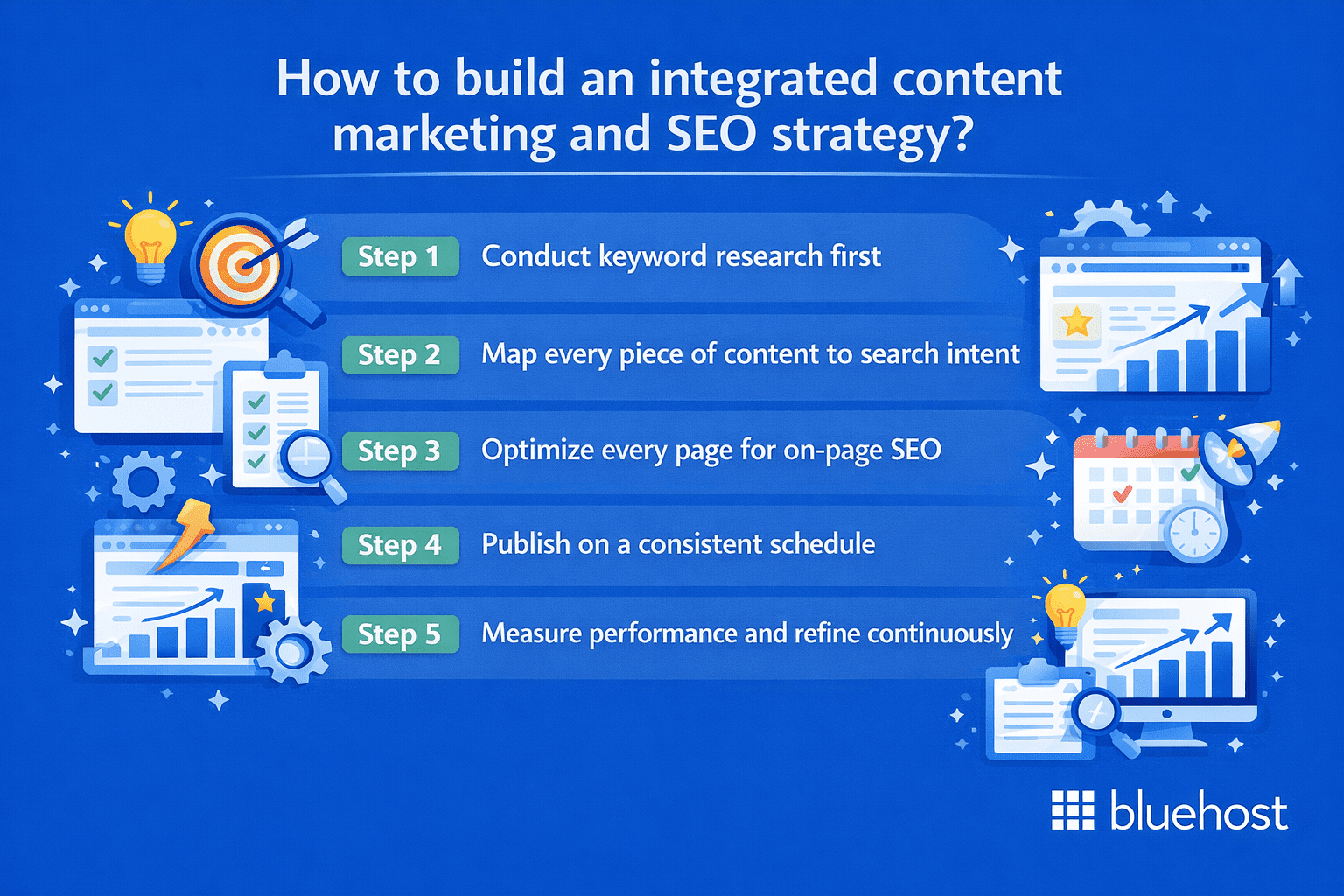
Combining content marketing and SEO requires a clear, repeatable process. Follow these steps to build a strategy that delivers sustainable results.
Step 1: Conduct keyword research first
Before creating any content, identify the keywords your audience uses. Use tools such as Google Search Console or Moz. Look for:
- High-volume keywords with manageable competition
- Long-tail keywords that reflect specific user intent
- Questions surfaced in Google’s “People Also Ask” results
- Seasonal or trending topics in your industry
Group related keywords into topic clusters. This approach builds topical authority and helps search engines understand the depth of your expertise.
Step 2: Map every piece of content to search intent
Every search query reflects a specific intent. The four main intent types are:
- Informational: The user wants to learn something (e.g., “what is content marketing”)
- Navigational: The user is looking for a specific website or brand
- Commercial: The user is comparing options before buying
- Transactional: The user is ready to take action or purchase
Match your content format and tone to the intent. Informational queries need educational blog posts. Transactional queries need product pages or clear landing pages.
Step 3: Optimize every page for on-page SEO
After drafting your content, apply on-page SEO discipline. For each post or page:
- Include the target keyword in the H1, opening paragraph and at least one H2
- Write a compelling meta description between 150 and 160 characters
- Add descriptive alt text to all images
- Link internally to two or three related pages on your site
- Use schema markup where relevant for featured snippet eligibility
Step 4: Publish on a consistent schedule
Consistency signals reliability to both search engines and audiences. Google favors websites that publish regularly and maintain content freshness.
Start with a realistic cadence. Two thoroughly researched posts per month outperform four thin, rushed articles every time. Quality always wins over volume in modern SEO.
Step 5: Measure performance and refine continuously
Track performance across both strategies to identify what drives results. Key metrics to monitor include:
- Organic traffic volume via Google Analytics or Search Console
- Keyword ranking changes over time
- Bounce rate and average time on page
- Backlinks earned and domain authority growth
- Conversions and revenue from organic traffic
Use this data to identify your highest-performing topics. Expand them into content clusters. Update underperforming content with refreshed data and improved optimization.
What are the common mistakes that undermine both strategies?
Many businesses invest in content and SEO but still see poor results. The most common pitfalls include:
- Creating content without keyword research: Publishing topics no one searches for wastes time and budget
- Ignoring search intent: Ranking for a keyword means nothing if the content does not satisfy the query
- Neglecting technical SEO: Even excellent content underperforms on a slow or poorly structured website
- Running content and SEO as separate teams: Siloed efforts lead to missed opportunities and inconsistent messaging
- Focusing only on rankings: Rankings are a means to an end; conversions and business impact matter more
- Never updating old content: Outdated posts lose rankings steadily and damage your credibility
Avoiding these mistakes significantly accelerates the results you see from both disciplines.
Also read: 8 Key Benefits of Digital Marketing for Small Businesses in 2026
Strengthen your content marketing and SEO strategy with Bluehost
Creating high-quality content is only part of a successful digital strategy. To maximize the impact of your content marketing and SEO efforts, you also need tools that help you analyze performance, identify optimization opportunities and execute marketing campaigns effectively.
Bluehost provides solutions that help businesses improve search visibility and manage digital marketing with greater efficiency.
Bluehost Website SEO Checker
The Bluehost Website SEO Checker is a free tool that runs a website audit and generates an SEO report with improvement opportunities. It highlights issues that can hold your content back in search results—so you can fix them before they affect rankings and traffic.
What it covers?
- Real-time SEO analysis + actionable tips: The tool provides an SEO analysis and recommendations you can act on.
- Technical issues discovery: It can surface issues like broken links and status code errors as part of the audit.
- Mobile checks: It includes checks for mobile site speed, responsiveness and content scaling to help identify mobile-related ranking issues.
- Backlink profile analysis: It analyzes backlinks and reports metrics such as link quality, anchor text distribution and domain authority so you can spot opportunities to improve authority.
- Security-focused checks: It includes security scanning to help flag vulnerabilities, SSL issues and potential malware threats, which can affect trust and search performance.
- Local SEO tracking: It supports local SEO by tracking visibility in local search results, Google Maps rankings and business listings to help strengthen presence in target markets.
Bluehost Professional Digital Marketing Services
Bluehost Professional Digital Marketing Services are designed for businesses that want expert help running SEO and/or PPC without managing everything themselves. Bluehost positions it as a done-for-you option where you can access performance reporting and their team analyzes results.
We have two core offerings:
1) Pro SEO Assist (SEO services)
This service focuses on expert-led on-page SEO execution and ongoing optimization recommendations:
- SEO experts perform ongoing on-page SEO optimizations based on simple SEO recommendations
- On-page SEO improvements designed to increase search engine visibility and rankings
- Works even if your site isn’t hosted on Bluehost
- SEO strategies focused on improving search visibility and driving organic website traffic
- Link-building services are available through Pro SEO Backlinks to help build authority and improve rankings
- Option to add Pro SEO Support Plus for a dedicated marketing account manager who reviews strategy and results monthly
2) Pro PPC (PPC management)
This service focuses on professionally managed Google PPC:
- Certified PPC specialists supported by AI-driven automation to create and manage ad campaigns
- Control over when/where ads appear within your budget
- Campaign performance monitoring with ongoing optimization and monthly campaign reviews
- Option to add Pro PPC Support Plus for a dedicated PPC specialist who conducts monthly review calls and spend optimizations
Final thoughts
An effective digital strategy relies on integrating content marketing vs SEO. These disciplines are most powerful when combined rather than treated as separate silos.
Content creates value, while SEO ensures discovery. Together, they build sustainable organic traffic that reduces your long-term reliance on paid advertising.
The difference between content marketing and SEO is tactical; both serve the shared goal of growing your business through high-quality, searchable information.
To start, audit your current content for keyword gaps and implement a unified strategy that addresses both user needs and search engine requirements.
Looking for expert guidance? Let our team handle the technicalities and strategy. Bluehost Professional Digital Marketing Services provides the specialized support needed to accelerate your online growth.
FAQs
The core difference between content marketing and SEO is their focus. Content marketing focuses on creating valuable content for a target audience. SEO focuses on making that content visible and discoverable in search engine results. Both are necessary for a complete digital strategy.
You can apply technical and on-page SEO without a formal content strategy. However, search engines rank content. Without consistent, high-quality content, your ability to rank for competitive keywords is severely limited. Content marketing and SEO work best when used together.
Neither is more important because each depends on the other. Content marketing without SEO produces content that may never be found. SEO without content marketing has nothing valuable to optimize or rank. The most effective approach integrates both into one unified strategy.
Most businesses begin seeing measurable results within three to six months of consistent effort. Competitive industries may take longer. Unlike paid advertising, results from content marketing and SEO compound over time and continue generating returns long after publication.
Long-form blog posts, comprehensive guides, how-to articles and FAQ pages tend to perform best for SEO. Content that thoroughly addresses search intent, demonstrates expertise and earns backlinks naturally ranks most consistently. Updating existing content regularly also improves and sustains search performance.



Write A Comment