



Key highlights
- Learn when online sellers need a seller’s permit or business license based on state-specific U.S. regulations.
- Understand how sales tax rules, economic nexus thresholds and exemptions apply to eCommerce businesses.
- Clarify the difference between seller’s permits, sales tax permits and general business licenses.
- Explore additional licensing needs, including export, employer and home-based business permits.
- Get a simple overview of how to apply for licenses and how long approvals typically take.
Whether you need a seller’s permit to sell online depends on where you do business. Each U.S. state has its own licensing rules, names for permits, and sales tax requirements, which can make online business laws confusing.
On top of that, the rules can change based on how you sell. A home-based Shopify store, an Etsy side hustle, and a full-scale ecommerce brand might face different permit and registration requirements, even within the same state.
That’s why you’ll often see terms like ‘seller’s permit,’ ‘sales tax permit,’ or ‘resale certificate’ used differently from one state to another.
Below, we’ll break down the business permits you may need to sell online in the U.S., how to apply for them and when you might qualify for an exemption. If you’re wondering, “Do I need a business license to sell online?” This guide will walk you through the essentials.
We’ll also cover export licenses, common types of business permits, application steps and how long approval typically takes.
Understanding business licenses for selling online
A business license is a government permit that allows a person or company to operate a business in a specific area. It helps make sure you follow local rules and pay the right taxes.
Having a business license is important because it makes your business official and helps you follow the rules. If you don’t get the right permits, you could face fines or other penalties.
Asking yourself, “Do I need a business license to sell online?”
The requirement for a business license when selling online differs by jurisdiction. However, many regions require online merchants to obtain a license. Business licensing laws might change without warning. Consult your local government to guarantee compliance with these regulations.
In states such as Delaware, New Hampshire, Oregon and Montana, you don’t need a license to sell online other from your business registration certificate. Sellers are exempt from paying general sales tax in these states. However, online firms are required to pay sales taxes in South Dakota, New York and California.
Taxes that you include in the cost of your goods or services are known as general sales taxes. This additional sum must be gathered and paid to the government, usually at the state and local levels.
Keep in mind that every state has different legal interpretations on how they grant licenses to online retailers. There may not be a business license law that applies to online vendors in some states. For example, when granting business licenses, Alaska prioritizes your business activity over your location.
The state concentrates on the type of business you run. This covers your company’s organizational structure and the kinds of goods you offer. For instance, whether you sell handmade health goods from a physical store in downtown Anchorage or online in rural Alaska, you could require a specific license.
Meanwhile, if your internet firm generates more than $100,000 in annual revenue, South Dakota will collect sales taxes. Hence, investigate local and national regulations to determine whether a business license is required. The requirements can vary depending on your area.
Some digital platforms have internal licensing restrictions in place to protect sellers’ legal rights. If you wish to sell on these sites, you must follow their policies.
Also read: A Comprehensive Guide – Understanding the Need for a Business License for Selling Online
When do you qualify for a business license exemption while selling online?
In the United States, if you are a sole owner operating under your legal name, business registration is not required. However, depending on your business and location, you may need additional state or federal licenses and permits.
If you’re still wondering “Do I need a business license to sell online?” The answer depends on your legal structure, location and the products or services you’re selling.
Sometimes, you might not need a license if your business type or income qualifies for an exemption. Many states, even those that tax online sellers, offer these exemptions. For example, South Dakota doesn’t require businesses earning $100,000 or less to collect sales tax.
Some license exemptions have limits. For instance, Alaska doesn’t have a general sales tax, but local governments there might still require sales tax or offer exemptions for certain businesses.
Ask your local tax office if your business qualifies for an exemption. This way, you can save money and stay within the rules.
Is a business license required to sell things globally?
To sell products worldwide, you may need to obtain a license. The Bureau of Industry and Security (BIS) oversees United States Export Administration Regulations (EAR) and develops export control laws governing the export of certain items.
Online vendors are required to comply with these regulations, which may include getting licenses and complying with export limitations based on the destination country.
EAR does not apply to all US goods, services and technologies. Specific government agencies are responsible for specialized exports. The Department of State, for example, is responsible for defense issues. The BIS website lists more controlling agencies.
To find out if your product qualifies for an exemption or needs an export license, contact the EAR or the relevant export authorities.
Types of permits and licenses for online sellers
Let’s examine the many licenses required to manage your company, hire staff and conduct online sales.
Online vs. brick-and-mortar business license
States such as Alaska make no distinction between online shops and physical enterprises. In some states, however, you must have a municipal license to sell restricted items or provide regulated professional services. Selling, whether online or offline, will not be considered when issuing the license.
Aside from obtaining state and federal business registration and licenses, you may require additional specialized permits to sell products online. Check with your local tax office to see if your internet business requires a specific license to sell products or services.
Seller’s permit vs. sales tax permit
Although sales tax permits and seller permits are frequently used interchangeably, each state has its own definition. Nonetheless, both licenses allow companies to gather and send sales taxes to the state.
An outline of each permit is provided below:
Sales tax permit:
- This is the right of a state to impose sales tax on qualified transactions.
- A sales tax authorization is required for companies that sell tangible objects or specific digital products.
- With the permit, you can collect sales tax on transactions and remit the proceeds to the state’s tax authority.
Seller’s permit:
- Seller’s permits may cover more than sales tax in some states.
- It may authorize sellers to collect and remit other taxes, such as use tax on goods bought for in-state use without sales tax at purchase.
- Seller’s permits may serve regulatory purposes for governments, like coordinating tax collection with resale certificates.
Some states use “sales tax permit,” and others use “seller’s permit” or similar terms. So, terminology and requirements differ. Additionally, some states mandate permits at the state level and others at the municipal level.
General business licenses
General business licenses are typically issued by city or county governments, not by state or federal authorities. Many jurisdictions require businesses to obtain a local license before beginning operations, particularly if they engage in activities like selling physical goods or providing digital services.
Only a few states issue statewide general business licenses. Most states instead focus on regulating specific professions or industries such as healthcare, finance, or construction, while leaving general licensing responsibilities to local governments. As a result, the requirements and costs of business licensing vary widely depending on location.
For example, in California, businesses involved in food, beverages, healthcare, or professional services must obtain specialized state or industry-specific licenses, in addition to any local permits. In New York, restaurants are typically required to get city-issued permits and health department licenses. Home-based food businesses may be exempt from some requirements, depending on local laws.
Employer permits and licenses
To keep your business and personal finances distinct, obtain a federal Employer Identification Number (EIN) from the Internal Revenue Service. This is a free tax ID. An EIN is required to convert from a sole proprietorship to an employer, open a business bank account and manage your business on marketplaces such as Amazon.
In addition, if you employ people, you must register for employer withholding tax in your state or municipality. Employers withhold income and payroll taxes from their employees’ paychecks on behalf of the government, covering income tax, Social Security and Medicare. If you have employees, you must register for employer withholding tax with your state or municipality
Other employment permits may be required in your county or state. Seek advice from your local tax authorities.
Professional and occupational permits
Many states, like California, maintain comprehensive lists of licenses, certifications and permits required for individuals and businesses operating in regulated professions and trades.
Depending on your business type, you may need specific occupational or professional licensing for the following:
- Licensed professions: These include regulated fields that require specific qualifications, such as healthcare, law, accounting, architecture and real estate.
- Skilled trades: Examples include construction, transportation, cosmetology and food preparation, which often require certifications or inspections.
- Regulated industries: Certain business activities like selling alcohol, tobacco, or operating gambling services fall under industry-specific regulation. Similarly, activities like dealing in cryptocurrency or offering financial services are regulated under financial or money services laws, not occupational licensing.
To determine what applies to your business, search your state or local government’s website for guidance on required professional licenses, certifications and permits. This will help you stay compliant with relevant laws and ensure smooth business operations.
How to obtain an online business license if you need one to sell online?
You may need a general business license to operate an online business, depending on the regulations in your state. A seller’s permit, sales tax permit or general sales tax license falls under this category.
It is intended for companies to collect and remit taxes to state or municipal governments on goods supplied remotely, even though states differ in how they define licensing.
The South Dakota v. Wayfair ruling by the U.S. Supreme Court in 2018 significantly expanded the scope of sales tax collection. The decision allowed states to collect and remit sales taxes based on their economic activity or “economic nexus” within the state. Even if the seller had no physical presence there. This ruling broadened the applicability of seller permits to include businesses engaged in remote or online sales.
States released their regulations for internet vendors after this historic decision. Small business owners, however, might be eligible for an exception.
Do you need a sales tax permit?
Whether you need a sales tax permit depends on your business activities and the state or municipality where you operate. Typically, it applies to tangible goods, such as electronics, clothing and furniture. However, some states also tax services and digital products.
Your local tax authority can advise you on the types of items subject to sales tax in your area.
How to get a seller’s permit or sales tax permit?
An online business license helps you legitimize your online venture. Follow these steps to obtain your permit:
- Research state regulations: Business licenses vary by state, so get acquainted with the specific requirements in your location. Visit your state’s Department of Revenue website for accurate information.
- Determine your business structure: Determine if your business is a sole proprietorship, limited liability company (LLC) or corporation and register your business name if required. Your business structure influences the license you need. Prepare the necessary details about your business, including your Employer Identification Number (EIN) and product or service information.
- Apply for the license: Most states offer online applications. Fill out the required forms carefully and double-check for accuracy. Scan and attach requested documents, such as identification, proof of address and business plans. Be ready to provide details about your online sales activities, location and ownership.
- Submit your application: Carefully review your application for errors. Once satisfied, follow the submission instructions provided. Some states may require a fee, while others, like Texas, offer free permits.
Licensing authorities might contact you for additional information while reviewing your application. Once you’ve obtained your online business license, display it prominently on your website.
Avoid license termination by setting up reminders for license renewal dates. Stay compliant to avoid legal issues.
The steps highlighted here are an overview. Your state or municipal authorities may require additional processes.
Do you need a home occupation permit?
You need a home occupation or home-based business permit to conduct business activities from a residential property. This ensures compliance with local zoning regulations. If your home address doubles as your business address, secure this license.
Some states, like California, may require additional business licenses for your home-based business. For instance, you’ll need a business license from the tax collector’s office after getting a home occupation permit in California.
Here’s how to obtain a home occupation permit:
- Check local rules: Contact your local zoning office by website, email or phone to make sure your business can get a home occupation permit.
- Apply for the permit: Give correct business details in your application and pay any fees.
- Submit documents: Depending on local laws, provide the necessary paperwork, such as a site plan or business plan.
After reviewing your application, authorities may examine your property to determine how it would affect the community. You’ll receive an acceptance or rejection after the review is finished.
Each jurisdiction may have very different regulations. To find out the exact regulations and whether your home-based business needs a permit, always consult your local government or zoning office.
Additionally, some jurisdictions may grant exemptions to companies that meet specific requirements, such as producing only low traffic or having little impact on the community.
Running an online business from home?
Once you have your home-based business permit, make sure your eCommerce setup is reliable as well.
Bluehost’s WooCommerce hosting is built for small and home-based businesses. It offers secure hosting, optional payment integrations through WooCommerce extensions and tax management tools.
These features help streamline compliance with sales tax requirements across multiple states as your business expands.
How long will it take to get your business license?
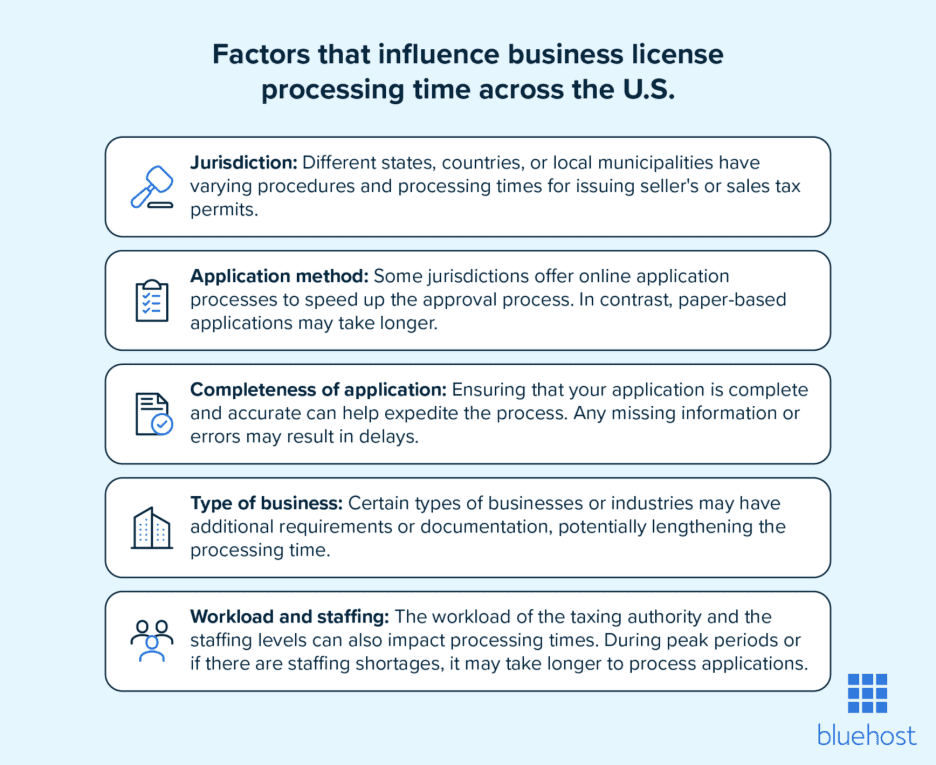
Seller’s or sales tax permit processing times differ depending on the application procedure and location (state or municipality). Licensing time is also influenced by workload, business type, jurisdictional procedures and the thoroughness of the application.
Permits usually take a few weeks, although online applications might speed up the process. For example, online processing can be completed in as little as two business days in Illinois. Verify precise processing times with the tax authorities in your area.
What local business licenses do you need before selling online?
A business permit office is your local government’s one-stop resource for licensing information. Think of it as a help desk for permit requirements. Before contacting them, gather key details about your business. This includes your business location, legal structure, what you sell and where you sell it. Also note your estimated sales volume.
Most states have online permit portals where you can search by business type. Always verify you’re on an official government website by checking for .gov domains. Look for official seals and government branding to confirm authenticity.
If online resources don’t provide clear answers, call or email the permit office directly. Their staff can walk you through requirements specific to your situation. Remember to confirm all details with the relevant agency before making compliance decisions.
Final thoughts
Managing business licenses across U.S. states can be tricky, especially when each state sets its own rules. From local permits to export licenses, getting legal compliance rights is essential, but it’s only the beginning. Your choice of eCommerce platform also plays a major role in long-term success, particularly when it comes to tax compliance and payment processing. Without the right setup, manual errors and ongoing admin work can quickly add up.
That’s why many sellers rely on platforms that automate heavy lifting.
With Bluehost WooCommerce hosting, you get a secure, scalable foundation for your online store, plus built-in tax support through WooPayments. Everything runs from a single dashboard, helping reduce errors as you grow.
Choose a Bluehost hosting plan that supports your business goals in 2026 and beyond.
FAQs
It depends on the state. Some states tax digital goods and require a sales tax or seller’s permit, while others exempt them. Always check state-specific tax rules.
You may not need a general business license if operating under your legal name, but you could still need a seller’s permit or sales tax registration depending on your state.
Many marketplaces collect and remit sales tax on your behalf, but you may still need to register for a seller’s permit to stay compliant with state laws.
You only need to register in states where you have sales tax nexus, such as meeting economic thresholds or having physical presence.
Some states issue permits that don’t expire, while others require periodic renewal. Check out your state’s Department of Revenue for renewal rules.


Write A Comment