 ChatGPT,
 Claude,
 Gemini,
 Grok — all four for
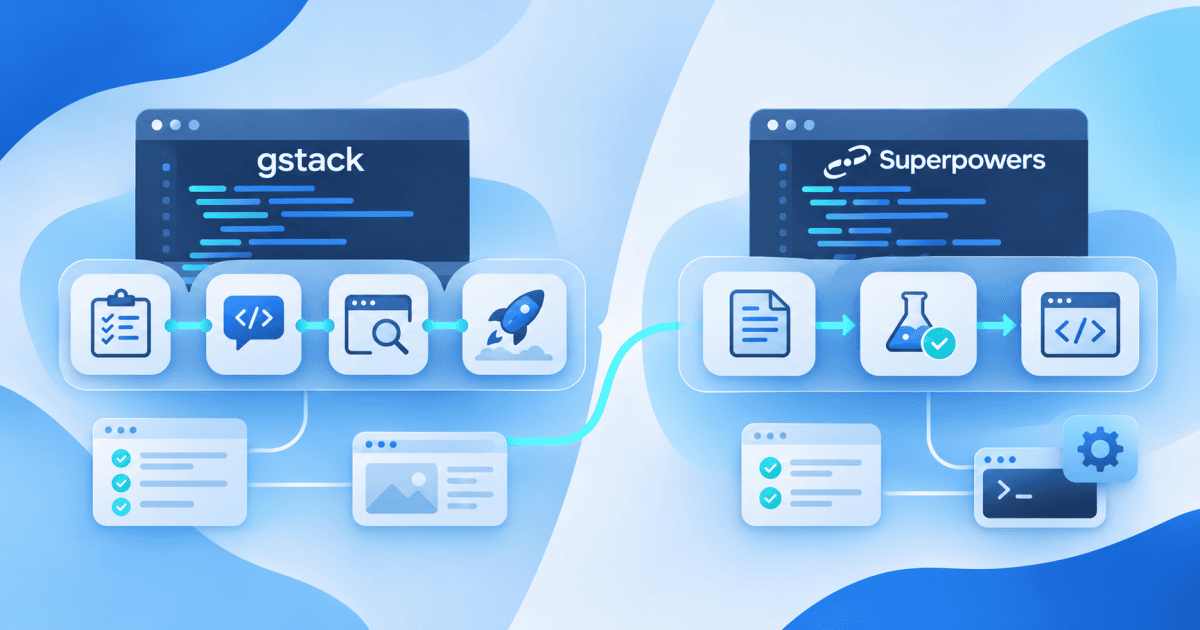
Choosing the right workflow for Claude Code depends on how much structure you want around planning, coding, testing and delivery.
gstack, Superpowers and GSD(Get Shit Done) all extend AI-assisted development, but they approach the problem differently. gstack organizes development around specialized engineering roles and broader software delivery workflows. Superpowers emphasizes structured planning, specification, Test-Driven Development and subagent-driven execution. GSD focuses on spec-driven development and context management for longer AI coding projects.
GBrain sits in a different category. Rather than replacing these workflows, it provides persistent project memory and knowledge that AI agents can retrieve across sessions.
This guide compares gstack, Superpowers, GSD and GBrain across workflow scope, planning, testing, browser capabilities, memory and deployment. It also explains the VPS resources you may need when running gstack and Claude Code workflows on an always-on server.
Quick answer: gstack vs Superpowers vs GSD
| Tool | Choose it if… |
| gstack | You want a broader AI software development workflow — covering product planning, engineering review, browser-based QA, and release tasks |
| Superpowers | Your priority is a disciplined development methodology built around specification, planning, Test-Driven Development, and structured implementation |
| GSD | You need strong context engineering and spec-driven workflows that keep longer AI coding projects organized across multiple tasks and sessions |
| GBrain | You need persistent project knowledge and searchable memory across sessions- used alongside gstack or other AI agents, not as a standalone pick |
In short: gstack covers the broadest slice of the dev lifecycle, Superpowers enforces TDD discipline, and GSD is built to keep long, complex projects organized across sessions. GBrain isn’t a fourth competing option, it’s the memory layer you’d pair with any of the three.
What is the difference between gstack, Superpowers and GSD?
gstack, Superpowers and GSD all add structure to AI-assisted software development, but they differ in how they organize planning, implementation, testing and project context.
| Feature | gstack | Superpowers | GSD |
| Primary approach | Role-based software delivery | Structured development methodology | Spec-driven development and context engineering |
| Planning | Product and engineering workflows | Requirements, specifications and implementation plans | Project specs and phased execution plans |
| Implementation | Specialized engineering workflows | Structured, subagent-driven execution | Task-based execution from defined plans |
| Testing | Code review and browser-based QA workflows | Strong Test-Driven Development emphasis | Verification within planned workflows |
| Context management | Project state and workflow context | Specifications and task-level context | Strong focus on managing context across longer projects |
| Browser workflows | Built-in browser and visual QA capabilities | Not a primary focus | Not a primary focus |
| Best suited for | Broader AI-assisted software delivery | Disciplined feature development | Complex, multi-stage AI coding projects |
The main difference is where each framework places its structure. gstack extends Claude Code across broader software delivery roles. Superpowers emphasizes disciplined planning, specification, testing and implementation. GSD focuses heavily on maintaining project context and execution structure as AI coding projects become more complex.
gstack: Role-based software delivery
gstack is an open-source workflow framework that gives Claude Code access to specialized development roles and skills across the software lifecycle.
Its workflows extend beyond code generation into areas such as product planning, engineering review, browser-based QA and release tasks. This makes it useful for developers who want Claude Code involved across more stages of software delivery.
Superpowers: Structured development methodology
Superpowers is an open-source agentic development framework built around structured software engineering practices.
Its workflow combines requirements discovery, specification, planning, Test-Driven Development and subagent-driven implementation. Rather than focusing only on generating code, it introduces guardrails around how features are defined, implemented and verified.
GSD: Spec-driven context engineering
GSD, or Get Shit Done, uses specifications, planning artifacts and structured execution to keep longer AI coding projects organized.
It breaks complex work into manageable phases and carries the required project context between tasks. This helps reduce context drift and keeps AI coding tools aligned with the original project scope as development progresses.
How does gstack compare to Superpowers for Claude Code?
gstack and Superpowers both structure Claude Code workflows, but they focus on different parts of development.
gstack covers broader software delivery tasks such as planning, code review, browser-based QA and release workflows.
Superpowers focuses more on development discipline through requirements, implementation planning, Test-Driven Development and structured subagent execution.
| Area | gstack | Superpowers |
| Core focus | Broader software delivery | Structured development methodology |
| Planning | Product and engineering workflows | Requirements and implementation plans |
| Testing | Code review and browser QA | Strong TDD workflow |
| Execution | Role-based skills | Structured subagent execution |
| Best fit | End-to-end workflow support | Disciplined feature development |
When should you choose Superpowers over gstack?
Superpowers offers targeted advantages for developers wanting strict testing methodology:
- Strict Test-Driven Development: Superpowers enforces unit test creation before code generation. This prevents untested code from entering repository branches.
- Lightweight local execution: Superpowers operates without bundled headless browser binaries. This minimizes local CPU and memory overhead.
- Targeted specification rules: The framework provides clean prompt guardrails for developers. It suits teams preferring manual control over planning and release steps.
Choosing Superpowers suits teams seeking focused TDD discipline during local feature implementation. Examining how gstack compares to GSD highlights a different set of workflow trade-offs.
How does gstack compare to GSD?
gstack and GSD both structure AI coding workflows, but they solve different problems.
gstack focuses on broader software delivery with role-based workflows for planning, review, browser QA and release tasks.
Example: using gstack
For a new checkout flow, you could use gstack to plan the feature, review the implementation, test it in a browser and prepare it for release.
GSD focuses more heavily on spec-driven development and context management, helping longer AI coding projects stay organized across multiple phases and tasks.
Example: using GSD
For a larger project, GSD can break the work into phases, create structured plans and verify each phase before moving forward.
| Area | gstack | GSD |
| Core focus | Broader software delivery | Spec-driven context engineering |
| Planning | Product and engineering workflows | Structured specs and phased plans |
| Context | Workflow and project state | Strong focus on long-running project context |
| Testing | Review and browser-based QA | Verification within planned execution |
| Best fit | Broader delivery workflows | Complex, multi-stage coding projects |
Choose GSD when your priority is keeping complex projects structured and maintaining context across longer workflows.
Choose gstack when you want Claude Code involved across more software delivery roles, including review, QA and release tasks.
Is GBrain a competitor or an addition to gstack?
GBrain is better viewed as a complement to gstack, not a direct competitor.
gstack structures how AI agents work across planning, engineering, QA and release tasks. GBrain focuses on persistent project memory, helping agents retrieve useful knowledge from previous work and codebase documentation.
Example: using GBrain with gstack
A team could use gstack to manage development workflows while GBrain stores architectural decisions, project notes and codebase context for future sessions.
This makes the two tools complementary: gstack manages the workflow, while GBrain helps preserve long-term project knowledge.
What VPS hardware is required to run gstack and alternative skill packs?
The hardware you need depends on how many Claude Code sessions, browser tasks and background workflows you plan to run.
For Bluehost gstack VPS image, the recommended minimum is 2 CPU cores, 4 GB RAM and 20 GB disk space. Bluehost recommends 4 CPU cores, 8 GB RAM and 30 GB disk space for heavier workloads.
| Workload | Suggested resources |
| Basic gstack use | 2 CPU, 4 GB RAM |
| Recommended gstack setup | 4 CPU, 8 GB RAM |
| Browser QA and parallel workflows | More CPU and memory headroom recommended |
| Superpowers or GSD | Depends mainly on Claude Code workload and project size |
gstack generally benefits from more resources when you run browser-based QA, multiple Claude Code sessions or parallel background tasks.
Superpowers and GSD do not rely on the same browser-heavy workflow by default, so their resource needs are more closely tied to the size of your projects and the number of concurrent coding sessions.
Why run gstack and Claude Code on a VPS?
Running gstack and Claude Code on a VPS gives you an always-on development environment that is not tied to your local machine.
A VPS is especially useful when you need to:
- Keep workflows running: Continue background tasks even when your laptop is offline.
- Run browser-based QA: Give headless browser workflows dedicated server resources.
- Support parallel sessions: Run multiple Claude Code or agent workflows without competing with local applications.
- Keep dependencies consistent: Maintain the same tools, packages and project environment across sessions.
- Access projects remotely: Connect through SSH from different devices when needed.
For lighter development work, a local machine may be enough. A VPS becomes more useful as workflows become longer, more automated or more resource-intensive. Look at the best VPS plans for running gstack and Claude Code.
Why choose Bluehost for running gstack and Claude Code skill packs?
Bluehost Self-Managed VPS gives gstack and Claude Code workflows dedicated server resources with full root SSH access.
You can choose a VPS configuration based on how many coding sessions, browser tasks and background processes you expect to run.
Key advantages include:
- Full root access: Install and manage the tools, packages and dependencies your workflow needs.
- DDR5 RAM and NVMe storage: Support active development tasks, repositories and browser-based workflows.
- Always-on environment: Keep development tools and background processes available without relying on a local machine.
- Flexible VPS resources: Choose more CPU, memory and storage as workloads grow.
- gstack deployment option: Select the gstack application during supported Self-Managed VPS setup to reduce manual configuration.
For heavier gstack workflows, the recommended configuration is a better fit than the minimum setup, especially when running browser QA or multiple Claude Code sessions.
Final thoughts
gstack, Superpowers and GSD aren’t competing to solve the same problem. Each adds structure to a different part of the process: delivery breadth for gstack, testing discipline for Superpowers, context management for GSD. GBrain sits outside that choice entirely, adding memory to whichever framework you’re already running.
The more useful question at this point isn’t which framework fits today but it’s what happens once you push it. Parallel Claude Code sessions, browser-based QA, and long-running background tasks all demand more from the machine underneath, regardless of which framework is organizing the work. At that point, the limiting factor stops being the workflow and starts being the infrastructure.
If gstack is the framework you land on, this Bluehost VPS configuration comes with the gstack image pre-selected on a 2-year term, so you can size CPU, RAM and storage to the workflow instead of guessing upfront.
FAQs
gstack automates a full-cycle 7-stage sprint process (Think to Reflect) with engineering role skills and bundled headless browser QA. Superpowers focuses specifically on Test-Driven Development discipline and specification writing guardrails.
GSD is a lightweight meta-prompting system designed to manage context windows and prevent AI drift. gstack provides an end-to-end software delivery pipeline, including visual QA testing, code review and automated deployment.
No. GBrain is an open-source persistent memory store created by Garry Tan. It integrates directly into gstack via /setup-gbrain and /sync-gbrain to provide long-term knowledge graph storage.
Bluehost recommends the NVMe 8 VPS plan. It features 4 vCPU cores, 8 GB DDR5 RAM and 200 GB NVMe storage. Pricing starts at $12.99 per month on a 24-month term (renews at $28.99 per month). It provides sufficient memory for background headless Chromium instances.
Yes. Bluehost offers pre-installed gstack provisioning on Self-Managed VPS plans. You can select gstack under the Software section on the Application tab during server checkout.

Write A Comment