


Key highlights
- Choosing between a new domain vs expired domain depends on your goals, budget and risk tolerance.
- A new domain gives you complete brand control with zero risk of inherited penalties or toxic backlinks.
- Expired domains can transfer existing authority and help bypass the Google Sandbox Effect in competitive niches.
- Domain age alone is not a Google ranking factor. Backlink quality and history are what truly matter.
- Always audit an expired domain for penalties, spam score and backlink profile before making any purchase.
- Registering a new domain with Bluehost takes minutes and includes a free domain with select hosting plans.
Somewhere between buying your hosting plan and setting up your first page, a question stops you cold – should you register a new domain or just buy an expired one with authority already built in?
Nobody really prepares you for this moment. And the internet does not make it easier – half the advice says expired domains are an SEO goldmine, the other half says avoid them entirely. Both sides sound convincing enough to keep you stuck.
Sound familiar?
This is exactly where most new website owners lose time, money and sometimes both. The domain decision feels simple on the surface but carries real consequences for your search rankings, brand identity and long-term growth.
So before you type anything into a search bar or hand over your card details, read this first.
This blog breaks down new domain vs expired domain in plain language so you can make the right call with confidence.
What is a new domain?
A new domain is any domain name that has never been registered before or has been registered fresh without any prior history. When you register a new domain name, you start with a completely blank record – no backlink profile, no indexed pages, no prior penalties and no association with any previous content or owner.
New domains are the most common starting point for businesses, bloggers and entrepreneurs building a web presence for the first time. They are widely available through domain registrars and hosting providers, often at minimal annual cost. Many web hosting plans, including entry-level shared hosting packages, include a free domain for the first year to lower the barrier to entry.
Advantages of a new domain
- Full creative control over your brand name and domain extension
- Zero risk of inherited penalties, toxic backlinks or spam associations
- Clean content history that aligns entirely with your niche
- Easier to build a consistent brand identity from day one
- Transparent ownership with no reputation baggage
Disadvantages of a new domain
- Slower initial ranking progress due to the Google Sandbox Effect
- Requires more time and investment in link building and content creation
- No pre-existing domain authority to leverage from day one
- Organic traffic growth typically follows a longer curve
The trade-off is that new domains typically take anywhere from three to twelve months to gain meaningful traction in search results. Google tends to observe new sites carefully before awarding strong rankings, a phenomenon sometimes called the Google sandbox effect.
Who should register a new domain?
- You are launching a new business, blog or personal site
- You want full control over your brand name and identity
- Your budget is limited and you prefer predictable, low costs
- Your timeline is flexible – you can invest in long-term content and SEO
- You want zero risk of inheriting someone else’s digital history
Bluehost includes a free domain name for the first year with select hosting plans. And if the name you want is already taken, the Bluehost AI Domain Name Generator helps you find smart, brandable alternatives based on your keywords – so you are never stuck starting from scratch on naming.
What is an expired domain?
An expired domain is a domain name that was previously registered but whose owner chose not to renew it. Once the renewal deadline passes and the grace period ends, the domain enters a deletion cycle and eventually becomes available for public registration or auction.
Understanding what happens when a domain expires is critical before you pursue this strategy. The process generally follows a predictable timeline:
- Expiration: The domain expires on its renewal date
- Grace period: The original owner typically has 0–45 days to renew at standard cost
- Redemption period: A further 30-day window where renewal is possible at a higher fee
- Pending delete: The domain is queued for deletion (approximately five days)
- Public availability: The domain is released and can be registered or auctioned
Expired domains are sought after because they may carry residual SEO value from their previous life. If the former owner built quality content and earned legitimate backlinks, those links may still be active and pointing to the domain – providing an immediate head start in search rankings.
Advantages of an expired domain
- Potential to inherit valuable backlinks and domain authority
- May skip the Google Sandbox period entirely with a solid, clean link profile
- Indexed pages may still appear in search results, accelerating early visibility
- Possible residual traffic from users who bookmarked the site or clicked old links
- Ideal for competitive niches where building authority from scratch takes years
- Opportunities in domain flipping for resale at profit
Disadvantages of an expired domain
- Risk of inheriting Google penalties or manual actions from a prior owner
- Toxic or irrelevant backlinks can actively harm your SEO rather than help it
- Premium expired domains carry a significantly higher purchase price
- Due diligence is time-consuming and requires SEO expertise and the right tools
- Past content that mismatches your niche can confuse Google about your site’s purpose
Also read: Domain Renewal Importance: Expired Domain Recovery Guide
Why you might want an expired domain
An expired domain is worth considering when you want to skip the slow, uncertain climb that comes with building authority from zero. The core appeal is time: instead of waiting months for Google to trust your site, you inherit an existing backlink profile, domain history and SEO equity that can compress your path to visibility.
For small business owners and content creators entering competitive niches – think personal finance, health or digital marketing – this head start is genuinely valuable. A well-chosen expired domain can mean ranking for target keywords in weeks rather than a year or more. The real strategic advantage is not just the domain age itself, but the accumulated trust signals attached to it: quality inbound links, indexed pages and an established footprint that search engines already recognize. When those signals align with your niche, the SEO compounding effect can be significant.
New domain vs expired domain: A side-by-side comparison
Both options serve very different purposes, and the right choice depends entirely on what you are trying to build, how fast you need results and how much risk you are willing to manage. A new domain gives you safety, simplicity and complete brand ownership. An expired domain offers a potential shortcut to authority – but only when chosen carefully.
Before diving into the full breakdown, here is a quick reference to see how both options stack up across the factors that matter most.
| Factor | New domain | Expired domain |
|---|---|---|
| SEO authority | Starts from zero | May carry existing DA/backlinks |
| Backlink profile | None – built from scratch | Pre-existing (quality varies) |
| Cost | Low ($10–$20/year) | Variable ($50 to thousands+) |
| Risk level | Very Low | Medium to High |
| Branding control | Full – you define the name | Limited to what’s available |
| Google sandbox effect | Yes – initial ranking delay | Possibly bypassed if domain is clean |
| Setup complexity | Simple | Requires due diligence |
| Traffic from Day 1 | None | Possible residual traffic |
| History/Baggage | None | Could be clean or penalized |
| Best for | New brands, long-term building | SEO-competitive niches, faster authority |
Deciding when to buy an expired domain vs. a new domain
The right choice depends on your goals, experience level and timeline. Use these scenarios as a practical guide:
- You are launching a brand-new business or personal brand: Register a new domain. You get full naming control and zero risk of inherited penalties from a previous owner.
- You are a beginner building your first site: Stick with a new domain. It is simpler to manage and eliminates the need for technical due diligence or SEO audits.
- You are entering a competitive niche like finance, health or legal: A clean expired domain with a strong backlink profile can compress years of authority building into months.
- You are an agency or SEO professional scaling client sites: Purchasing an expired domain with verified metrics and topical relevance delivers measurable ranking advantages faster than starting fresh.
- You are exploring domain flipping: Expired domains with high domain ratings and clean histories offer strong resale potential across any active expired domain marketplace.
Domain age and SEO: Does it really matter?
One of the most frequently searched questions in this space is: does domain age affect SEO? The short answer is – somewhat, but not in the way most people think.
Google’s John Mueller has publicly stated that domain age itself is not a direct ranking factor. However, this does not mean age is irrelevant. Older domains tend to have a longer history of content, more accumulated backlinks and an established trust signal with search engines. It is not the age alone that matters – it is what the domain did during those years that counts.
When you buy an aged domain, you are essentially buying the reputation it built over time. If that reputation is strong – relevant backlinks from authoritative sites, a clean spam score, consistent content history in a defined niche – then domain age and SEO performance can be positively correlated. If the history is poor, you inherit those problems.
Key SEO signals attached to expired domains
- Backlink profile: The number and quality of inbound links pointing to the domain
- Domain rating (DR): A metric used by tools like Ahrefs to gauge overall link authority
- Spam score: A Moz metric indicating how closely the domain resembles known spam sites
- Anchor text distribution: Whether the link profile looks natural or over-optimized
- Content niche alignment: Whether the domain’s past content matches your intended use
Tools like Ahrefs, Majestic and SEMrush allow you to audit a domain’s history thoroughly before committing. Skipping this step is one of the most common and costly mistakes buyers make on an expired domain marketplace.
Who should buy an expired domain?
An expired domain makes the most strategic sense when you are entering a competitive niche where building authority from zero would realistically take years. If you are building a content site, an affiliate site or a digital publication in a crowded vertical – think finance, health, legal or technology – inheriting a domain with a strong, relevant backlink profile can meaningfully accelerate your timeline.
This path is best suited for marketers and SEO professionals who are comfortable running full domain audits and know how to interpret the data correctly. The process is not casual – it requires investment in tools, time and judgment. If you have that expertise, or access to someone who does, and you have found a domain with verified clean history and topically aligned backlinks, the upside can be significant.
How to find and buy an expired domain
If you have decided that an expired domain is the right strategy, the next step is knowing where and how to purchase expired domain names safely and effectively.
Best places to buy expired domains
Several platforms specialize in listing expired domain for sale options across various niches. Here are the most reputable sources:
- GoDaddy auctions: One of the largest expired and expiring domain marketplaces with extensive filtering options
- Namecheap marketplace: A reliable platform for finding affordable aged domains with decent metrics
- ExpiredDomains.net: A free aggregator that pulls data from multiple registrars and includes backlink and Moz metrics
- Flippa: More geared toward full website acquisitions but includes aged domain listings
- SEDO: A premium expired domain marketplace focused on high-value domain transactions.
Also read: The Best Domain Registrars: Choose the Right Domain Registrar
What to check before you buy an aged domain
Rushing into a buy aged domain decision without proper vetting is a costly mistake. Run every domain through the following checklist before committing:
- Check the backlink profile in Ahrefs or Majestic for link quality and relevance.
- Run the domain through Moz’s Link Explorer to review the spam score – keep it below 30%
- Search the domain in Google to confirm it is not currently penalized or deindexed
- Review historical content via the Wayback Machine to ensure the niche aligns with your plans
- Check WHOIS history to understand how many times the domain has changed hands
- Verify that the domain has not been used for black-hat SEO or link farming schemes
If the domain passes these checks, it is likely a solid candidate. If any red flags emerge – particularly a Google penalty or a spam score above 50 – walk away regardless of the metrics it shows on third-party tools.
Pro tips for buying expired domains successfully
Going beyond the basics separates a smart purchase from an expensive mistake. These expert-vetted steps will sharpen your vetting process before you commit to any expired domain for sale:
- Cross-check the Wayback Machine: Review archived snapshots at web.archive.org to confirm the domain’s historical content matches your niche – multiple unrelated uses signal instability
- Check Google Search Console for manual actions: If possible, request access from the previous owner or search “site:[domain].com” in Google to spot deindexed pages
- Audit anchor text ratios: Over-optimized exact-match anchors above 30% in Ahrefs indicate manipulative link building that could trigger future penalties
- Verify the domain resolves cleanly: Confirm no active redirects or parked ad pages are currently attached
- Pair with reliable hosting infrastructure: Even a domain with strong history needs a dependable foundation – Bluehost’s built-in failover systems ensure uptime stability as you rebuild and grow the site
Where to register or acquire your domain
Whether you are going with a fresh domain or an expired one, the platform you register through matters. Here is where to get started based on the path you choose.
Registering a new domain with Bluehost
Once you have locked in the right name, getting it registered on Bluehost is a quick and simple process. Follow these steps to get started:
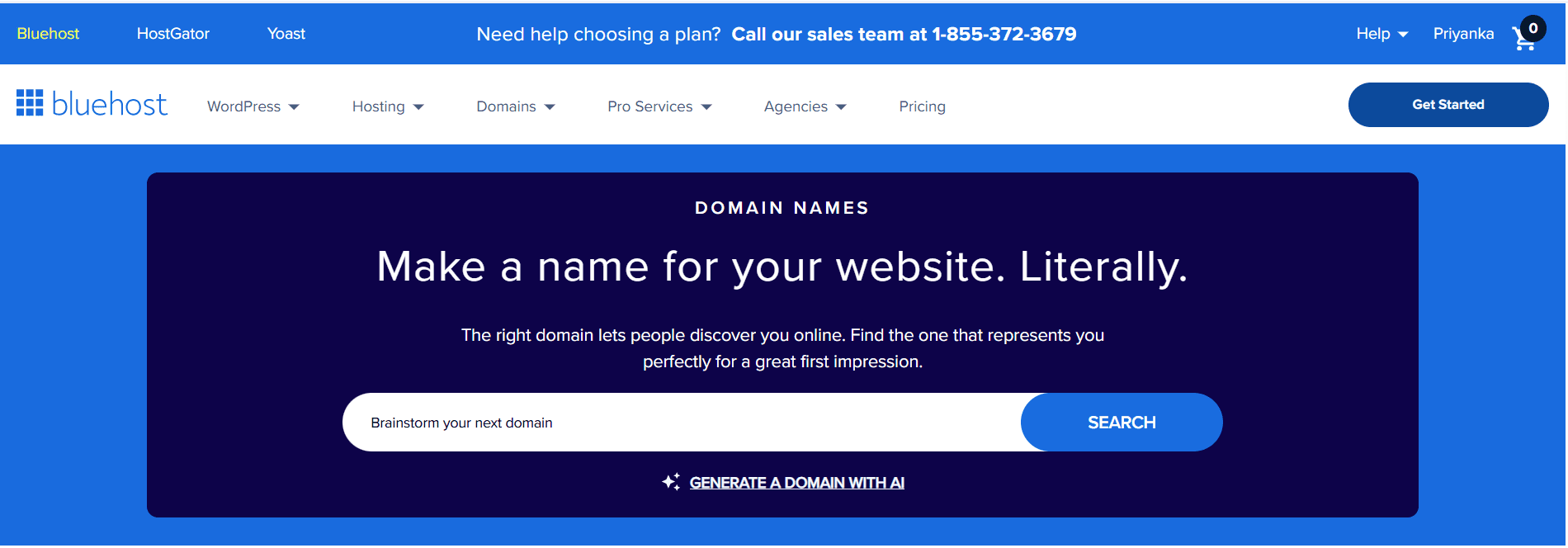
Step 1: Search for your domain: Head over to Bluehost’s domain search tool, enter the name you have in mind and click search. You will see availability results right away – along with alternative suggestions in case your first choice has already been claimed.
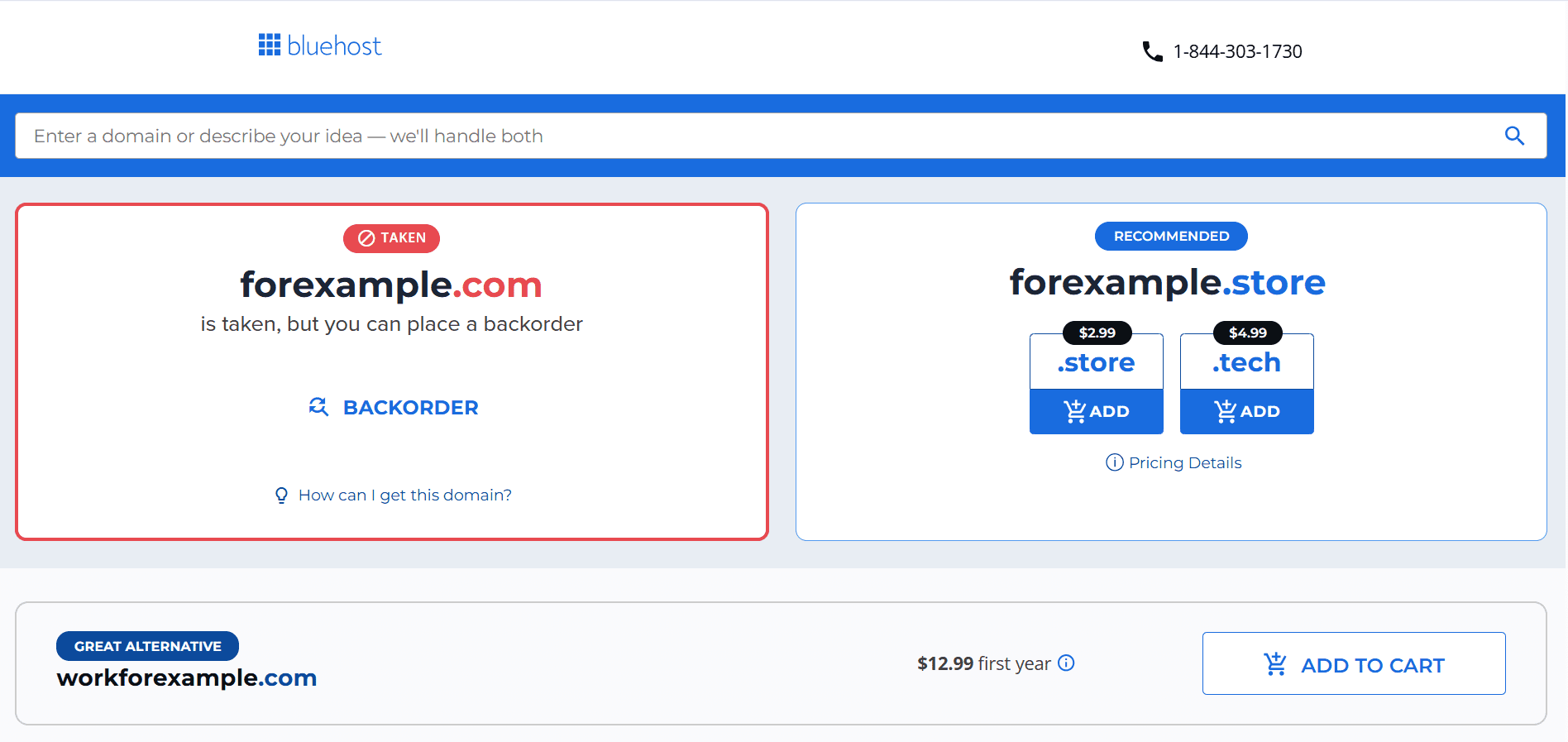
Step 2: Select your domain: Pick the name and extension that best represent your brand. If the .com version is not available, Bluehost displays other extension options so you can compare and choose the best fit without leaving the page.
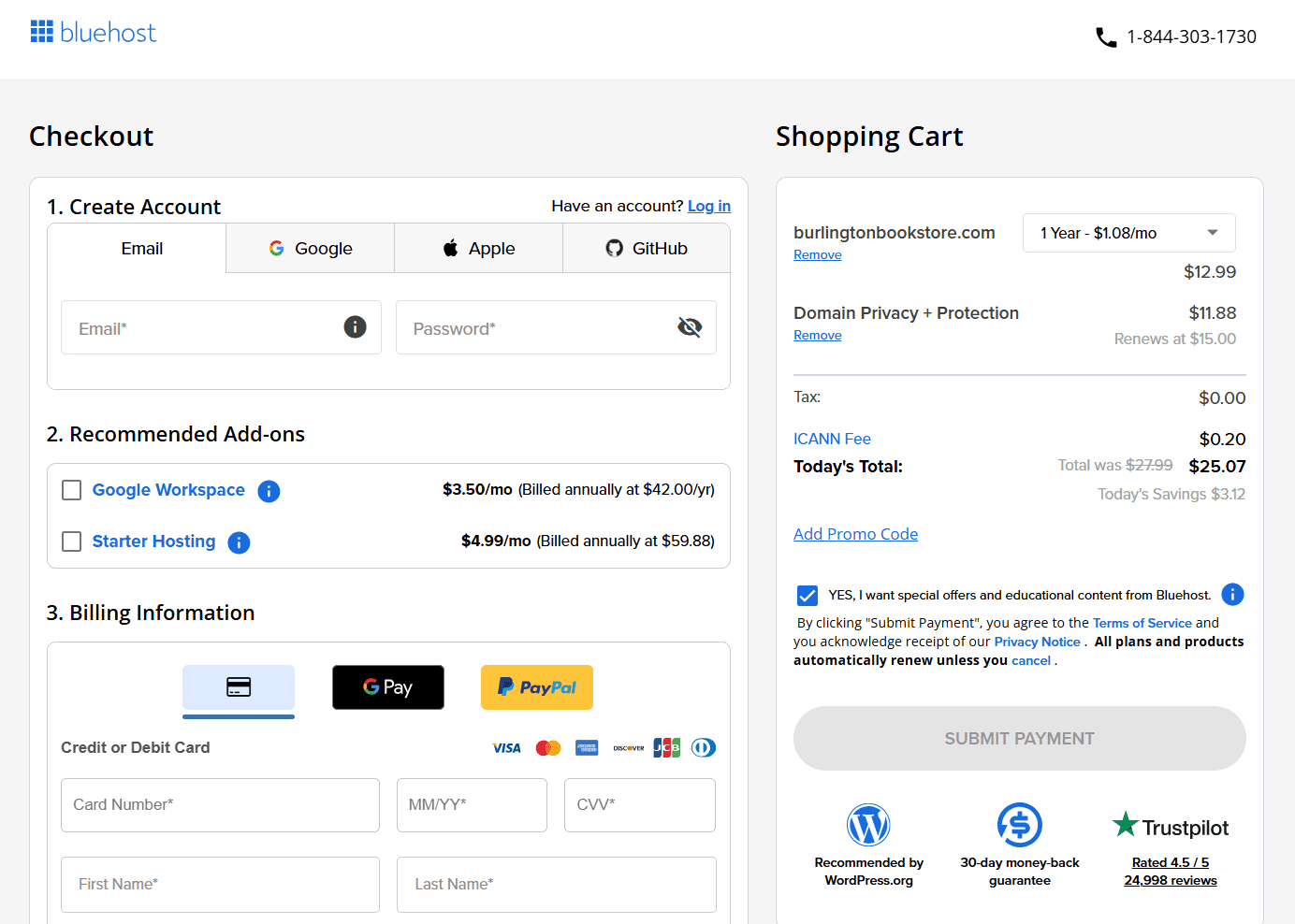
Step 3: Add domain privacy protection: During checkout, you will see the option to include Domain Privacy + Protection. Enabling this shields your personal contact details from appearing in the public WHOIS directory – a small step that is well worth taking.
Step 4: Create your Bluehost account: Enter your account details to get set up. If you are combining your domain with a hosting plan, this is the stage where you make that selection. Certain hosting plans come with a free domain for the first year and an SSL certificate is included at no extra cost.
Step 5: Complete your purchase: Go over your order summary, confirm payment and your domain is registered. From your Bluehost dashboard, you can handle everything going forward – renewals, DNS configuration and privacy settings all in one place.
Using a 301 redirect with an expired domain
One advanced strategy that SEO professionals use is purchasing an expired domain and setting up a 301 redirect expired domain to funnel its link equity into a new or existing site. A 301 redirect is a permanent redirect that tells search engines the content has moved – and that the authority of the original domain should follow.
This tactic can be powerful when executed correctly. If you find an expired domain with relevant backlinks pointing to it, redirecting it to your primary domain may help pass that link authority over, strengthening your main site’s rankings without requiring you to actually build out a second website.
Important caveats for 301 redirect strategies
- Google does not guarantee that 100% of link equity transfers through a redirect
- Redirecting an irrelevant domain to your site can dilute topical authority
- Expired domains used purely for manipulation may trigger algorithmic scrutiny
- Always match the niche of the expired domain to your primary site’s topic
The 301 redirect approach works best when the expired domain has a natural, organic backlink profile and when the redirect makes contextual sense to both users and search engines.
Final thoughts
You came into this with a question and hopefully you are leaving with a clear answer.
A new domain is not the slow option. It is the smart option for anyone who wants to build something real, on their own terms, without cleaning up someone else’s mess first.
An expired domain is not a cheat code. It is a calculated move that pays off only when the research backs it up completely.
Either way, the domain is just the starting point. What you build on it is what actually determines where you end up in search results six months from now.
So stop sitting on the decision. Your website does not get built in browser tabs.
Ready to take the first step? Register your domain on Bluehost today and build something worth ranking for. Your future site is one search away.
FAQs
When a domain expires, it enters a grace period during which the original owner can renew it. If not renewed, it moves to a redemption period and then a pending delete phase before being released for public registration or auction. The entire process typically takes 60-80 days from the expiration date.
Domain age is not a direct Google ranking factor, but older domains often carry more accumulated backlinks and trust signals that indirectly improve SEO performance. What matters more than age itself is the quality of the domain’s history – including its content, backlink profile and absence of penalties.
The best places to buy expired domains include GoDaddy Auctions, ExpiredDomains.net, SEDO and Namecheap Marketplace. Each platform offers different filtering tools and price ranges. Always audit domain metrics through Ahrefs, Moz or Majestic before making a purchase, regardless of the platform you use.
Yes, a 301 redirect from an expired domain can help pass link equity to your primary website, but results are not guaranteed. Google does not transfer 100% of authority through redirects, and the expired domain must be topically relevant to your site. Using unrelated domains purely for manipulation can trigger algorithmic penalties.
Domain flipping can be profitable for those with strong SEO knowledge and an understanding of <a href=”https://www.bluehost.com/blog/how-to-calculate-domain-worth/” target=”_blank” title=”How Much Is My Domain Worth? Quick Valuation Guide”>domain valuation</a>. Expired domains with high authority and clean backlink profiles can resell at significant premiums. However, it requires active research, market awareness and upfront investment – it is not a passive income strategy.

Write A Comment