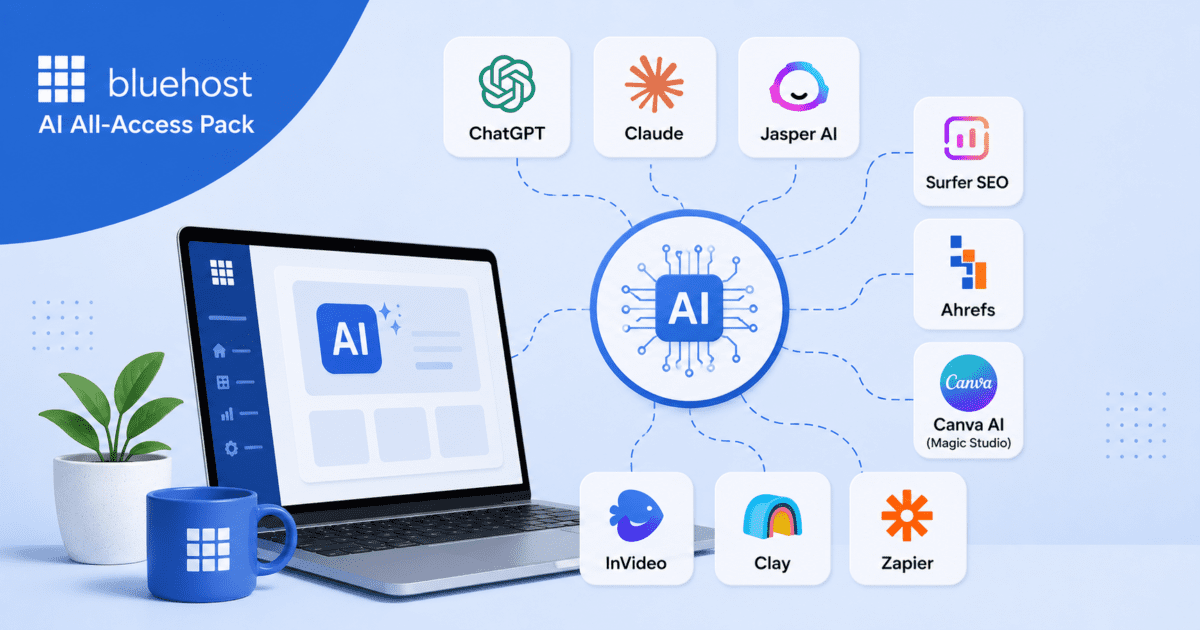
 ChatGPT,
 Claude,
 Gemini,
 Grok — all four for
Key highlights
- Discover the 10 best AI tools for affiliate marketing in 2026, covering content creation and outreach automation.
- Learn how Bluehost AI All-Access Pack bundles 4 tools into a single $20/month subscription instead of four separate bills.
- Understand which AI tools also run their own affiliate programs, including Bluehost, InVideo and Leonardo AI, so you can earn commissions.
- Explore a step-by-step workflow for automating affiliate growth, from keyword research and drafting content and outreach.
- Uncover five ready-to-use ChatGPT prompts built specifically for affiliate marketing.
If you’ve been doing affiliate marketing for more than a few months, you already know the job is bigger than “find a product, write about it.” On any given week you’re researching keywords, drafting content, optimizing for SEO, designing graphics, pitching partners and digging through analytics often all before lunch. That’s a lot for one person to carry, which is exactly why ai tools for affiliate marketing have gone from a nice-to-have to something close to a survival tool.
In this guide, we’ll walk through the 10 best AI tools for affiliate marketing right now, point out which ones also run their own affiliate programs you can promote and cover a step-by-step workflow. It also includes specific ways to use ChatGPT for affiliate marketing for scaling affiliate marketing with automation instead of just your writing.
What are AI tools for affiliate marketing?
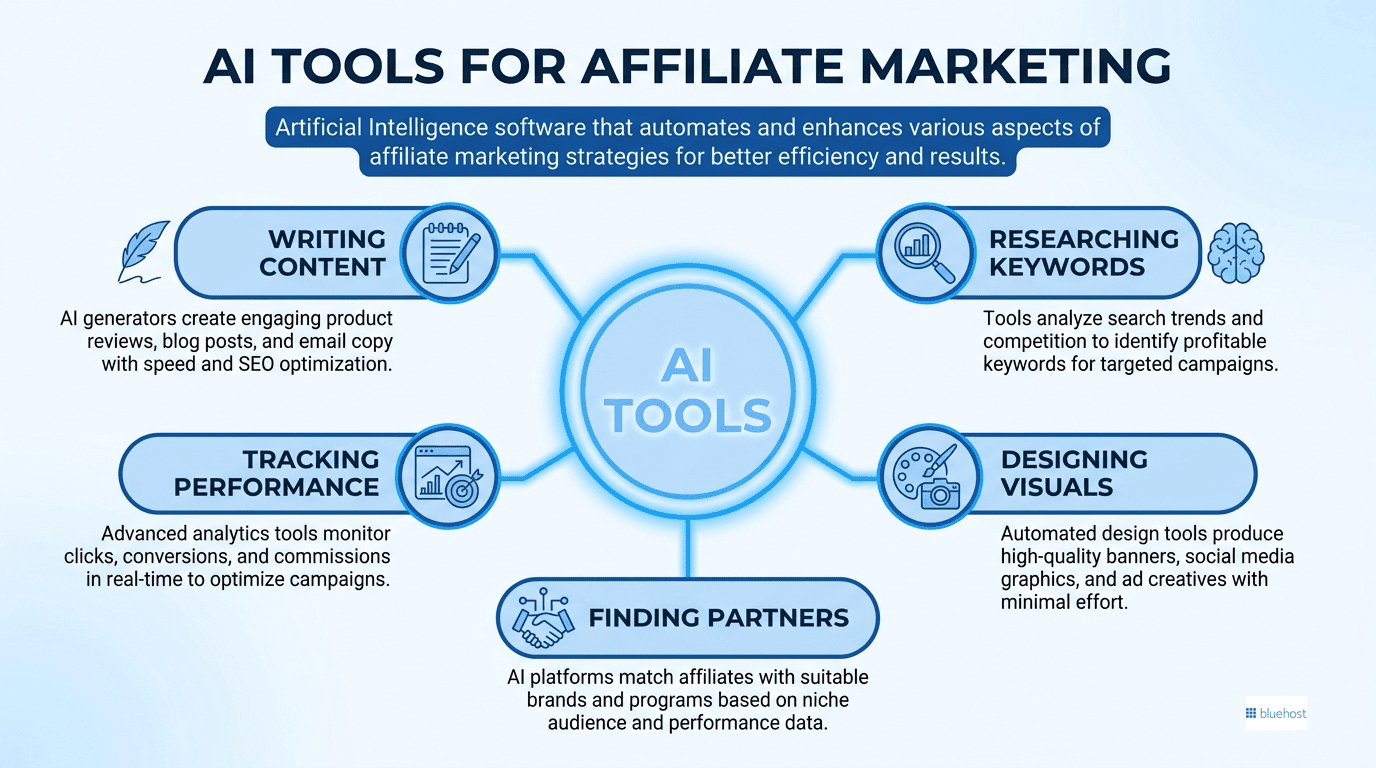
AI tools for affiliate marketing are software platforms that use artificial intelligence to speed up or automate the tasks affiliate marketers handle every day writing content, AI-driven keyword research, designing visuals, finding partners and tracking performance.
Most of what’s on the market falls into four categories:
- Content & SEO: Drafting reviews, comparisons and guides built to rank
- Research: Keyword gaps, competitor moves and audience insights
- Visuals & video: Thumbnails, social graphics and short-form clips
- Outreach & automation: Finding partners and connecting your tools so work happens without you
Most affiliate marketers end up needing at least one tool from each bucket, not a single tool that claims to do everything.
Also read: 25 Best AI Productivity Tools to Boost Work Efficiency in 2026
How we chose these tools?
Before ranking anything, we looked at what actually matters for affiliate marketers specifically, not marketers in general:
- Actionable output: Does it produce something publishable, not just a rough idea
- Real ROI potential: Does it plausibly move traffic, conversions or hours saved
- Ease of use: Can you get value in your first session, not after a week of setup
- Specialization: Does it solve one specific problem really well
- Value for the price: Is the subscription justified by what it replaces
Quick comparison: Best AI tools for affiliate marketing at a glance
Here’s the short version before we get into the details on each one.
Comparison of best AI tools for affiliate marketing
| Tools | Best for | Key features | Starting price |
| Bluehost AI All-Access Pack | One sub, four AI models | ChatGPT + Claude + Gemini + Grok bundled | $20/mo |
| ChatGPT | Drafting & ideation | Fast iteration, custom GPTs | Free / ~$20/mo |
| Claude | Long-form research content | Large context, careful reasoning | Free / ~$20/mo |
| Jasper AI | On-brand marketing copy | Brand Voice + 100+ templates | From ~$39/mo |
| Surfer SEO | On-page SEO optimization | Real-time Content Score | From ~$89/mo |
| Ahrefs | Keyword & competitor research | Site Explorer + content gaps | From ~$129/mo |
| Canva AI (Magic Studio) | Visuals & social creatives | Magic Design, Magic Media | Free / ~$13/mo |
| InVideo | Turning posts into video | Script-to-video, auto captions | From ~$20/mo |
| Clay | Affiliate/partner outreach | 150+ data sources, AI enrichment | From ~$149/mo |
| Zapier | Connecting your stack | No-code automations | Free / ~$20/mo |
Note: Pricing listed above is accurate as of 23 June 2026 and is subject to change. For the most up-to-date pricing, features and plan details, visit the official Bluehost pricing page.
The 10 best AI tools for affiliate marketing in 2026
Here’s the breakdown, what each tool actually does, who it’s best for and where it falls short.
1. Bluehost AI All-Access Pack: Best all-in-One AI subscription for affiliate marketers

Most affiliate marketers don’t actually want just one AI model. You want ChatGPT for fast drafts, Claude for the long, careful stuff, Gemini for research and multimodal work and Grok for digging into real-time trends. The problem is paying for all four separately can run $80–100+ a month before you’ve published a single article.
Bluehost AI All-Access Pack solves that exact problem. For about $20/month, you get paid access to ChatGPT, Claude, Gemini and Grok in one place i.e. no separate logins, no juggling four billing pages and no Bluehost hosting plan required to use it.
Why it earns the top spot: affiliate content benefits from switching models depending on the task one for punchy product comparisons, another for nuanced, fact-heavy reviews. Getting all four under one $20 subscription instead of four separate ones is the simplest way to cut your AI budget without cutting your output.
- Four leading models, one login: ChatGPT, Claude, Gemini and Grok under a single $20/month plan
- Pre-built AI agents: Ready-made workflows for drafting, research and more, no setup required
- Built-in privacy mode: A sanitization layer for sensitive prompts on the higher-tier plan
- Works standalone: No Bluehost hosting plan required to use it
- One bill instead of four: Cuts AI spend without cutting which models you can use
Best for: Affiliate marketers and small teams who want flexibility across AI models without paying for four separate subscriptions.
Pricing: Plans start around $20/month.
2. ChatGPT: Best for fast drafting & content ideation
ChatGPT is still the most familiar entry point for ai tools for affiliate marketing and for good reason, it’s fast, flexible and good at getting a blank page moving.
It earns its spot here for brainstorming angles, generating outlines, drafting first-pass product descriptions, rewriting in different tones and turning long product specs into a quick comparison table.
- Pros: Huge ecosystem of custom GPTs, web browsing for current info, very fast iteration.
- Cons: Long-form output can read generic if you don’t edit and add your own experience; anything number-heavy still needs fact-checking.
Best for: Outlines, first drafts, brainstorming and quick-turn content.
Pricing: Free tier available; Plus around $20/month (also included in Bluehost AI All-Access Pack alongside three other models).
3. Claude: Best for long-form, research-heavy reviews

Claude tends to handle nuanced comparisons and long documents more carefully than a quick-draft tool which matters when you’re writing a 3,000-word buying guide that has to stay accurate across a dozen products.
It’s particularly useful for working with multiple product spec sheets or research docs at once and for restructuring a messy first draft into something genuinely readable without losing the details that matter.
- Pros: Strong with long documents and careful reasoning; good at holding a consistent argument across a long piece.
- Cons: Slightly less “playful” with copy than some tools; like any AI, still needs a human edit pass.
Best for: Long buying guides, comparison posts and research-heavy reviews.
Pricing: Free tier available; Pro around $20/month (also included in Bluehost AI All-Access Pack).
4. Jasper AI: Best for on-brand marketing copy at scale
If your affiliate business has outgrown one blog and now includes email sequences, social captions and ad copy, Jasper is built for that breadth.
Its Brand Voice feature keeps tone consistent across writers and channels and its large template library covers everything from Facebook ad copy to product description blocks.
- Pros: Versatile across formats; useful for teams that need consistency across multiple writers.
- Cons: Long-form blog output usually needs more editing than a writing-specific tool; doesn’t generate images or charts on its own.
Best for: Multi-channel affiliate brands juggling blog, email, social and ads at once.
Pricing: Plans start around $69/month.
5. Surfer SEO: Best for on-page SEO optimization
Writing a great review doesn’t matter much if it never ranks. Surfer closes that gap by analyzing what’s already ranking for your target keyword and handing you a concrete blueprint.
It gives a real-time Content Score while you write, suggesting word count, headings and related keywords based on top-ranking pages taking a lot of the guesswork out of on-page SEO.
- Pros: Data-backed structure instead of guessing; pairs well with any AI writer.
- Cons: It doesn’t write your content for you, you still need ChatGPT, Claude or a human writer to fill in the blueprint.
Best for: Affiliate sites focused on organic search traffic.
Pricing: Plans start around $119/month (billed monthly).
6. Ahrefs: Best for keyword & competitor research
Before you write anything, you need to know what’s actually worth writing about and what your competitors are ranking for that you’re not.
Ahrefs offers deep keyword data, content gap analysis and a clear view of exactly which pages are sending competitors organic traffic, with built-in AI summaries that speed up the “what should I write next” decision.
- Pros: Reliable, well-established data set; useful for both content planning and link building.
- Cons: Pricier than most single-purpose tools; has a learning curve if you’re new to SEO software.
Best for: Serious keyword research and ongoing competitor tracking.
Pricing: Plans start around $129/month.
7. Canva AI (Magic Studio): Best for visuals & social creatives
A wall of text doesn’t convert as well as a wall of text with a clean comparison graphic, a clear pros-and-cons image or a scroll-stopping Pinterest pin.
Magic Design turns a prompt into a usable layout, Magic Media generates images and quick clips and the resize tool makes repurposing one graphic across formats nearly instant.
- Pros: Genuinely easy for non-designers; the free tier is generous.
- Cons: The strongest AI features and premium assets sit behind Canva Pro.
Best for: Blog graphics, social posts and comparison images.
Pricing: Free; Pro around $114/month.
8. InVideo: Best for turning posts into short-form video
Affiliate content doesn’t have to live only on a blog anymore, Reels, Shorts and TikTok send real traffic to review content and InVideo is built to turn a script or blog post into video fast.
It can take a prompt, script or existing blog post and build a structured video around it, with stock footage and auto captions handling the parts that usually stall creators.
- Pros: Fast way to repurpose existing written content into video; solid template library.
- Cons: Like most AI video tools, output benefits from a manual trim-and-polish pass before publishing.
Best for: Repurposing reviews and roundups into short-form video.
Pricing: Plans start around $17/month (Basic plan).
9. Clay: Best for automating affiliate & partner outreach
Growing an affiliate business isn’t only about content at some point you’re also recruiting partners, pitching brands for better commission rates or building a network of sub-affiliates. Clay automates the un-fun parts of that.
It pulls data from 150+ sources to build “waterfall” enrichment workflows: find people writing about your niche, locate their contact details and send a genuinely personalized pitch at scale instead of one by one.
- Pros: Outreach personalization that’s very hard to match manually; flexible enough to build almost any prospecting workflow.
- Cons: Real learning curve; costs can climb with data-heavy workflows.
Best for: Affiliate marketers actively recruiting partners or pitching brands directly.
Pricing: Free plan, Paid plans start around $167/month.
10. Zapier: Best for connecting your entire AI stack
None of the tools above do much for you in isolation. The actual “automate your growth” part of affiliate marketing happens when they talk to each other.
Zapier connects thousands of apps without code a new keyword in your spreadsheet can trigger a content brief, a published post can trigger a social caption draft and a new lead from Clay can drop straight into your CRM.
- Pros: No-code automation across almost any tool you’re already using; a huge integration library.
- Cons: Complex multi-step automations can get pricey on higher tiers and take some trial and error to set up cleanly.
Best for: Tying your content, SEO, design and outreach tools into one workflow.
Pricing: Free tier available; paid plans start around $20/month.
Bonus: AI tools with affiliate programs you can promote
Here’s the part most “best AI tools” lists skip: several AI tools also run their own affiliate programs, meaning you can use them and recommend them. If you’re building a niche site or newsletter about AI tools or productivity, that’s a legitimate second income stream from content you’re already writing about ai tools with affiliate programs.
Commission plans of affiliate programs
| Commission | Cookie length | |
|---|---|---|
| Bluehost (incl. AI All-Access) | Up to $25 Visa prepaid card per referral | Trusted by 50,000+ affiliates |
| InVideo | 50% on monthly plans, 25% on annual | One-time payout |
| Writesonic | 30% recurring commission | 30 days |
| Leonardo AI | 60% on first month’s purchase | 30 days |
| Murf AI | 20% recurring for 24 months | 90 days |
A quick honesty check before you promote any of these: commission terms change, so always confirm current rates on the program’s live affiliate page rather than trusting a screenshot from 2025. Favor programs with recurring commissions and longer cookie windows creators rarely buy on the first click, so a 30–90 day cookie gives your content time to actually convert.
How to use AI for affiliate marketing: A step-by-step workflow?
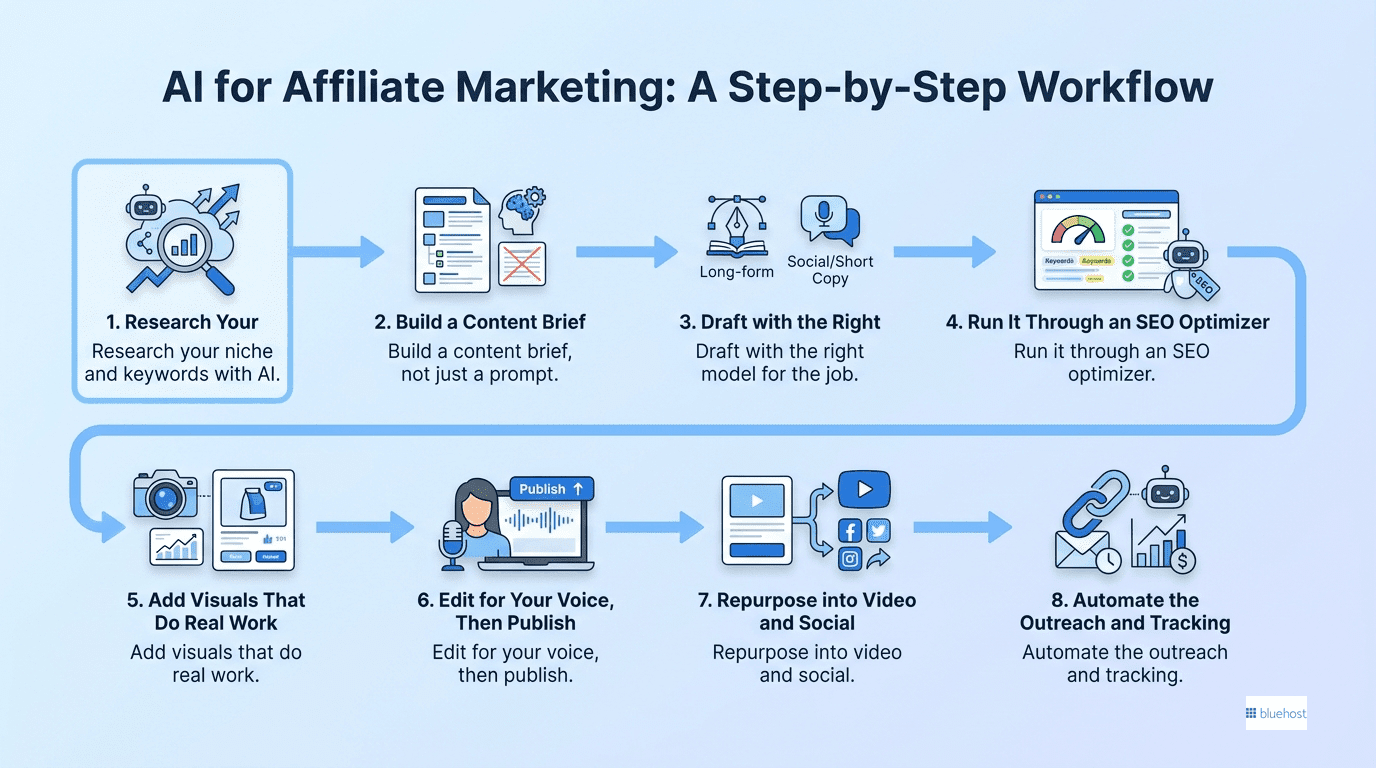
Here’s the short version: research → brief → draft → optimize → design → publish → repurpose → outreach → track. Here’s what that actually looks like in practice.
- Research your niche and keywords with AI. Feed your keyword tool’s data into ChatGPT or Claude and ask it to cluster related keywords by intent and flag the 3–5 gaps competitors haven’t covered well.
- Build a content brief, not just a prompt. Ask your AI model for a structured brief target keyword, search intent, headings and the specific questions readers expect answered before you write a single sentence.
- Draft with the right model for the job. Use ChatGPT for a fast first pass on shorter posts, then switch to Claude for long comparison guides where accuracy across multiple products matters most.
- Run it through an SEO optimizer. Paste your draft into Surfer (or similar) and tighten headings, word count and missing subtopics based on what’s actually ranking right now.
- Add visuals that do real work. Use Canva AI to build a comparison table graphic or a pros/cons image readers (and Google) respond to scannable visuals, not just paragraphs.
- Edit for your voice, then publish. This is the step people skip. Read it out loud, cut anything that doesn’t sound like you and add one genuine personal observation or test result.
- Repurpose into video and social. Drop your finished post into InVideo to generate a short-form recap, then schedule the clip with a caption.
- Automate the outreach and tracking. Use Clay to find and pitch new affiliate partners and connect your published-post and analytics tools with Zapier so things keep moving without your manual input.
Also read: The Best AI Assistants in 2026 (Tested and Compared)
A practical 30-day plan to start affiliate marketing with free AI tools
The workflow in the previous section covers every moving part. This plan makes it concrete: four weeks, mostly free tools, one clear deliverable per phase so you always know exactly what to do next.
- Week 1 is about choosing direction. Compare a few niche ideas in Google Trends, then ask ChatGPT’s free tier which keywords a new site could realistically rank for. By day 7, you’ll have a shortlist of target keywords and a live WordPress site.
- Week 2 is where you start publishing. Draft two or three product reviews with ChatGPT or Claude, then edit every draft yourself cut generic phrasing, add a detail or opinion only you could write and verify prices and specs against the live product page. Don’t forget an affiliate disclosure at the top of each post.
- Week 3 is about making your best post work harder. Build a comparison graphic in Canva’s free tier, then repurpose that same review into a short video draft with InVideo a useful test run before deciding if a paid plan is worth it.
- Week 4 is when you go live and start measuring. Apply to two or three matching affiliate programs (Amazon Associates and ShareASale are easy starting points), then set up Google Analytics and Google Search Console to see what’s gaining traction. Let that data, not guesswork, shape month two.
Using ChatGPT for affiliate marketing: Prompts that actually work
Since “chatgpt for affiliate marketing” is one of the most common ways people search for this exact topic, here are five prompts worth saving.
1. Comparison table generator
“Create a comparison table for [Product A] vs [Product B] vs [Product C] for [audience], covering price, best feature and ideal use case. Keep each cell under 12 words.” Why it works: it gives you a publish-ready visual structure instead of a wall of paragraphs.
2. Review outline based on real questions
“List the 10 questions a first-time buyer of [product category] actually searches before purchasing, then group them into an article outline.” Why it works: it anchors your outline in real search intent instead of generic review sections.
3. FAQ block built for snippets
“Write 6 FAQ-style Q&As about [topic], where each answer starts with a direct one-sentence answer followed by 2–3 sentences of detail.” Why it works: this is exactly the format AI Overviews and featured snippets tend to pull from.
4. Email sequence for affiliate promos
“Write a 3-email sequence promoting [product] to people who already downloaded my [lead magnet], with email 1 building trust, email 2 handling objections and email 3 creating urgency without sounding pushy.”
5. The rewrite-in-my-voice prompt
“Here’s a paragraph I wrote: [paste]. Here are 3 examples of how I usually write: [paste samples]. Rewrite the first paragraph to match my tone and sentence rhythm, not yours.” Why it works: ChatGPT’s biggest weakness is defaulting to its own tone, this prompt forces it to match yours instead.
One more thing worth knowing: ChatGPT and Claude tend to be strong at different parts of this list, ChatGPT for the quick, punchy stuff and Claude for the long, careful stuff. That’s part of why bundling both, along with Gemini and Grok, through something like Bluehost AI All-Access Pack tends to cover more ground than betting on a single model.
How to automate your affiliate growth (Not just your writing)
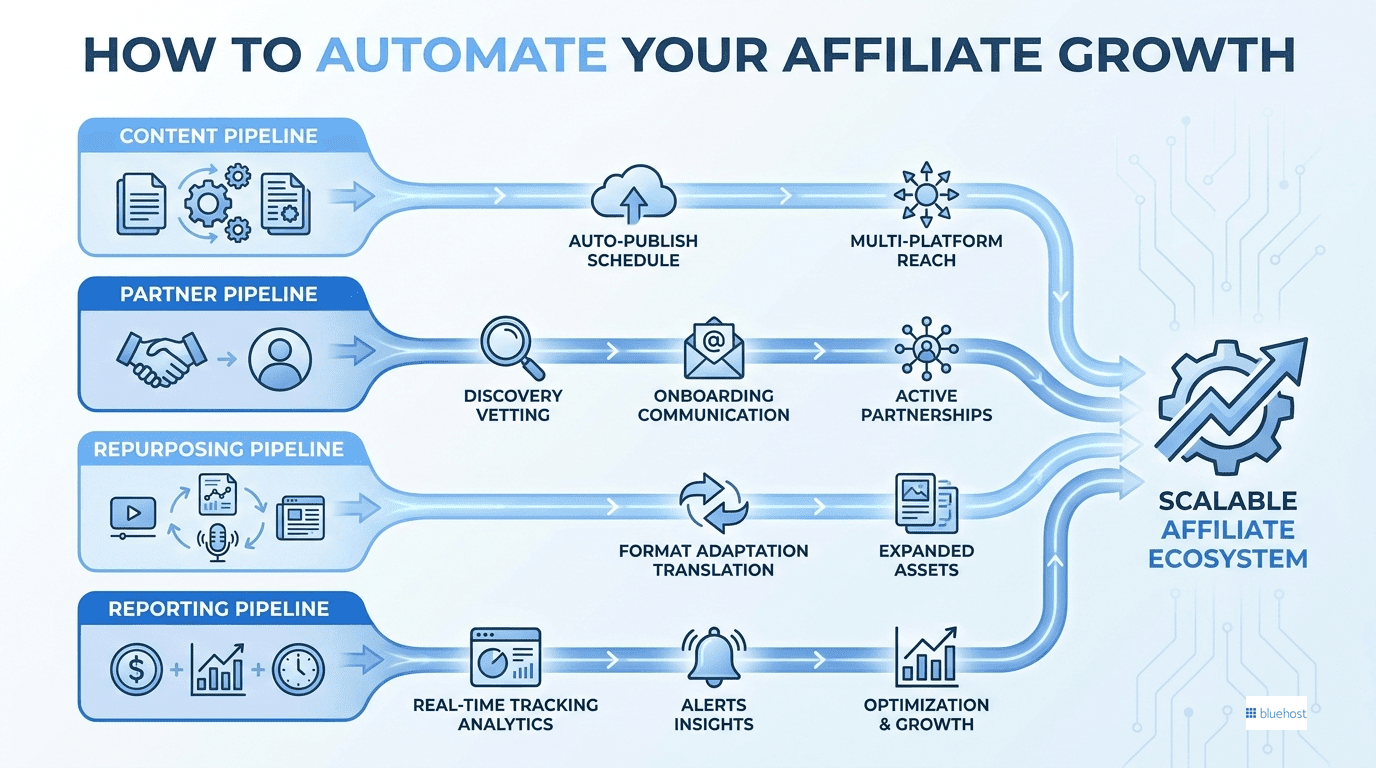
Most people stop at “AI helps me write faster.” That’s only half the opportunity. Automating growth means the system keeps moving even on the days you don’t touch it.
- Content pipeline: brief → draft → SEO check → publish, with each handoff happening in a shared doc or triggered automatically through Zapier.
- Partner pipeline: Clay finds and pitches new affiliates or brand partners while you’re focused on other work.
- Repurposing pipeline: every published post automatically becomes a video script and a few social captions instead of sitting unused after day one.
- Reporting pipeline: weekly traffic and conversion numbers land in your inbox instead of requiring you to open five separate dashboards.
The cheapest place to start is your model subscriptions, since they touch nearly every pipeline above. That’s the practical case for something like Bluehost AI All-Access Pack i.e one $20/month bill instead of four, which frees up budget for whichever SEO, design or outreach tool will actually move the needle next.
Also read: Is ChatGPT Secure? What Users and Businesses Should Know in 2026
Common mistakes to avoid when using AI for affiliate content
While AI can speed up affiliate content creation, relying on it without oversight can hurt credibility, compliance and conversions. Watch out for these common mistakes.
- Publishing without an edit pass: generic AI phrasing is easy for both readers and search engines to spot; add a real opinion, test result or detail only you would know.
- Skipping disclosure: affiliate links still need clear disclosure regardless of who or what, wrote the surrounding content.
- Letting AI invent specifics: have it draft structure and language, but verify prices, specs and commission terms yourself before publishing.
- Over-automating outreach: a personalized-sounding mass email that obviously wasn’t read by a human burns trust fast; keep a human checkpoint before sending.
- Betting everything on one model: different models are better at different tasks, so relying on a single one limits both your content variety and your leverage on subscription costs.
Final Thoughts
You don’t need all 10 of these tools on day one. Pick the one that fixes your biggest current bottleneck i.e. content, SEO, visuals or outreach. Get comfortable with it for a couple of weeks and add the next one once you actually feel the gap it’s filling.
If you’re not sure where to start, the simplest first move is usually the cheapest one: swap whatever single AI subscription you’re paying for now for Bluehost AI All-Access Pack and get ChatGPT, Claude, Gemini and Grok working for your content from day one for about the price of just one of them.
FAQs
What are the best AI tools for affiliate marketing?
The best AI tools for affiliate marketing cover four jobs: content creation (ChatGPT, Claude, Jasper), SEO (Surfer, Ahrefs), visuals (Canva AI) and outreach or automation (Clay, Zapier) with Bluehost AI All-Access Pack worth considering first since it gives you four leading AI models under one subscription.
Are there free AI tools for affiliate marketing?
Yes. ChatGPT, Claude and Canva all offer usable free tiers and most paid tools, including Bluehost AI All-Access Pack, offer trials or low entry pricing, so you can test a workflow before committing to a full stack.
Can I use ChatGPT alone for affiliate marketing?
You can and many people do, but pairing ChatGPT with at least one other model for long-form or research-heavy content, like Claude, tends to produce more accurate and better-structured results than relying on a single model for everything.
Which AI tools have their own affiliate programs?
Several AI tools you’d already use for content or research also run affiliate programs, including Bluehost (up to $100+ per referral), InVideo, Writesonic and Leonardo AI making them worth covering in your own content as a second income stream.
How much should I budget for AI tools as an affiliate marketer?
Most solo affiliate marketers can run a solid stack for $50–150/month: one AI model subscription or a bundle like Bluehost AI All-Access Pack at $20/month for four models, one SEO tool and a design tool, adding outreach or AI automation tools once content volume justifies it.
Does using AI for affiliate content hurt SEO rankings?
Not inherently, search engines reward quality and usefulness regardless of how content was drafted, but thin, unedited AI output that lacks original insight tends to underperform, so the edit and personalization step matters more than the tool itself.

Write A Comment