 ChatGPT,
 Claude,
 Gemini,
 Grok — all four for
A developer fixing a bug in a live repository needs a very different AI tool from a team running an always-on agent on a virtual private server. That contrast is the real story behind Hermes Agent vs. Claude Code. Both serve developers, but they are built for different jobs.
Claude Code focuses on software engineering inside or around a codebase. It reads files, edits code, runs commands and helps move work from issue to commit. Hermes Agent focuses on persistence: memory across sessions, reusable skills, self-improvement and flexible deployment on a local machine, a VPS, a GPU cluster or serverless infrastructure.
If you are comparing a repo-first coding assistant with a broader self-hosted AI agent, the right choice depends less on model quality and more on workflow design. The sections below break down where each tool fits, where each one falls short and when using both makes more sense than choosing only one.
Quick verdict: Hermes Agent vs. Claude Code
Most developers can make a fast first decision by matching the tool to the job. The table below covers the clearest dividing lines.
| Choose Hermes Agent if… | Choose Claude Code if… |
|---|---|
| You want a self-hosted AI agent. | You want a coding agent inside your repo. |
| You need memory across sessions. | You need fast code edits and debugging. |
| You want to run an agent on a VPS. | You work mainly in terminal or IDE. |
| You want reusable skills and workflows. | You want repo-aware coding help. |
| You want provider flexibility. | You want Claude’s coding performance. |
One practical rule works well: pick Claude Code when software engineering is the main task, pick Hermes when persistence and deployment control matter most. Many advanced teams end up pairing them, with Claude handling repo work and Hermes running longer-lived automation around it.
What is Hermes Agent?
Hermes Agent is an open-source, self-improving AI agent from Nous Research. It is built to learn from experience, create reusable skills, remember knowledge across sessions and run in flexible environments like a local machine, VPS, GPU cluster or serverless setup.
Key things to know:
- Self-improving design: Hermes Agent can learn from repeated tasks and improve workflows over time.
- Reusable skills: It can create and refine skills based on experience, so it does not start from scratch every time.
- Persistent memory: It can retain knowledge across sessions, which helps with recurring technical tasks.
- Flexible deployment: Developers can run it locally, on a VPS, on a server, on a GPU cluster or through serverless infrastructure.
- Not limited to an IDE: Hermes Agent can work outside a code editor, including through messaging-style workflows.
- Best fit: It is useful for long-running workflows such as deployment checks, incident notes, research tasks and infrastructure routines.
Hermes Agent can help with coding, but its bigger strength is persistent agent workflows. Compared with repo-first tools like Cursor, GitHub Copilot or Claude Code, Hermes is closer to a long-running agent platform that can live in your infrastructure and improve through repetition.
What is Claude Code?
Claude Code is Anthropic’s agentic coding tool for developers. It is built to help engineers work inside a codebase by reading files, understanding project structure, editing code, running commands, fixing bugs and automating development tasks.
Key things to know:
- Terminal-first workflow: Claude Code is designed to fit into the way developers already work from the command line.
- Codebase awareness: It can inspect a repo, understand relevant files and suggest changes based on the project structure.
- File edits: Claude Code can make direct changes across files instead of only giving code snippets.
- Command execution: It can run commands, checks and tests to validate changes during the workflow.
- Development automation: It can help with tasks like bug fixes, feature implementation, lint fixes, merge conflicts and release notes.
- IDE and app support: Claude Code can work across terminal, IDE, desktop and web surfaces.
- MCP integrations: It can connect to external sources like Google Drive, Figma and Slack through MCP, which helps teams bring in design specs, docs, tickets and internal context.
- Best fit: It is strongest when the task is tied to a repo, such as debugging, refactoring, writing tests or shipping a feature.
Claude Code is best understood as an AI coding partner for repo work. Its strength is helping developers move from problem to implementation inside the development workflow. Compared with Hermes Agent, Claude Code is less about long-term memory or self-hosted agent workflows and more about helping teams understand, edit and ship code faster.
Hermes Agent vs. Claude Code: Feature comparison
While both, Hermes Agent and Claude Code can both support developer workflows, but they are built for different jobs. Hermes Agent focuses on persistent agent operations, memory, reusable skills and flexible deployment. Claude Code focuses on codebase work, file edits, command execution and helping developers ship changes faster.
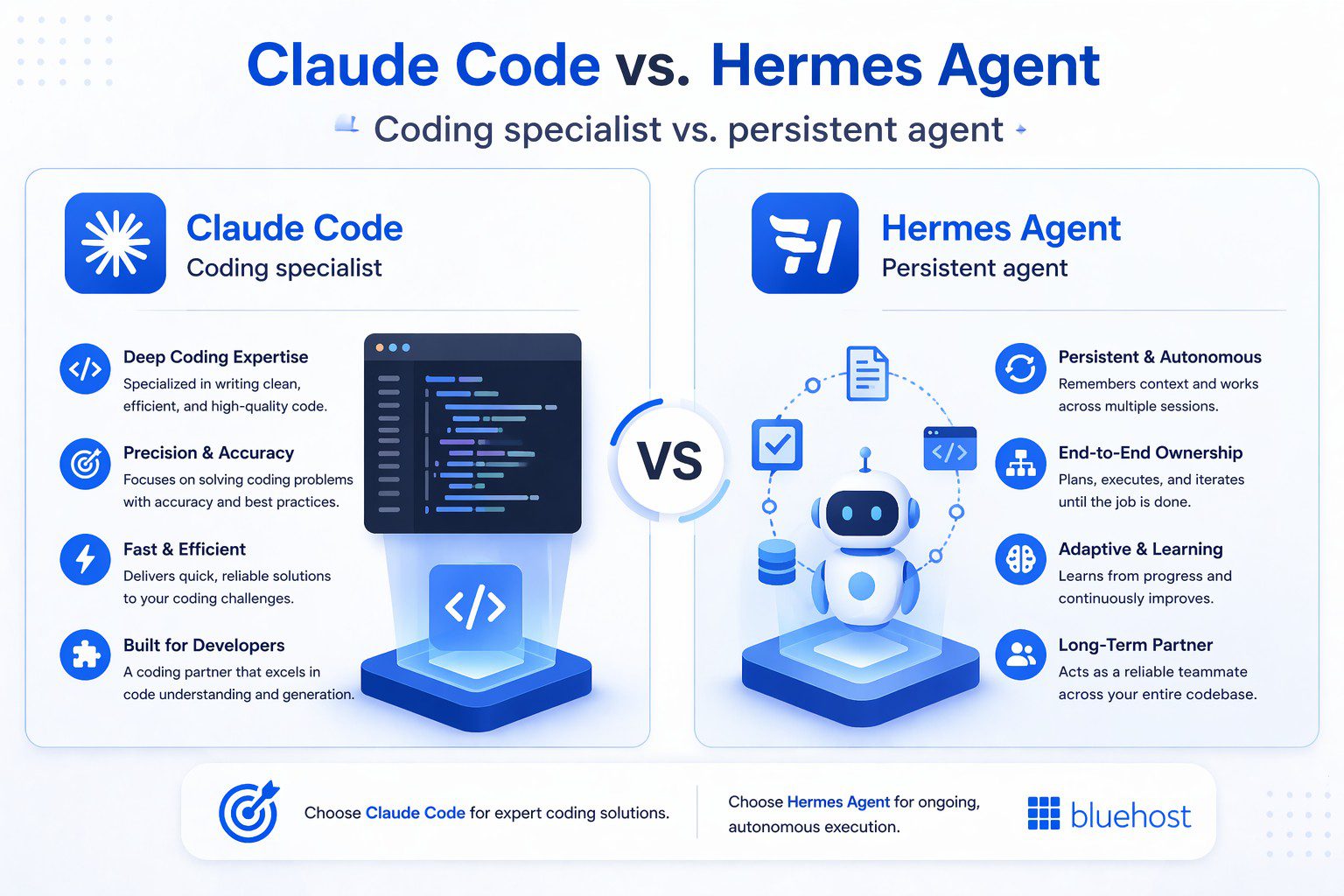
The table below breaks down the main differences:
| Feature | Hermes Agent | Claude Code |
|---|---|---|
| Primary use case | Persistent self-hosted AI agent | Agentic coding assistant |
| Best environment | VPS, cloud virtual machine, local machine, serverless | Terminal, IDE, desktop, browser |
| Coding support | Useful, but broader than coding | Core strength |
| Codebase awareness | Depends on setup and context | Core product capability |
| File editing | Agent or tool dependent | Built-in coding workflow |
| Command execution | Yes, through agent tools | Yes |
| Memory | Strong emphasis on cross-session learning | More project and session workflow oriented |
| Skills | Creates and improves reusable skills | Uses commands, tools, MCP and workflows |
| Self-hosting | Strong fit | Not the main positioning |
| Always-on use | Strong fit with VPS and gateway workflows | Better for interactive coding and automation |
| Cost factor | Open-source, but you pay for hosting, compute and model/API usage. | Paid through Claude plans, team seats or API/model usage. |
| Model flexibility | Strong angle | Claude-centered, with some surfaces supporting third-party providers according to current docs |
| Best for | Long-running workflows and agent operations | Building, debugging and shipping code |
In simple terms, Claude Code helps developers work faster inside a codebase. Hermes Agent is better for long-running workflows that need memory, flexible hosting and automation beyond the IDE.
Where Hermes Agent is stronger?
Once the comparison moves away from daily repo edits, Hermes begins to pull ahead. Its strongest value comes from persistence, infrastructure control and work that lasts beyond a single coding session.
1. Persistent memory and skill formation
Hermes Agent is stronger when you want memory across long-running workflows. A recurring task such as reviewing logs, checking deployment status or following a standard investigation path becomes more useful when the agent keeps knowledge and improves reusable skills with repeated use.
That strength sets Hermes apart from many session-oriented assistants. A personal or team automation agent benefits from continuity, especially when the same technical routines appear every week.
2. Self-hosting and infrastructure control
Developers looking for a self-hosted AI agent often care about where the agent runs, which models it can call and how the underlying system is managed. Hermes is a better fit for that audience because self-managed deployment is part of the product identity, not a side benefit.
A remote agent on a VPS is a good example. Hermes can live on infrastructure you control, stay available over time and support workflows that continue even when your IDE is closed.
3. Workflows outside the coding window
Hermes Agent is not just a coding companion. Its bigger value is persistence. A developer can run it on a VPS, connect it to messaging workflows, let it accumulate knowledge and use it as an always-available agent for recurring technical tasks.
Hermes Agent strengths and weaknesses become clearer at this point. The strengths are memory, deployment freedom and reuse across workflows. The weakness is that deep repo-aware editing is not its defining advantage, so developers focused mostly on code changes may find a dedicated coding tool faster.
Overall, Hermes Agent is not just a coding companion. Its bigger value is persistence. A developer can run it on a VPS, connect it to messaging workflows, let it accumulate knowledge and use it as an always-available agent for recurring technical tasks.
Where Claude Code is stronger?
For direct software engineering, Claude Code is the stronger option. Anthropic has built it around the work developers actually do inside an existing project: read the code, change the files, run the commands and validate the result.
1. Repo-aware feature work and bug fixing
Claude Code should be the default choice when the job is mostly software engineering inside an existing repo. It is built for reading the project, making coordinated file changes, running commands and helping developers move from issue to commit.
Anthropic says Claude Code can build features from descriptions, debug and fix issues, navigate codebases and automate tasks such as lint fixes, merge conflicts and release notes. That collection of abilities maps directly to day-to-day engineering output.
2. Faster edit, test and debug loops
File edits and command execution matter most when speed counts. Claude Code can inspect the relevant code, modify multiple files and kick off the next verification step without forcing the developer to switch tools or rebuild context repeatedly.
A terminal AI coding agent is most valuable when it shortens the loop between finding a problem and validating a fix. Claude Code is designed for that exact pattern, which is why it is usually better for active implementation work.
3. Connected engineering workflows with MCP
Teams often need code decisions tied to design artifacts, tickets and internal notes. Claude Code’s MCP support gives it a practical edge here because it can pull from sources like Google Drive, Figma and Slack according to Claude API Docs.
That integration layer does not replace long-term memory, but it does make Claude Code a strong fit for coordinated engineering work where context lives across several team systems.
Overall, Claude Code should be the default choice when the job is mostly software engineering inside an existing repo. It is built for reading the project, making coordinated file changes, running commands and helping developers move from issue to commit.
Hermes Agent vs. Claude Code: the real tradeoffs
Hermes Agent and Claude Code overlap in some developer workflows, but they are built around different ideas. That is why the comparison should not stop at “which one writes better code.” The better question is: Do you need a coding specialist, or do you need an always-on agent layer for broader automation? The tradeoffs below make that difference clearer.
1. Coding specialist vs. persistent agent
Claude Code is the stronger fit when the work starts inside a codebase. Hermes Agent is stronger when the work needs to continue across sessions, tools and environments.
2. Repo-first workflow vs. agent-first workflow
Claude Code is built around repo work: reading files, editing code, running commands and helping developers ship changes. Hermes Agent is built around broader agent workflows: memory, reusable skills, self-hosted deployment and recurring automation.
3. Session-based help vs. compounding memory
Claude Code is useful for focused engineering tasks in the current project. Hermes Agent becomes more valuable when it can remember workflows and improve repeated tasks over time.
4. Local developer flow vs. always-on runtime
Claude Code fits naturally into terminal and IDE workflows. Hermes Agent is better suited for always-on setups that can run on a VPS or server after you close your laptop.
5. Fast adoption vs. flexible setup
Claude Code is easier to adopt for teams that want coding help quickly. Hermes Agent may need more setup, but it gives developers more control over hosting, models, endpoints and runtime behavior.
6. Subscription cost vs. ownership cost
Claude Code costs are tied to plans, seats or model usage. Hermes Agent is open-source, but you still need to account for hosting, compute, model/API usage and maintenance.
7. Controlled code execution vs. deployment control
Claude Code focuses on approvals, file edits and command execution inside developer environments. Hermes Agent gives more control over where the agent runs, what it connects to and how it operates.
8.Best practical setup: use both where they fit
Use Claude Code for coding work. Use Hermes Agent for persistent workflows, memory, monitoring, research, reminders and always-on automation.
Hermes Agent vs. Claude Code for VPS hosting
When comparing Hermes Agent and Claude Code for VPS hosting, the key question is what you want the VPS to do. If the VPS is meant to run a persistent AI agent with memory and recurring workflows, Hermes Agent is the better fit. If the VPS is mainly a remote coding environment for repo work, Claude Code is more useful.
The table below shows which tool fits common VPS use cases better:
| VPS use case | Better fit | Why |
|---|---|---|
| Run an always-on personal AI agent | Hermes Agent | Designed to live wherever you deploy it |
| Schedule recurring agent workflows | Hermes Agent | Better fit for long-running agent tasks |
| Work inside a repo over SSH | Claude Code | Stronger coding workflow |
| Connect coding tasks to continuous integration | Claude Code | Stronger coding automation fit |
| Build a remote memory-based agent | Hermes Agent | Memory and skills are core positioning |
| Run an agent from your terminal on a cloud virtual machine | Both | Depends on whether the task is coding or broader automation |
Takeaway: Use Hermes Agent for self-hosted, always-on VPS agent workflows. Use Claude Code when the VPS is mainly a remote coding environment.
Also read:How to Run Hermes Agent 24/7 on a VPS (The Complete 2026 Guide)
Which should you use in 2026?
The right choice depends on where your workflow begins and how long you need the AI assistant to stay useful. Claude Code is the better fit when the work starts inside a repo. Hermes Agent is the better fit when the workflow needs memory, self-hosting and always-on automation beyond one coding session.
| Use case | Better choice | Why |
|---|---|---|
| You work inside a codebase every day | Claude Code | It is built for repo-aware coding workflows. |
| You want fast coding help | Claude Code | It can understand code, suggest changes and support implementation work. |
| You need bug fixes, feature work, tests and commits | Claude Code | These are core software engineering tasks. |
| You prefer terminal or IDE workflows | Claude Code | It fits naturally into developer environments. |
| You want Claude’s coding performance | Claude Code | It is designed around Anthropic’s coding-focused model experience. |
| You want to self-host an AI agent | Hermes Agent | It is better aligned with self-hosted agent workflows. |
| You want a VPS-based agent that stays online | Hermes Agent | It can support persistent, always-on automation. |
| You care about memory and reusable skills | Hermes Agent | Memory and skill creation are central to its positioning. |
| You want automation beyond coding | Hermes Agent | It is broader than repo-based development work. |
| You want to experiment with model providers and endpoints | Hermes Agent | It gives more flexibility around infrastructure and model setup. |
| You want an agent that improves over time | Hermes Agent | It is designed for repeated workflows and cross-session learning. |
| You want coding plus long-running automation | Use both | Claude Code can handle repo work, while Hermes Agent handles recurring workflows, research, reminders, monitoring and memory-based tasks. |
In simple terms, use Claude Code when the job starts in your codebase. Use Hermes Agent when the job needs to keep running after the coding session ends.
Final verdict: Hermes Agent or Claude Code?
Claude Code is the stronger choice if your priority is coding. It is built for codebase understanding, file edits, debugging, command execution and day-to-day software engineering. Hermes Agent is the stronger choice if your priority is a persistent, self-hosted AI agent that can live on a VPS, remember workflows, create reusable skills and support broader developer automation.
For many developers, the best setup is simple: use Claude Code for repo work and Hermes Agent for always-on workflows. And when Hermes Agent needs to stay online beyond your laptop, Bluehost VPS offers 1 click Hermes agent installation to run it with more control over hosting, uptime and deployment.
Get started with Hermes Agent on Bluehost VPS and build self-hosted agent workflows that are ready to run beyond local development.
FAQs
Hermes can be a Claude Code alternative when your priority is a self-hosted agent for broader automation rather than deep repo work. Developers reviewing Claude Code alternatives in 2026 often consider Hermes when VPS deployment and long-running memory matter more than coding-centric workflows.
Yes, for most direct coding tasks. Claude Code is purpose-built for understanding codebases, editing files, running commands and helping developers move faster through implementation and debugging work.
Yes, that is one of Hermes’s clearest advantages. Hermes is more closely aligned with self-managed deployment, persistent operation and infrastructure control, while Claude Code is mainly positioned around interactive coding workflows.
Yes. Hermes is designed to run in flexible environments including a VPS, which makes it a strong option for an always-available remote agent that keeps context over time. With Bluehost VPS, you can give Hermes Agent a self-managed space to run, automate tasks and stay available whenever your workflow needs it.
Claude Code can participate in automated workflows, but a 247 persistent agent model is not its main positioning. Hermes is the cleaner fit when the goal is a long-running agent that stays online and keeps memory across sessions.
Claude Code is better for developers whose main work happens inside a repository. Hermes is better for developers who want a persistent, self-hosted agent for recurring technical workflows outside a single coding session.
Yes. Persistent knowledge across sessions is one of the main claims around Hermes, along with learning from experience and improving reusable skills over time.
Claude Code is designed to understand and navigate a codebase, but practical performance still depends on project size, task scope and how much context you provide. Good prompting and careful review still matter on large or complex repositories.
For many advanced workflows, yes. Claude can handle repo-focused coding while Hermes handles memory, recurring tasks, research, monitoring and always-on automation running in the background.
Not for everyone. Hermes Agent can replace Claude Code only if your main need is a self-hosted agent for broader developer automation. If your main need is deep codebase editing and debugging, Claude Code remains the better fit.
Not if you specifically need a persistent self-hosted AI agent. Claude Code is excellent for coding workflows, but Hermes Agent is better aligned with long-running, self-hosted, memory-based agent use cases.

Write A Comment