 ChatGPT,
 Claude,
 Gemini,
 Grok — all four for
Hermes Agent is built for developers who want AI agents that do more than answer one prompt at a time. Instead of starting from scratch in every session, it can remember work, improve through experience and turn repeated actions into reusable skills.
Built by Nous Research, Hermes Agent is an open-source, self-improving AI agent designed to run on infrastructure you control. You can host it on a local machine, VPS, Docker setup or cloud environment, giving you more flexibility over how and where your agent works.
Unlike a coding copilot tied to an IDE or a chatbot wrapper around one API, Hermes Agent is built for persistent workflows. It can continue working across tasks, retain useful context and support long-running developer or research workflows without resetting after every session.
This guide explains what Hermes Agent is, how the learning loop works, what developers can use it for and what to consider before hosting Hermes Agent yourself.
What is Hermes Agent?
“Hermes Agent is an autonomous AI agent framework available on GitHub under the MIT license. It was built by Nous Research and is positioned as a self-improving AI agent that learns from repeated use. ”
The Hermes AI agent connects to model providers such as Nous Portal, OpenRouter, OpenAI and other OpenAI-compatible endpoints. This gives developers flexibility over which model powers the agent instead of forcing them into one provider.
Where many AI tools are built around single sessions, Hermes Agent focuses on continuity. It can maintain memory across sessions, search past conversations, create reusable skills and improve those skills during use. That makes it useful for developers working on long-running projects, recurring workflows and self-hosted automation.
Hermes Agent can run on Linux, macOS, WSL2 and self-hosted environments such as a VPS or Docker container. The official quickstart is designed to get users from installation to a working conversation quickly.
Getting Hermes Agent running is only the first step. Its value becomes clearer when you look at the challenges developers face with ongoing AI workflows.
What problem does Hermes Agent solve?
Hermes Agent helps developers preserve project knowledge, automate recurring tasks and run workflows on their own infrastructure. It addresses four common limitations in AI agent setups:
- Lost session context: Without persistent memory, an AI agent may require you to repeat project details and instructions. Hermes Agent stores selected facts and can search its own past conversations to retrieve relevant information.
- Local downtime: An agent running only on your laptop becomes unavailable when the machine shuts down. You can run Hermes Agent on your own server or a cloud VM, with its gateway configured as a background service, to support scheduled workflows while your laptop is offline.
- Provider dependence: Setups tied to one model provider can restrict your options. Hermes Agent supports multiple providers and compatible endpoints, giving you flexibility to choose models based on capability, cost and hosting requirements.
- Repeated workflows: Complex tasks often involve procedures you need again. Hermes Agent supports autonomous skill creation, allowing it to save reusable skills and refine them during later work. This self-improving behavior updates stored knowledge and procedures.
These capabilities support developer automation through an agent loop that coordinates models, tools and memory across tasks.
Together, model choice, persistent memory, reusable skills and an always-on gateway help Hermes Agent address these challenges.
How does Hermes Agent work?
Hermes Agent runs as a persistent service on self-hosted infrastructure. It receives input, sends the task to a configured language model, executes tools, stores useful results in memory and repeats the loop until the task is complete.
A VPS is one practical option for running Hermes Agent 24/7 because the agent can stay online even when your personal machine is closed. Docker can be useful when you want isolated execution. Local setup works well for testing, but it is less suitable for long-running background workflows.
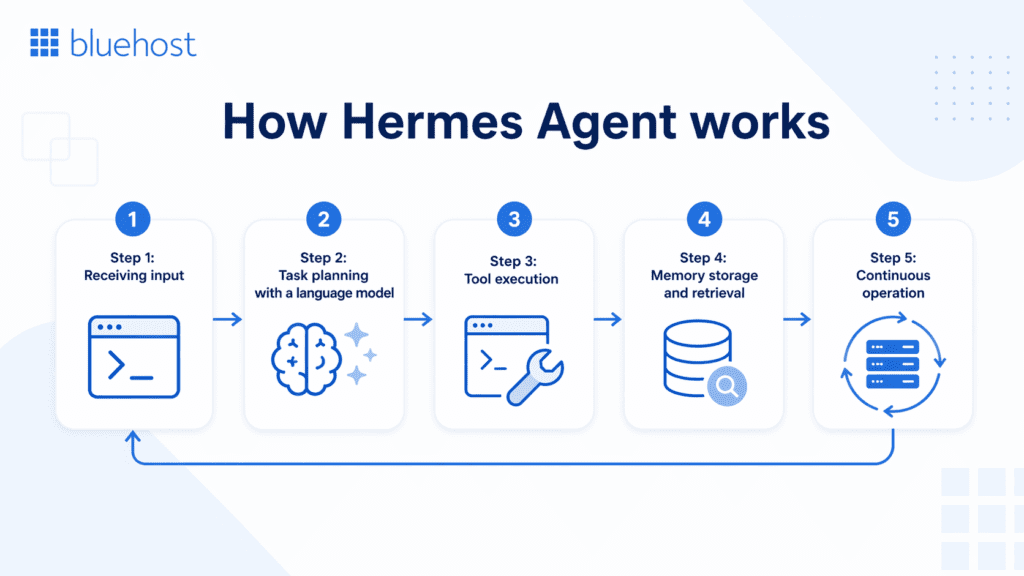
Step 1: Receiving input
A task reaches Hermes Agent through the CLI, a messaging platform, a scheduled workflow or another connected interface. Developers can start with the terminal and later connect platforms like Telegram, Discord or Slack depending on their setup.
Step 2: Task planning with a language model
Hermes Agent sends the request to the configured model along with relevant context, memory and available tools. It supports OpenAI-compatible endpoints, which gives developers more control over model choice, cost and hosting setup.
Step 3: Tool execution
The Hermes Agent AI framework can call tools for terminal work, file editing, browser tasks, code execution and connected integrations. Tool outputs are fed back into the agent loop so it can decide the next step.
Step 4: Memory storage and retrieval
Hermes Agent stores useful context so future sessions can build on earlier work. This is one of its main differences from many AI assistants that are optimized for a single session or one coding workflow.
Step 5: Continuous operation
After a task is complete, Hermes Agent can wait for the next trigger instead of shutting down. This is why Hermes Agent hosting on a VPS makes sense for developers who want to run an AI agent 24/7.
Together, these steps create a persistent agent loop that can work across tasks, platforms and sessions.
What features does Hermes Agent give developers?
Hermes Agent is an open-source AI agent framework built by Nous Research. This self-improving AI agent combines persistent memory, reusable skills and tool execution. Developers can run Hermes Agent on their own infrastructure and configure it for interactive tasks, messaging access or scheduled automation.
1. Multi-platform messaging support
Hermes Agent connects to Telegram, Discord, Slack, WhatsApp, Signal and email through a single gateway process. The CLI provides a separate terminal interface. Conversation history is managed per chat, so switching messaging platforms does not automatically transfer the full conversation.
2. Persistent memory and skill creation
Hermes uses agent-curated memory to retain selected project facts and preferences. It can also search its own past conversations to retrieve relevant details.
Its built-in learning loop supports autonomous skill creation and skill self-improvement, allowing it to save and refine reusable procedures. Developers can add their own skills or install community skills through the Skills Hub.
3. Scheduled automation and background tasks
Hermes supports natural language cron scheduling for recurring reports, briefings and maintenance workflows. The gateway executes scheduled jobs and delivers results to configured destinations. This supports unattended developer automation when the host, gateway and required tools remain available.
4. Subagent delegation and parallel execution
Hermes can divide complex tasks among subagents with separate conversation contexts and terminal sessions. Their final summaries return to the parent agent, reducing the amount of intermediate work in its context. Subagent model calls still consume tokens.
For multi-step pipelines, programmatic tool calling also lets the agent write Python scripts that combine supported tool calls and process their results before returning selected output to the model.
5. Configurable execution backends
Supported terminal backends include local, Docker, SSH, Singularity, Modal, Daytona and Vercel Sandbox. These determine where terminal commands and supported code execution run.
Isolation varies by backend and configuration. Docker offers container isolation, while local execution uses the host environment and SSH executes work on a remote machine. Container hardening does not apply uniformly across these options.
6. Web, browser and media tools
Hermes supports web search, browser automation, vision, image generation and text-to-speech through configured AI tools. Depending on the tool, setup may require API keys, local dependencies or external services.
Nous Portal can simplify setup by bundling model access with supported web and media services.
For tasks that benefit from multiple model perspectives, Hermes Agent supports configured Mixture of Agents presets. Reference models contribute analysis, while an aggregator uses their input to produce a response and call tools when needed. These capabilities support a range of practical developer workflows.
What are the real-world use cases for Hermes Agent?
Hermes Agent is an open-source AI agent from Nous Research that supports coding, research and developer automation. These examples show what you can build with the appropriate tools and access configured.
1. CLI coding and debugging
Use Hermes Agent in the terminal to inspect project files, edit code and run terminal commands. Developers can write Python scripts, investigate errors and check changes through code execution.
Example: Ask the agent to fix a failing unit test and rerun it to check the result.
2. Telegram and Discord assistants
Connect the agent to messaging platforms such as Telegram, Discord, Slack and WhatsApp through its gateway. This gives users a chat interface for requesting research or accessing tools on their own infrastructure.
Example: Ask your Discord assistant to find an installation guide using web search.
3. Scheduled automation
Run Hermes Agent on your own server to schedule recurring reports, reminders or periodic checks. Its cron scheduler starts tasks at configured times, provided the host and gateway remain running.
Example: Check whether your staging website responds every morning and send a short status report.
4. Custom tools and reusable skills
Create your own skills to document repeatable workflows. A skill contains instructions and may include scripts or reference files. Separately, connect an MCP server to give the agent access to external tools, such as an issue tracker.
Example: Combine an issue tracker integration with a reusable skill to turn completed tickets into release notes.
5. Model evaluation and training data
Researchers can use batch processing to run prompts across tool-calling models and collect tool-calling trajectories. These records capture conversations and tool activity for evaluation or preparation of training data. Generating this data does not itself fine-tune a model.
Example: Give two models the same five file-search tasks and compare their results and tool errors.
6. Python application integration
Developers can embed the agent’s AI Agent class in a configured Python environment or connect an application through its API server. This lets an existing product submit tasks and use the responses programmatically.
Example: An internal support app sends an error log to the agent and displays its explanation.
These use cases show what Hermes Agent can do. A comparison with other AI agents can help you decide when to use it.
How does Hermes Agent compare with other AI agents?
Hermes Agent is not the only AI agent or automation tool developers can use. It overlaps with coding assistants, workflow automation platforms, no-code AI assistants and self-hosted AI agent tools. The right choice depends on whether you need long-term memory, VPS hosting, app automation, coding support or multi-agent orchestration.
The comparison below shows where Hermes Agent fits against OpenClaw, Paperclip, Lindy AI, n8n and Claude Code before breaking down each tool in more detail.
Hermes Agent vs. other AI tools at a glance
Use this table as a quick snapshot of how Hermes Agent compares with other AI agents across use case, self-hosting support, memory, automation style and VPS hosting fit.
| Feature | Hermes Agent | OpenClaw | Paperclip | Lindy AI | n8n | Claude Code |
| Primary use case | Personal self-improving AI agent | Self-hosted AI agent hosting on VPS | Multi-agent orchestration | No-code business automation | Workflow automation | Coding assistance |
| Best for | Users who want an AI agent that remembers, adapts and creates skills | Users who want to host an AI agent on private VPS infrastructure | Users who need to manage multiple AI agents | Teams that want ready-to-use AI assistants for daily business tasks | Users who want to connect apps and automate workflows | Developers who need coding support |
| Self-hosting support | Strong | Strong | Strong | Limited compared to self-hosted tools | Strong | Not the main focus |
| Memory and learning | Strong focus on memory, skills and improvement over time | Not the main feature | More focused on coordinating agents than personal memory | Workflow memory depends on setup | Not focused on personal memory by default | Focused more on coding context than long-term agent memory |
| Automation style | Conversational and adaptive | Hosted AI agent workflows | Agent teams with roles and goals | No-code task automation | Trigger-based visual workflows | Code-focused assistance |
| VPS hosting fit | Good fit for self-hosted users | Best fit for VPS positioning | Possible, but more orchestration-focused | Not ideal for VPS hosting positioning | Good for self-hosted workflow automation | Not ideal for VPS hosting positioning |
| Main limitation | More experimental and technical | Less focused on self-improving memory | May be more complex for single-agent use cases | Less control than open-source self-hosted tools | Not a personal AI agent by default | Mainly useful for coding workflows |
This table shows that Hermes Agent is strongest when memory, learning and self-hosting matter. OpenClaw is stronger when the goal is simple VPS-based AI agent hosting, while n8n, Lindy AI and Claude Code fit more specific automation or coding needs.
Hermes Agent vs OpenClaw
Hermes Agent is better for advanced users who want a personal AI agent that remembers, adapts and creates skills over time. It is more experimental and agent-focused, which makes it a good fit for developers exploring the Nous Research Hermes Agent ecosystem.
OpenClaw is better for users who want to host an AI agent on a VPS with a clearer infrastructure story. It connects more naturally to private hosting, predictable costs, always-on access and practical self-hosted AI agent use cases.
Verdict: Both can run on Bluehost VPS for ongoing, self-hosted AI workflows. Choose Hermes Agent when persistent context and skill creation matter most. Choose OpenClaw when messaging access and gateway integrations are your priority.
Hermes Agent vs Paperclip
Hermes Agent is a self-improving AI agent from Nous Research. It focuses on memory, reusable skills and long-term project context.
Paperclip is more focused on multi-agent orchestration. It is better suited for users who want to coordinate several agents with roles, goals and structured workflows.
Verdict: Choose Hermes Agent if you want one AI agent that learns from your work and improves over time. Choose Paperclip if you need to manage multiple AI agents for team-style automation.
Hermes Agent vs Lindy AI
Hermes Agent is a self-hosted, open-source AI agent that focuses on memory, reusable skills and long-term project context.
Lindy AI is a no-code AI assistant platform for business workflows such as email, scheduling, customer support, sales follow-ups and CRM updates.
Verdict: Choose Hermes Agent if you want an open-source AI agent with more control and self-hosting flexibility. Choose Lindy AI if you want a simpler business automation tool without managing infrastructure.
Hermes Agent vs N8N
Hermes Agent and n8n can overlap in automation use cases, but they are built for different jobs.
It’s an AI agent that remembers, learns and creates reusable skills from experience. It is better suited for users who want a conversational and adaptive assistant.
n8n is a workflow automation platform. It is stronger for connecting apps, building trigger-based automations and creating structured workflows.
Verdict: Use Hermes Agent if you want an adaptive AI agent. Use n8n if you want visual workflow automation.
Hermes Agent vs Claude Code
Hermes Agent is not only a coding assistant. It can support coding workflows, but its broader value is persistent memory, reusable skills and self-hosted operation across sessions.
Claude Code is stronger for developers who want coding assistance inside a software development workflow. It is more focused on writing, editing and understanding code.
Verdict: Choose Hermes Agent if you want a self-hosted AI agent with memory and learning. Choose Claude Code if your main need is coding assistance.
Also read: Hermes Agent vs Claude Code: Which should developers use?
Once you understand how Hermes Agent compares with other tools, the next step is learning how to set it up and use it effectively.
How to get the best results from Hermes Agent?
A reliable Hermes Agent setup starts with clear instructions, current project context and controlled tool access. These practices apply whether you run Hermes Agent locally or on your own server.
1. Write specific prompts
Give the AI agent a clear goal, relevant file paths, exact error messages and an expected outcome. For complex tasks, explain the constraints and how it should check its work.
Example: “Fix the CSV import error in src/import.py, preserve the column names and run the related tests.”
2. Provide project context
Document your framework, project structure and coding standards in an AGENTS.md file. Start Hermes from the project directory so it can discover these instructions. Higher-priority context files can take precedence, so check which instructions your setup loads. Keep them concise and current.
3. Separate memory from skills
Use agent-curated memory for stable environment facts and personal preferences. Create reusable skills for repeatable workflows, such as release checks or report preparation. Ask the agent to correct outdated memories and update your own skills when procedures change.
4. Match models to tasks
Use hermes model to configure your model provider and model. Test capable tool-calling models for debugging and architecture work, then evaluate faster options for routine edits. Compare accuracy, response time and actual usage costs on representative tasks.
5. Isolate code execution
Choose the Docker terminal backend to run commands inside a container. Limit mounted folders, forwarded API keys and network access to what the task needs. Docker adds isolation, but its protection depends on the configuration. Review unfamiliar scripts and community skills before running them.
Also read: Hermes Agent Docker Setup: Compose, Install & Production Config Guide
6. Restrict messaging access
When connecting Telegram, Discord, Slack or WhatsApp, control access through platform-specific allowlists or approved pairing where supported. Keep public access disabled for an agent that can execute terminal commands or read project files. Enable only the tools each messaging platform needs.
How can Bluehost VPS support Hermes Agent?
Bluehost offers one-click Hermes Agent installation on a self-managed VPS, giving your agent a place to run beyond your laptop. You can:
- Keep the gateway available for messaging and scheduled tasks while your VPS is running.
- Preserve memory, skills and configuration across sessions with persistent storage.
- Use root access to configure model providers, tools and integrations for your workflow.
- Choose VPS resources that match your workload as your needs grow.
This setup supports ongoing Hermes Agent workflows while giving you control over how the agent runs.
Final thoughts
Hermes Agent is a strong choice for developers who want an AI agent that does more than respond inside a single chat. Its biggest strengths are persistent memory, self-hosting flexibility, model provider choice and the ability to create reusable skills from repeated work.
For technical users, researchers and builders, Hermes Agent offers a flexible way to run long-lived AI workflows on infrastructure they control. It can work on a local machine, Docker setup, VPS or cloud environment, but the real value appears when it runs continuously and keeps context across tasks.
If your goal is to experiment with a self-improving AI agent, Hermes Agent is worth exploring. With 1-click VPS installation, you can deploy Hermes on private infrastructure with predictable costs, 24/7 availability and always-on access.
FAQs
Hermes Agent is an open-source AI agent developed by Nous Research for coding, research and automation. Its self-improving design combines persistent memory with the ability to create and refine reusable skills. It uses configured language models and tools to carry out tasks.
Yes. Hermes Agent is available on GitHub under the MIT license. Developers can inspect, modify and redistribute its source code under the license’s conditions, including preserving the required copyright and permission notices.
Yes. Hermes Agent can run on a VPS with its gateway configured as a background service. This supports scheduled tasks and messaging access while your laptop is off. Continuous operation depends on the server, gateway and required model or tool services remaining available.
Hermes Agent emphasizes a built-in learning loop for creating and improving skills. OpenClaw emphasizes a gateway connecting messaging apps, AI agents and devices. Both support memory, reusable skills and self-hosting, so the choice depends on your preferred workflows and integrations.
Yes. Their documented API capabilities support a custom integration using n8n’s HTTP Request node and Hermes Agent’s API server. n8n can submit a task and pass the response to later workflow steps. You must configure the endpoint, authentication and network access.
Beginners can get started with Hermes Agent through its desktop installer or interactive setup wizard. The wizard helps configure a model provider and tools. Running it on a VPS requires additional server administration knowledge. Start with a simple chat before adding messaging platforms or automation.

Write A Comment