



Key highlights
- Understand the core difference in inbound marketing vs outbound marketing and how each strategy supports business growth in a different way.
- Learn what is inbound marketing and how it helps you attract audiences through content, SEO and long-term trust building.
- Explore what is outbound marketing and how it helps you reach potential customers quickly through direct promotion and paid channels.
- Compare the two approaches across cost, ROI, audience intent, speed of results and brand perception to see what is the difference between inbound and outbound marketing.
- Discover when to use inbound, when to use outbound and how Bluehost Full Service + SEO can support a stronger overall marketing strategy.
Businesses worldwide spend over $600 billion on advertising each year. Yet many still struggle to choose the right marketing approach. Do you attract customers or actively pursue them? That single question sits at the heart of the inbound marketing vs outbound marketing debate.
Your answer shapes your budget, your channels and your entire growth strategy. Whether you run a startup or an established brand, understanding the difference is non-negotiable. The right choice determines your cost per lead, your audience quality and your long-term results.
This guide explains what is inbound marketing, what is outbound marketing and what is the difference between the two. You will also learn when to use each approach and how to combine both for the best outcomes.
Let’s explore the inbound marketing vs outbound marketing battle!
What is inbound marketing?
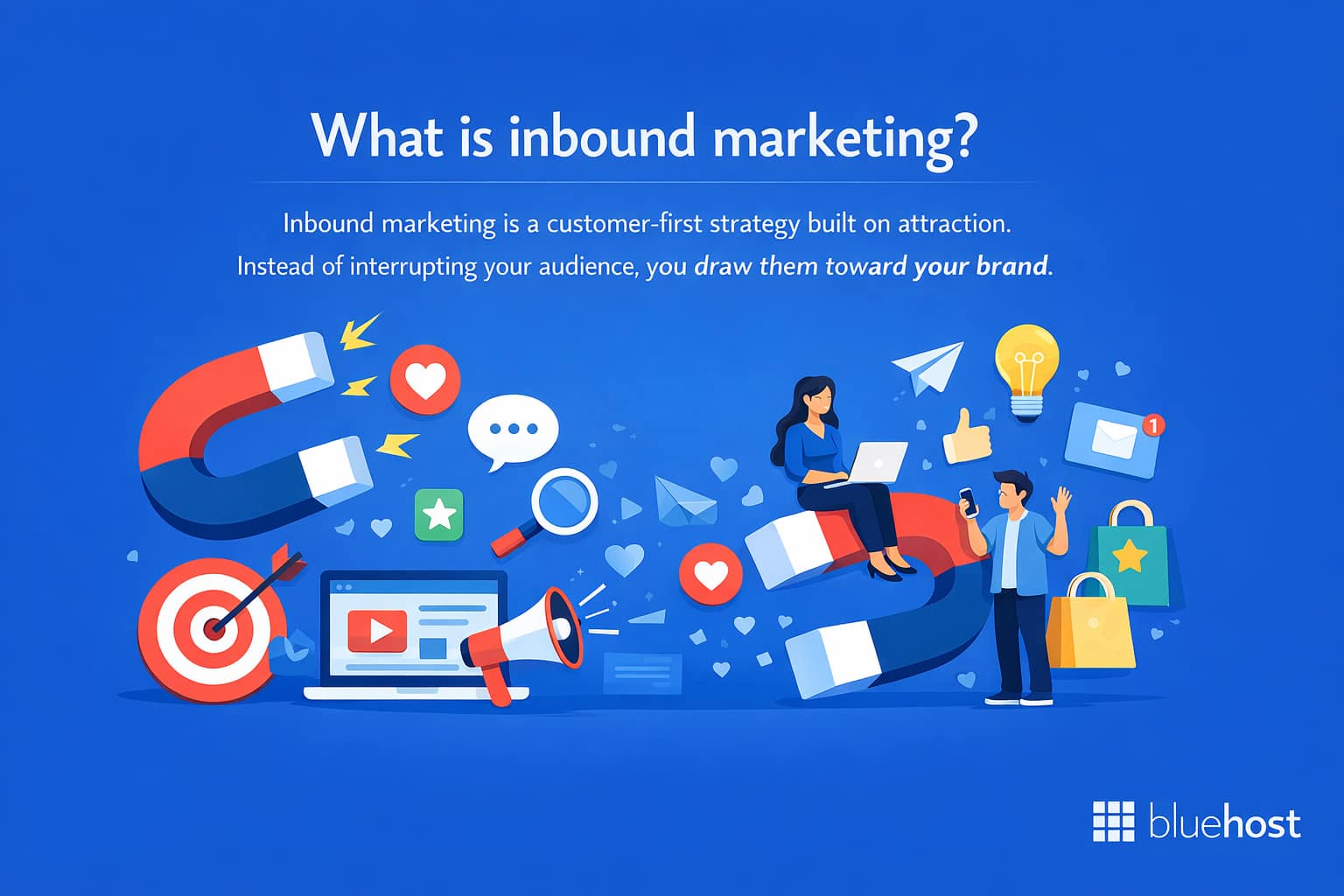
Inbound marketing is a customer-first strategy built on attraction. Instead of interrupting your audience, you draw them toward your brand. You do this by delivering valuable, relevant content at the right time and place.
The core idea is simple: be present when your audience is actively searching for answers. You build trust, demonstrate expertise and guide prospects through the buying journey naturally.
How inbound marketing works?
Inbound marketing follows a three-stage framework designed around the buyer’s journey:
- Attract: Draw in the right visitors using content, SEO and social media.
- Engage: Convert visitors into leads through targeted offers and messaging.
- Delight: Turn customers into loyal advocates by continuing to add value.
Each stage builds on the last. The goal is to create a self-sustaining engine for lead generation over time.
What are some key inbound marketing channels?
To understand what is inbound marketing in practice, it helps to look at the core channels businesses use to attract and engage the right audience.
- Search engine optimization (SEO)
- Blog articles and thought leadership content
- Organic social media posts
- Email newsletters and nurture sequences
- YouTube videos and podcasts
- Webinars and online events
- eBooks, whitepapers and in-depth guides
What are the benefits of inbound marketing?
When evaluating inbound marketing vs outbound marketing, one of the biggest advantages of inbound is its ability to generate sustainable, long-term value.
- Builds long-term brand authority and credibility
- Generates compounding organic traffic over time
- Attracts prospects already interested in your solutions
- Costs significantly less per lead than outbound methods
- Creates content assets that deliver value around the clock
What are some challenges of inbound marketing?
Inbound marketing offers strong long-term value, but it also comes with limitations that businesses should plan for. It is highly effective when executed consistently, yet it often requires patience, resources and ongoing optimization.
Common challenges of inbound marketing include:
- Slower time to results: SEO, content marketing and organic brand building usually take time. It can take several months before you see meaningful growth in traffic, rankings or lead volume.
- High content demands: Inbound marketing depends on a steady flow of valuable content. Creating blog posts, guides, videos, webinars and email sequences requires time, expertise and planning.
- Strong competition in search: Many industries are saturated with high-quality content. Ranking organically for competitive keywords can be difficult, especially for newer or smaller brands.
- Ongoing maintenance and optimization: Content cannot simply be published and forgotten. It needs regular updates, performance reviews and optimization to remain effective over time.
- Delayed return on investment: Inbound can be cost-efficient in the long run, but businesses may not see immediate returns early in the process. This can be challenging for teams under pressure to deliver fast results.
What are some examples of inbound marketing?
Understanding channels is useful, but real-world examples make the inbound marketing vs outbound marketing comparison easier to apply. Inbound marketing works best when businesses create valuable experiences that attract audiences naturally.
Here are common examples of inbound marketing in action:
- SEO-driven blog content: A business publishes blog articles targeting questions its audience is already searching for. These articles attract organic traffic and guide users toward relevant products or services.
- Lead magnets and gated resources: A company offers an eBook, checklist or whitepaper in exchange for contact information. This helps convert anonymous visitors into qualified leads.
- Email nurture sequences: After someone subscribes or downloads a resource, the business sends a series of helpful emails that educate, build trust and move the lead closer to a decision.
- Educational webinars and online events: Brands host webinars to answer common questions, demonstrate expertise and engage prospects who want more in-depth information.
- Organic social media content: Businesses share helpful tips, insights and thought leadership posts to build visibility and encourage ongoing audience engagement without direct promotion.
These examples show why inbound marketing is often associated with long-term trust building. Instead of forcing attention, it earns interest through relevance and value.
Also read: Types of Digital Marketing and The Best Digital Marketing Methods
What is outbound marketing?
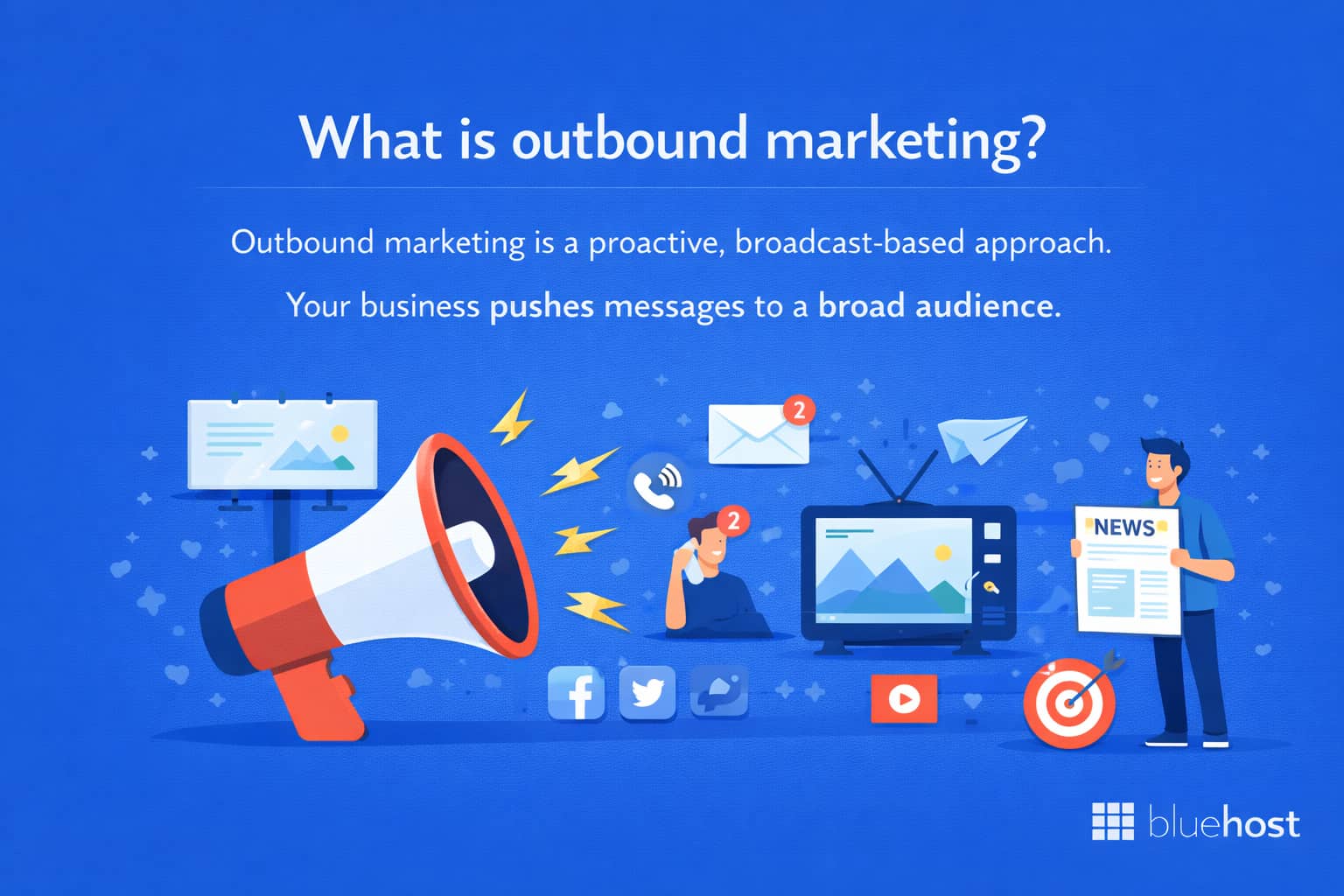
Outbound marketing is a proactive, broadcast-based approach. Your business pushes messages to a broad audience. The goal is to create awareness and drive immediate response, regardless of whether the audience is actively searching.
Unlike inbound marketing, you initiate contact. You place your message in front of potential customers rather than waiting for them to find you. This makes outbound faster to deploy but often more expensive to sustain.
How outbound marketing works?
Outbound relies on interruption-based tactics. A business broadcasts its message across multiple channels to reach a large pool of potential buyers. The audience receives the message whether or not they are ready to buy.
Success depends on reach, repetition and targeting. The more precisely you define your audience, the better your return on investment.
What are some key outbound marketing channels?
To understand what is outbound marketing, it is useful to look at the channels businesses use to push messages directly to potential customers.
- Television and radio advertising
- Print advertising in newspapers and magazines
- Cold email outreach and cold calling
- Paid digital ads including display banners and programmatic
- Direct mail campaigns
- Trade shows and in-person events
- Billboards and out-of-home advertising
- Sponsored content and paid social media ads
What are the benefits of outbound marketing?
When comparing inbound marketing vs outbound marketing, outbound stands out for its ability to deliver visibility, reach and faster short-term results.
- Generates fast brand awareness at scale
- Delivers immediate and measurable reach
- Works well for new product or service launches
- Effective for reaching audiences not yet searching online
- Allows precise budget control per campaign
What are some challenges of outbound marketing?
Outbound marketing can deliver fast visibility, but speed often comes with trade-offs. Because it depends on active promotion and paid distribution, it can become expensive and difficult to sustain without careful targeting.
The most common challenges of outbound marketing include:
- Higher upfront costs: Paid media, event sponsorships, print campaigns and direct outreach often require larger initial budgets than inbound efforts.
- Results stop when spending stops: Unlike content or SEO assets, outbound campaigns do not usually keep delivering value once the campaign ends or the budget runs out.
- Lower audience intent: Outbound marketing often reaches people who are not actively searching for a solution. This can lead to lower engagement and lower conversion rates.
- Ad fatigue and message saturation: Repeated exposure can reduce effectiveness over time. Audiences may begin to ignore ads, emails or promotional messages if they see them too often.
- Perception of intrusiveness: Some outbound tactics, especially cold outreach and interruptive advertising, can feel unsolicited. This may affect trust if the message is not relevant or well-targeted.
What are some examples of outbound marketing?
Outbound marketing is easier to understand when viewed through practical use cases. In the inbound marketing vs outbound marketing discussion, outbound stands out because it places promotional messages directly in front of an audience rather than waiting for discovery.
Here are common examples of outbound marketing:
- Paid search advertising: A business runs Google Ads to appear instantly for high-intent keywords and drive traffic to landing pages or product pages.
- Display and social media ads: Brands use banner ads, sponsored posts and paid social campaigns to reach targeted audiences across websites and platforms.
- Cold email outreach: Sales or marketing teams contact prospects directly with personalized offers, product introductions or meeting requests.
- Trade shows and industry events: Companies promote their offerings in person through booths, sponsorships and face-to-face networking to generate leads quickly.
- Direct mail campaigns: Businesses send promotional postcards, catalogs or printed offers to targeted households or decision-makers.
These examples highlight the core strength of outbound marketing: immediate visibility. It allows businesses to create awareness fast, especially when timing, reach and campaign control matter most.
Also read: 8 Key Benefits of Digital Marketing for Small Businesses in 2026
What are the similarities between inbound and outbound marketing?
Although the inbound marketing vs outbound marketing discussion usually focuses on differences, both approaches share several core goals. Each is designed to help businesses attract attention, generate leads and support revenue growth. The main difference lies in how they reach and influence potential customers.
Here are the most important similarities:
- Drive business growth: Inbound and outbound marketing are both used to increase brand awareness, generate demand and convert prospects into customers.
- Rely on audience targeting: Whether you publish SEO content or launch a paid ad campaign, success depends on reaching the right audience with relevant messaging.
- Support the buyer journey: Each strategy can play a role at different stages of the funnel, from awareness and consideration to conversion and retention.
- Require strong messaging: Clear value propositions, compelling offers and consistent branding are essential in both inbound and outbound campaigns.
- Depend on performance measurement: Metrics such as traffic, click-through rates, lead volume, conversion rates and cost per acquisition help improve results over time.
Understanding these similarities makes the inbound marketing vs outbound marketing comparison more useful. Rather than viewing them as opposites, businesses should see them as two strategic methods that can work together toward the same objectives.
Also read: Influencer Marketing: Boost Your Brand with Strategic Partnerships
Inbound marketing vs outbound marketing: The key differences
Understanding what is the difference between inbound and outbound marketing is essential if you want to choose the right channels, allocate your budget effectively and build a strategy that matches your growth goals. While both approaches aim to generate awareness, leads and revenue, they do so in very different ways.
At the core of the inbound marketing vs outbound marketing comparison is one simple distinction: inbound attracts potential customers by offering value, while outbound reaches out to them directly through promotion. That difference influences everything from cost and timing to audience quality and brand perception.
The table below gives a quick side-by-side view of the most important comparison factors.
| Comparison factor | Inbound marketing | Outbound marketing |
|---|---|---|
| Direction of communication | Pulls customers in through helpful content and discovery | Pushes messages out to an audience through promotion |
| Cost and ROI | Often more cost-efficient over time because assets continue to perform | Usually requires ongoing spend to maintain results |
| Targeting and audience intent | Reaches users already searching for answers or solutions | Reaches broader audiences, including those with lower immediate intent |
| Timeline for results | Builds momentum gradually over time | Can generate visibility and leads quickly |
| Trust and audience perception | Often seen as educational, helpful and less intrusive | Can feel more direct, interruptive or promotional |
1. Inbound marketing vs outbound marketing: Direction of communication
This is the most fundamental difference in the inbound marketing vs outbound marketing discussion.
Inbound marketing is a pull strategy. Customers discover your business because your content, search presence or resources align with something they are already looking for. Instead of chasing attention, you earn it by showing up with useful information at the right moment.
Outbound marketing is a push strategy. Your business takes the initiative by placing promotional messages in front of potential customers, whether through ads, cold outreach, sponsorships or other direct channels. Rather than waiting to be found, you actively go out and seek attention.
In simple terms, inbound invites prospects in, while outbound reaches out to them first.
Also read: Remarketing vs Retargeting: What They Are and Which Converts
2. Inbound marketing vs outbound marketing: Cost and ROI
Cost structure is another major area where the two approaches differ.
Inbound marketing often requires an upfront investment in content creation, SEO, strategy and ongoing optimization. However, those assets can continue generating traffic, leads and visibility long after they are published. A strong article, guide or landing page can keep working for months or even years, which makes inbound more efficient over time.
Outbound marketing, on the other hand, typically involves direct media spend or campaign costs from the start. Whether you are running paid search ads, sponsoring an event or launching a direct mail campaign, performance is often closely tied to active spending. Once the budget stops, results usually slow down or disappear as well.
According to HubSpot, inbound leads cost 61% less than outbound leads on average. This is one reason many businesses view inbound as the stronger long-term investment, especially when cost efficiency and sustained growth are priorities.
3. Inbound marketing vs outbound marketing: Targeting and audience intent
Another key difference lies in the type of audience each strategy tends to attract.
Inbound marketing is built around intent. It reaches people who are already researching a problem, exploring options or looking for a solution. Because these users arrive through relevant content, search queries or educational resources, they are often more qualified and more likely to engage meaningfully.
Outbound marketing casts a wider net. It allows businesses to reach large or highly specific audiences quickly, but not everyone exposed to the message will be actively interested or ready to buy. That means outbound can be excellent for generating awareness, though it may also produce lower-intent traffic or less qualified leads if the targeting is too broad.
This is a major answer to what is the difference between inbound and outbound marketing: inbound usually captures existing demand, while outbound often works to create or accelerate it.
4. Inbound marketing vs outbound marketing: Timeline for results
Speed is one of the biggest practical differences between the two.
Inbound marketing usually takes more time to gain traction. SEO rankings, content authority and audience trust do not develop overnight. It often takes weeks or months before you see meaningful increases in traffic, lead generation or organic visibility. The advantage is that these gains can compound over time and become more sustainable.
Outbound marketing tends to produce faster results. A paid ad campaign, sponsored promotion or outbound outreach effort can start generating clicks, impressions or leads within hours or days. This makes outbound useful when a business needs immediate awareness, quick testing or short-term campaign performance.
In other words, inbound is slower to build but longer-lasting, while outbound is faster to launch but often shorter-lived.
Also read: SEO vs SEM: Understand Both and Drive More Traffic
5. Inbound marketing vs outbound marketing: Trust and audience perception
How audiences experience your marketing also matters.
Inbound marketing is generally perceived as more helpful, educational and customer-focused. Because it provides answers, insights or value before asking for a sale, it often builds trust more naturally. This is especially important for businesses with longer sales cycles or more complex offerings that require education and credibility.
Outbound marketing is more direct by nature. That can be a strength when visibility and repetition are the goal, but it can also make campaigns feel interruptive if the message is poorly timed or irrelevant to the audience. Cold outreach, display ads and repeated promotions can create awareness, yet they may also face resistance if they are not targeted carefully.
This is why inbound is often stronger for trust-building, while outbound is often stronger for immediate exposure and brand recall.
When to use inbound vs outbound marketing?
Neither approach is universally superior. The right strategy depends on your business stage, budget and growth objectives. Here is a practical framework to guide your decision.
When to choose inbound marketing?
Inbound marketing is the stronger long-term investment in these situations:
- You want to build lasting brand authority in your industry
- Your audience actively searches for solutions online
- Your budget is limited and cost-efficient lead generation is a priority
- You sell complex products or services that require buyer education
- You are willing to invest consistently before seeing significant returns
- You want content assets that generate traffic without continuous spend
When to choose outbound marketing?
Outbound marketing delivers faster, broader results in these scenarios:
- You need rapid brand awareness in a new market
- You are launching a time-sensitive product or promotion
- Your audience is not yet searching for your type of solution
- You have a defined media budget and need measurable reach
- You are entering a competitive market and need immediate visibility
- Your sales cycle is short and requires high-volume top-of-funnel activity
Industry-specific considerations
- B2B companies often benefit strongly from inbound tactics like SEO-driven content and thought leadership.
- eCommerce brands frequently combine both to drive traffic and accelerate conversions.
- Service businesses in competitive markets use paid search as a fast outbound entry point.
- Early-stage startups may rely on outbound for quick traction before scaling an inbound engine.
How to combine inbound and outbound marketing for better results?
The most effective marketing programs blend both strategies. Inbound and outbound marketing are not rivals. They are complementary tools that reinforce each other when deployed strategically.
Practical ways to integrate both approaches
- Run outbound paid ads to drive traffic to high-value inbound content like blog posts or landing pages
- Retarget organic visitors with paid display or social media ads
- Build email subscriber lists through inbound lead magnets and nurture them with outbound sequences
- Use outbound events or trade shows to amplify your inbound thought leadership positioning
- Distribute your best-performing organic content through paid social campaigns
Also read: Email Marketing Best Practices to Boost Engagement in 2026
Aligning both strategies across the buyer journey
- Top of funnel: Use outbound awareness ads alongside SEO-driven content to maximize reach.
- Middle of funnel: Nurture inbound leads with targeted email and retargeting campaigns.
- Bottom of funnel: Combine personalized retargeting ads with high-converting inbound content.
This integrated model maximizes both reach and relevance. You attract warm prospects through inbound and accelerate their decision-making with outbound nudges. The result is a marketing system that works at every stage of the funnel.
What are the best practices for inbound marketing vs outbound marketing?
Knowing the difference between these two strategies is important, but execution is what ultimately drives results.
In the inbound marketing vs outbound marketing discussion, both approaches can be effective when they are aligned with audience needs, business goals and performance data. The key is to apply each strategy with the right structure and intent.
What are the best practices for inbound marketing?
To understand what is inbound marketing in practice, it helps to focus on the habits that improve visibility, trust and long-term lead generation.
- Start with audience and search intent research: Identify what your audience is searching for, what problems they need to solve and what content they expect at each stage of the journey.
- Create valuable content consistently: Publish useful blog posts, guides, videos, webinars and email content that educate, answer questions and build authority over time.
- Optimize every asset for SEO: Use relevant keywords, strong headings, internal links, metadata and clear structure to improve discoverability and organic performance.
- Match content to the buyer journey: Build awareness, consideration and decision-stage content so users can move naturally from discovery to conversion.
- Measure and refine performance regularly: Track traffic, rankings, engagement, lead quality and conversions, then update content to improve results over time.
What are the best practices for outbound marketing?
To understand what is outbound marketing more effectively, it is important to focus on the practices that improve targeting, response rates and campaign efficiency.
- Define your audience precisely: Use clear demographic, behavioral or industry-based targeting so your message reaches people who are most likely to respond.
- Lead with a clear and compelling message: Outbound campaigns should communicate value quickly, with direct headlines, relevant offers and strong calls to action.
- Choose channels based on campaign goals: Use the right mix of paid search, display ads, cold outreach, direct mail or events depending on whether you want awareness, leads or conversions.
- Test and optimize continuously: Experiment with creatives, offers, targeting and landing pages to improve performance and reduce wasted spend.
- Track ROI closely: Measure reach, click-through rates, cost per lead, conversion rates and acquisition costs to understand what is working and where to adjust.
How do Bluehost Professional Digital Marketing Services support your marketing strategy?
If you want to strengthen both your inbound and outbound efforts, Bluehost Professional Digital Marketing Services gives you expert support across SEO and PPC.
Pro SEO is designed to help businesses improve search visibility over time, while Pro PPC helps businesses get found more quickly in search results through paid advertising.
Here’s how it supports a stronger strategy:
- SEO support for long-term growth: Bluehost Pro SEO helps businesses improve search engine rankings by targeting relevant keywords, optimizing website content and building authority through link building. It also includes performance tracking and expert support.
- PPC support for faster visibility: Bluehost Pro PPC helps businesses reach potential customers quickly through custom ads, keyword strategy, location-based targeting and ongoing campaign optimization.
- Expert-led execution: Both services are built for small business owners who want better visibility online but may not have the time or expertise to manage digital marketing on their own.
- A more balanced marketing approach: Bluehost’s product messaging makes the distinction clear: PPC helps businesses get found online quickly, while SEO supports longer-term visibility in the non-paid area of search results. Together, they can support a more complete digital marketing strategy.
Whether your goal is to build long-term organic visibility, generate faster exposure through paid search or combine both approaches, Bluehost Professional Digital Marketing Services can support both sides of your marketing strategy.
Final thoughts
Understanding inbound marketing vs outbound marketing comes down to knowing when you need long-term visibility and when you need faster reach. Inbound helps you attract audiences through content, trust and organic discovery, while outbound helps you reach potential customers more quickly through paid promotion and direct search visibility. For most businesses, the strongest approach is using both together.
That is where Bluehost Professional Digital Marketing Services can support you. If you want to build your organic presence over time, Pro SEO helps you improve search visibility through keyword targeting, on-page optimization and ongoing SEO support. If you want faster exposure, Pro PPC helps you reach potential customers through managed paid search campaigns aligned with your goals.
Ready to strengthen your strategy? Explore Bluehost Professional Digital Marketing Services to grow your visibility, drive more traffic and create more opportunities online.
FAQs
An example of inbound marketing is a company creating a comprehensive blog post that ranks for specific search terms, attracting users who are actively seeking information. In contrast, an outbound marketing example is a television commercial or a mass-market cold email campaign where the brand initiates contact with a broad audience regardless of their current search intent.
The 3-3-3 rule is a framework for capturing and holding audience attention: marketers have 3 seconds to hook a prospect’s interest, 30 seconds to get them to engage with the core message and 3 minutes to drive them toward a clear call to action or purchase decision.
Inbound product marketing focuses on gathering intelligence from the market, such as analyzing customer feedback and conducting research to guide product strategy and development. Outbound product marketing is externally focused, handling the positioning, messaging and promotional campaigns needed to launch the product and enable sales teams to reach the target audience.
The four primary types of marketing are generally categorized as inbound marketing, outbound marketing, digital marketing and traditional marketing. This mix allows brands to combine “pull” strategies like SEO and content creation with “push” strategies like print advertisements, direct mail and broadcast media to maximize reach and conversion.
The main difference is direction. Inbound marketing attracts customers to you through valuable content and SEO. Outbound marketing pushes your message to a broad audience through ads, cold outreach and paid media. Inbound is a pull strategy. Outbound is a push strategy.
Inbound marketing is generally more cost-effective over the long term. HubSpot reports that inbound leads cost 61% less than outbound leads on average. However, outbound delivers faster results. The most cost-efficient approach depends on your timeline, budget and business goals.
Yes. Small businesses can use digital outbound tactics like paid search ads or social media advertising on modest budgets. Platforms like Google Ads and Meta Ads allow precise audience targeting and full budget control. This makes outbound accessible for businesses of all sizes.
Inbound marketing typically takes three to six months to produce meaningful results. SEO and content marketing are long-term investments. The timeline depends on your niche, content quality and publishing frequency. However, once established, inbound assets generate traffic and leads continuously.
Email marketing can be both. When subscribers opt in to receive your emails, it is inbound because they chose to engage with your brand. When you send cold emails to purchased or scraped lists without prior consent, it becomes an outbound tactic. The intent and origin of the list determine the category.


Write A Comment