 ChatGPT,
 Claude,
 Gemini,
 Grok — all four for
Key highlights
- Learn what each channel does well, how organic search earns visits and how social platforms reach people.
- Compare SEO vs social media marketing on speed, cost, targeting and content lifespan to plan your budget.
- Choose one channel or the right mix based on your goals, timeline, budget and audience behavior.
- Discover how search and social content support each other when you plan both channels together.
- Know when Bluehost Pro SEO fits if you want experts to handle search for your current website.
Choosing between search engine optimization (SEO) and social media marketing is hard when your time and budget are limited. SEO captures demand people already search for and builds over months, while social media marketing delivers fast visibility and discovery. If you have the capacity, you can run both and give each channel a different job.
Weighing SEO vs social media marketing side by side helps you see where each one fits. Both can grow traffic, but they work differently and show results at different speeds.
This guide defines each channel, compares them across eight factors and helps you choose one or a mix. You’ll also learn how SEO and social media marketing work together and how to build one plan for both.
What is SEO?
SEO stands for search engine optimization. It is the process of improving your website so it ranks higher in search engine results pages (SERPs).
Higher rankings mean more visibility and more organic traffic without paying for each click. SEO focuses on content quality, technical website performance and authority building.
- Optimizing content, keywords, title tags and meta descriptions.
- Improving site speed, mobile usability and crawlability.
- Building backlinks and online authority from external sources.
- Optimizing for location-based searches and Google Business Profile.
- Creating high-quality, keyword-optimized content that serves user intent.
- Drives consistent, free organic traffic over time.
- Establishes credibility and topical authority in your industry.
- Targets users with high purchase intent at the right moment.
Also read: SEO Fundamentals: A Beginner’s Guide
What is social media marketing?
Social media marketing is the use of social platforms to promote your brand, connect with audiences and drive traffic to your website. Platforms like Instagram, LinkedIn, Facebook and TikTok allow businesses to publish content, run targeted ads and build loyal communities. Social media marketing blends organic content creation with paid promotion strategies.
- Content creation: Producing posts, reels, stories, videos and infographics for each platform.
- Community management: Responding to comments, messages and reviews consistently.
- Paid social advertising: Running targeted ad campaigns with specific audience parameters.
- Influencer partnerships: Collaborating with creators to expand your brand reach.
- Analytics and reporting: Tracking performance metrics and refining content over time.
Also read: How to Improve Social Media Presence
SEO vs social media marketing: Key differences
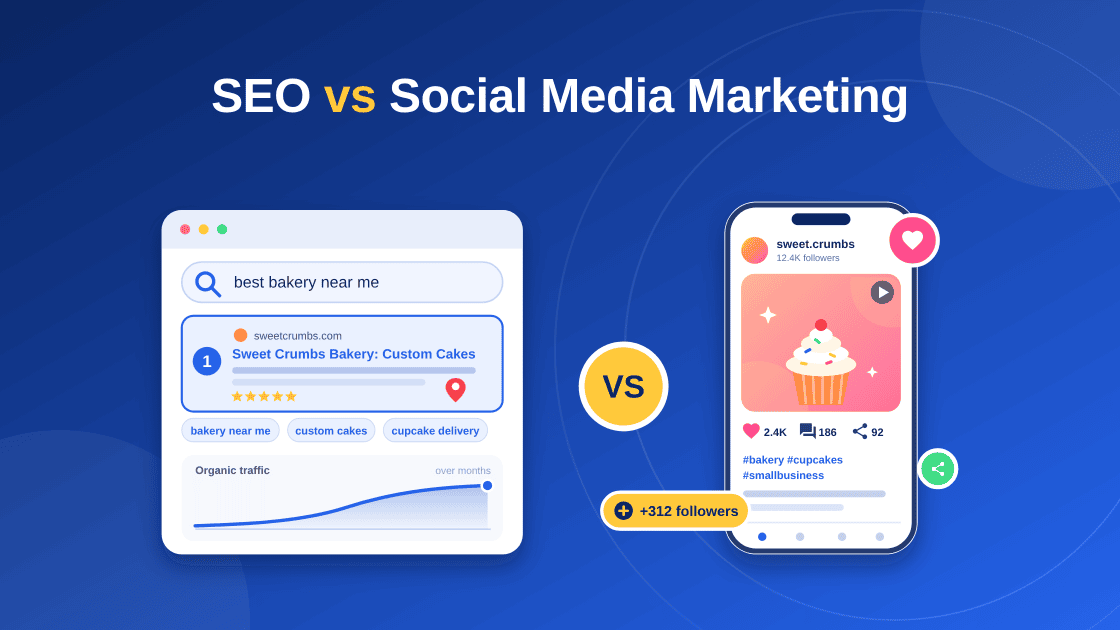
The biggest difference between SEO and SMM is intent: SEO reaches people who are already searching for what you offer, while social media marketing reaches people while they browse.
Both are valuable digital marketing channels, but they work in different ways and deliver value on different timelines. SEO is designed to capture existing search demand, while social media marketing is better suited for discovery, engagement and real-time visibility.
| Factor | SEO | Social media marketing |
|---|---|---|
| Primary goal | Capture intent-driven traffic from search engines. | Build awareness and engage audiences in real time. |
| Traffic source | Organic visits from search engines like Google and Bing. | Referral traffic from platforms like Instagram, LinkedIn and TikTok. |
| Speed of results | Often takes several months to build momentum; timing varies by competition and site history. | Can generate visibility and engagement within hours. |
| Content lifespan | Content can drive traffic for months or years. | Posts often get much of their visibility soon after publishing. |
| Targeting and audience reach | Reaches users actively searching for solutions. | Reaches users based on interests, demographics and behavior. |
| Cost and investment model | Requires upfront investment with compounding long-term returns. | Often depends on ongoing content production and paid promotion. |
| Trust, visibility and brand building | Builds authority through strong search rankings. | Builds trust through direct interaction and community engagement. |
| Metrics for measuring success | Focuses on rankings, traffic, backlinks and conversions. | Focuses on reach, engagement, follower growth and clicks. |
1. Primary goal
The primary goal of SEO is to improve visibility in search results and attract users who are already searching for relevant information, products or services. Social media marketing has a different role. It helps brands increase exposure, create conversations and stay top of mind through ongoing engagement.
- SEO: Rank for the keywords your customers search and capture high-intent visitors.
- Social media: Build awareness and keep your brand top of mind through ongoing engagement.
2. Traffic source
SEO drives traffic from search engines such as Google and Bing, where users actively type in queries and look for answers. Social media marketing drives referral traffic from platforms where users discover content while browsing, scrolling or engaging with their networks.
- SEO: Organic visits from search engines like Google and Bing, where people type in queries.
- Social media: Referral visits from platforms like Instagram, LinkedIn and TikTok, where people discover content while browsing.
Also read: SEO vs PPC: Which Drives Better ROI for Your Business
3. Speed of results
One of the biggest differences in SEO vs social media marketing is the speed at which results appear. Social media marketing can deliver fast visibility, especially when content performs well early or is supported by paid promotion.
- SEO: Slower, because pages must be crawled, indexed and evaluated first. Google’s SEO Starter Guide says “some changes might take effect in a few hours, others could take several months.”
- Social media: Faster. Posts can drive engagement within hours and paid ads can send traffic from day one.
4. Content lifespan
SEO content generally has a much longer lifespan because it can continue ranking and bringing in traffic long after it is published. Social media content moves much faster, with many posts getting much of their reach shortly after they go live.
- SEO: Blog posts and landing pages can bring traffic for months or years, especially when updated regularly.
- Social media: Posts usually get most of their reach soon after publishing, so you need to keep posting.
5. Targeting
SEO reaches people who are actively searching for a solution, which makes it highly effective for intent-based targeting. Social media marketing reaches people based on their interests, demographics and behavior, making it stronger for discovery and audience expansion.
- SEO: Reaches people already searching for a solution, based on intent.
- Social media: Reaches people by interests, demographics and behavior, including those not yet searching.
6. Cost
SEO often requires upfront investment in content, technical optimization and ongoing site improvements. The advantage is that returns can grow over time without paying for every visit. Social media marketing may begin organically, but many businesses rely on continuous ad spend and frequent content creation to sustain results.
- SEO: Upfront investment in content and technical work, with returns that grow without paying per visit.
- Social media: Often needs ongoing content production and paid promotion to sustain results.
7. Trust and brand building
SEO builds trust by helping your business appear prominently when users search for relevant topics, products or services. Strong rankings often signal authority. Social media marketing builds trust in a more human and interactive way by allowing brands to communicate directly with their audience.
- SEO: High rankings and helpful content signal authority during research.
- Social media: Direct interaction makes your brand feel approachable and builds community.
8. Metrics
The way you measure success also shows how differently the two channels work. SEO performance is tied more closely to search visibility and conversion-focused traffic, while social media performance is often measured through engagement, reach and referral activity.
- SEO: Rankings, organic traffic, backlinks and conversions.
- Social media: Reach, engagement, follower growth and clicks.
Also read: Step-by-Step Guide to Building an SEO Website Structure
Which should you choose for your business?
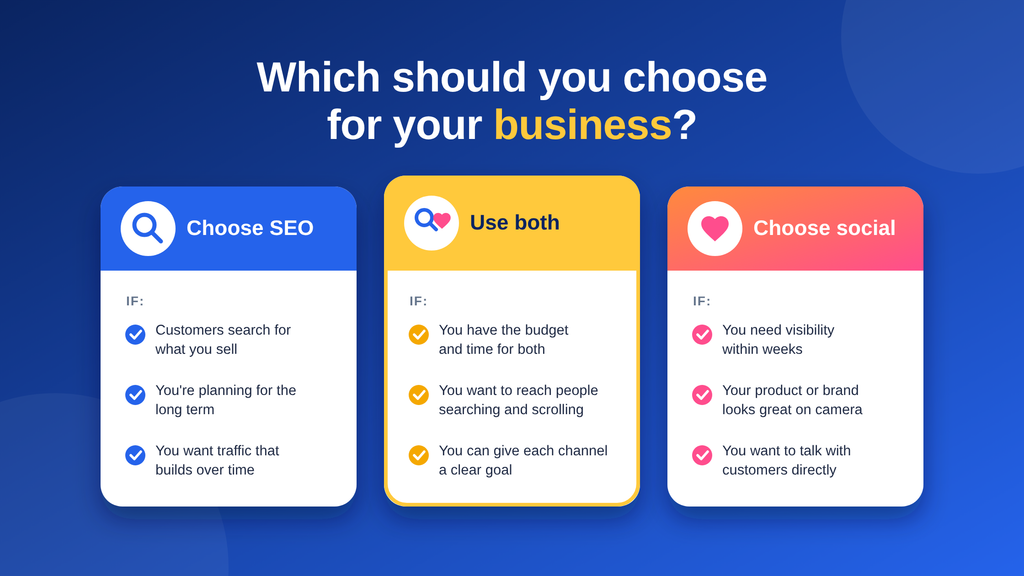
If you’re weighing social media marketing vs SEO, start with how your customers find businesses like yours and how soon you need results. Match your answers to the conditions below.
Choose SEO if:
- Your audience actively searches for your products or services.
- You want long-term organic traffic without recurring ad spend.
- Your niche has enough search volume to go after.
- You can publish consistent, high-quality content.
Choose social media marketing if:
- You need fast visibility for a launch or new product, within weeks.
- Your brand is visual or lifestyle-driven and suits social platforms.
- You want to build a community and talk with customers in real time.
- Your audience is highly active on platforms like Instagram or TikTok.
Use both if:
- You want to reach people at more points before they buy.
- You need short-term visibility and long-term organic growth.
- You have the budget and team to run each channel well.
How does SEO work?
Search engines process your website content in stages before showing it in results. Each stage decides whether your pages are discovered, stored and ranked for relevant searches.
- Crawling: Search engine bots scan your website to discover new and updated pages.
- Indexing: Bots store and organize your content in a massive searchable database.
- Serving and ranking: Algorithms analyze hundreds of factors to determine page order in results. Google doesn’t publish how much each signal weighs, so focus on the areas below.
When a user enters a query, Google retrieves the most relevant indexed pages. It then orders them by what it judges to be the most helpful, high-quality results. Google also notes that not all pages make it through each stage.
Best tools for SEO
These tools help you track search visibility, fix technical issues and research keywords.
- Google Search Console: Shows clicks, impressions and average positions in Google Search and flags indexing issues. Free.
- Google Analytics: Tracks visits, engagement and key events (conversions) so you can see what organic traffic does on your site. Free.
- Ahrefs / Semrush: Keyword research, competitor analysis and backlink tracking. Paid.
- Screaming Frog: Crawls your site to find broken links, missing titles, duplicate content and other technical issues. Free for up to 500 URLs, paid beyond that.
- Yoast SEO / Rank Math: WordPress plugins that help you optimize titles, meta descriptions and on-page content as you write. Free versions available.
Also read: SEO vs SEM: Understand Both and Drive More Traffic
How does social media marketing work?
Each platform uses its own algorithm to decide which content reaches which users and when. Platforms look at what a post contains and how people respond to it. Distribution depends on relevance, format and engagement signals that influence how far a post travels.
- Platforms review a post’s format and topic when you publish it.
- Algorithms predict who’s likely to engage based on past behavior.
- On TikTok’s For You feed, interactions such as likes, shares, comments and watching or skipping shape recommendations, along with content details and user information.
- TikTok’s guide to how its recommendations work adds that interactions, which can include time spent watching, are generally weighted more heavily for most users and that weighting can change over time.
- Paid promotion lets you reach targeted audiences beyond your followers.
Best tools for social media marketing
Managing social media effectively requires tools that support planning, design, publishing and performance analysis. The right platforms help marketers stay consistent, improve content quality and make smarter campaign decisions.
- Hootsuite / Buffer: Schedule and manage posts across multiple platforms efficiently.
- Canva: Create professional graphics and social media visuals quickly.
- Meta Business Suite: Create and schedule Facebook and Instagram posts, stories and ads and reply to messages in one place.
- Sprout Social: Analytics and social listening for deeper audience insights.
- Later: Visual planning and scheduling for Instagram, TikTok, Pinterest, LinkedIn and other platforms.
Also read: Content Marketing vs SEO: How They Work Together
How SEO and social media support each other?
SEO and social media marketing reinforce each other when you plan them together. Search content gives your social channels proven topics and social activity helps new content reach people sooner. Here’s how each channel helps the other:
- Search data gives social its topics: Keyword research and high-ranking pages show what your audience wants to know, so you can repurpose proven topics into social posts instead of guessing.
- Landing pages convert social traffic: Optimized pages on your site give social visitors a clear place to act, which helps turn clicks from your posts into leads or sales.
- Social promotion speeds up discovery: Sharing new content on social platforms puts it in front of people sooner and some of them may link to it or search for your brand later. Engagement on those posts also shows which topics are worth expanding on your site.
- SEO is the steady base when social algorithms shift: Organic search traffic keeps building while social reach rises and falls, so running both covers people who are searching and people who are browsing.
Common SEO and social media mistakes
Avoiding these common mistakes helps protect your investment and improve performance across both channels. Review your current plan against this list to spot gaps early.
- Ignoring audience intent: Creating content before you know what your audience needs leads to posts and pages that few people search for or share.
- Inconsistent publishing: Irregular posting makes it harder to stay visible in social feeds and to keep your site’s content current.
- Neglecting technical SEO: Slow pages and broken links can weaken the content you publish for both search and social visitors.
- Chasing vanity metrics: Likes and impressions show attention, but traffic and conversions show whether that attention turns into business results.
- Siloing both channels: Running SEO and social media separately means each channel misses the topics, data and traffic the other could provide.
How to build one plan for both channels?
A unified strategy amplifies results from both channels simultaneously. Follow these five practical steps to build yours.
- Set goals and audience Write down one measurable goal for each channel, such as organic leads from search or referral clicks from social and describe who you want to reach. Tie each goal to a business outcome like leads or revenue so every later step has a clear target.
- Match keywords to social topics: Use your SEO tools to find keywords with workable search volume, then check which of those topics your audience already discusses on social platforms. The overlap shows you which subjects can earn search traffic and social engagement at once.
- Create for search first, then repurpose: Write the long-form page around your target keyword, then pull short posts, visuals and videos from it for each platform. Starting with the search-focused piece gives your social content a proven topic to build on.
- Distribute and refresh: Share each new page on the social channels where your audience is active soon after you publish it and spread its key points across several posts over the following weeks. Update older SEO content regularly so it keeps earning visits.
- Review and adjust: Check rankings, organic traffic and keyword positions monthly and look at social engagement and referral traffic weekly. Test headlines, formats and posting times, then shift your plan toward what your data shows is working.
How can Bluehost help strengthen your strategy?
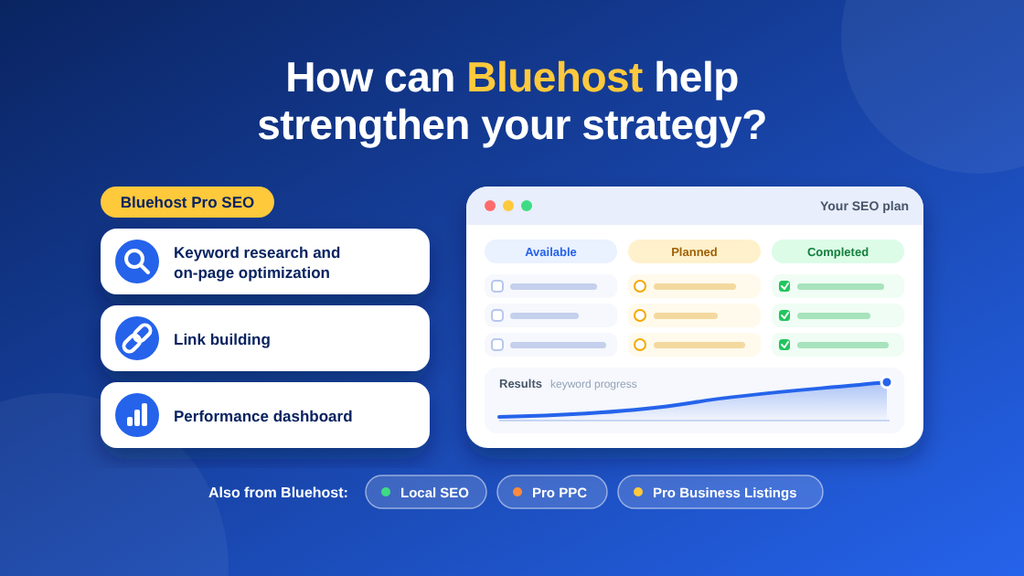
Bluehost offers Professional Digital Marketing services in which our experts run your online marketing for you, so you can focus on running your business. For search, that starts with Pro SEO, backed by Pro PPC and Pro Business Listings.
Pro SEO
Pro SEO is an expert-managed service that helps more customers find your website through search over time.
- Keyword research and on-page optimization: Experts find the terms your customers search for and optimize your existing pages, including title tags, meta descriptions, H1 tags and image alt tags.
- Link building: We submit content relevant to your industry and location to blogs and directories that link back to your site, helping build your authority.
- Dedicated support: An expert helps plan and run your SEO work and reviews progress with you.
- Performance dashboard: See planned and completed actions and your keyword ranking progress in one place.
- Yoast SEO AI+: On-page and technical SEO tools, plus AI Brand Insights to see how your brand shows up across AI platforms.
- Works with your current site: Built somewhere else? We can work on any site we can access through FTP.
Best for: small business owners with a live website who don’t have the time or know-how to run SEO themselves.
Most businesses begin seeing meaningful improvements within 3-6 months. SEO results are not guaranteed and may vary by business, industry and market conditions.
Pro PPC
Pro PPC is a managed pay-per-click service where our experts create and run your Google search ads for you.
- Custom ads and keyword strategy: Google Ads certified experts build ads around the terms your customers use.
- AI-driven optimization: Machine learning monitors and adjusts bids in real time, with a monthly campaign review by your team.
- Location targeting: Choose where your ads show so your budget reaches the right area.
- Flexible budget: Adjust spend as seasons change and stay in control.
Best for: businesses whose customers search on Google and who want to appear in results soon after launch.
Your ads can appear as soon as your campaign is live. It’s the speed many businesses look for in social media, aimed at people already searching.
Pro Business Listings
Pro Business Listings keeps your business details accurate across the online directories where local customers look for you.
- Fully managed setup: We claim your existing listings and create new ones across 20+ directories, including Google Business Profile, Yelp, Bing, Facebook and Foursquare.
- One update, everywhere: Submit a change once and we push it to every directory within two business days.
- Consistent details: Matching name, address, phone and hours build customer trust and support your local search visibility.
- Flexible terms: No long-term contract.
Best for: local businesses with a physical location in the US or Canada.
Not sure where to start? Book a consultation to find the right mix for your site and goals.
Final thoughts
The right choice comes down to matching each channel to how your customers find you and how soon you need results. Pick one clear goal for each channel you use, then start with step 1 of the plan above.
If search is one of those goals and you don’t have time to run it, Bluehost can help. Explore Bluehost Professional Digital Marketing services to choose Pro SEO, Pro PPC, Pro Business Listings or a mix that fits your goals and budget.
FAQs
Neither is better for every small business. SEO tends to fit businesses whose customers search for what they sell, while social media marketing fits businesses that need fast visibility or sell something visual. With limited time and budget, start with the channel where your customers already look for you, then add the second one later.
SEO usually takes several months to show meaningful results and timing varies by competition and site history. Social media marketing can bring visibility and engagement within hours or days, especially with paid promotion. If you need traffic quickly, social or paid ads can fill the gap while your SEO work builds.
Social media activity can support your SEO indirectly, but likes, shares and follower counts are not confirmed ranking factors. Sharing your content helps more people find it and some may link to it or search for your brand later. Google also notes that content from social and video platforms can appear in Google Search.
SEO optimizes your website so it can appear in search results, while social media optimization (SMO) optimizes your social profiles and posts so people can find and share them on those platforms. SMO covers details like bios, keywords, hashtags and post formats. It’s one part of social media marketing, which also includes paid ads, community management and analytics.
Yes. Google says AI Overviews and AI Mode have no additional requirements or special optimizations, so standard SEO best practices still apply. Your pages need to be indexed and eligible to show in Google Search with a snippet, as explained in Google’s guidance on AI features.
Yes. SEO works on any website that search engines can crawl and index, no matter which platform built it. You can improve content, page speed and structure on your current site without rebuilding it. If you’d rather hand the work off, Bluehost Pro SEO can work on any site we can access through FTP.
No. SEO focuses on improving your website for search engines, while social media marketing happens on the social platforms themselves. The two can overlap, though, because Google says social and video content can appear in Google Search. Search Console can report on how that content performs.

Write A Comment