


Key highlights
- Understand the core distinctions between malware vs hacking to identify specific threats to your website.
- Learn how to recognize early warning signs of cyber attacks to prevent data loss.
- Explore proactive security measures that shield your online presence from malicious software.
- Uncover the best practices for maintaining a secure environment and avoiding common vulnerabilities.
- Secure your website with advanced protection services by choosing Bluehost today.
Running a website shouldn’t feel like a constant battle against invisible threats. Whether you’re managing a personal blog, a small business storefront or a growing eCommerce site, understanding the risks is the first step toward staying safe. You’ve likely heard the terms malware and hacking used interchangeably, but they are actually very different.
Knowing the real difference between malware vs hacking will change how you respond to threats, which tools you invest in and how effectively you protect your online presence.
In this guide, you’ll learn exactly what is malware, what is hacking, how they overlap and most importantly how to prevent hacking and malware from compromising your website. We’ll also cover the best malware removal tools, how a website security scanner works and how hosting platforms like Bluehost provide built-in protections to keep your site safe.
What is malware? Understanding the most common cyber threat
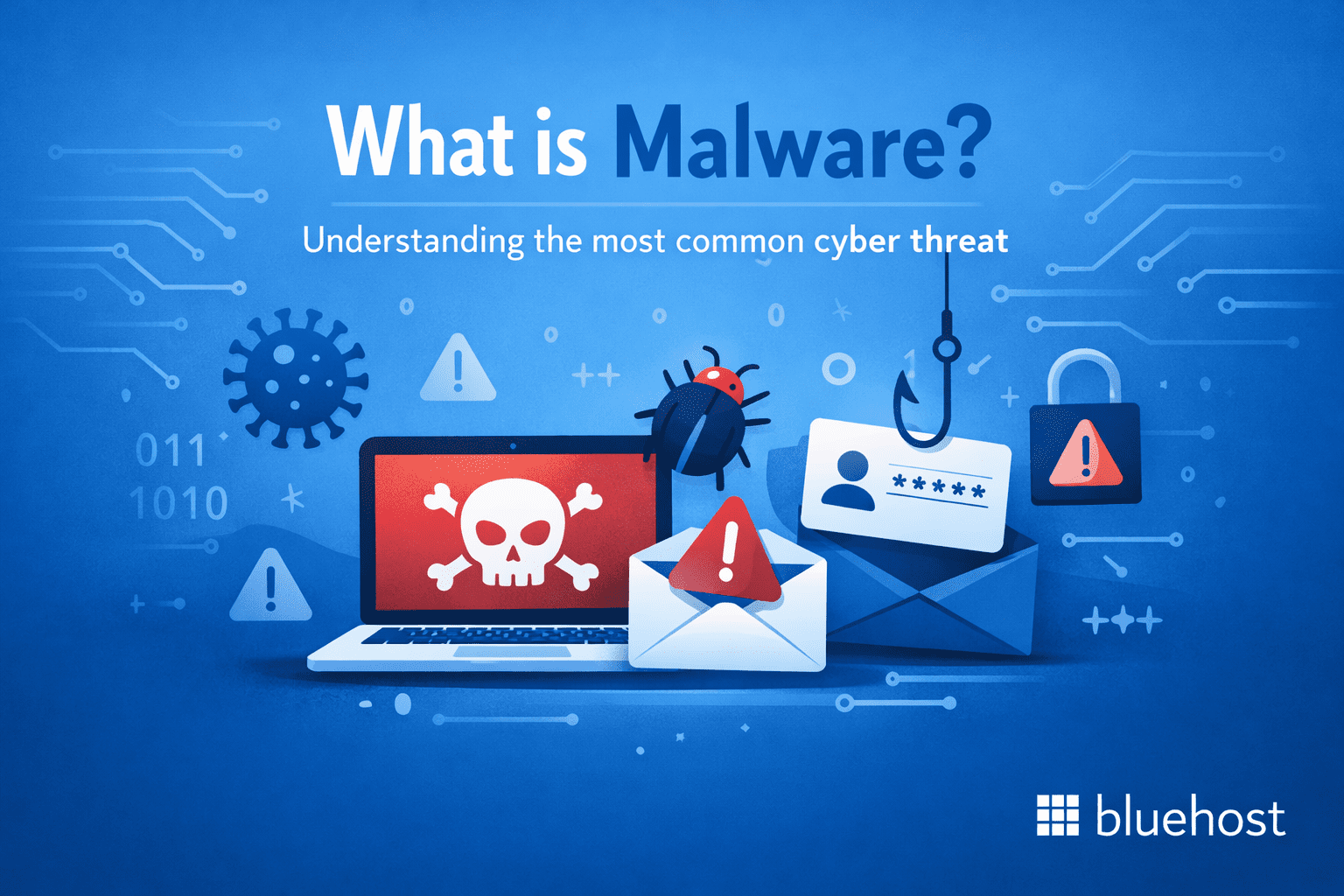
Malware, short for malicious software is any program or code specifically designed to damage, disrupt or gain unauthorized access to a computer system, network or website. Think of malware as the weapon used in a cyberattack. It is the tool that does the dirty work: stealing data, corrupting files, locking users out of their systems or secretly recruiting devices into a botnet.
Malware is typically delivered through infected email attachments, malicious download links, compromised plugins, outdated software vulnerabilities or even legitimate-looking websites that have been secretly infected.
Types of malware you need to know
Not all malware behaves the same way. Here are the most common types of malware that threaten websites and online systems:
- Viruses: Self-replicating code that attaches itself to legitimate files and spreads when those files are shared or executed.
- Ransomware: Encrypts your data and demands a ransom payment to restore access. One of the most financially damaging types.
- Spyware: Silently monitors your activity, collects sensitive data like passwords and sends it back to a third party.
- Trojans: Disguised as legitimate software, trojans trick users into installing them before executing harmful actions in the background.
- Adware: Injects unwanted advertisements into your browser or website, often slowing performance and degrading user experience.
- Rootkits: Deep-level malware that embeds itself into a system’s core, making it extremely difficult to detect and remove.
- Worms: Self-replicating programs that spread across networks without requiring any user interaction.
- Keyloggers: Record every keystroke made on a device, capturing login credentials and financial information.
How does malware work once it infects a site?
Understanding how does malware work is critical for prevention. Once malware enters a system, often through an unpatched plugin, a weak password or a malicious file upload, it begins executing its programmed objective. Some malware operates immediately and visibly, while other strains lie dormant for weeks, quietly collecting information or waiting for the right command.
For websites specifically, malware can redirect visitors to phishing pages, inject spam links into your content, display pop-up ads without your knowledge or steal customer payment data. Search engines like Google actively scan for infected sites and a malware infection can result in your website being blacklisted, wiping out your organic traffic overnight.
Pro tip: If your website is suddenly getting flagged by browsers with a “This site may harm your computer” warning, there’s a strong chance malware has been injected into your pages. Run a website security scanner immediately.
Also read: How to Prevent Malware Attacks: Detect, Remove & Secure
What is hacking? The human element behind cyberattacks
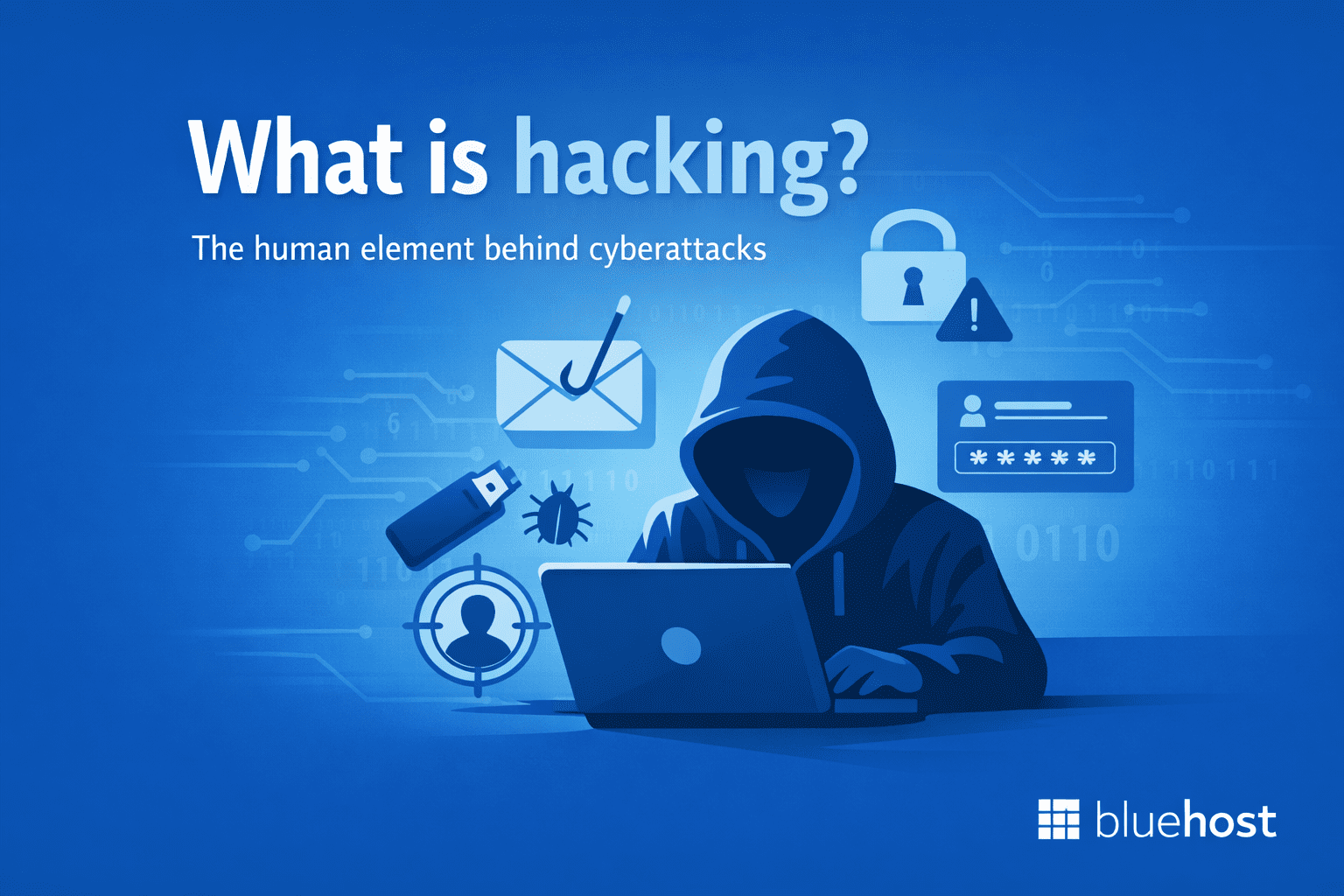
Hacking refers to the act of exploiting vulnerabilities in a system, network or application to gain unauthorized access. While malware is the tool, hacking is the technique, the method a person uses to break into a system. Not all hacking is inherently malicious (ethical hackers, also called “white hat” hackers, help organizations find security flaws), but in most everyday contexts, hacking refers to unauthorized and harmful intrusions.
Hackers target websites for a variety of reasons: financial gain, data theft, political motives, competitive sabotage or simply the challenge of breaking in. A hacker might use malware as part of their attack or they might rely entirely on social engineering, brute-force methods or exploiting software vulnerabilities without ever deploying a single piece of malware.
Common hacking techniques targeting websites
- Brute force attacks: Automated tools cycle through thousands of username and password combinations until they find the right one.
- SQL injection: Malicious code is inserted into a website’s database query fields to extract or manipulate data.
- Cross-site scripting (XSS): Attackers inject scripts into web pages that execute in a visitor’s browser, stealing session cookies or credentials.
- Phishing: Deceptive emails or fake login pages trick users into handing over their access credentials.
- Man-in-the-middle (MITM) attacks: An attacker secretly intercepts communication between two parties to eavesdrop or alter data.
- DDoS attacks: Distributed Denial-of-Service attacks flood a server with traffic to knock a website offline.
Also read: How to Protect Against SQL Injection & Secure Your Database
Malware vs hacking: Key differences explained
Now that we’ve defined both terms individually, let’s break down the core differences between malware vs hacking in a clear, side-by-side comparison.
| Feature | Malware | Hacking |
|---|---|---|
| Definition | Malicious software designed to harm or exploit systems | Unauthorized access or manipulation of a system |
| Nature | A tool or weapon | A technique or method |
| Requires human action? | Runs autonomously once deployed | Usually involves active human decision-making |
| Entry method | Downloads, email attachments, infected plugins | Exploiting vulnerabilities, phishing, brute force |
| Can they overlap? | Yes, hackers often deploy malware as part of an attack | |
| Detection | Website security scanner, antivirus tools | Log monitoring, intrusion detection systems |
| Primary goal | Data theft, disruption, financial gain | Unauthorized access, control or data exfiltration |
The simplest way to think about it: hacking is the act of breaking in; malware is often the lockpick used to do it. A hacker might use malware to gain entry, maintain access or cover their tracks, but not every hacking incident involves malware and not every malware infection is the direct result of an active hacker targeting your site specifically.
How malware and hacking affect website security?
Website security is your site’s overall defense posture, the combination of tools, protocols and practices that protect it from threats. Both malware and hacking can devastate your website security in very real, measurable ways.
Consider the downstream effects of a successful attack:
- Loss of visitor trust: Browsers like Google Chrome display security warnings for infected sites, turning visitors away before they even land on your page.
- SEO damage: Google can blacklist infected websites. Recovering lost rankings after a malware incident can take weeks or months.
- Data breaches: Customer data, payment information and login credentials can be exposed, leading to legal liability and regulatory penalties.
- Revenue loss: Downtime caused by DDoS attacks or ransomware can translate directly into lost sales, especially for eCommerce sites.
- Reputation damage: A single high-profile breach can permanently erode the trust you’ve spent years building with your audience.
Strong website security is not optional, it is a fundamental requirement for any website that wants to stay online, rank in search results and earn visitor trust.
Also read: Website Security 101: Easy Steps to Protect Your Site from Cyber Threats
How to prevent hacking and malware attacks on your website?
Knowing how to prevent hacking and malware starts with understanding that no single solution is enough. Effective website security is layered, combining technical safeguards, good practices and proactive monitoring. Here are the best practices listed for you:
- Keep everything updated: Outdated CMS platforms, plugins and themes are the most common entry points for malware. Always apply security patches promptly.
- Use strong, unique passwords: Weak passwords are prime targets for brute force attacks. Use a password manager and enable two-factor authentication (2FA) on all admin accounts.
- Install an SSL certificate: SSL (Secure Sockets Layer) encrypts data transmitted between your website and visitors. Most reputable hosts, including Bluehost, include a free SSL certificate with all plans.
- Limit login attempts: Implement rate limiting on login pages to block brute force attacks before they succeed.
- Regularly back up your site: Automated daily backups ensure you can restore your website quickly if a malware attack or hack compromises your data.
- Use a web application firewall (WAF): A WAF filters malicious traffic before it reaches your website, blocking common attack patterns in real time.
- Restrict file upload permissions: Limit the file types that can be uploaded to your site to prevent malicious scripts from being injected via upload forms.
- Monitor your site regularly: Use a website security scanner to routinely check your site for vulnerabilities, suspicious code and signs of compromise.
Pro tip: Set up Google Search Console for your website. It actively alerts you if Google detects malware or hacking attempts on your domain, giving you an early warning system that’s completely free.
Also read: Jetpack Security Suite for Agency: Backup & Malware
Malware removal tools and website security scanners to trust
If you suspect your site has been compromised, acting fast is critical. Malware removal tools and website security scanners are your first line of response.
| Tool | Best for | Key feature |
|---|---|---|
| Sucuri SiteCheck | Quick external malware scan | Free website security scanner with blacklist monitoring |
| Wordfence | WordPress websites | Real-time firewall and malware scanner with threat intelligence |
| MalCare | Automated malware removal | One-click malware removal without touching core files |
| Jetpack Security | WordPress with integrated management | Real-time backups, malware scanning and downtime monitoring |
A good website security scanner does more than detect known malware signatures. It monitors for behavioral anomalies, checks outbound links, verifies your domain against blacklists and alerts you to changes in critical files. Running regular scans, ideally automated and daily is a non-negotiable part of responsible site management.
When choosing malware removal tools, look for solutions that offer both detection and remediation, not just alerts. Knowing you have a problem without having a clear path to fix it only adds to the stress of a security incident.
How Bluehost helps protect your website from malware and hacking?
Choosing a hosting provider that prioritizes security is one of the most important decisions you can make as a website owner. Bluehost builds multiple layers of protection directly into its hosting environment, so security isn’t something you have to manage alone.
- Free SSL certificate: All Bluehost hosting plans include a free SSL certificate to encrypt data between your website and visitors, protecting logins, forms and transactions.
- Jetpack security features: Bluehost WordPress plans include Jetpack, which provides automatic backups, tracks all site changes, monitors for issues and enables one-click restores to protect websites from data loss, malware and human error.
- Malware detection and remediation: Bluehost Managed WordPress plans include built-in malware detection and removal, helping safeguard your site without requiring separate security services.
- Network-level protections: Bluehost hosting includes infrastructure-level security measures along with Cloudflare CDN integration to help filter malicious traffic and reduce exposure to common web attacks.
- Enterprise-grade security: Bluehost WordPress hosting plans include a powerful firewall and offers daily malware scanning to keep vulnerabilities and threats at bay.
Why your hosting platform matters?
Website security starts at the server level. Bluehost’s hosting platform is powered by Oracle Cloud Infrastructure (OCI), delivering enterprise-grade reliability and performance for small businesses and creators. Integrated Cloudflare CDN support helps distribute content globally while reducing the impact of malicious traffic, including certain DDoS attacks. It’s time to empower your website with us at Bluehost!
Final thoughts
Cybersecurity doesn’t have to be overwhelming. The core difference between malware vs hacking is straightforward: malware is the weapon and hacking is the action. Together, they represent the two most significant threats to your website, your business and your visitors’ trust. By understanding what is malware, what is hacking and how both work, you’re already ahead of the vast majority of website owners who treat security as an afterthought.
Combining the right malware removal tools and a reliable website security scanner with smart hosting decisions gives you a robust, layered defense. Keep your software updated, use strong authentication, run regular scans and choose a hosting provider that takes security as seriously as you do.
Bluehost makes it easy to build with confidence. With built-in malware detection and removal, free SSL, Jetpack brute force protection and enterprise-level infrastructure, all included in your plan, you get powerful website security without the complexity. Get started today!
FAQs
Malware is a type of malicious software designed to damage or infiltrate systems, while hacking refers to the technique or act of gaining unauthorized access to a system. Hacking is the method; malware is often the tool used during that attack. They can occur independently or together as part of the same cyberattack.
Malware is malicious software that infects systems to steal data, disrupt operations or gain unauthorized control. It typically enters websites through outdated plugins or themes, compromised file uploads, weak admin passwords, infected third-party scripts or vulnerabilities in the website’s core software.
Common signs include unexpected redirects to unfamiliar sites, new admin users you didn’t create, Google security warnings appearing for your domain, a sudden drop in search traffic, suspicious content appearing on your pages or your hosting account flagging unusual activity. Run a website security scanner immediately if you notice any of these signs.
Some of the most trusted malware removal tools for WordPress include Wordfence, MalCare, Sucuri SiteCheck, SiteLock and Jetpack Security. For users on Bluehost’s Managed WordPress plans, malware detection and removal is included directly within the hosting plan at no extra cost.
To prevent hacking, keep all software, plugins and themes updated, use strong and unique passwords with two-factor authentication enabled, install an SSL certificate, use a web application firewall, run regular scans with a website security scanner and choose a hosting provider with built-in security protections. Combining these measures significantly reduces your site’s attack surface.

Write A Comment