 ChatGPT,
 Claude,
 Gemini,
 Grok — all four for
Key highlights
- Bluehost’s free migration tool lets you move your WordPress site from WP Engine to Bluehost in under two hours, no developer needed.
- Before you start, back up your WP Engine site, confirm your email configuration and review your contract terms to avoid surprises mid-migration.
- Two migration paths are covered in this guide: the Bluehost site migration tool for most users and manual migration via FTP and phpMyAdmin for developers who want full control.
- After migration, update your nameservers to point your domain to Bluehost and allow up to 48 hours for DNS propagation to complete.
- Your WP Engine site stays live throughout the entire process and only switches over once your nameservers are updated.
If you are on WP Engine and your hosting bill does not match what your site actually needs, it is time to make a move.
WP Engine is built for agencies and enterprise teams. For small business owners and independent WordPress site owners, the pricing is hard to justify, especially when comparable or better performance is available at a fraction of the cost.
When you migrate hosting from WP Engine to Bluehost, you get WordPress-optimized hosting, a free built-in migration tool and 24/7 live chat and phone support from day one. And the process is far less complicated than it sounds.
This guide covers everything you need to do it right. You will learn how to prepare your site before the move, which migration method fits your setup and what to do once the transfer is complete, so your site stays live and nothing gets lost along the way.
Why migrate from WP Engine to Bluehost?
WP Engine is a managed WordPress host built for agencies and large development teams. If you are running a small to mid-sized WordPress site, you are likely paying for infrastructure and account restrictions you do not need.
Here is how the two hosts compare on the factors that matter most:
| Feature | WP Engine | Bluehost |
| Starting price | $30/mo* | $3.99/mo* |
| Uptime guarantee | 99.95% | 99.9% |
| 24/7 support | Live chat + ticket | Live chat + phone |
| Free domain | Not included | Included (first year) |
| Free migration | Not included | Yes, free |
| Plugin restrictions | Yes, blocked plugins list | No restrictions |
| WordPress pre-installed | Yes | Yes |
*Note: Please note that pricing is subject to change. Refer to the website for the most up-to-date details.
Here is why WordPress site owners choose to migrate hosting from WP Engine to Bluehost:
- Cost at renewal: WP Engine’s entry plan renews at a significantly higher rate than most small site owners expect. Bluehost offers professional-grade WordPress hosting at a price that scales with your business
- Plugin blocklist: WP Engine restricts certain plugins for performance reasons. On Bluehost, you install and run whatever your site needs without limitations
- Free migration included: Bluehost’s migration tool is built into your account from day one, so moving your site does not cost extra or require a developer
- Support when you need it: Bluehost provides 24/7 live chat and phone support at every stage of your migration, so you are never troubleshooting alone
Now that you know why the switch makes sense, here is how to migrate hosting from WP Engine to Bluehost the right way.
How to prepare before migrating from WP Engine to Bluehost?
Jumping straight into migration without prep is the fastest way to run into problems. Taking 30 minutes to work through these steps before you start will save you hours of troubleshooting later.
Back up your WP Engine site
Before anything else, create a full backup of your WP Engine site. This includes your WordPress files and your database. WP Engine’s dashboard lets you generate a backup point manually under the Backup Points section. Download the backup to your local machine so you have a copy independent of WP Engine’s servers.
If something goes wrong during migration, this backup is your safety net.
Confirm where your domain is registered
Your domain registrar and your hosting provider are not always the same. Log into WP Engine and check whether your domain is registered there or with a third-party registrar like GoDaddy, Namecheap or Google Domains.
This matters because you will need to update your nameservers after migration, and knowing where your domain lives tells you exactly where to make that change.
Check your email setup
WP Engine does not provide email hosting. If you are using a third-party email provider like Google Workspace or Zoho, your email will not be affected by the migration. However, confirm your email DNS records before you start so you do not accidentally overwrite them when updating nameservers after the move.
Note your WP Engine contract end date and cancellation terms
Do not cancel your WP Engine account the moment your migration is complete. Check your billing cycle and contract terms first. Keep your WP Engine account active until your Bluehost site is fully live, your DNS has propagated and you have verified everything is working correctly. Canceling too early risks losing access to your files or backups.
Set up your Bluehost hosting account
If you have not already, sign up for a Bluehost WordPress hosting plan before you begin migration. Once your account is active, log into your Bluehost portal. Your migration tool is available from the dashboard and ready to use as soon as your account is set up.
How to migrate from WP Engine to Bluehost: step by step
There are two ways to migrate hosting from WP Engine to Bluehost. The first uses Bluehost’s built-in migration tool and works for most users. The second is a manual process suited for developers who want full control over every step. Choose the method that matches your comfort level and technical setup.
Method 1: Migrate using the Bluehost site migration tool (recommended)
Bluehost’s free site migration tool handles the heavy lifting for you. It connects directly to your existing WordPress site and transfers your files and database automatically. Here is how to use it:
- Log into your Bluehost portal
- Click Add Website
- Select Transfer WordPress Website
- Wait while Bluehost prepares your account, then click Start Transfer
- Enter the URL of your current WP Engine site and click Connect
- Click Yes, Continue to Login – you will be redirected to your existing WordPress site
- Log in with your WordPress username and password
- Click Yes, I approve this connection
- Wait while Bluehost connects to your site – the status will change from Connecting to Connected
- Your files and database transfer automatically from this point
- You will receive a confirmation email when migration is complete. Click Go to site to verify everything has transferred correctly
Pro tip: Do not make any changes to your WP Engine site while the transfer is in progress. Edits made during migration may not carry over to Bluehost.
Method 2: Manually migrate from WP Engine to Bluehost
Manual migration gives you complete control over every file and database record that moves to Bluehost. It is best suited for WP Engine sites with custom configurations that require direct handling of files and databases, or when Bluehost support recommends this path for your specific setup. While it involves working with FTP, phpMyAdmin and your WordPress database directly, it ensures everything transfers on your terms, including your WP Engine custom templates and site-specific configurations.
Step 1: Transfer your website files
Use an FTP client like FileZilla to connect to your WP Engine server. Download your entire WordPress installation, including the wp-content folder, wp-config.php and all core files, to your local machine. Once downloaded, connect to your Bluehost server via FTP and upload the files to the public_html directory.
Step 2: Export your WordPress database
Log into your WP Engine User Portal and navigate to your site’s phpMyAdmin. Select your WordPress database, click Export, choose the Quick export method and save the .sql file to your local machine.
Step 3: Create a new database on Bluehost
Log into your Bluehost control panel and open MySQL Databases. Create a new database, create a new database user and assign that user full permissions to the new database. Note the database name, username and password – you will need these in Step 5.
Step 4: Import your database
In your Bluehost control panel, open phpMyAdmin and select the new database you just created. Click Import, upload the .sql file you exported from WP Engine and run the import.
Step 5: Update your wp-config.php file
Open the wp-config.php file you transferred to Bluehost in Step 1. Update the following values to match the new Bluehost database credentials:
define('DB_NAME', 'your_new_database_name');
define('DB_USER', 'your_new_database_username');
define('DB_PASSWORD', 'your_new_database_password');
define('DB_HOST', 'localhost');
Save the file and re-upload it to your Bluehost public_html directory via FTP.
Step 6: Fix your permalinks
Log into your WordPress dashboard on Bluehost. Go to Settings, then Permalinks. Without changing anything, click Save Changes. This refreshes your .htaccess file and ensures your URLs resolve correctly on the new server.
Step 7: View your site
Before updating your nameservers, preview your migrated site on Bluehost using a temporary URL or by editing your local hosts file. Confirm your pages, posts, images and plugins are all intact before pointing your domain to Bluehost.
Bluehost site migration tool vs manual migration
Not sure which method suits your situation? Here is a quick comparison:
| Factor | Bluehost site migration tool | Manual migration |
| Technical skill needed | None | Intermediate to advanced |
| Time to complete | Under 2 hours | 2 to 4 hours |
| Risk of error | Low | Higher without prior experience |
| Best for | Most WordPress site owners | Developers who want full control |
| Cost | Free | Free |
For the majority of users migrating hosting from WP Engine to Bluehost, the site migration tool is the faster and lower-risk path. Use manual migration only if you have a specific reason to handle the transfer yourself.
Final steps after migration
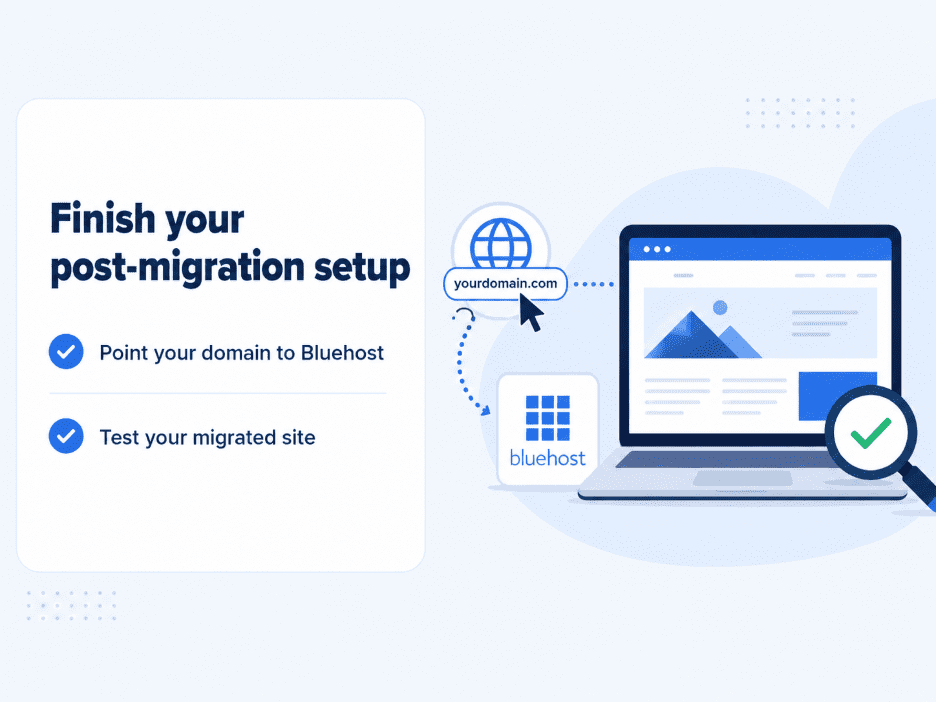
Your files and database are on Bluehost. Before you call the migration done, there are two things left to take care of: pointing your domain to Bluehost and verifying your site is running correctly.
Point your domain to Bluehost
To make your site live on Bluehost, you need to update your domain’s nameservers. Where you do this depends on where your domain is registered.
Log into your domain registrar’s account, find your domain’s DNS settings and replace the existing nameservers with Bluehost’s nameservers:
- ns1.bluehost.com
- ns2.bluehost.com
Save the changes. DNS propagation can take anywhere from a few hours to 48 hours to complete globally. During this window, some visitors may still see your WP Engine site while others land on Bluehost. This is normal and temporary.
Pro tip: Keep your WP Engine account active until propagation is fully complete. Do not cancel early.
Test your migrated site
Once your domain is pointing to Bluehost and propagation is complete, run through this checklist before considering the migration closed:
- Homepage and key pages: Open your site and click through your main pages to confirm content and layout are intact
- Images and media: Check that images load correctly across pages and posts
- Forms and plugins: Submit a test form and verify your active plugins are functioning as expected
- SSL certificate: Confirm your site loads on https and the padlock is showing. Bluehost includes a free SSL certificate on all plans
- Site speed: Run a quick speed check using a tool like Google PageSpeed Insights to confirm performance on the new server
- Redirects: If you had any 301 redirects set up on WP Engine, confirm they are working correctly on Bluehost
If everything checks out, your migration is complete. You can now cancel your WP Engine plan according to their cancellation terms.
Final thoughts
Migrating hosting from WP Engine to Bluehost is a straightforward process when you follow the right steps. Back up your site, choose your migration method, update your nameservers and test thoroughly before canceling your old account.
Bluehost’s free migration tool makes it possible for most WordPress site owners to complete the move without any technical background. And with 24/7 support available throughout, you have help on hand if anything comes up along the way.
Ready to make the switch? Get started with Bluehost WordPress hosting today and bring your site over for free.
FAQs
Yes. Bluehost includes a free site migration tool with all WordPress hosting plans. You can use it to transfer your WP Engine site, including your files and database, directly from your Bluehost dashboard without needing a developer or paying an additional fee.
No. Transferring your domain is optional. You can keep your domain registered at WP Engine and simply update your nameservers to point to Bluehost. Your site will run on Bluehost without your domain needing to move registrars.
Yes. Your domain registrar and your hosting provider do not have to be the same. Update your nameservers to ns1.bluehost.com and ns2.bluehost.com from within your WP Engine domain settings and your site will resolve to Bluehost while your domain stays where it is.
Using the Bluehost site migration tool, most transfers complete in under two hours. Manual migration typically takes two to four hours depending on your site size and your familiarity with FTP and phpMyAdmin. DNS propagation after migration can take up to 48 hours.
No. Your WP Engine site stays live throughout the entire migration process. Your site only switches over to Bluehost once you update your nameservers and DNS propagation completes. With the right prep, there is no downtime at any stage.
WP Engine does not provide email hosting, so your email is not affected by the migration. If you use a third-party email provider like Google Workspace or Zoho, your email will continue to work as long as your email DNS records are preserved when you update your nameservers.
No. Wait until your Bluehost site is fully live, your DNS has propagated and you have tested everything thoroughly before canceling your WP Engine account. Check your WP Engine billing cycle and cancellation terms to avoid unexpected charges and ensure you do not lose access to your backups prematurely.

Write A Comment