


Key highlights
- Explore how OpenClaw AI moves beyond traditional chatbots by enabling autonomous agents that can plan, execute and manage complex workflows.
- Understand how OpenClaw evolved from a simple weekend project called WhatsApp Relay into a viral open-source AI platform with massive developer adoption.
- Discover how self-hosting OpenClaw gives developers and teams full control over their AI infrastructure, data privacy and customization.
- Learn how OpenClaw integrates with messaging platforms, APIs and software tools to automate repetitive tasks and streamline digital workflows.
- See how the rise of autonomous AI agents and open-source ecosystems is reshaping the future of automation, productivity and agent-based computing.
We’re finally moving past the phase where AI is just a fancy chatbot for quick answers. A whole new category is taking center stage: AI agents. These tools are built to do much more than just react to a single prompt. Instead of tackling one question at a time, they can actually plan complex tasks, navigate different software and handle multi-step workflows with very little human oversight. It’s a huge shift from simply looking up information to actually getting the work done.
Among the many tools emerging in this space, OpenClaw has started gaining notable momentum. It’s an open-source, self-hosted AI agent that enables users to build custom assistants and operate them within their own infrastructure. By connecting with messaging platforms, APIs and various software tools, OpenClaw can handle repetitive tasks that would otherwise require constant manual input. For developers and automation enthusiasts, the biggest appeal is the level of control it provides over how AI systems operate.
This guide breaks down exactly what OpenClaw AI is, how it functions and why it’s quickly becoming a favorite for anyone building intelligent automation systems.
What is OpenClaw AI?
OpenClaw AI is an open-source autonomous agent framework that allows developers to build systems capable of completing complex tasks with minimal human intervention. It enables AI agents to plan actions, interact with APIs and execute multi-step workflows.
Unlike traditional chatbots that only provide textual responses to prompts, it enables the creation of digital assistants that can plan actions, interact with various software systems and execute multi-step workflows across different digital environments.
At its core, OpenClaw is built around the concept of agentic behavior. This functionality allows the AI to take a high-level objective, break it down into smaller, manageable sub-tasks and utilize connected tools or APIs to complete the work autonomously.
Because it possesses the ability to execute actions rather than just generate text, OpenClaw moves far beyond simple Q&A. The platform serves as a robust foundation for building intelligent automation systems that coordinate disparate tools, manage data workflows and keep business processes running efficiently in the background.
Also read: OpenAI’s Shift to OpenClaw Explained
In simple terms, OpenClaw bridges the gap between sophisticated AI reasoning and practical, real-world execution. Before exploring its technical capabilities, it is helpful to understand the journey of how this platform came to be.
How OpenClaw started: From side project to global platform
Many influential open-source technologies begin as small experiments rather than carefully planned corporate projects. OpenClaw followed a similar path.
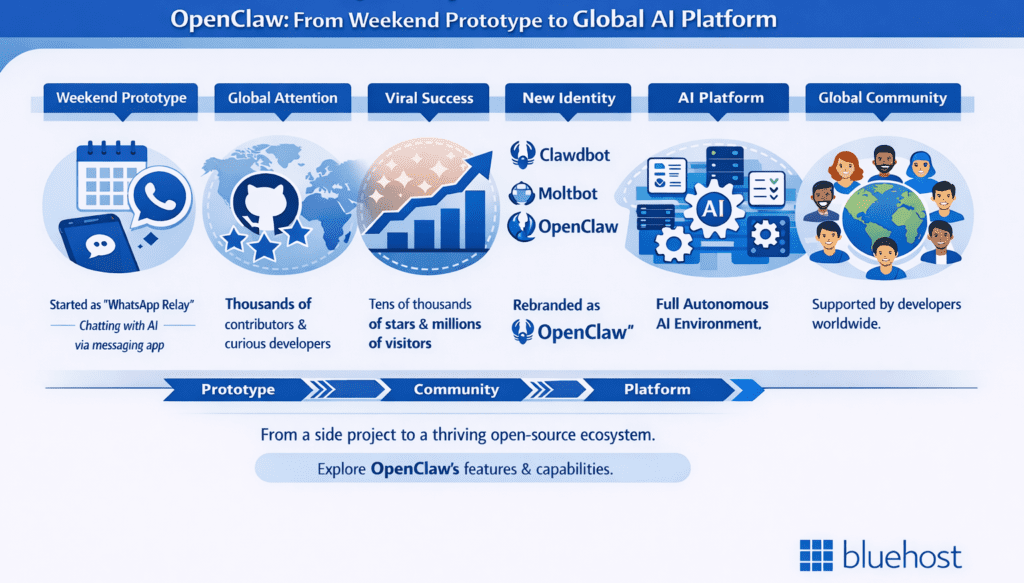
The project originally started as a weekend prototype called “WhatsApp Relay.” The primary idea was simple: allow people to interact with powerful large language models directly through familiar messaging apps like WhatsApp.
Instead of forcing users to open a web browser or navigate a complex technical interface, they could simply send a message and receive intelligent AI responses within a chat environment they already used daily.
What was meant to be a minor experiment quickly gained significant attention from the global developer community. As word spread, the project’s GitHub repository rapidly attracted thousands of contributors and curious visitors who saw the potential for something much larger.
Within weeks, the project had accumulated tens of thousands of stars and drawn millions of visitors. It soon became clear that the platform had outgrown its original scope as a simple relay and needed a more permanent identity.
After exploring several naming ideas, including Clawdbot and Moltbot, the team ultimately chose OpenClaw. This name reflected the project’s commitment to open-source development while maintaining its unique lobster-themed identity.
By this point, the platform had evolved into a comprehensive runtime environment for autonomous AI agents. It was now capable of coordinating external tools, managing sensitive data and executing sophisticated workflows across various services.
What began as a simple weekend project quickly became a fast-growing open-source platform supported by a global developer community. With the history of the project in mind, we can now examine the specific features and functionalities that OpenClaw provides to users.
What are the key features that make OpenClaw powerful?
OpenClaw provides a sophisticated framework for transforming standard AI interactions into a high-performance operational layer. By choosing to deploy on a self-managed VPS, organizations can develop autonomous systems while maintaining strict data privacy and total infrastructure control. These features help explain what is OpenClaw AI and why it is a vital tool for internal development.
| Feature | What it does | Why it matters |
| Advanced AI orchestration | Coordinates multiple agents to handle tasks across different platforms. | Operates without needing constant human input, increasing efficiency. |
| Tool calling and API chaining | Connects agents directly to internal services and APIs. | Automates workflows and eliminates repetitive manual tasks. |
| Memory and context systems | Tracks and maintains context over extended periods. | Improves accuracy for complex research and long-term projects. |
| Autonomous task execution | Sets AI tasks to run on a schedule or based on specific conditions. | Reduces the overall manual workload for your team. |
| Self-hosted deployment | Allows the platform to run on private servers, such as a Bluehost VPS. | Ensures your data remains completely secure and private. |
In summary, knowing what is OpenClaw AI reveals it as a complete engine for autonomous work instead of just a chatbot. By combining task management, memory and secure hosting, it allows technical teams to build reliable AI infrastructure they fully control.
How does OpenClaw actually work?
Understanding the inner mechanics of OpenClaw AI reveals why it is becoming a premier choice for those seeking an autonomous open-source AI agent. By combining sophisticated natural language understanding with a structured execution framework, it effectively bridges the gap between simple chat interactions and complex task automation.
To better understand how this system handles your requests, let’s examine the specific technical processes that drive its decision-making and execution workflow.
1. Input processing and intent detection
The process begins when a user submits a request through a terminal command, API call or chat interface. Rather than just identifying basic keywords, OpenClaw utilizes its core language model to determine the actual intent behind the message. By grasping the “why” behind your specific request, the agent can more accurately plan its subsequent actions to meet your goals.
2. Context retrieval and long-term memory
For an autonomous agent to be effective, it must remember the context of a project as it evolves. OpenClaw maintains a rolling conversation history and captures essential data points throughout the session. This form of long-term memory ensures the agent keeps a coherent flow, meaning you don’t have to provide the same instructions repeatedly as your project grows in complexity.
3. Smart tool selection and task planning
Before taking action, the AI assesses its suite of available tools and integrations to find the right fit for the task. It develops a logical sequence of steps, deciding whether it needs to perform a web search, run a specialized script or connect to an API. This strategic planning phase is what allows the agent to deliver precise results tailored to the user’s needs.
4. Flexible local or server-side execution
OpenClaw offers significant versatility in terms of where the actual computation takes place. It is designed to run tasks either on your local machine, prioritizing data privacy and security or on a remote server when more raw processing power is required. This flexibility makes it a favorite for developers who want full control over their computing environment.
5. Autonomous follow-ups and proactive responses
One of the standout features of OpenClaw is its proactive nature, moving beyond the standard prompt-and-response loop. It is capable of working through multi-stage tasks on its own, pausing only to ask for clarification or provide a status update when necessary. This level of autonomy makes it feel less like a tool and more like a true digital collaborator.
By layering these advanced capabilities, from intent detection to flexible execution, OpenClaw provides a comprehensive framework for autonomous problem-solving. This robust architecture ensures that the agent remains adaptable and efficient, providing a powerful open-source solution for modern AI workflows.
How does OpenClaw compare to other AI tools?
To truly understand what is OpenClaw AI, it is helpful to see how it fits into the broader ecosystem of artificial intelligence and automation. While there are many tools available for interacting with large language models, OpenClaw is designed specifically for those who require a high degree of autonomy and privacy that standard cloud-based applications often lack.
The following comparison table highlights the critical differences between OpenClaw and other popular solutions, such as traditional chatbots and workflow orchestrators, to help you determine which is right for your needs.
| Feature | OpenClaw | Traditional AI assistants | Workflow automation tools | n8n |
| Deployment | Self-hosted on your own infrastructure | SaaS hosted on external servers | SaaS or self-hosted | Usually self-hosted |
| Data control | Full ownership of data and prompts | Data processed on vendor servers | Depends on platform | Full control when self-hosted |
| Core purpose | Autonomous AI agents and reasoning | Conversational assistance | Task automation | Workflow orchestration |
| Task handling | Multi-step reasoning and autonomous decisions | Single prompt responses | Rule-based workflows | Event-driven workflows |
| Best use case | Building AI-driven systems | Chat, research, quick answers | Moving data between apps | Connecting APIs and automations |
| Infrastructure control | Full control via self-hosted VPS | No control | Limited | Partial |
Key takeaway: OpenClaw distinguishes itself by offering a self-hosted environment where autonomous agents can perform complex, multi-step reasoning while ensuring the user maintains 100% ownership of their data.
In summary, while traditional tools are excellent for simple tasks, OpenClaw provides the robust infrastructure necessary for building sophisticated, independent AI systems.
Is OpenClaw secure?
OpenClaw AI prioritizes user safety by leveraging its open-source nature and self-hosted architecture. Because the software is transparent, users can inspect the code to ensure there are no hidden vulnerabilities or data leaks. The following sections detail the specific security benefits and considerations when using this autonomous agent.
1. Trust through open-source transparency
Since OpenClaw is an open-source project, its entire codebase is available for public scrutiny on platforms like GitHub. This transparency allows developers and security experts to identify and fix potential bugs quickly, fostering a collaborative environment for security improvements. By seeing exactly how the AI processes information, users can feel more confident in its integrity.
2. The privacy advantages of self-hosting
One of the primary security features of OpenClaw is the ability to run the software on your own local hardware or private server. This self-hosting model ensures that your sensitive data and API keys never leave your controlled environment or get stored on third-party servers. It provides a level of data sovereignty that is often missing in proprietary, cloud-based AI services.
3. Navigating the risks of autonomous AI agents
While OpenClaw offers great utility, autonomous agents inherently carry risks since they can perform actions on behalf of the user. It is essential to understand the scope of tasks the agent is performing to prevent unintended consequences or unauthorized system changes. Users should always monitor the agent’s behavior and set clear boundaries for its autonomous operations.
4. Importance of proper configuration and permissions
Security in OpenClaw depends heavily on how the user configures the underlying environment and access rights. Implementing the principle of least privilege ensures that the AI agent only has access to the specific files and tools it needs to complete its tasks. Taking the time to properly lock down your system will significantly reduce the surface area for potential security breaches.
When deployed on a VPS, OpenClaw also benefits from stronger infrastructure security. Dedicated resources improve environment isolation and give developers more control over system configuration, making it easier to protect sensitive data and reduce exposure to external threats.
Also read: VPS Security Tips and Best Practices to Secure your Server
Ultimately, while OpenClaw provides robust security foundations, its safety is a shared responsibility between the software developers and the users who deploy it.
Who is OpenClaw AI actually for?
While OpenClaw may sound like a tool built only for hardcore AI engineers, its real audience is broader than that. The platform is designed for technical users who want more control over how AI agents run, integrate and automate tasks across different workflows.
To better understand where OpenClaw fits, let’s look at the types of users who can benefit the most from using it.
1. Developers and Software Engineers
If you’re the type of person who loves to get under the hood and see how things work, OpenClaw AI is basically a playground. It’s perfect for developers who want to build their own autonomous agents without the restrictions or the price tag, of a closed-source ecosystem. Because it’s open-source, you have total control over the code, making it a great choice for those who need to customize every last detail of their AI agents.
2. AI Enthusiasts
You don’t need a computer science degree to get excited about this. If you spend your free time experimenting with LLMs or trying to automate your daily life, this tool gives you a flexible, open framework to see what’s possible with agentic AI. It’s a great way to stay on the cutting edge of tech… plus, it’s just fun to see what these autonomous agents can handle on their own.
3. Automation Professionals
For anyone whose job involves streamlining workflows, OpenClaw AI is a bit of a game-changer. It’s designed to handle those repetitive, multi-step tasks that usually eat up your entire afternoon. It’s less about replacing humans and more about offloading the “busy work” to an agent so you can focus on the creative problems that actually require a human brain.
4. Businesses Exploring AI Agents
Plenty of companies are curious about what AI can do but aren’t quite ready to sign a five-figure contract for a proprietary platform. OpenClaw acts as an ideal entry point. It lets teams pilot autonomous tasks and test out the technology to see where it adds real value before they go all-in on an enterprise-level solution.
Ultimately, whether you are a solo coder or a growing business, OpenClaw AI provides the necessary tools to harness the power of autonomous agents in a way that is both scalable and customizable.
How to Get Started With OpenClaw AI?
Launching your journey with OpenClaw means moving away from restrictive SaaS models and embracing total infrastructure ownership. By utilizing Bluehost VPS One-Click OpenClaw, technical operators can launch a private AI automation engine in minutes. This self-managed environment empowers you to build, run and scale internal AI agents while maintaining absolute control over your proprietary data and execution logic.
Deploying private AI infrastructure with Bluehost VPS
The transition from AI experimentation to a reliable operational system requires dedicated infrastructure. With the Bluehost VPS One-Click OpenClaw solution, teams can bypass the limitations of opaque external bots. This setup is designed for those who need AI embedded directly into their systems, offering a scalable layer for autonomous task execution without the risks of sending sensitive data to third-party providers.
- AI orchestration: Coordinate multiple agents to perform structured, repeatable tasks across various business systems efficiently.
- Workflow & prompt pipelines: Standardize your processes by building reusable, versioned prompt chains that deliver consistent and reliable results.
- Tool calling & API chaining: Connect your AI agents to internal tools and services like Slack, GitHub or Notion to take real-world actions autonomously.
- Memory & context systems: Ensure continuity in long-term processes by persisting state across interactions, which is essential for complex research and support workflows.
- Self-hosted security: Keep all sensitive operations on your own server to avoid vendor lock-in and ensure maximum data privacy.
Scaling your AI capabilities
OpenClaw provides a foundation for sophisticated multi-step reasoning flows, where the output of one task directly informs the next. This capability allows for complex triage and analysis that single-prompt tools cannot handle. Furthermore, by pairing OpenClaw with workflow automation tools like n8n on your VPS, you create a comprehensive, owned automation stack. In this ecosystem, self-managed VPS hosting for self-hosted n8n manages event-driven integrations while OpenClaw serves as the reasoning engine, providing a professional-grade AI infrastructure for builders.
Also read: Bluehost Self-Managed VPS: How to Use the n8n VPS Template
Setting up a personalized AI environment through OpenClaw grants you the creative freedom to innovate without being hindered by the restrictive usage limits of third-party providers. This self-hosted model ensures that your autonomous agent’s capabilities expand in direct alignment with your unique technical needs and data security requirements, providing a truly independent automation solution. As these localized environments become more sophisticated, it is crucial to examine how this technology will continue to evolve and shape the next generation of automation.
Why choose Bluehost self-managed VPS for OpenClaw?
Real-world AI requires more than just smart code, it requires reliable infrastructure. Most SaaS options feel like a cage, limiting your flexibility and potentially risking sensitive data. That’s where a self-managed Bluehost VPS steps in. It gives your team the raw control needed to weave OpenClaw directly into your own internal systems. Here’s why Bluehost is the right move for scaling.
Retain full control with self-hosting
Deploying OpenClaw on a Bluehost self-managed VPS hosting keeps your AI agents, workflows, prompts and integrations entirely within your environment. Teams maintain ownership of data and operations, enabling secure experimentation and reliable automation without exposing proprietary information.
Launch quickly with one-click deployment
Bluehost’s One-Click VPS setup simplifies installation, allowing developers to start using OpenClaw immediately. With minimal configuration, teams can deploy a working AI agent platform and begin building autonomous workflows without delays.
Reliable infrastructure for autonomous AI
VPS resources, dedicated CPU, RAM and storage, ensure OpenClaw agents run consistently, manage background tasks and scale with operational demands. Multi-step reasoning, prompt pipelines and continuous task execution operate seamlessly, making autonomous AI practical for daily business operations.
Embed AI directly into workflows
OpenClaw agents connect to internal systems, services and APIs via tool calling and API chaining. This integration enables AI to take real actions within existing workflows, reducing manual effort and supporting end-to-end automation across business processes.
Run production-ready AI systems
By combining OpenClaw’s autonomous capabilities with Bluehost VPS, teams can move beyond ad-hoc experimentation. This self-managed environment supports scaling internal AI workflows, maintaining operational reliability and embedding AI directly into day-to-day systems.
Bluehost self-managed VPS provides a secure, scalable platform for OpenClaw, enabling teams to deploy autonomous AI workflows efficiently while retaining complete control over data and infrastructure.
What does the future of OpenClaw and AI agents look like?
We are rapidly moving beyond the era where AI serves merely as a conversational interface. The future of OpenClaw lies in the transition toward autonomous agent systems capable of performing tangible work within a company’s secure infrastructure. This represents a significant shift from experimental AI to the creation of proprietary operational systems that organizations can scale and integrate without being dependent on a third-party black box.
1. Autonomous AI workflows
Modern AI frameworks are being reimagined to manage intricate, structured workflows without constant human oversight. Instead of simply responding to prompts, these agents can execute specific triggers, synchronize data across platforms and complete recurring tasks automatically. This positions OpenClaw as a dependable operational layer integrated into internal tools rather than a standalone application.
2. Agent-based computing
A new paradigm of agent-based computing is emerging as a viable alternative to legacy software. In this environment, various specialized AI agents work in concert to complete complex projects by planning multi-step sequences and navigating internal APIs. This allows enterprises to develop sophisticated internal copilots that drive research and automation beyond basic text summarization.
3. Open-source AI ecosystems
For many businesses, the risk of exposing sensitive data to a proprietary cloud is a major barrier. The expansion of open-source platforms allows teams to build private AI environments that maintain data sovereignty. By adopting a self-hosted ecosystem like OpenClaw, organizations can orchestrate multiple models and automation tools while retaining full control over their security and technical evolution.
Ultimately, the evolution of OpenClaw signals a move toward high-performance, private AI environments that empower businesses to automate complex logic securely. As agent-based computing matures, these open-source tools will become the foundational infrastructure for modern enterprise operations.
Final thoughts
The jump from basic chatbots to OpenClaw AI is a massive shift in how we interact with technology. We aren’t just talking to screens anymore; we’re deploying autonomous agents that can actually think and act on our behalf.
What makes this setup so compelling is the absolute control it gives you. By choosing to self-host, you aren’t forced to trade privacy for convenience. It’s that sweet spot where deep customization meets automation, all while keeping your data exactly where it belongs, under your own roof. For anyone looking to build a secure, truly personalized digital assistant, this is the clear path forward.
AI is evolving at a breakneck pace and honestly, it’s an exciting time to be in the loop. Overall, leaning into these agents now is the smartest move you can make for your technical workflow. These tools aren’t just “coming soon”, they’re here, they’re more capable than ever and they’re ready for you to put them to work.
Don’t just watch the AI revolution from the sidelines. Launch your own Bluehost self-managed VPS for one-click OpenClaw installation today and start building your autonomous future right now.
FAQs
OpenClaw is used to build and manage private AI agents and automated workflows. It enables technical operators to orchestrate complex tasks, integrate AI into existing systems via APIs and maintain full data control on a self-hosted VPS infrastructure.
Yes, OpenClaw is optimized for self-managed VPS hosting. Using Bluehost one-click deployment, technical operators can launch private AI agents on dedicated infrastructure, ensuring total control over sensitive data, complex workflows and execution logic while avoiding restrictive external SaaS dependencies.
Yes, OpenClaw is an open-source platform for building private AI agents. It provides technical operators with full infrastructure control, allowing for self-hosted deployments on VPS. You can leverage community-driven integrations and maintain complete ownership over your data, prompts and automation logic.
Yes, OpenClaw requires a server to function. By deploying it on a Bluehost VPS, you gain full infrastructure control. This self-hosted approach ensures your sensitive data stays private while allowing you to build and run autonomous AI agents and workflows.


Write A Comment