 ChatGPT,
 Claude,
 Gemini,
 Grok — all four for
Key highlights
- You can migrate a WordPress site from GoDaddy to Bluehost in under 30 minutes using Bluehost’s free self-service migration tool.
- Before you start, back up your GoDaddy site, check your email setup and note your GoDaddy contract end date to avoid double-billing.
- You have two migration paths: the Bluehost Site Migration Tool (recommended for most users) or a manual migration via cPanel and phpMyAdmin.
- After migration, update your nameservers to point your domain at Bluehost but DNS propagation takes up to 48 hours.
- Your GoDaddy site stays live throughout the migration. It only switches to Bluehost after you update your nameservers.
Many website owners first use GoDaddy to register a domain, then review hosting once their site needs more from the platform. At that point, the decision is no longer only about where the domain sits. It becomes about WordPress performance, support quality, security coverage and the tools needed to manage the site with confidence.
Bluehost is built for what comes next. Whether you’re running a WordPress blog, an online store or a business website, you get faster hosting, 24/7 expert support and the tools you need included from day one.
This guide covers the complete migration from GoDaddy to Bluehost: what to prepare before you start, which migration method fits your setup and how to verify everything is working before you make the final cutover.
Ready to start your migration? Move to Bluehost today!
Why migrate from GoDaddy to Bluehost?
GoDaddy works primarily as a domain registrar. As a hosting provider for WordPress sites, it has real limitations, particularly around WordPress-specific performance, support depth and the cost of features that Bluehost WordPress Hosting includes by default.
| Feature | GoDaddy | Bluehost |
| WordPress.org recommended | No | Yes – since 2005 |
| Free SSL | Included | Included in every plan |
| Free domain | First year on select plans | Included in every plan (first year) |
| 24/7 WordPress support | Included – generic support | Included WordPress support; premium support plan available |
| Malware scanning | Available on select plans | Included on all plans |
| Free site migration | Limited (Managed Hosting for WordPress plans only) | Free via self-service tool |
| Money-back guarantee | 30 days | 30 days |
| Best for | Domain registration and basic sites | WordPress and WooCommerce hosting |
Here are the most common reasons users make the switch from GoDaddy to Bluehost:
- Lower entry barrier: GoDaddy’s entry-level WordPress hosting starts at $6.99/mo but renews at $14.99/mo. Bluehost’s entry plan starts at $3.99/mo and renews at $9.99/mo, making it the lower-cost option on both intro and renewal pricing.
- WordPress performance: Bluehost servers are configured specifically for WordPress. GoDaddy’s shared environment is more generalist.
- Support quality: GoDaddy support is broad. Bluehost’s 24/7 team is trained specifically on WordPress and WooCommerce issues.
- Security included from day one: WAF, malware scanning and DDoS protection are included on every Bluehost plan from day one. On GoDaddy, these features come as a one-month trial and require a paid upgrade to keep.
Each of these compounds over time. A site on GoDaddy’s entry plan renews at $14.99/mo, while the equivalent Bluehost plan renews at $9.99/mo and comes with full security coverage already included.
* Note: Pricing referenced in this article is as of May 2026. For the latest pricing, visit the official website.
How to prepare before you start migrating from GoDaddy to Bluehost
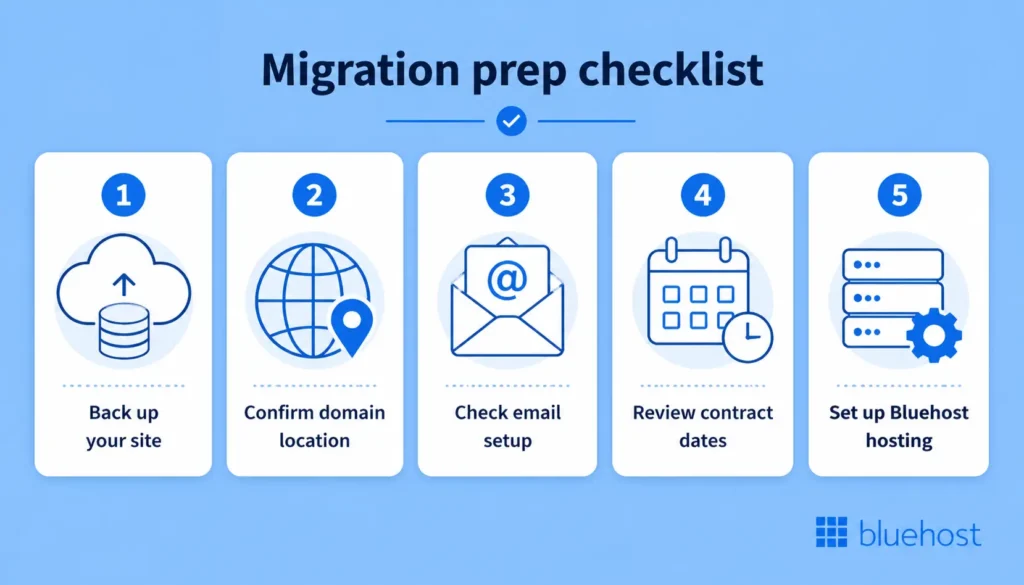
Each item below takes under five minutes to check. Missing any one of them is the most common reason migrations require a do-over.
- Back up your GoDaddy site: Export a full backup from GoDaddy’s cPanel, files and database together. If something goes wrong mid-migration, this is your safety net. Store it locally, not just on GoDaddy’s servers.
- Confirm where your domain is registered: Your domain may be registered at GoDaddy (common), or it may be registered elsewhere and pointed at GoDaddy hosting. This affects your post-migration DNS steps. Log in to GoDaddy and check under Domains > My Domains to confirm.
- Check your email setup: If you use a GoDaddy email address (Workspace Email or Microsoft 365 through GoDaddy), those accounts are separate from hosting. Migrating your hosting does not automatically move your email. Decide in advance whether you’ll migrate email to Bluehost or keep it at GoDaddy and update MX records accordingly.
- Note your GoDaddy contract end date and cancellation terms: GoDaddy does not automatically cancel hosting when you stop using it. Check your renewal date and cancellation policy before you migrate. Cancel after your Bluehost migration is confirmed, not before, to avoid any overlap downtime.
- Set up your Bluehost hosting account: You need an active Bluehost Hosting account before migration begins. If you don’t have one yet, purchase here and return to this guide once your account is ready.
With these five items confirmed, the migration itself becomes a one-direction process with no backtracking required.
You can also refer to the Bluehost website migration checklist for a broader pre-migration reference.
How to migrate hosting from GoDaddy to Bluehost: step by step
Follow the method that fits your setup. If you are unsure, start with Method 1. The manual route is there if the tool runs into an edge case your site configuration requires.
Method 1: Migration using the Bluehost Site Migration Tool (recommended)
This method uses our free self-service migration tool, powered by InstaWP. It transfers your WordPress files, database and content automatically without any cPanel access.
Step 1: Log in to your Bluehost portal: Go to bluehost.com and log in to your account.
Step 2: Add your website: In the left-hand menu, click Websites, then click Add Website.
Step 3: Select Transfer WordPress Website: On the Add Website screen, click Transfer WordPress Website. This initiates the migration workflow.
Step 4: Wait for account preparation: Bluehost prepares your account for the import. This takes a few seconds. Do not close or refresh the page during this step.
Step 5: Click Start Transfer: Once your account is ready, click Start Transfer to continue.
Step 6: Connect your GoDaddy site: Enter the full URL of your current WordPress site on GoDaddy (for example: https://[yoursite].com). Click Connect.
Step 7: Continue to login: Click Yes, Continue to Login. You’ll be redirected to your GoDaddy WordPress admin login screen.
Step 8: Log in with your WordPress credentials: Enter your WordPress username and password — not your GoDaddy account credentials. Click Log In.
Pro tip: If you’ve forgotten your WordPress login, use the “Lost your password?” link on the login screen before starting this process. Resetting it mid-migration adds unnecessary friction.
Step 9: Authorize the connection: Click Yes, I approve this connection. This gives Bluehost permission to access your site’s files and database.
Step 10: Wait for the transfer to complete: The status will move from Connecting to Connected as Bluehost pulls your files and database. You’ll receive a confirmation email when the migration is complete.
Step 11: Verify your migrated site: Click Go to site in the confirmation email and review your site on Bluehost’s servers before updating your DNS.
If the migration tool shows an error, contact Bluehost support before starting over. Our team can help review the issue, confirm whether the tool can continue and guide you to manual migration if needed.
Method 2: Manual migration from GoDaddy to Bluehost
Use this method if Bluehost support recommends a manual path, or if your site has a custom configuration that needs direct file and database handling. Manual migration gives you more control, but it requires cPanel, phpMyAdmin and WordPress database updates.
For a detailed technical reference, see our WordPress manual migration guide.
Step 1: Transfer your website files: Log in to GoDaddy cPanel > File Manager. Navigate to public_html, select all files, compress them into a ZIP archive and download to your local machine. Then log in to Bluehost cPanel > File Manager, navigate to public_html, upload the ZIP and extract.
Step 2: Export your WordPress database: In GoDaddy cPanel, open phpMyAdmin. Select your WordPress database, click Export, choose Quick export in SQL format and download the .sql file.
Step 3: Create a new database on Bluehost:. In Bluehost portal, go to MySQL Databases. Create a new database, create a new database user, assign the user to the database with all privileges and note the database name, username and password.
Step 4: Import your database: In Bluehost portal, open phpMyAdmin, select your new database, click Import, upload the .sql file from Step 2 and run the import.
Step 5: Update your wp-config.php file: In Bluehost File Manager, locate wp-config.php in public_html. Update the following lines with your new Bluehost database credentials:
define('DB_NAME', 'your_bluehost_db_name');
define('DB_USER', 'your_bluehost_db_user');
define('DB_PASSWORD', 'your_bluehost_db_password');
define('DB_HOST', 'localhost'); // In most cases;
Step 6: Fix your permalinks: Log in to your WordPress admin on Bluehost. Go to Settings > Permalinks and click Save Changes without making any edits. This regenerates your .htaccess file and fixes any broken URL structures.
Step 7: Preview your migrated site: Before updating DNS, preview the site on Bluehost’s servers using a temporary URL or by editing your local hosts file to confirm everything looks correct.
Bluehost Site Migration Tool vs. manual migration: which should you use?
The right method depends on your technical comfort level and how your site is configured. For most WordPress users migrating from GoDaddy, the tool is the faster and lower-risk option.
| Comparison criteria | Bluehost Site Migration Tool | Manual migration |
| Technical skill needed | None; guided UI | Intermediate; requires cPanel and phpMyAdmin access |
| Time to complete | 20–30 minutes | 1–2 hours |
| What it moves | Files, database, content | Files, database (separate steps) |
| Best for | WordPress sites on any host | Sites with custom configurations or large databases |
| Risk level | Low; automated with support fallback | Medium; manual steps, more room for error |
| Cost | Free | Free |
Use the Bluehost Site Migration Tool unless you have a specific reason to migrate manually. For most GoDaddy WordPress users, the tool handles everything in one automated pass.
Final steps after the migration
Your site is now on Bluehost’s servers. These two steps make it live on your domain and confirm everything transferred correctly before you cut over permanently.
1. Point your domain to Bluehost
Once you’ve confirmed the migration looks correct, update your domain’s nameservers to point at Bluehost.
If your domain is registered at GoDaddy:
- Log in to GoDaddy > Domains > My Domains.
- Select your domain and click Manage DNS.
- Under Nameservers, click Change.
- Select I’ll use my own nameservers and enter:
- NS1.BLUEHOST.COM
- NS2.BLUEHOST.COM
- Save changes.
DNS propagation typically takes 24–48 hours. During this window, some visitors may reach your GoDaddy site and others your Bluehost site, which is why it’s critical to have your migration verified before updating nameservers.
2. Test the migrated site
After DNS propagation completes, run through this checklist:
Front-end checks:
- Homepage loads correctly
- Internal links and images work
- SSL certificate shows as active (padlock in browser)
Functionality checks:
- Contact forms submit successfully
- WooCommerce checkout works (if applicable)
- Email delivery is functioning
If any item fails, reach out to our 24/7 support team to diagnose the issue without any downtime.
Final thoughts
Migrating from GoDaddy to Bluehost is a one-time process that removes an ongoing friction point. Once your site is on Bluehost’s WordPress-optimized infrastructure, with 99.99% uptime, 24/7 expert support and free SSL, you’re off a platform built primarily for domain sales and on one built specifically for WordPress performance.
Start your migration today, risk-free. Every Bluehost WordPress Hosting plan is backed by a 30-day money-back guarantee. If anything doesn’t meet your expectations, you’re covered.
FAQs
Sign up for a Bluehost WordPress Hosting plan, then use the free Bluehost Site Migration Tool, accessible from your portal under Websites > Add Website > Transfer WordPress Website. The tool connects to your existing site and transfers files and database automatically.
No. You can keep your domain at GoDaddy and point it to Bluehost by updating your nameservers to NS1.BLUEHOST.COM and NS2.BLUEHOST.COM. Transferring the domain is optional but highly recommended. It simplifies billing and management but is not required for hosting migration.
The process involves three steps: transfer your site’s files and database to the new host, update your wp-config.php to reflect the new database credentials and update your domain’s nameservers to point to the new host. Bluehost’s Site Migration Tool automates the first two steps.
Using the Bluehost Site Migration Tool, most WordPress sites migrate in 20–30 minutes. Manual migration takes 1–2 hours depending on database size and file volume. DNS propagation after the migration adds another 24–48 hours before the switch is fully visible to all visitors.
No. Your GoDaddy site stays live during the migration. The Bluehost tool copies your site to Bluehost servers without touching the original. Your site only switches to Bluehost when you update your nameservers, which you control.
Yes. Update your domain’s nameservers in GoDaddy to point to Bluehost (NS1.BLUEHOST.COM and NS2.BLUEHOST.COM). Your domain stays registered at GoDaddy. Your hosting runs on Bluehost. Many users maintain this setup permanently.
No. Verify your Bluehost migration is fully functional and DNS has fully propagated (48 hours) before canceling GoDaddy hosting. Canceling too early can cause downtime if anything needs to be retrieved from your GoDaddy environment.

Write A Comment