 ChatGPT,
 Claude,
 Gemini,
 Grok — all four for
Key highlights
- Compare introductory domain registration deals and long-term renewal rates between Hostinger and Namecheap.
- See how Hostinger and Namecheap differ in domain privacy, DNS and management tools before choosing a registrar.
- Learn which provider fits your needs best, whether you want low introductory pricing or a domain-first experience.
- Understand when buying domains and hosting together makes sense and when separate providers may offer more flexibility.
- Explore Bluehost Domains as an alternative for easy domain search, transfers, management and future hosting integration.
Choosing between Hostinger and Namecheap isn’t just about finding the lowest introductory domain price. While both providers let you register, transfer and manage domain names, they differ in renewal costs, WHOIS privacy, domain management tools, customer support and the overall experience of managing your domains over time.
For small business owners, freelancers, bloggers and website creators, these differences can have a bigger impact than first-year promotions alone.
In this blog, we will evaluates Hostinger and Namecheap across the factors that matter most. We’ll also show why should you consider an integrated domain solution like Bluehost Domains for an easier way to search, register and manage your domains from one place.
Hostinger vs Namecheap: Quick verdict
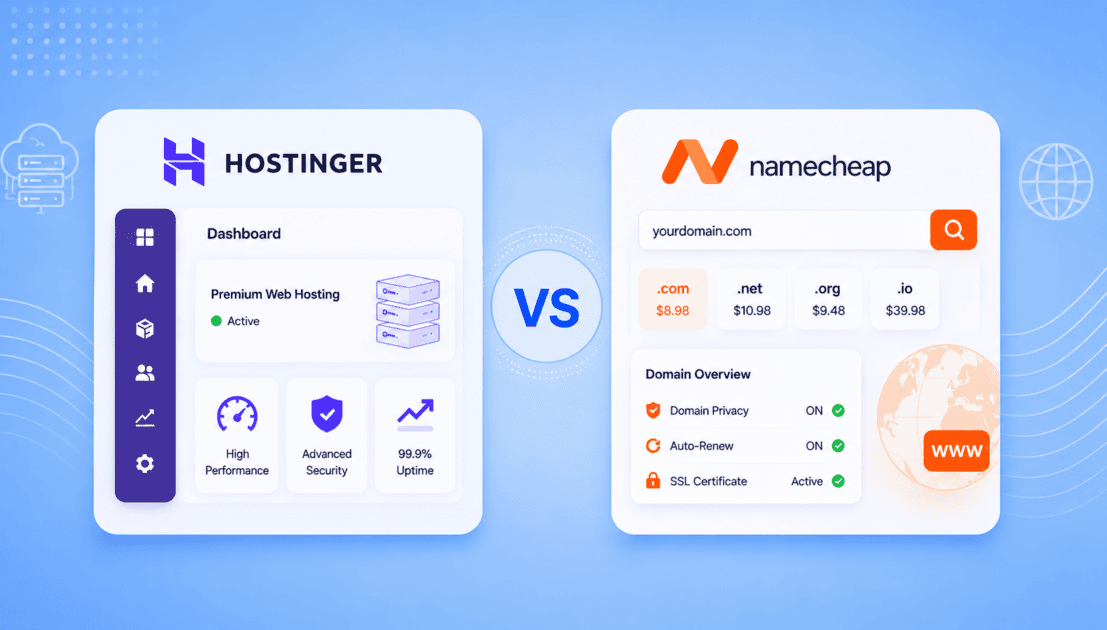
Hostinger and Namecheap are both reliable domain registrars, but they excel in different areas. Hostinger is the better choice if you want the lowest introductory pricing and plan to bundle your domain with hosting. Namecheap stands out for its registrar-first experience, competitive renewal pricing and free domain privacy on eligible domains.
| Choose… | If you want… |
|---|---|
| Hostinger | Low introductory domain pricing, integrated hosting and website management through hPanel. |
| Namecheap | Lower renewal pricing, free domain privacy on eligible domains and a domain-focused management experience. |
If you’re looking for a simpler way to search, register, transfer and manage domains, Bluehost Domains is another strong option. It combines intelligent domain search, an intuitive domain management dashboard, easy transfers, domain privacy and the flexibility to connect hosting whenever you’re ready to build your website.
Hostinger and Namecheap comparison for domain registration and web hosting
Hostinger and Namecheap both offer domain registration and web hosting, but they serve slightly different needs. Hostinger is more hosting-led, combining domains with its hPanel website management experience, while Namecheap has a stronger registrar-first focus, with domain management, DNS tools and free lifetime domain privacy on eligible domains.
For most users, the better choice comes down to more than the first-year registration price. It is worth comparing:
- introductory and renewal pricing
- domain privacy
- DNS and nameserver management
- domain transfers and renewals
- ease of managing one or multiple domains
- hosting options if you plan to build a website later
This distinction matters because promotional domain prices can change significantly after the initial term. For example, Namecheap currently lists a .com renewal at $18.48 per year, while its domain privacy remains free for life on eligible domains.
The sections below compare Hostinger and Namecheap across these long-term ownership factors, helping you decide which provider offers the right balance of cost, domain control and room to grow.
Also read: Migrate Hostinger Hosting to Bluehost: Step-by-Step Guide
How we compared Hostinger and Namecheap?
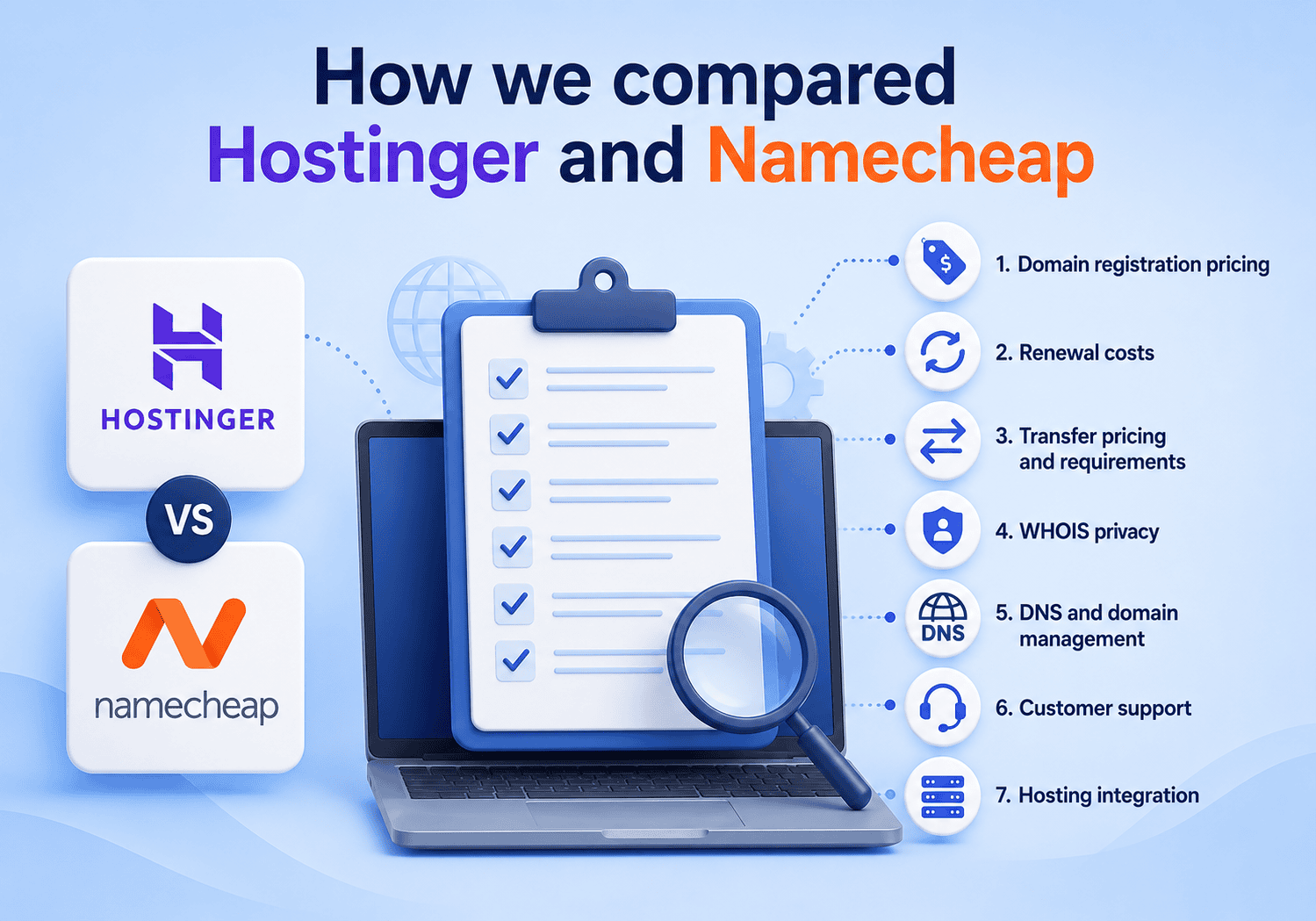
We compared Hostinger and Namecheap using current information from their official websites, focusing on the factors that matter most when choosing a domain registrar.
We evaluated:
- Domain registration pricing – including current .com introductory offers
- Renewal costs – to understand long-term domain ownership expenses
- Transfer pricing and requirements – for moving domains between registrars
- WHOIS privacy – including eligibility and privacy terms
- DNS and domain management – such as nameservers, DNS records and renewals
- Customer support – including available support channels
- Hosting integration – for users who want domains and hosting in one account
Pricing and promotional offers can change, so all rates should be checked with the provider before purchase.
Pricing reviewed: August 2026
What are the key differences between Hostinger and Namecheap?
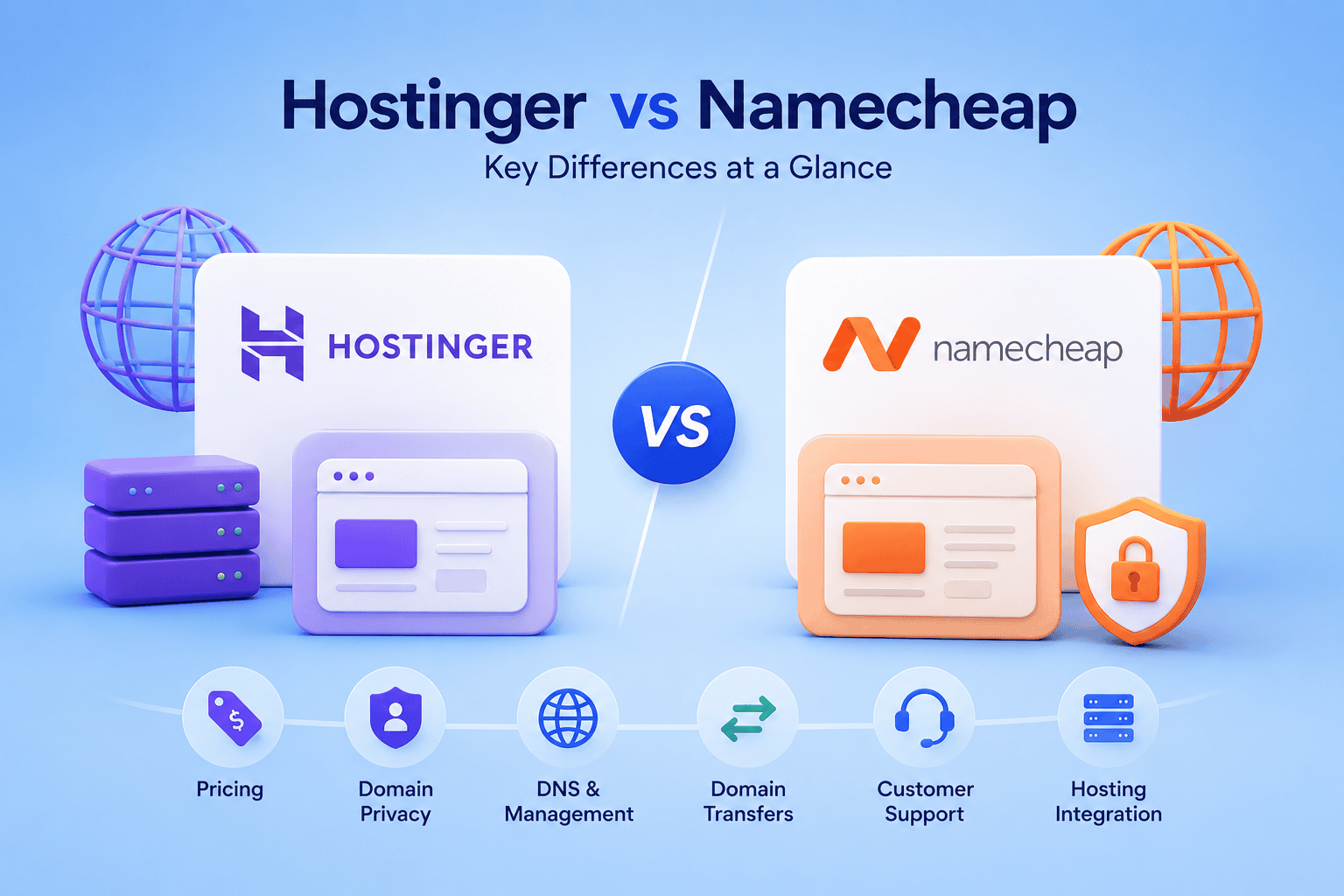
Hostinger and Namecheap differ most in how they approach domain pricing, management and website services. Hostinger combins domain tools with its broader hPanel ecosystem, while Namecheap is more registrar-focused, with domain management, DNS features and free lifetime domain privacy on eligible domains.
1. Domain pricing
Hostinger currently offers the lower introductory .com price, starting at $0.01 for the first year with a qualifying three-year term. The domain then renews at $19.99 per year.
Namecheap’s standard .com registration price is $10.98 per year, although new-customer promotions may reduce the first-year cost. Its current .com renewal price is $18.48 per year, slightly lower than Hostinger’s.
In short: Hostinger has the stronger introductory offer, while Namecheap currently has the lower .com renewal price.
2. Domain privacy
Both providers include domain privacy on eligible extensions.
Hostinger provides free WHOIS privacy for supported domains, helping keep eligible registrant information out of public WHOIS records.
Namecheap includes free Domain Privacy for life on eligible domains, including qualifying registrations and transfers.
In short: Both cover the core privacy requirement, although Namecheap places stronger emphasis on lifetime domain privacy.
3. Domain management
Hostinger manages domains through hPanel, where users can access domain status, renewals, privacy settings, nameservers and transfer controls alongside hosting, email and website tools.
Namecheap provides a more registrar-focused domain dashboard where users can manage individual or multiple domains, renewal settings, nameservers and related domain services.
In short: Hostinger may suit users who want domains and website services together, while Namecheap keeps domain administration more central to the experience.
4. DNS management
Both Hostinger and Namecheap let you manage the DNS settings needed to connect your domain with websites, email and other online services.
Hostinger provides DNS controls through hPanel, including common records such as A, AAAA, CNAME, MX and TXT. Users can also manage nameservers, DNSSEC and DNS history from the same account.
Namecheap provides DNS management through its domain dashboard, with support for common DNS records, nameserver changes, URL forwarding and email forwarding. It also offers PremiumDNS as an optional service for users who want additional DNS features.
In short: Both cover the DNS tools most domain owners need. Hostinger keeps DNS inside its broader hPanel ecosystem, while Namecheap offers a more registrar-focused DNS experience.
Also read: Common DNS Issues and How to Solve Them
5. Domain transfers
Both Hostinger and Namecheap support transferring eligible domains from another registrar. Transfers generally require the domain to be unlocked and an authorization or EPP code from the existing registrar.
Transfer pricing varies by extension. For .com domains, Hostinger currently lists a lower transfer price than Namecheap’s current promotional rate.
Note: Domain transfers are governed by the Internet Corporation for Assigned Names and Numbers (ICANN). In most cases, newly registered domains or domains with recent ownership changes cannot be transferred to another registrar for the first 60 days. Once the lock period ends, you can usually transfer your domain using an authorization (EPP) code and by following your registrar’s transfer process.
Also read: How to Transfer a Domain Name [FAQs]: Steps, Process & Fees
6. Customer support
Hostinger provides 24/7 assistance through Kodee and human support specialists.
Namecheap offers 24/7 live chat alongside its ticket-based support system.
Neither provider currently centers its support experience around phone assistance, making the quality of its online help resources and account tools more important for domain owners.
7. Hosting integration
Hostinger is the more hosting-led platform of the two. Domains sit within the same broader environment used to manage websites, hosting and email.
Namecheap also sells hosting and other website services, but its domain registrar business remains a more prominent part of the overall platform.
Final feature comparison
Hostinger may be a stronger fit if you want low introductory domain pricing and an integrated domain-and-hosting environment. Namecheap may suit you better if you want a registrar-focused experience, slightly lower current .com renewal pricing and free lifetime privacy on eligible domains.
Neither provider wins across every category, so the better choice ultimately depends on whether you prioritize first-year price, long-term renewal costs, privacy or how you prefer to manage your domains.
Also read: Bluehost vs Namecheap for WordPress: Full Comparison
How do Hostinger and Namecheap domain pricing and renewal rates compare?
The lowest first-year price does not always mean the lowest long-term domain cost. When comparing Hostinger and Namecheap, look at registration, renewal and transfer pricing to understand what you may pay throughout the life of your domain.
Hostinger currently offers .com domains from $0.01 for the first year, with renewals at $19.99 per year. Its current .com transfer price is $9.99, making the introductory and transfer costs relatively low compared with its ongoing renewal rate.
Namecheap currently promotes .com domains from $6.79 for new customers, while its listed .com renewal price is $18.48 per year. Transferring a .com domain to Namecheap is currently advertised at $11.48, with promotional pricing subject to change.
| .com pricing | Hostinger | Namecheap |
|---|---|---|
| First-year price | $0.01* | $6.79* |
| Renewal price | $19.99/year | $18.48/year |
| Transfer price | $9.99 | $11.48* |
| Promo conditions | Qualifying multi-year term | New-customer promotional offer |
| Lower upfront cost | Yes | No |
| Lower renewal cost | No | Yes |
*Promotional pricing and eligibility can change. Check the provider’s current terms before registering or transferring a domain.
Hostinger therefore has the stronger upfront price advantage, while the current renewal rates between the two providers are much closer. Namecheap presently renews .com domains for slightly less, while Hostinger currently charges less to transfer a .com domain.
Also read: Bluehost Domain Name Generator for SEO-Friendly Websites
Do Hostinger and Namecheap support different domain extensions?
Both Hostinger and Namecheap offer a wide range of domain extensions beyond .com, including popular options such as .net, .org, .co and many country-code and industry-specific TLDs.
The registration price, renewal cost, transfer fee and availability can vary depending on the extension you choose. While .com remains the most popular choice for businesses and personal websites, alternative TLDs may be a better fit if your preferred domain name isn’t available or if you want to target a specific country or industry.
When choosing a domain extension, consider:
- .com for broad recognition and business websites
- .net for technology-focused businesses
- .org for nonprofits and community organizations
- Country-code TLDs (ccTLDs) for local markets, such as .co.uk, .ca or .in
- Industry-specific TLDs like .store, .tech or .blog for niche branding
Before registering any domain, compare the registration, renewal and transfer costs for your chosen TLD, as pricing and eligibility may differ from standard .com domains.
Also read: .com vs .net: The Real Difference and Which One Wins
Does Hostinger or Namecheap offer better WHOIS privacy protection?
WHOIS privacy protection masks personal contact details from public ICANN lookup databases. Without domain privacy, your name, address, email and phone number become visible to spammers and telemarketers.
Both Hostinger and Namecheap offer WHOIS privacy features that help reduce the amount of registrant contact information exposed in public domain records, but their policies differ by domain extension and eligibility.
- Namecheap includes free Domain Privacy with eligible new registrations and transfers. Its privacy service replaces personal contact details in public WHOIS records with alternative information, helping limit exposure to marketers, fraudsters and other third parties.
- Hostinger also provides WHOIS privacy on eligible domains. When privacy is available for the selected TLD, registrant details are hidden or redacted from public WHOIS results while the domain remains active.
| Feature | Hostinger | Namecheap |
|---|---|---|
| WHOIS privacy | Free on eligible domains | Free for life on eligible registrations and transfers |
| Privacy included | Yes, on supported TLDs | Yes, on eligible domains by default |
| WHOIS lookup | Free lookup tool | Free lookup tool |
| Overall advantage | Integrated with hosting and domain management | Stronger privacy-focused domain offering |
For most users, both providers offer a solid baseline of domain privacy. Namecheap has the clearer privacy-first positioning, while Hostinger includes privacy as part of its broader domain management experience.
Beyond privacy, the next factor to compare is how easily each provider lets you manage DNS records, nameservers and multiple domains from its dashboard.
How do Hostinger hPanel and Namecheap control panel compare for domain management?
Hostinger and Namecheap both provide tools for managing domains, DNS records and renewals, but their dashboards are organized differently.
Hostinger hPanel brings domains, websites, hosting and email into one account interface. Its Domain Portfolio lets users view domain status and expiration dates, enable or disable auto-renewal and privacy protection, manage transfer locks, access authorization codes and update nameservers. DNS tools also support records such as A, CNAME, MX and TXT, along with DNSSEC and DNS history.
Namecheap’s dashboard has a stronger domain-management focus. Users can manage nameservers, DNS settings, domain renewals, auto-renewal and related domain services from their account, with additional tools for URL and email forwarding.
Non-technical users who prefer a visually modern workspace often enjoy hPanel’s guided layout. Freelancers and site owners managing multiple domain records usually favor Namecheap for its minimal interface and rapid DNS updates. Website owners exploring setup options can consult domain and web management guides for step-by-step tutorials on DNS configuration.
While standalone domain management remains crucial, combining domain registration with web hosting under one provider streamlines website operations.
Hostinger vs Namecheap: pros and cons
Hostinger and Namecheap both cover the essentials of domain registration and management, but their strengths differ. Hostinger combines aggressive introductory pricing with a broader hosting ecosystem, while Namecheap offers a more domain-focused experience with competitive renewal pricing and free privacy on eligible domains.
| Provider | Pros | Cons |
|---|---|---|
| Hostinger | • Very low introductory .com pricing • Domains, hosting and email managed through hPanel • DNS, nameserver, privacy and renewal controls in one interface • Competitive .com transfer pricing • Convenient if you plan to add hosting alongside your domain | • .com renewal costs increase after the introductory term • Lowest promotional pricing may require a longer-term commitment • More hosting-focused than domain-focused • No phone support |
| Namecheap | • Lower current .com renewal pricing • Free Domain Privacy on eligible registrations and transfers • Registrar-focused dashboard with DNS and domain controls • Supports domain transfers, forwarding and multi-domain management • Well suited to standalone domain management | • Higher introductory .com price than Hostinger • Some domain and hosting features are managed separately • No phone support • Transfer prices vary by domain extension |
Choose Hostinger if:
- You want the lowest possible introductory domain price.
- You plan to purchase web hosting and your domain from the same provider.
- You prefer managing domains, hosting and email from a single dashboard.
- You’re building a new website and want an all-in-one platform.
Choose Namecheap if:
- You mainly want a standalone domain registrar.
- Long-term renewal pricing is more important than first-year promotions.
- Free domain privacy on eligible registrations is a priority.
- You manage multiple domains and prefer a registrar-first experience.
Hostinger is the stronger option for users looking for an integrated website platform with competitive introductory pricing. Namecheap remains a strong choice for users focused primarily on domain registration, predictable renewals and long-term domain management.
Ultimately, neither provider is the best choice for every domain owner. The right registrar depends on the balance you want between upfront price, renewal costs, privacy, domain management and the ability to connect other website services as your needs grow.
Also read: Best WordPress Hosting for Small Business in 2026
Should you buy web hosting and domain registration as a bundle?
Bundling domain registration with web hosting simplifies site administration by consolidating billing, security and technical management under one account. Purchasing these services from separate companies introduces unnecessary setup steps for new website owners.
Buying a domain and hosting together
Both Hostinger and Namecheap let customers bundle domain registration with web hosting.
- Hostinger includes a free domain for the first year with eligible Premium Web Hosting plans. Domains, hosting and email are managed through the same hPanel dashboard, making it a convenient option for users building a website from scratch.
- Namecheap also offers hosting plans alongside domain registration. While the setup is straightforward, users purchasing a standalone domain can later connect it to Namecheap hosting or another provider by updating their DNS settings.
Buying a domain separately
Purchasing your domain separately gives you the freedom to move between hosting providers as your website grows. However, you’ll typically need to:
- update nameservers or DNS records manually
- manage separate accounts and billing
- renew your domain and hosting independently
- troubleshoot domain and hosting issues across different providers
For experienced users, these extra steps are often manageable. For beginners or small businesses launching their first website, managing everything through a single provider can reduce complexity and save time.
Why choose Bluehost for domain registration and web hosting?
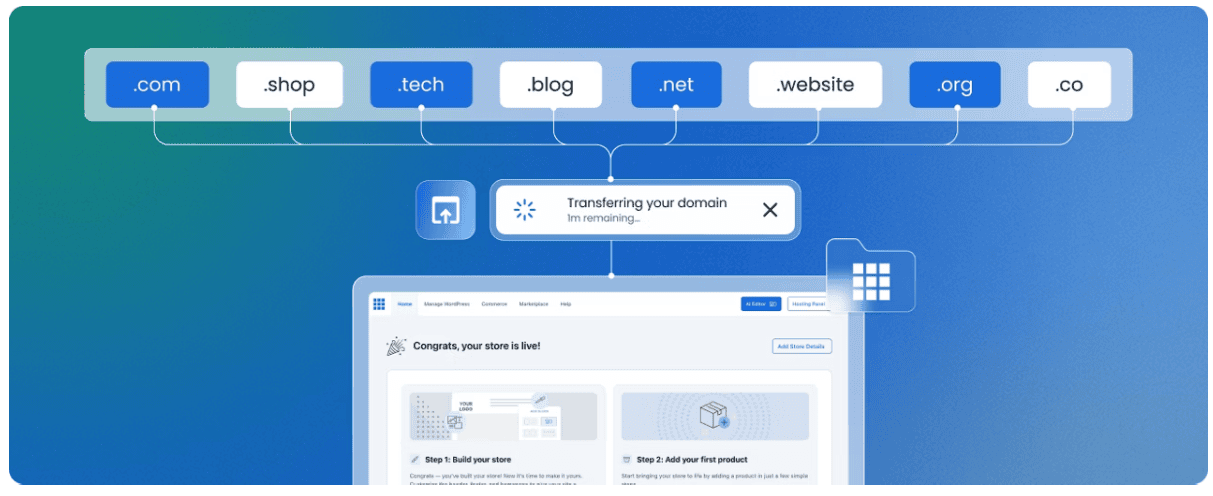
Choosing a domain registrar isn’t just about today’s registration price—it’s about how easy it is to search, register, protect and manage your domains over time. If you’re looking for a simpler way to manage your online presence, Bluehost combines domain registration, transfers and website services in one intuitive platform, making it easy to start with a domain today and expand into hosting whenever you’re ready.
Bluehost Domains is designed to make creating and managing domains quick and straightforward. Whether you’re registering your first domain or managing multiple domains for your business, everything is available from a single, easy-to-use dashboard.
- Quick domain search: Find the domain you want faster with intelligent search and alternative domain suggestions if your preferred name isn’t available.
- Intuitive domain management: Manage one or multiple domains, DNS records, renewals and transfers from a central dashboard without switching between multiple accounts.
- Easy domain transfers: Transfer existing domains into Bluehost and manage them alongside new registrations from the same account.
- Auto-renewal protection: Help prevent accidental domain expiration with automatic renewals, keeping your domain and website connected.
- Domain privacy: Protect your personal information with Domain Privacy, helping reduce exposure to spam and identity theft on eligible domains.
- Wide choice of domain extensions: Choose from popular, country-specific and niche domain extensions, making it easier to find a name that fits your brand or website purpose.
- Ready for website growth: When you’re ready to launch a website, you can easily connect your domain to Bluehost hosting without moving it to another provider.
Bluehost is built for more than just registering a domain. It provides an easy-to-use platform for searching, securing, transferring and managing domains while giving you the flexibility to expand into hosting, business email and other website services as your needs evolve. Instead of managing multiple providers, you can build and grow your online presence from one trusted platform.
Final thoughts
Hostinger and Namecheap are both reliable choices for domain registration, but they serve different priorities. Hostinger stands out for its low introductory pricing and integrated hosting ecosystem, making it a good option if you’re launching a new website. Namecheap is better suited to users looking for a registrar-first experience, with competitive renewal pricing, free domain privacy on eligible domains and straightforward domain management.
If you’re looking for a platform that combines easy domain search, intuitive management, domain transfers and the flexibility to add hosting as your website grows, Bluehost offers a compelling alternative. Instead of managing multiple providers, you can register, protect and manage your domains from one place while keeping the option to expand into website hosting whenever you’re ready.
Ready to secure your perfect domain? Search available domain names and register yours with Bluehost Domains today.
FAQs
Hostinger is a strong choice if you want very low introductory pricing and plan to manage your domain alongside hosting. Namecheap is more domain-focused, with competitive renewal pricing, free privacy on eligible domains and a registrar-first management experience.
Namecheap currently has a slightly lower .com renewal price than Hostinger. Hostinger usually wins on introductory pricing, so the better value depends on whether you care more about upfront savings or long-term renewal costs.
Yes. Both offer free WHOIS privacy on eligible domains, helping keep personal registrant details out of public WHOIS records. Availability can vary by domain extension and registry rules.
Yes. Both providers support domain transfers. You will typically need to unlock the domain, get the EPP or authorization code and meet any applicable transfer eligibility requirements.
Buying both from one provider can simplify setup, billing and DNS management. Using separate providers gives you more flexibility, so the better option depends on whether you prioritize convenience or control.
Bluehost makes it easy to search, register, transfer and manage domains from one dashboard. It also offers domain privacy, auto-renewal, multiple domain extensions and the option to connect hosting when you’re ready to build your website.

Write A Comment